
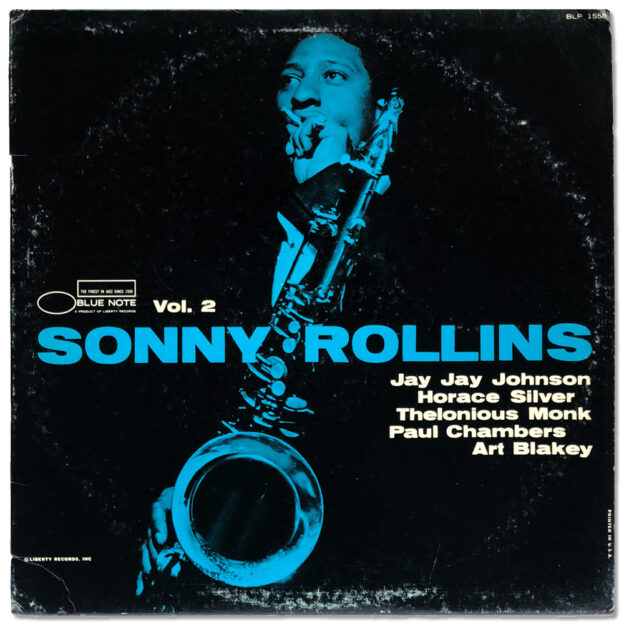
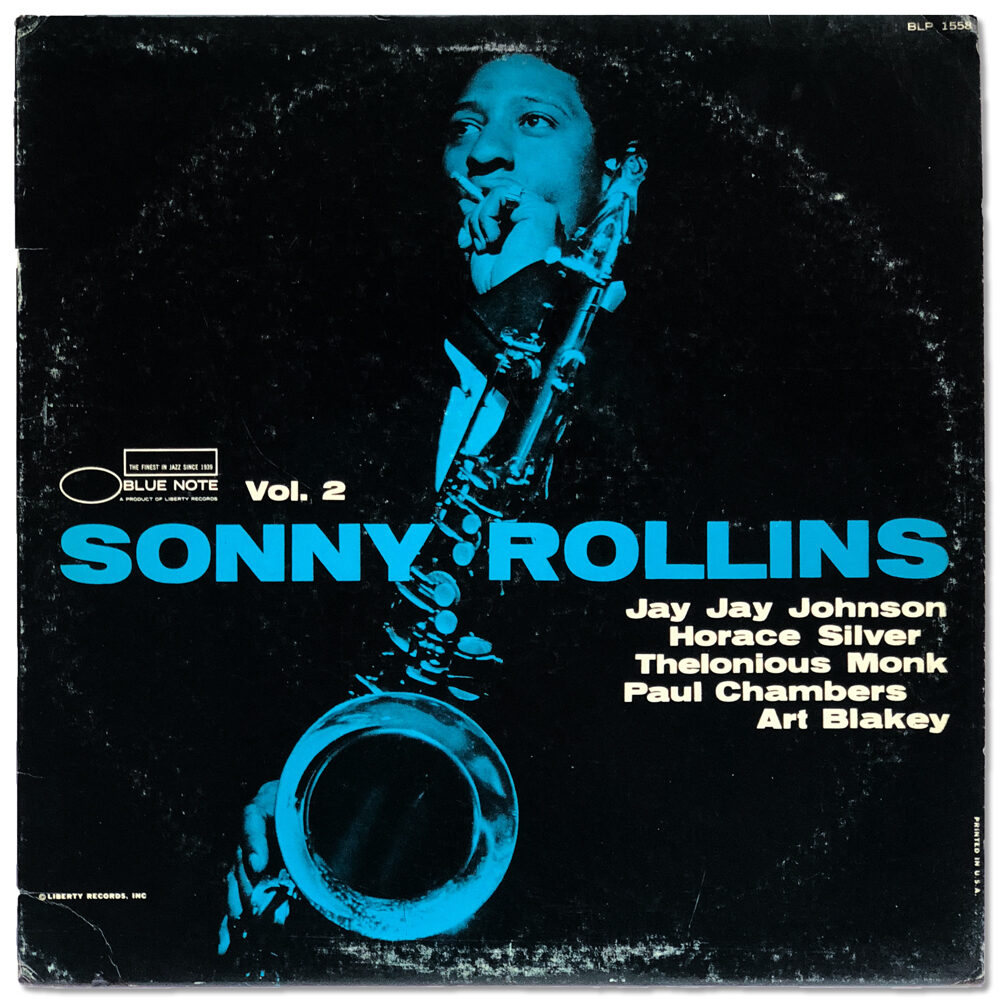
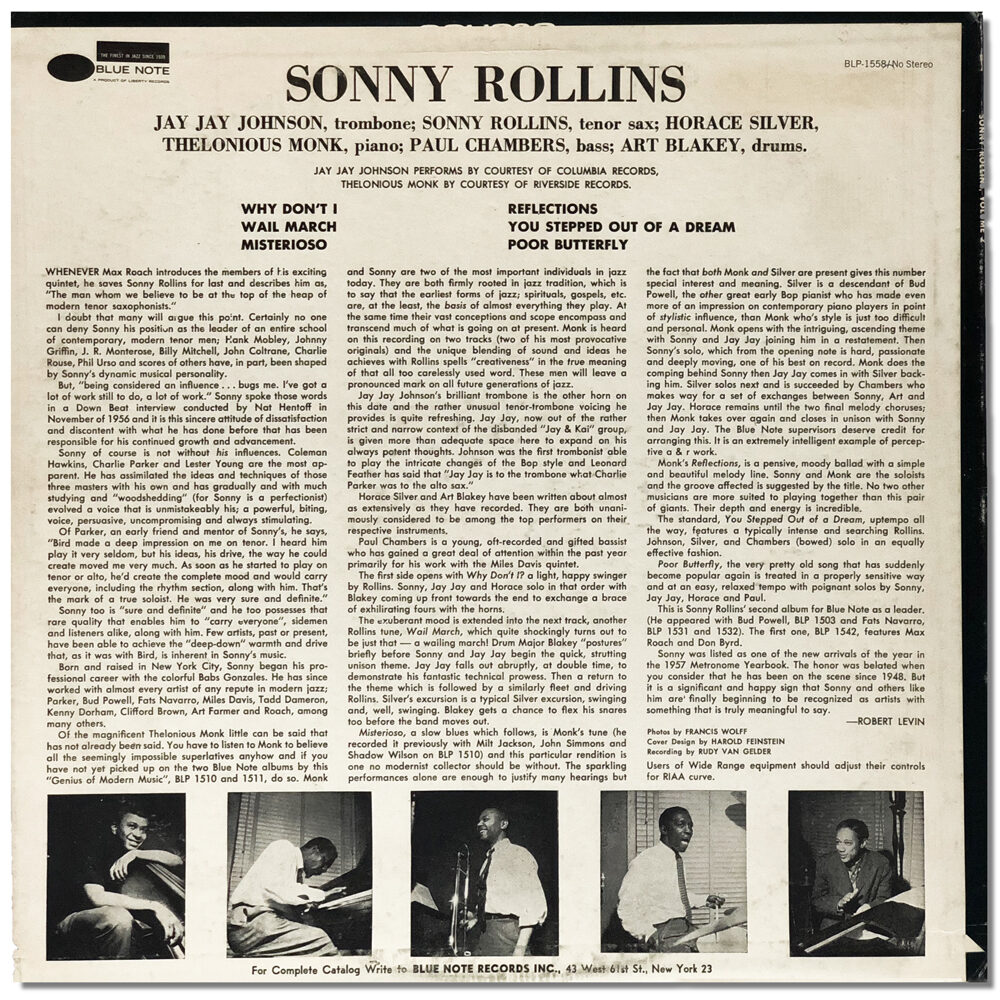
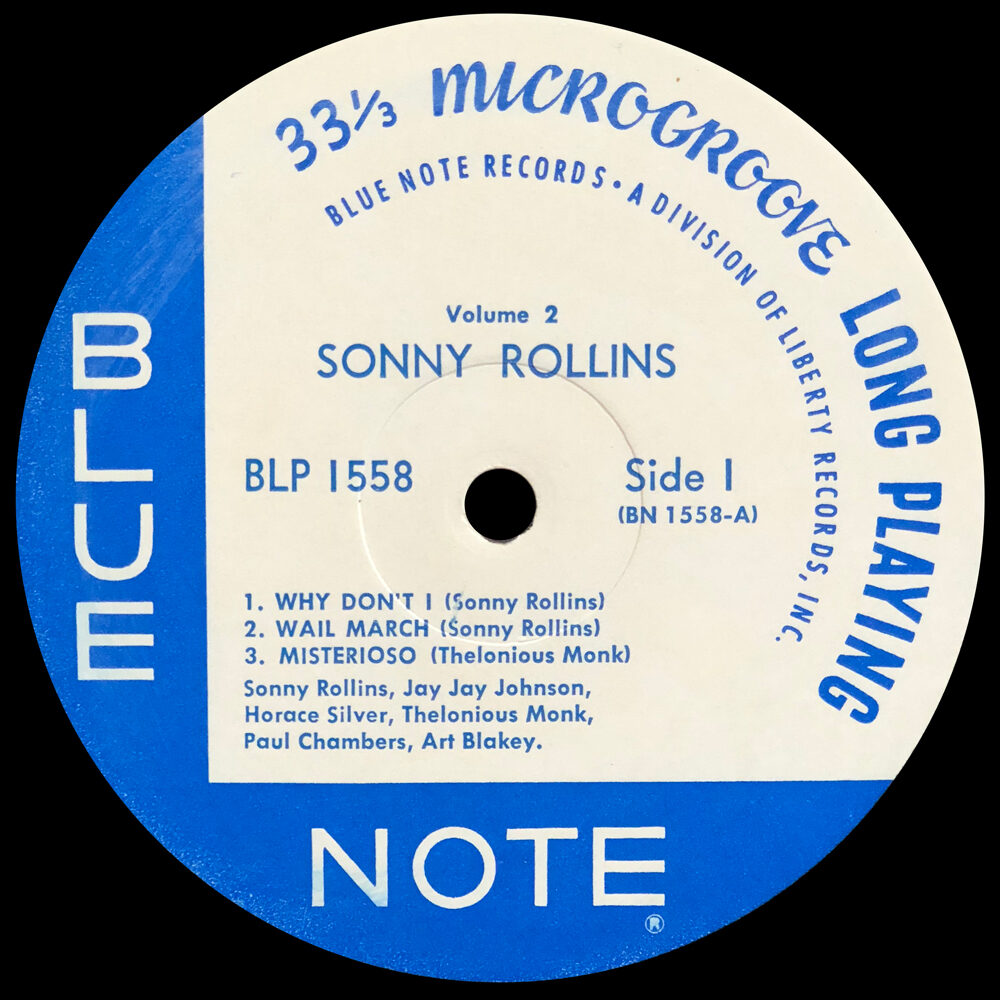
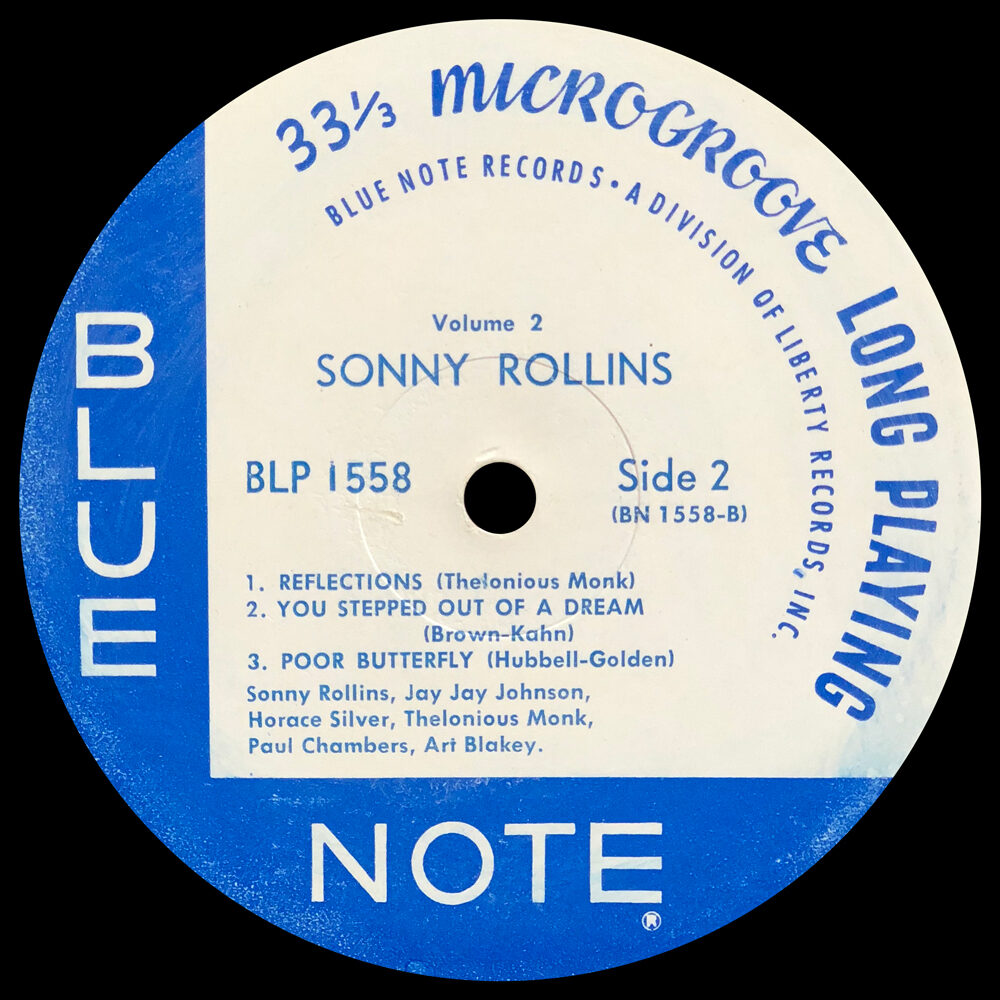
- Liberty mono pressing circa 1966-1970
- RVG etched in dead wax
Personnel:
- Sonny Rollins, tenor saxophone
- J.J. Johnson, trombone (all but “Reflections”)
- Horace Silver, piano (all but “Reflections”)
- Thelonious Monk, piano (“Reflections” and “Misterioso” only)
- Paul Chambers, bass
- Art Blakey, drums
Recorded April 14, 1957 at Van Gelder Studio, Hackensack, New Jersey
Originally released in September 1957
Selections:
“Wail March” (Rollins)
“Misterioso” (Monk)
As a jazz lover and record collector, I am very fortunate to live near New York and its dusty record stores, as well as fellow collectors like the namesake of this blog, Mr. Mono himself. If we can’t hunt for LPs together in person, he will sometimes send me pictures of any records I might be interested in from the stores in the city — and sometimes be so kind as to snag some for me to be mailed later. A few months ago, he was in a store that has a very serious reputation for jazz sales when he sent me a few shots of some early pressing Blue Notes at pretty fair prices. One of the pics was of a glossy early pressing of Sonny Rollins Volume 2. The copy was not the first pressing but still had all the things that make collectors warm inside: a West 63rd Street label, Rudy Van Gelder’s initials in the dead wax, and the famous cursive ‘P’ indicative of a copy made in the company’s heyday. Best of all, the dealer did not want an arm and a leg for the copy, and it was payday Friday.
I was very tempted. Sonny Rollins is hands down my favorite artist in the entire genre, and in my quest to own the best possible copies of his LPs that I can afford, Volume 2 is a record I did not have an original of. I did own a copy of this album on Capitol and it had never made an impression on me. Despite its critical acclaim and my liking every artist on the date, it had never caused me to want to listen to it frequently. I do not attribute this to the record I had; the purpose of this post is not to downplay or argue the fidelity of other copies of an LP, but my Capitol copy certainly didn’t do anything to elevate the music of this album higher than A Night at the Village Vanguard or Way Out West, my two favorite Sonny records. So I texted Rich back a dismissive reply: “Nah, forget it — it’s never been my favorite Rollins LP,” to which he replied, “Mine either.” This made me feel two ways: pleased because a fellow collector had validated my opinion, but upset that one of the most celebrated records by my favorite musician was somehow dismissed by two knowledgeable jazz lovers.
Fast forward to a few weeks ago. I had just run into a nice string of luck with my favorite saxophonist on Blue Note. Within a two-week span, I had lucked out on copies of Volume One and the LP that has eluded me most in recent years, Newk’s Time. A few days after buying Newk’s, I was browsing eBay and a seller was selling Volume 2 as a Buy It Now. I usually avoid the Buy It Now sellers for rare records. However, this was a Liberty copy with some wear on the cover, and it was a later cover with the Division of Liberty lettering on the cover. In other words, this copy was not one that a high stakes collector or dealer would value.
However, as a listener of Sonny Rollins, it had some very good things going for it. For one, it was a monaural copy, which I’m not terribly picky over, except for these very early Blue Note recordings where the focus, at least for sales purposes and sound quality, was mono over the primitive stereo of the day. Secondly, it had the initials of Rudy Van Gelder in the dead wax which, without going into too many details, usually results in a high quality sound regardless of year of issue. Lastly, this thing was cheap! Relatively so, but at less than half the price of the copy that Mr. Mono showed me. I felt that if I was ever going to enjoy this record in its somewhat original form, this was going to be the most affordable way to do so.
After a busy few days of package receiving because of the other Rollins LPs I had just purchased, Volume 2 arrived almost as if it matched my opinion of it, as an afterthought. It was the last in a string of records that I had just purchased, and the two records that preceded it (Volume 1 and Newk’s Time) were two of my favorites. Well imagine my surprise when I dropped the needle. The opening riff of “Why Don’t I?” leapt out of the speaker with great urgency. To me it could have been an outtake from Volume 1 with its loud, honking Rollins riff announcing his unmistakable tone in a similar manner to the Volume 1 jams “Decision” and “Bluesnote”. Despite the presence of a piano here, Rollins hints at the legendary style of pianoless strolling he would perfect the following year, all while trading loud, fast riffs with Art Blakey in a conversation punctuated by the drummer’s own Elvin Jones-esque grunts and patented press roll. It all makes for an exciting conclusion to the take.
Another surprising highlight of the album that mirrored my expectations is the song “Wail March”. I am not usually a fan of marches, from the traditional bop march of “Blues March” by Blakey’s Messengers to the almost avant garde style of march found on Bobby Hutcherson’s “Les Noires Marchant”, but “Wail March” changed that quickly. Normally turned off by their corny, almost antiquated style of beat, “Wail March” is a freewheeling song with the driving snare of any classic march but also wild, reckless improvisation by Rollins and trombonist J.J. Johnson and an admittedly catchy chorus. I could not picture any of the stereotypically bland members of a T.V. sitcom marching band playing such a swinging tune at all. It is one of the myriad example of Rollins taking a theme or tune that was considered ‘corny’ or ‘overdone’ and using his dominating tone and knack for off-the-cuff improvisation to make it into something fresh and revolutionary.
The track on this record that most critics laud is the rendition of the Thelonious Monk standard “Misterioso”, instantly memorable because of a repeating, haunting piano riff played by Monk with a sporadic stabbing motion. It has been recorded on many other albums, but this version instantly became my favorite. Every member of the band plays to their strengths on this song. J.J. Johnson has a memorable solo where he fluidly recreates the opening riff while Rollins finds yet another way to insert “Camptown Races” into a song. Horace Silver and Monk appear on the track — a rarity — and they do a remarkable job of playing their own styles. So many musicians have tried to play Monk’s songs just like he did and failed. These guys all knew how to play with Monk. They all retain their own unique sounds all while paying respect to the song’s original theme.
A few weeks ago, Rich and I had one of our many conversations about our respective collections. We discussed what we believed in our opinion to be the best pressings of Blue Note records in terms of collectability, sound quality, condition, lack of wear, and value. The Division of Liberty Blue Notes, especially reissues of earlier Blue Note material in mono, continued to come up in our talks. When I mentioned to Rich that I had quite a few of these, he asked me to review and write about them for his blog, and in the next few posts I hope to demonstrate that these pressings are not just a mere runner-up to original pressings. They have the potential to provide collectors with a high-quality, affordable listening experience while maintaining many of the hallmarks that make originals so collectable.
Many people think that there is a mystique to the Blue Note sound captured by engineer Rudy Van Gelder. That, of course, is an unscientific way of saying that there is an unexplainable and unique sound to these records. The fact that a Liberty pressing purchased at a discount price can project the classic Blue Note sound so well speaks volumes. It essentially changed my opinion of the recording and also provides evidence that Blue Note’s new parent label was capable of preserving the sound of the original LPs to a tee.
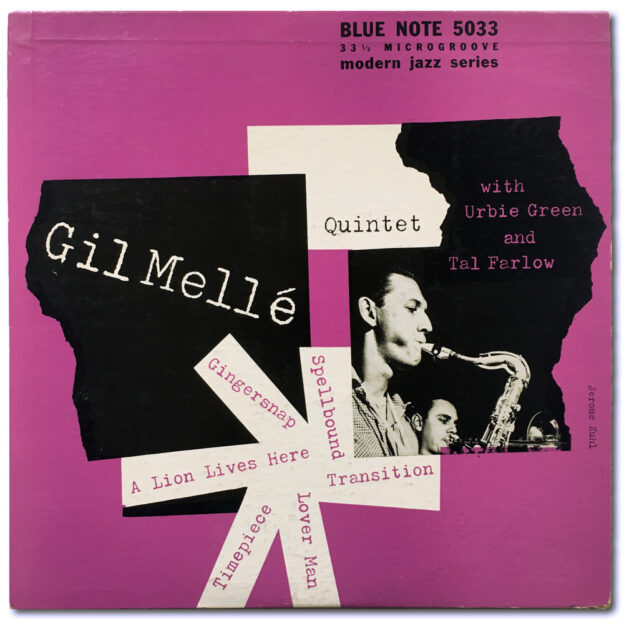
Vinyl Spotlight: Gil Mellé Quintet, Vol. 2 (Blue Note 5033) Original 10″ Pressing
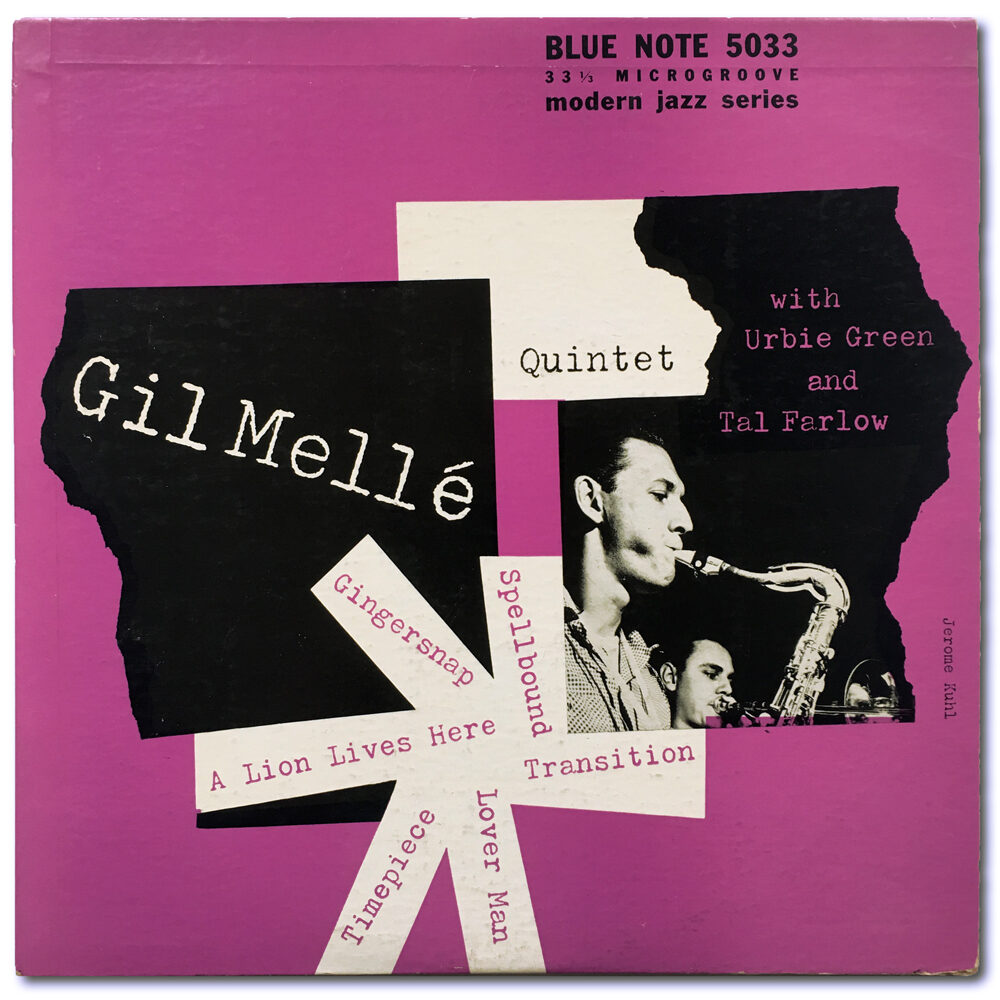


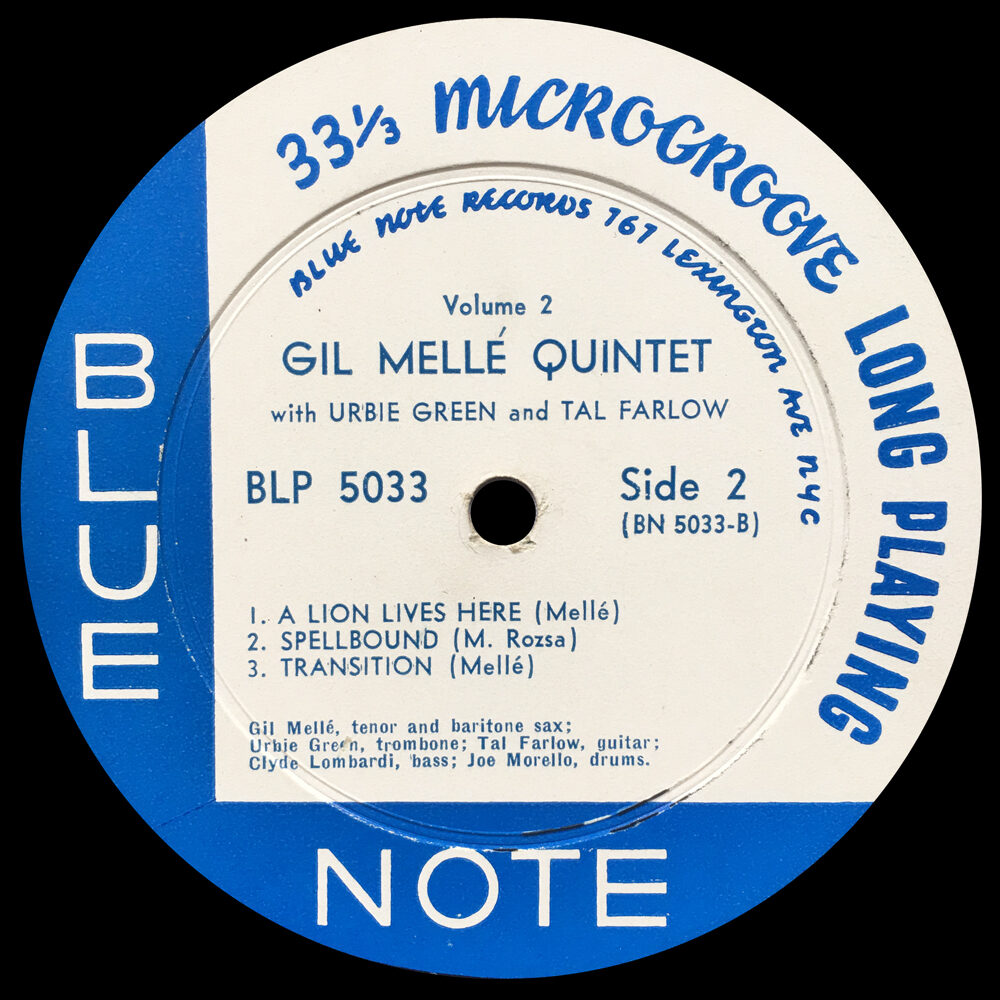
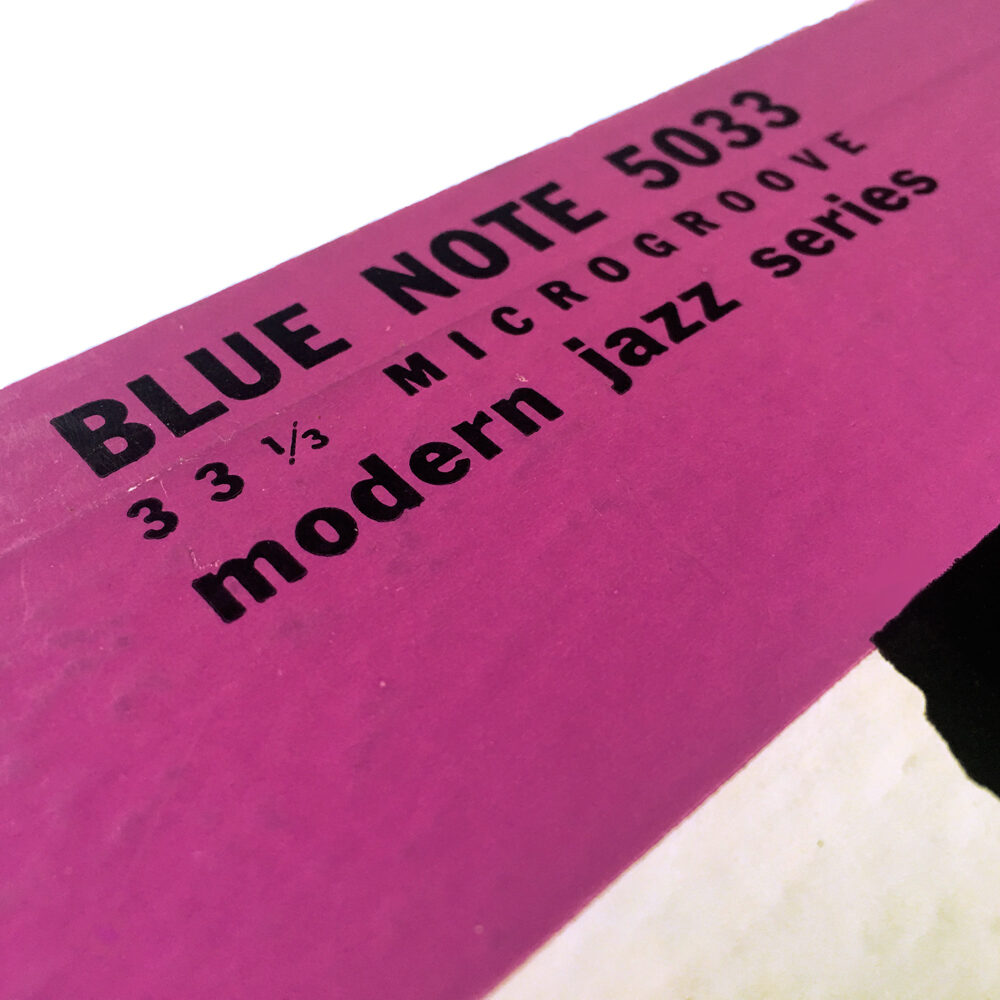
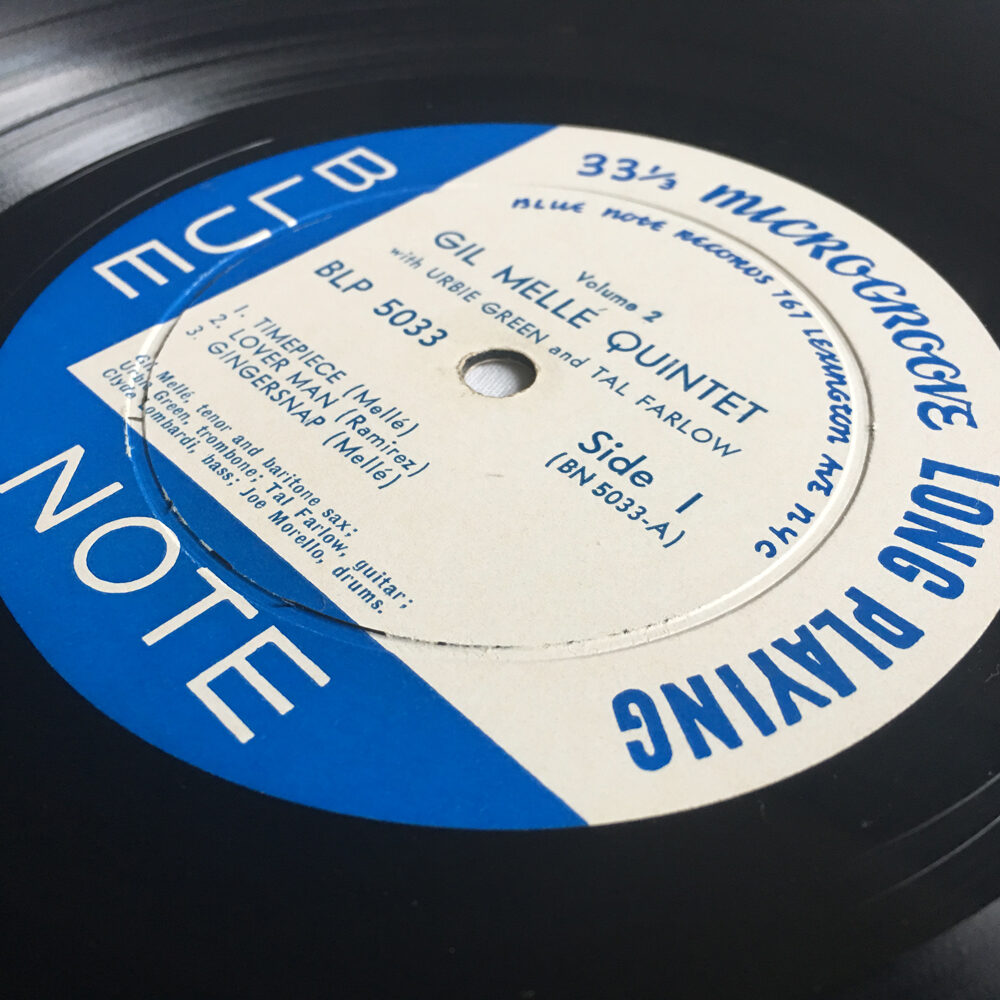
- Original 1953 pressing (10-inch)
- Lexington Ave. address on labels
- Deep groove on both sides
- Plastylite “P” in dead wax
Personnel:
- Gil Mellé, tenor & baritone saxophones
- Urbie Green, trombone
- Tal Farlow, guitar
- Clyde Lombardi, bass
- Joe Morello, drums
Recorded October 25, 1953 at Van Gelder Studio, Hackensack, New Jersey
Originally released December 1953
| 1 | Timepiece | |
| 2 | Lover Man | |
| 3 | Gingersnap | |
| 4 | A Lion Lives Here | |
| 5 | Spellbound | |
| 6 | Transition |
Selections:
“Gingersnap” (Mellé)
“A Lion Lives Here” (Mellé)
I decided on this Gil Mellé album. It sounded decent in spots and that bold purple on the cover was really speaking to me. I was pretty sure this was an early Hackensack recording, so I consulted with the Deep Groove Mono Rudy Van Gelder Collector’s Discography and sure enough, the October 25, 1953 session that produced this LP was just the fifth Blue Note recording date ever at Hackensack, which made sense in light of the well-known fact that Gil Mellé was responsible for introducing Van Gelder to Blue Note owner/producer Alfred Lion.
Knowing this made for an even more exciting listen. One might guess that it took a while for Van Gelder to build up his recording chops from the time he began taking commercial clients in the early ‘50s, but this album is evidence that he was a gifted engineer from the jump. The instruments sit in perfect balance, and as an added bonus there is little to none of the notorious Van Gelder spring reverb (I’m not sure when he acquired that unit and it’s possible that it’s not even used on this album).
An interesting note is that Van Gelder’s initials do not appear in the dead wax. Everyone knows that Van Gelder always insisted he master his own recordings, but did he master his earliest work? According to Frederick Cohen’s Blue Note guide, the earliest Blue Note recording to have Van Gelder’s initials etched into the dead wax was Here Comes Frank Foster (BLP 5043), recorded May 5, 1954. Indeed, 5033 embodies the bold sound, sharp treble roll-off and mid-high EQ bump characteristic of Van Gelder’s masters in the mid-fifties, though it’s certainly possible he had not yet acquired his Scully mastering lathe by the end of 1953, with the duty of mastering accordingly handed off to a third party.
The music itself is favorably characteristic of Gil Mellé’s cool mid-fifties fashioning, the intro track “Timepiece” being the album’s most upbeat number. I acquired this copy in the summer, and there’s something about Mellé’s baritone and Tal Farlow’s guitar that instantly made those dog days feel a little cooler. If you’re fortunate enough to own a copy of this album in any format, the next time there’s a scorcher I encourage you to close the blinds, turn the fan on, and kick back in the shade with this unsung classic.
Ed. Note: I have since upgraded the original copy; photos and audio clips have been updated.
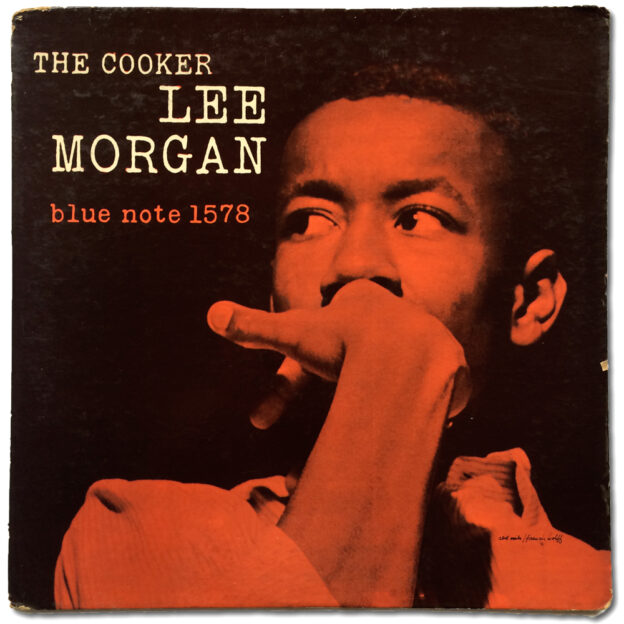
Vinyl Spotlight: Lee Morgan, The Cooker (Blue Note 1578) Original Pressing
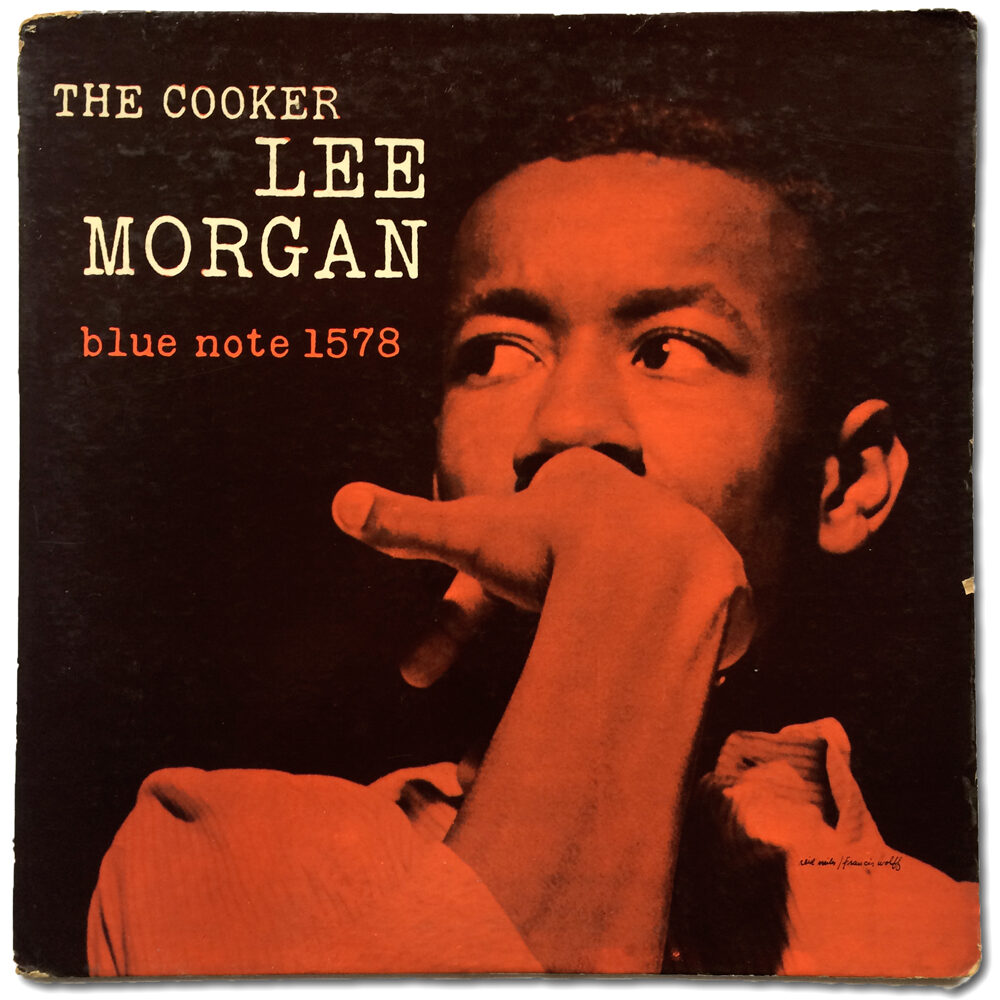

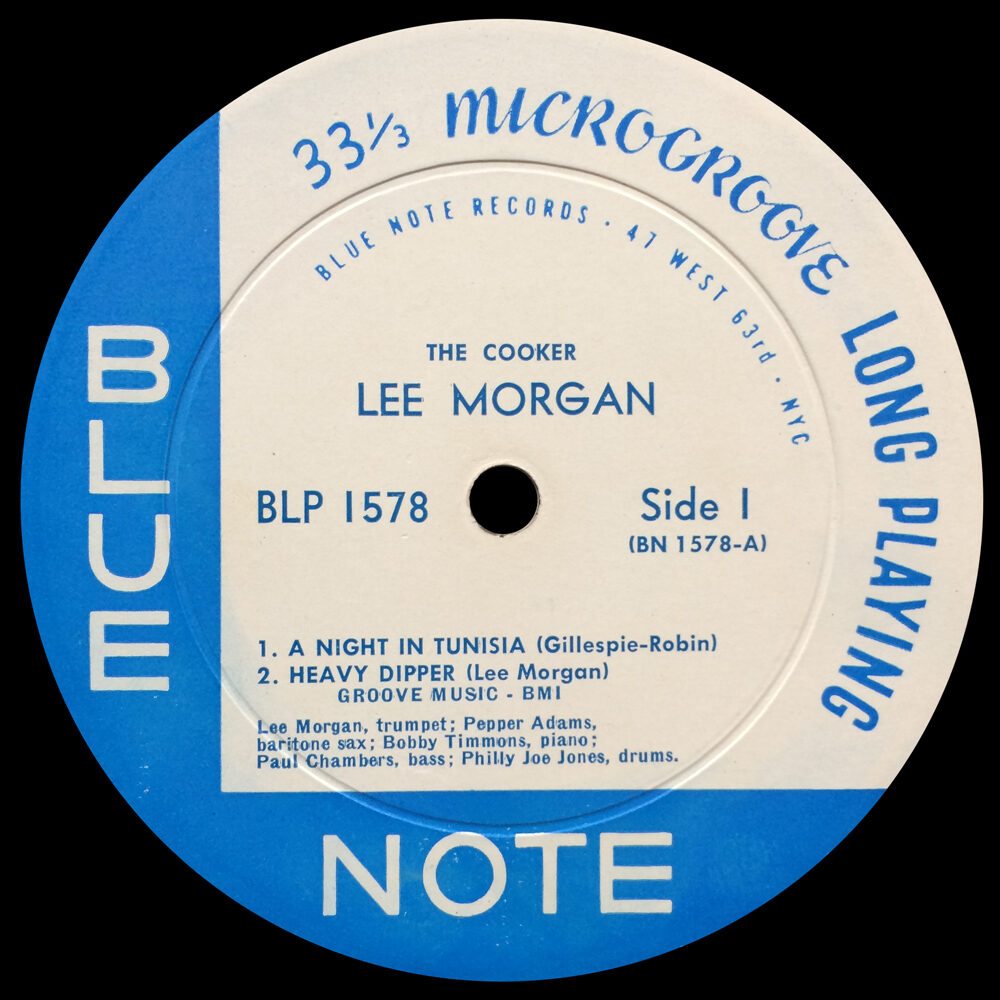
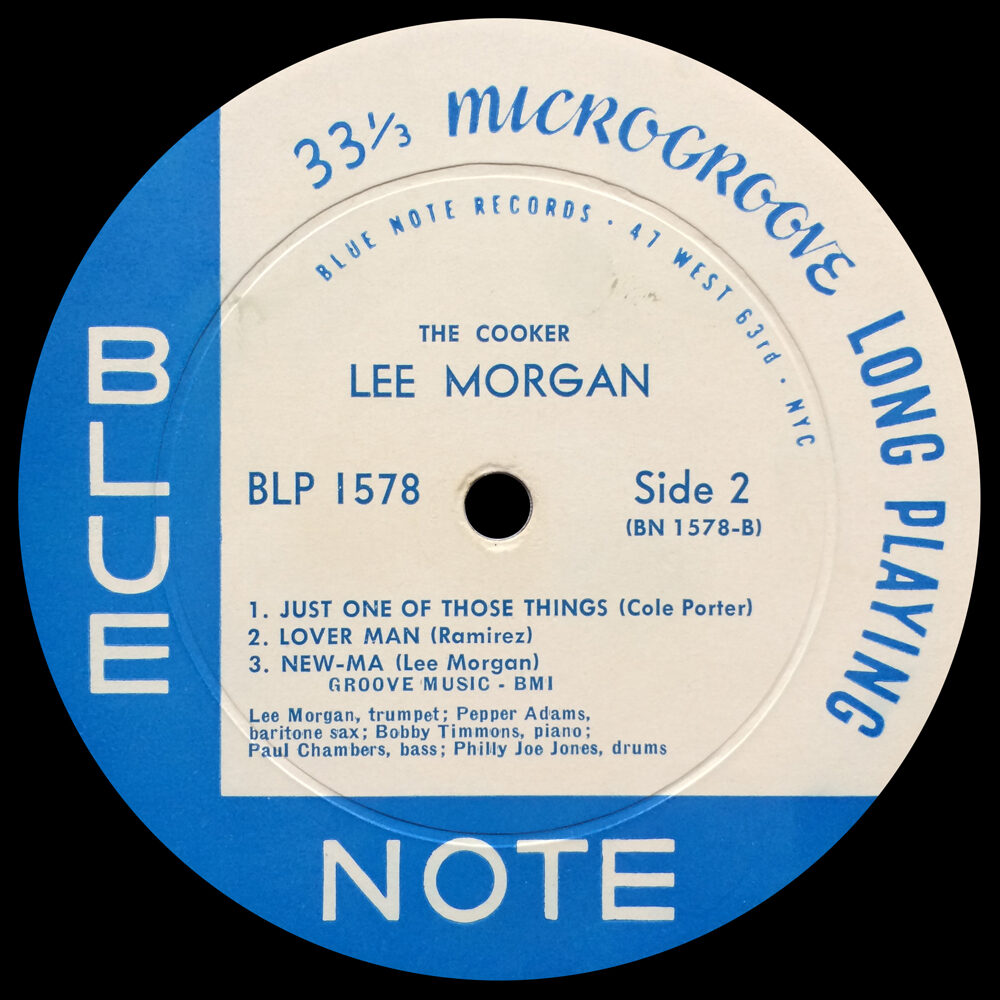
- Original 1957 mono pressing
- West 63rd address on both labels without registered trademark “R”
- Deep groove on both sides
- Plastylite “P” etched and “RVG” stamped in dead wax
Personnel:
- Lee Morgan, trumpet
- Pepper Adams, baritone saxophone
- Bobby Timmons, piano
- Paul Chambers, bass
- “Philly” Joe Jones, drums
Recorded September 29, 1957 at Van Gelder Studio, Hackensack, New Jersey
Originally released in November 1957
Selection: “Heavy Dipper” (Morgan)
A while ago I happened upon the YouTube channel of “KoolKatJazz”, a collector who takes pride in finding cheap original pressings of vintage jazz records that, while perhaps grade VG or lower, sound great at times nonetheless. Being a collector on a pretty strict budget made me think that this might be a collecting strategy I could benefit from.
Then I came across this copy of The Cooker. It looked VG at best, and while I would normally pass on a record like this due to a personal intolerance of audible wear and loud pops and ticks, this time I had the opportunity to preview the playback before buying. Indeed, the record had its share of loud ticks and even a skip at one point, but no distortion, and at times the thing sounded undeniably brilliant. The price was more than fair so I decided to go for it.
Though I was originally under the impression that mono issues of this album are quite rare, collecting buddy Clifford Allen informed me that in addition to a West 63rd “R” repressing, mono pressings with New York USA and even United Artists “classic” labels exist. Shout out to Clifford for helping make this article more accurate!
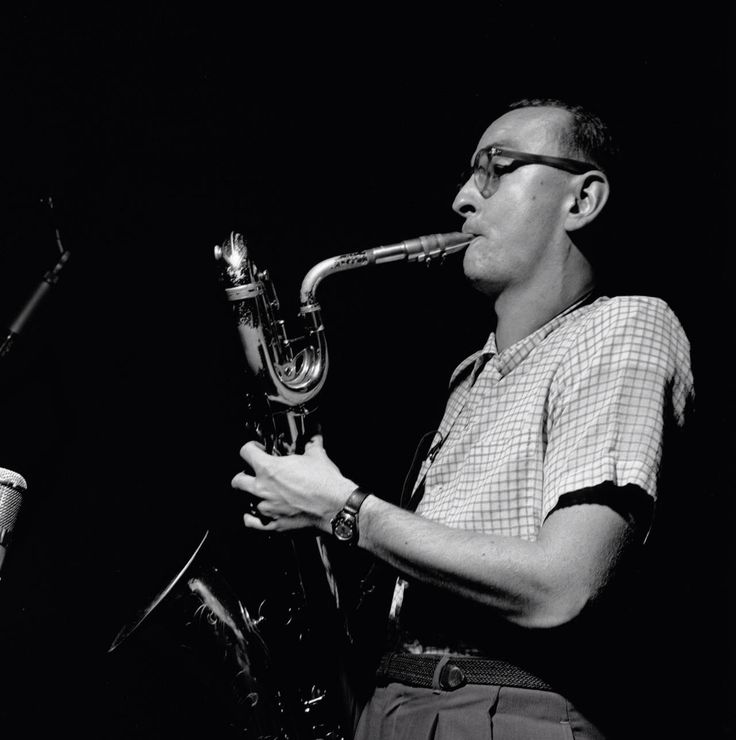 |
| Pepper Adams during the recording of The Cooker in 1957 |
I had never heard these sides before I found this copy. I’m not the biggest fan of the mega-standard “A Night in Tunisia” and accordingly was a little underwhelmed by this epic reading. But just as I began to fear that the date would ultimately amount to no more than “another bop blowing session”, Pepper Adams’ quirky presence grew on me, and I soon came to appreciate this pleasantly odd frontline pairing of trumpet and baritone sax. Prior to the release of The Cooker, Morgan had never laid to tape any of his own compositions, and thus with “Heavy Dipper” and “New Ma”, the world got its first glimpse of the leader’s talents as a songwriter. And most collectors will be able to appreciate the magic contained in these fresh 1957 mono Plastylite grooves.
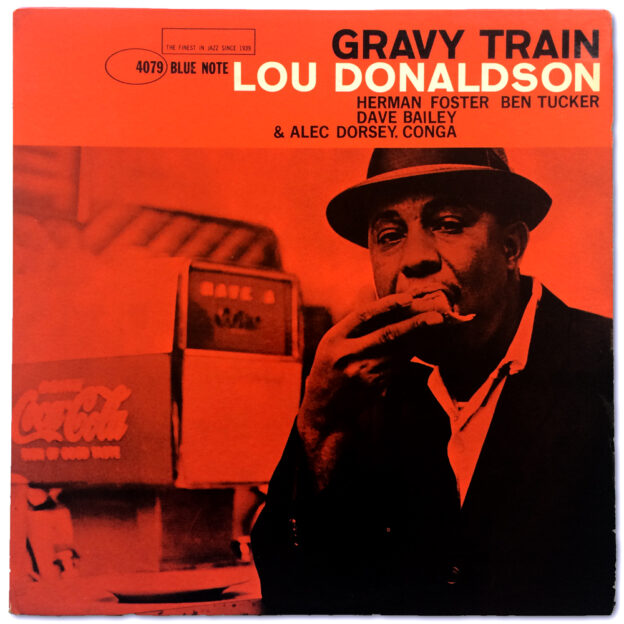
Vinyl Spotlight: Lou Donaldson, Gravy Train (Blue Note 4079) Original Mono Pressing
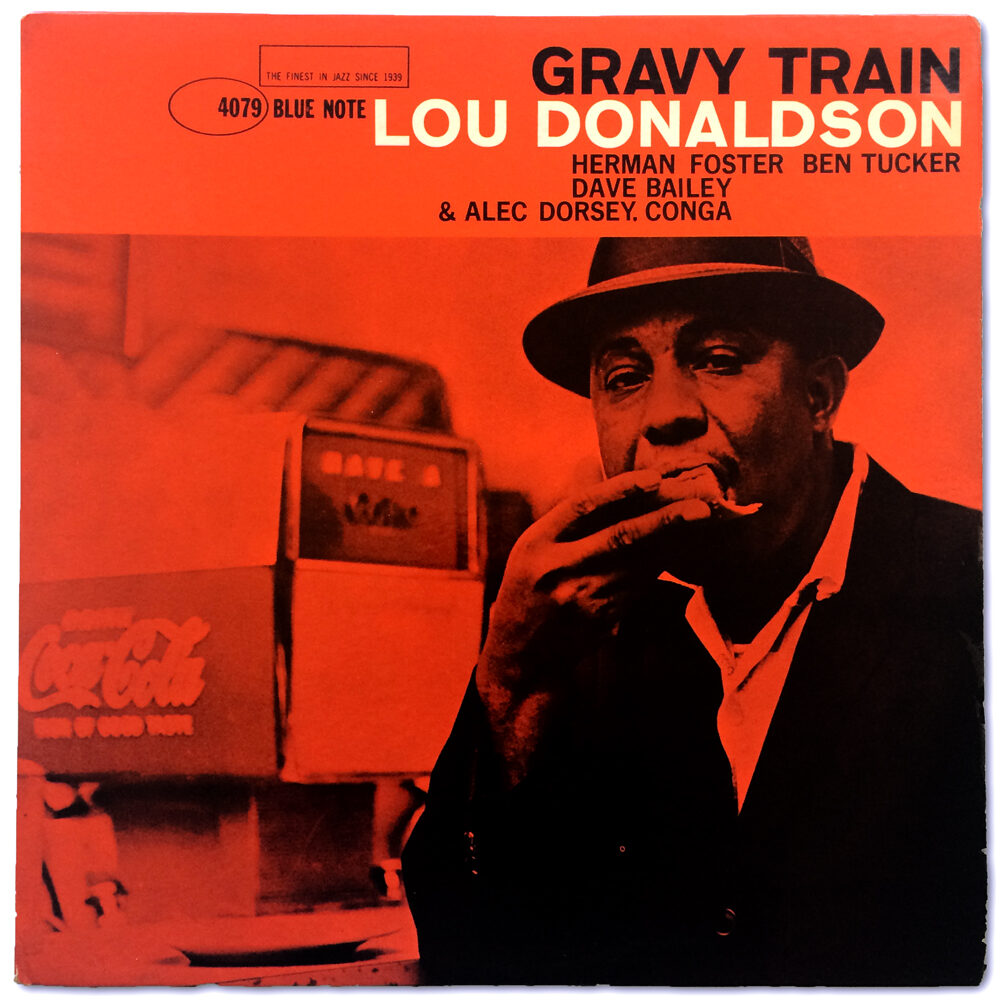
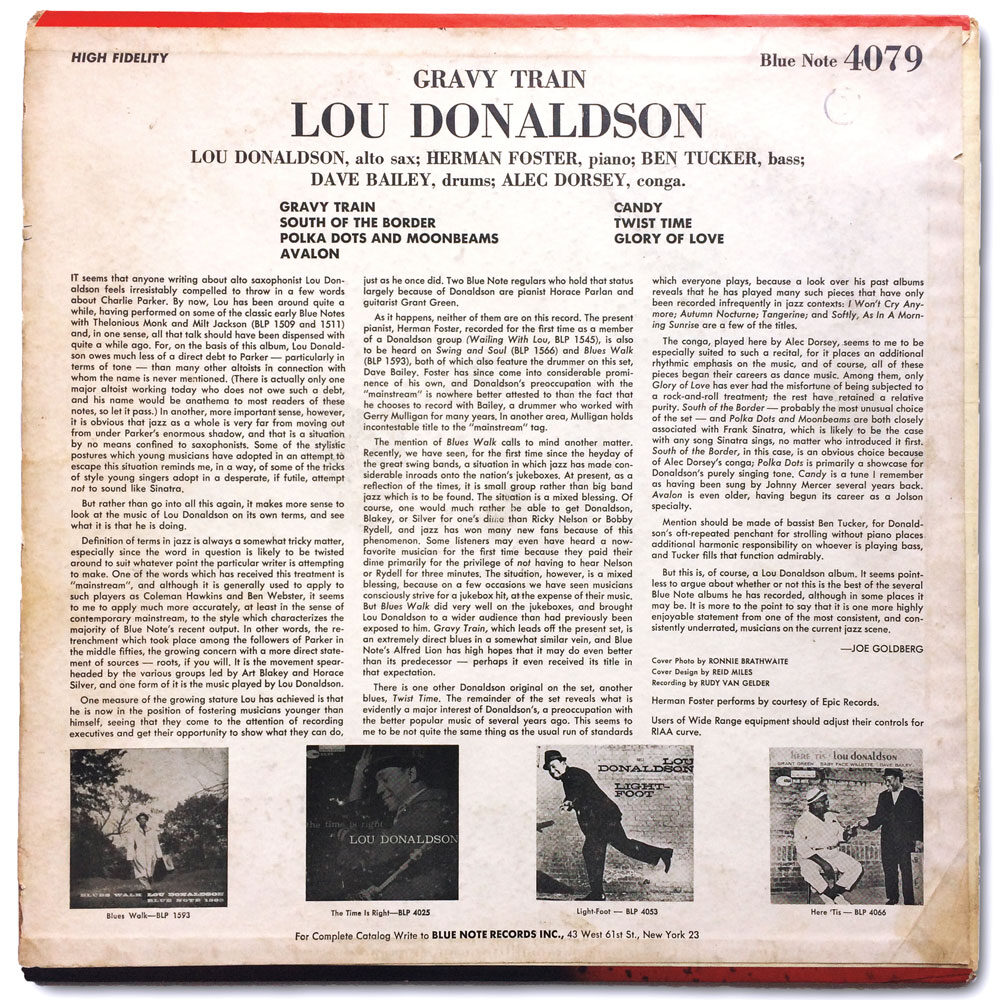
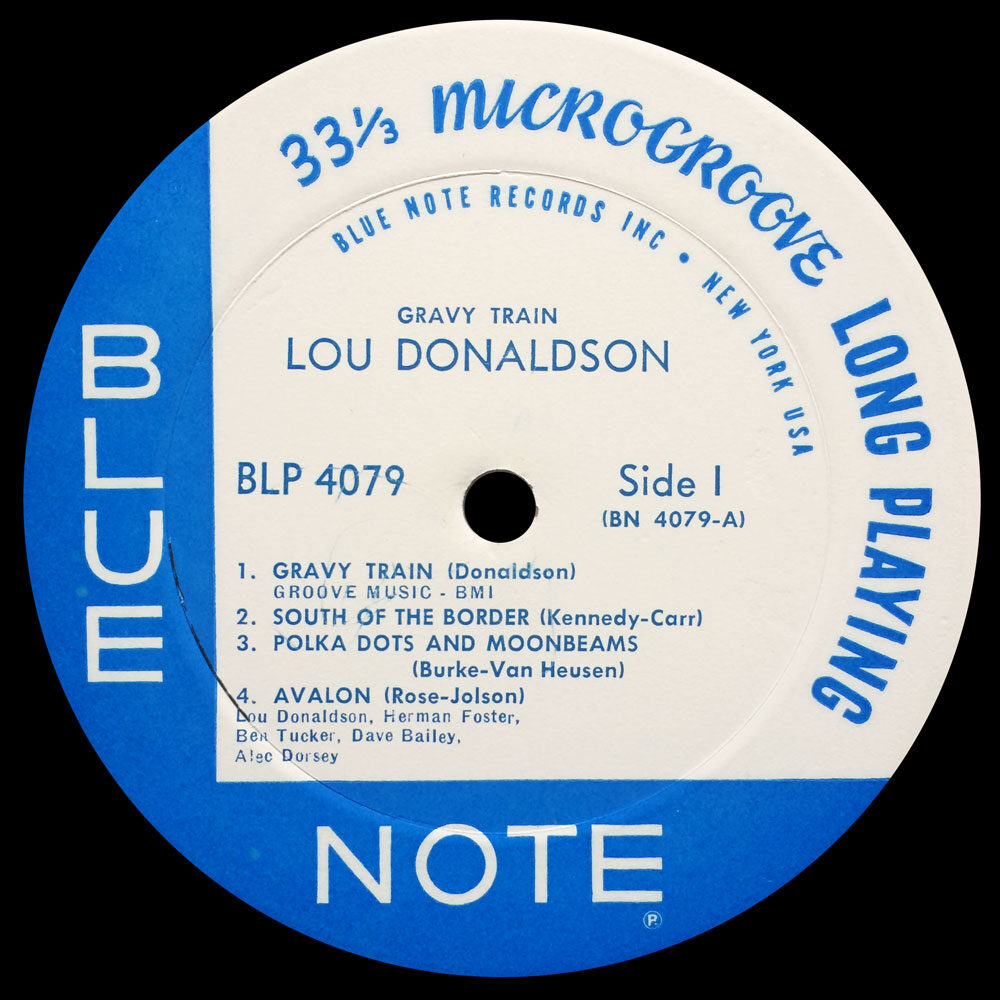
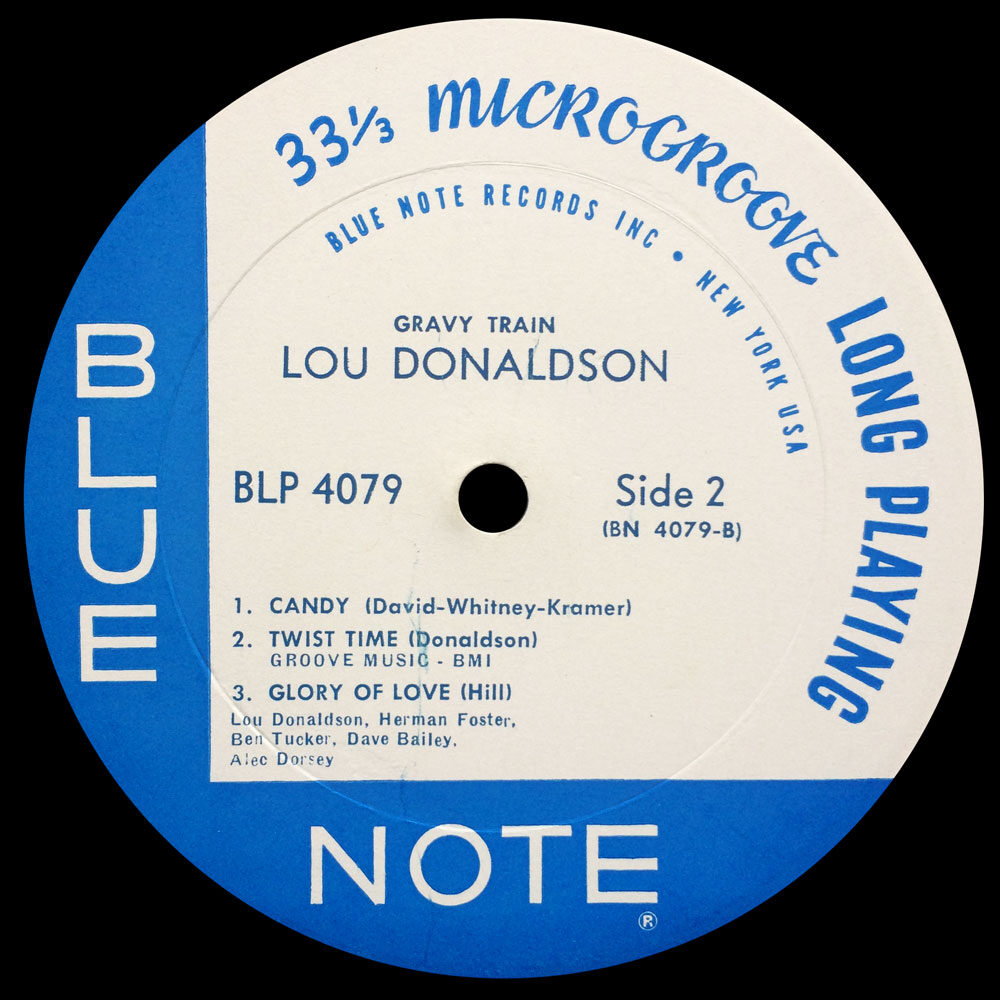
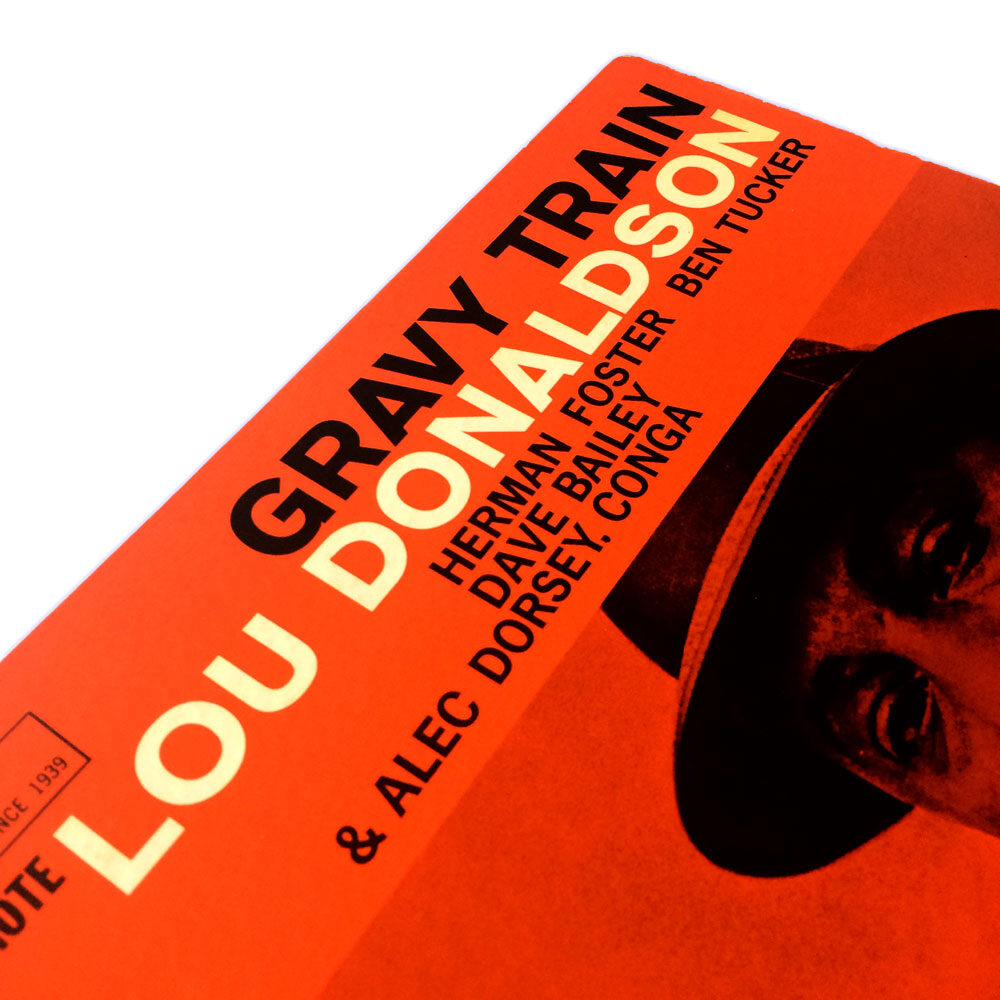
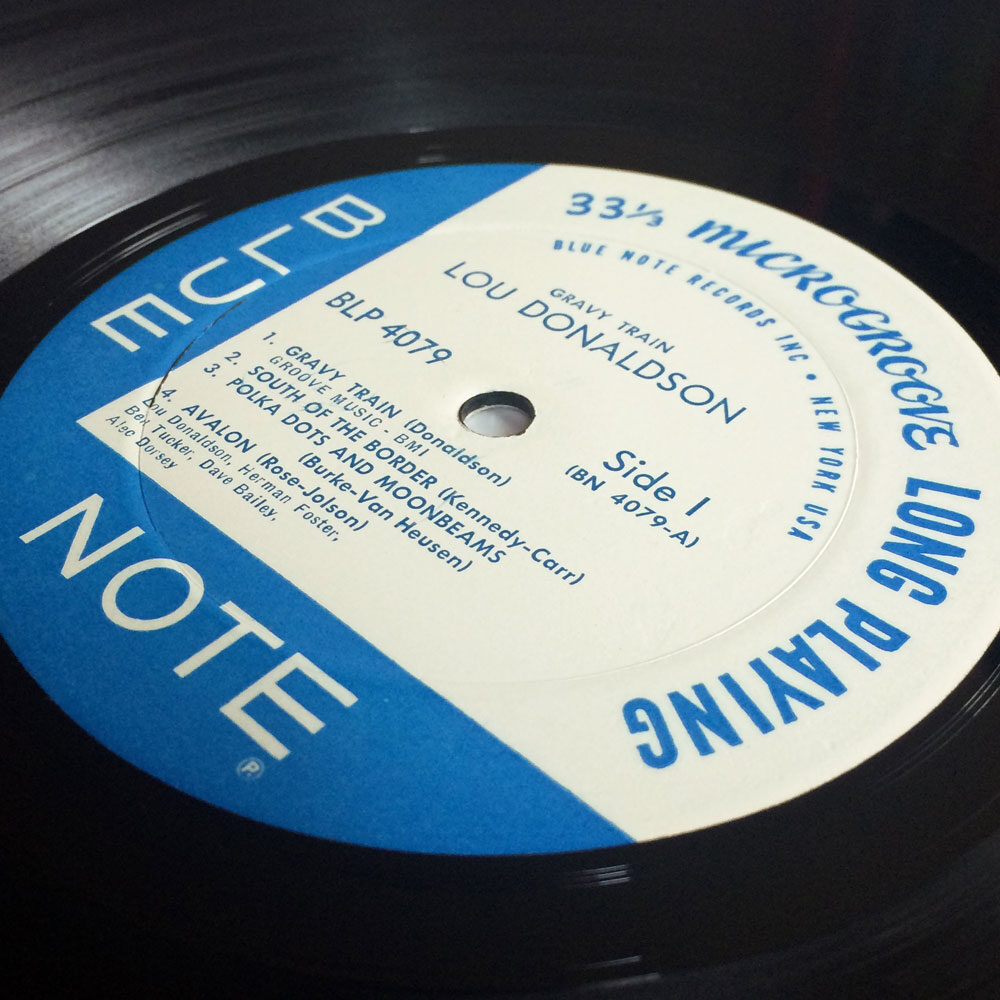
- Original 1962 mono pressing
- “NEW YORK USA” on both labels
- Plastylite “P” etched and “RVG” stamped in dead wax
- “43 West 61st St., New York 23” address on jacket
Personnel:
- Lou Donaldson, alto saxophone
- Herman Foster, piano
- Ben Tucker, bass
- Dave Bailey, drums
- Alec Dorsey, conga
Recorded April 27, 1961 at Van Gelder Studio, Englewood Cliffs, New Jersey
Originally released June 1962
| 1 | Gravy Train | |
| 2 | South of the Border | |
| 3 | Polka Dots and Moonbeams | |
| 4 | Avalon | |
| 5 | Candy | |
| 6 | Twist Time | |
| 7 | Glory of Love |
Selection: “Gravy Train” (Donaldson)
The first copy I owned was a VG copy I won on eBay in the dawn of my vintage jazz record collecting experience. I quickly replaced that worn copy with a wear-free but crackly copy. A couple years later I found a copy on eBay whose record was touted as VG+ but the jacket was exceptional (sometimes if a jacket is graded conservatively I’ll take a chance on a VG+ record).
That third copy ended up being fairly graded VG+. It looked EX but suffered from a mild case of…dun dun duuun: groove wear. I ultimately gave it up, not feeling it was worth what I paid. Then last year I found this copy at a local record shop for a much more reasonable price. It suffers from groove wear in much the same way as the last copy (the wear being less audible on the outermost tracks like my favorite, “Gravy Train”, as a result of inner groove distortion), and the jacket isn’t as clean as the last either, but I feel that its price more accurately represented its condition than the previous copy I owned. Generally speaking, the records that end up staying im my collection aren’t always the nicest but they always were purchased for a fair price.

Vinyl Spotlight: Johnny Coles, Little Johnny C (Blue Note 4144) “Earless NY” Mono Pressing


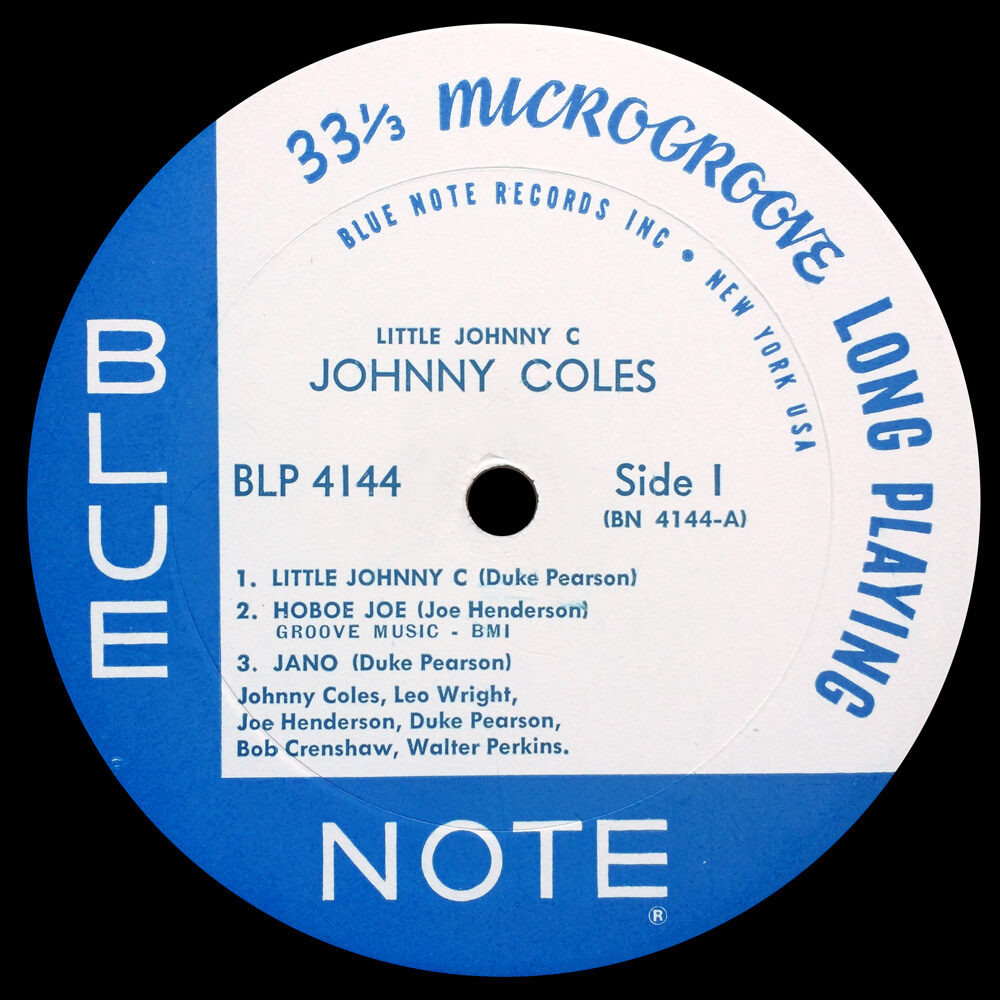
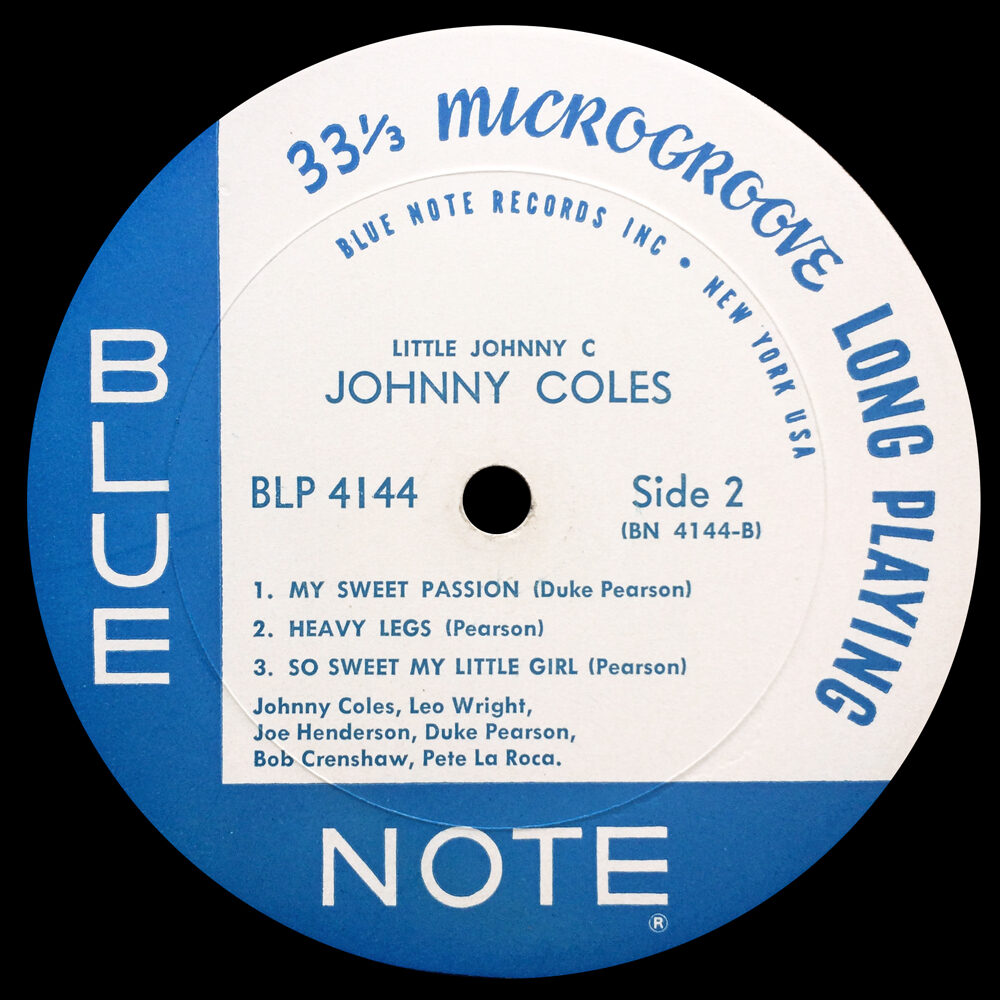
- “Earless NY” mono pressing ca. 1966
- “NEW YORK USA” on both labels
- “VAN GELDER” stamped in dead wax
- “43 West 61st St., New York 23” address on jacket with “Printed in U.S.A.”
Personnel:
- Johnny Coles, trumpet
- Leo Wright, alto saxophone & flute
- Joe Henderson, tenor saxophone
- Duke Pearson, piano
- Bob Cranshaw, bass
- Walter Perkins (Side 1) and Pete La Roca (Side 2), drums
Side 1 recorded July 18, 1963
Side 2 recorded August 9, 1963
All selections recorded at Van Gelder Studio, Englewood Cliffs, New Jersey
Originally released February 1964
| 1 | Little Johnny C | |
| 2 | Hobo Joe | |
| 3 | Jano | |
| 4 | My Secret Passion | |
| 5 | Heavy Legs | |
| 6 | So Sweet My Little Girl |
Selections:
“Little Johnny C” (Pearson)
“Jano” (Pearson)
“So Sweet My Little Girl” (Pearson)
Song for song, start to finish, this is a brilliantly executed body of work, and session pianist Duke Pearson deserves the lion’s share of the credit. As composer of five of the album’s six tracks, Little Johnny C demonstrates Pearson’s talents in a leadership role and points to his timely inclusion in the Blue Note family as an A&R man and producer.
Recorded on two separate dates, the program undergoes a drummer change between sides 1 and 2 while the frontline is maintained. Walter Perkins sits at the throne for the album’s most fast-paced tracks (“Little Johnny C” and “Jano”), his playing unique and imaginative on both takes. Coles seems to follow Miles in his “less is more” approach to solos, and Leo Wright’s work on alto sax is perhaps the finest of all the album’s soloists, arguably topping even tenor heavyweight Joe Henderson.
Engineer Rudy Van Gelder’s Englewood Cliffs recording studio typically exerts a roomy, larger-than-life sound on recordings. But in a rare break from routine, producer Alfred Lion has opted for a tighter, more up-close-and-personal sound here reminiscent of the days in Hackensack. The result is a unique take on the Blue Note sound that has the immediacy of a Hackensack record but also the clarity and definition of Englewood Cliffs.
Little Johnny C is a delightful roller coaster ride that ends with a slow and gentle stop. Rising and dipping between up-tempo and mid-tempo readings, the listener finally arrives at “So Sweet My Little Girl”, a heartfelt ballad unmatched in its syrupy pace. Pearson rightfully concludes the album with a string of breathtaking notes that comprise one of the most perfect endings to a song I have ever heard.
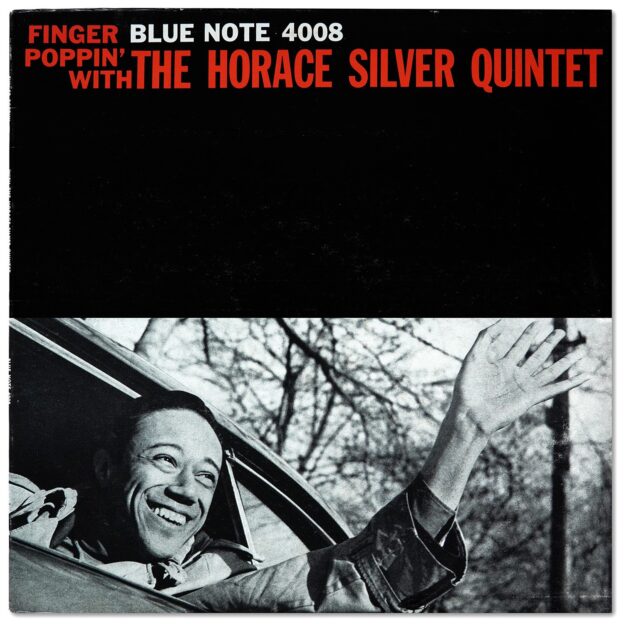
Vinyl Spotlight: Finger Poppin’ with the Horace Silver Quintet (Blue Note 4008) “Earless West 63rd” Mono Pressing
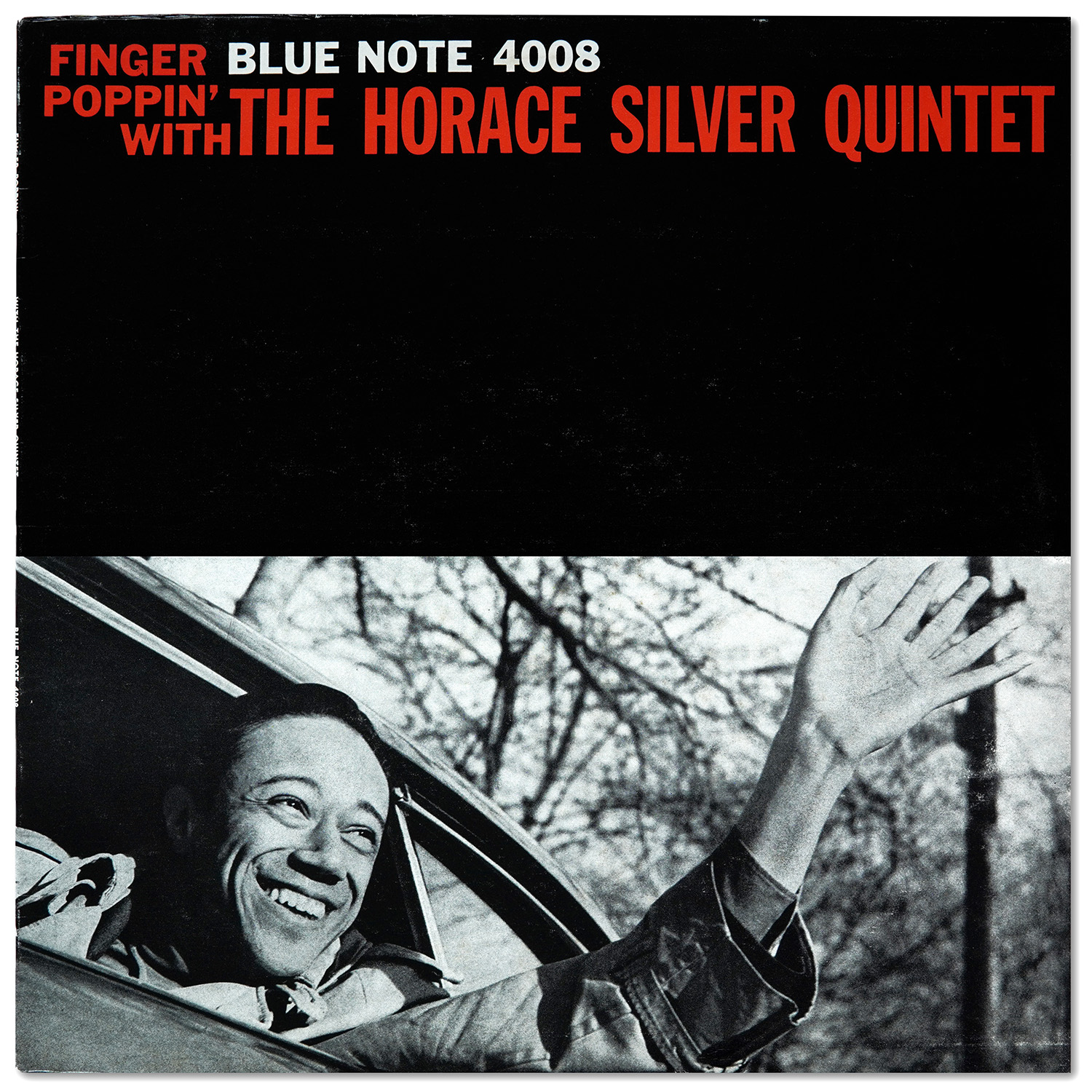
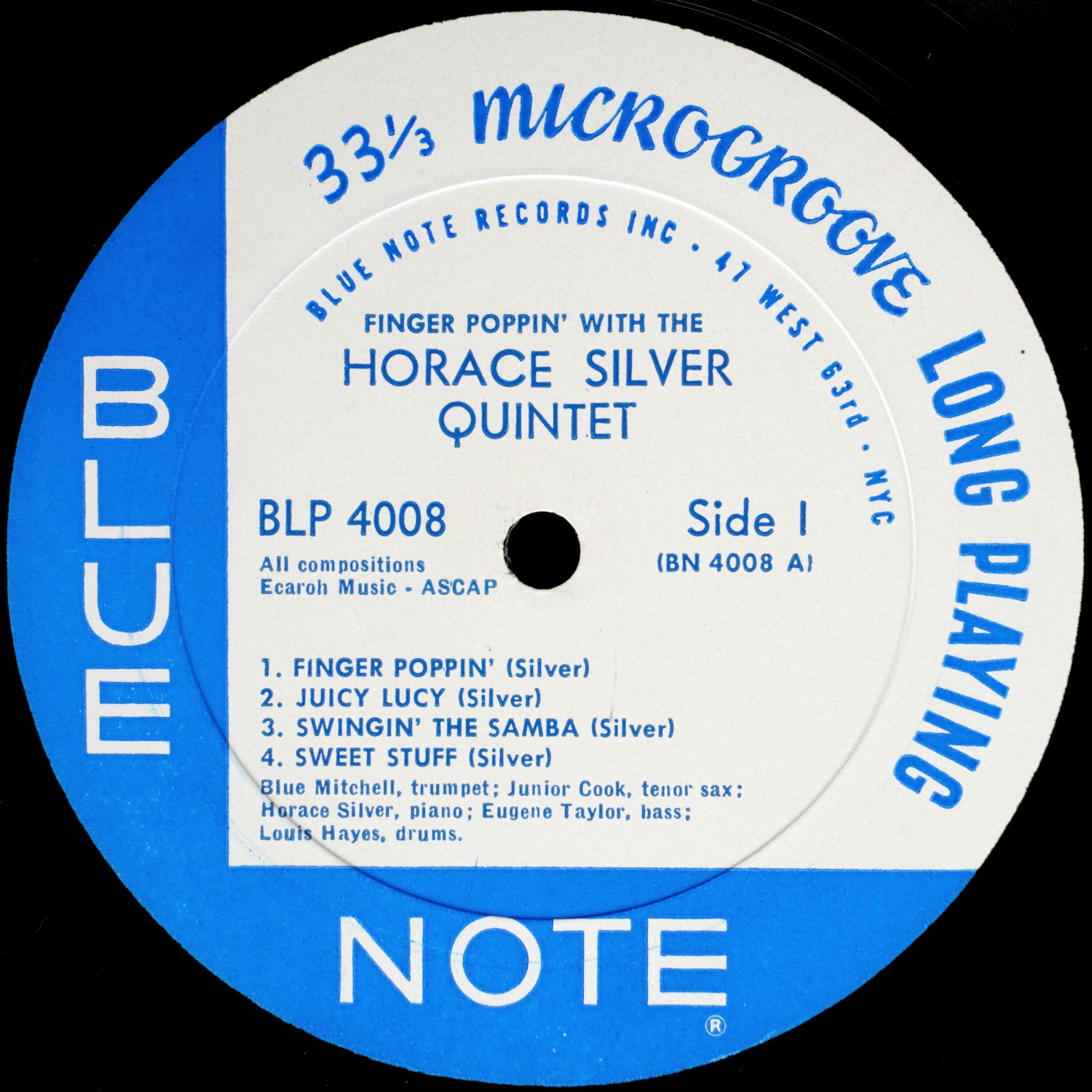
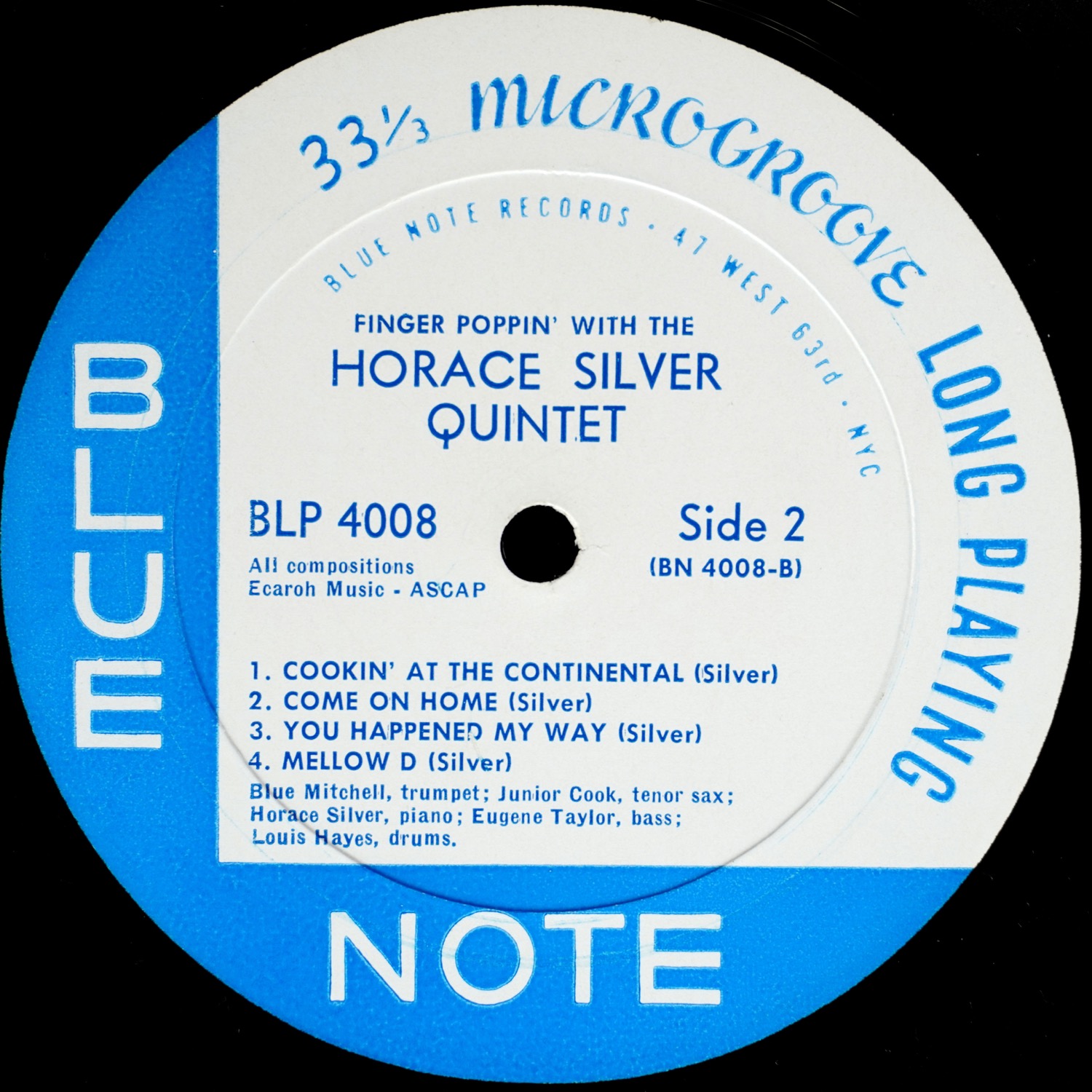
- “Earless” Liberty mono pressing ca. 1966
- “RVG” stamped in dead wax
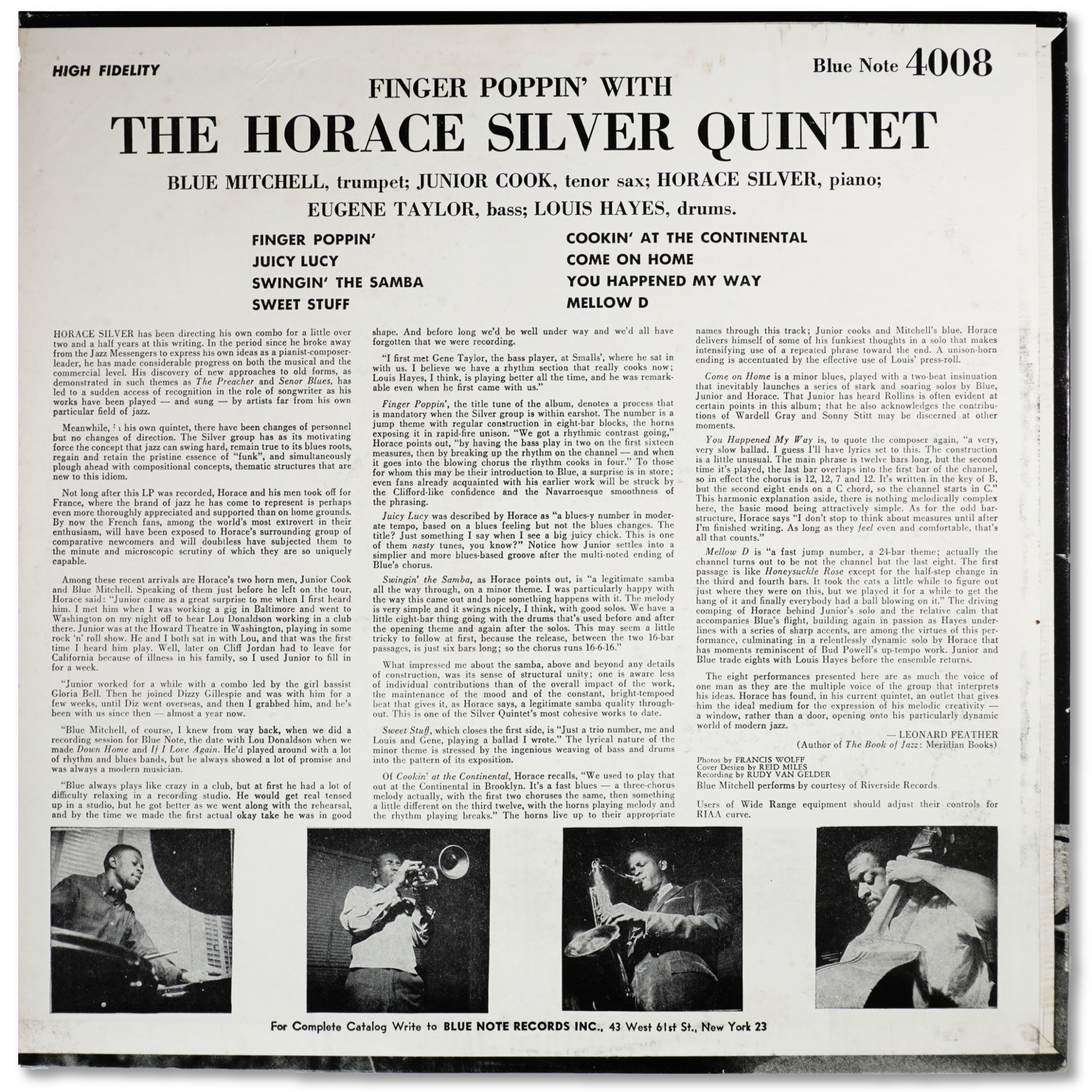
Personnel:
- Blue Mitchell, trumpet
- Junior Cook, tenor saxophone
- Horace Silver, piano
- Eugene Taylor, bass
- Louis Hayes, drums
Recorded January 31, 1959 at Van Gelder Studio, Hackensack, New Jersey
Originally released February 1959
| 1 | Finger Poppin’ | |
| 2 | Juicy Lucy | |
| 3 | Swingin’ The Samba | |
| 4 | Sweet Stuff | |
| 5 | Cookin’ at the Continental | |
| 6 | Come on Home | |
| 7 | You Happened My Way | |
| 8 | Mellow D |
Selection: “You Happened My Way” (Silver)
After doing a little research, a controversial Music Matters online article led me to the incorrect conclusion that Blue Note albums recorded after Halloween 1958 were intended for stereo release despite their mono counterparts being more valuable. So I found an original stereo copy via eBay Buy It Now (this was one of the earliest Blue Note stereo albums with the rectangular gold “STEREO” sticker). This copy was overpriced, over-graded, and didn’t sound much better than my mono copy.
A couple years went by without my giving much thought to vintage jazz records when I decided to give the hobby another go. Around this time I got lucky winning an auction that ended on a weekday morning for a very fair price, and that record is being presented here. It has its fair share of pops and ticks but it’s managed to remain in my collection because it’s wear-free, it’s a first pressing, and the cover and labels are both in great shape.
Shortly after acquiring this copy through the mail, I debated on whether I preferred the stereo or mono version of this album. I remember liking how I could hear all of the nuances of Louis Hayes’ drum kit on the stereo copy, but I also didn’t like the way Horace Silver was crammed in the left-hand corner of the mix along with the trumpet. Both mixes had their pluses and minuses, but after doing a lot of research I came to the conclusion that this album was meant to be heard in mono so I sold my stereo copy largely on principle. (Someday I might buy another original stereo copy, though. The spread was super-wide and it was a real treat to hear Louis Hayes’ drumming in such isolation.)
It’s fun to reminisce about the early days of my collecting, back when it was all so new and fresh to me, back when I had as much first-hand experience with mono Blue Note originals as I had with unicorns, back when I would marvel at the value of mono Blue Note originals in the Goldmine price guide. It’s crazy to think about how far removed I am from that place today both in terms of knowledge and experience. I’m a wiser collector with the collection to prove it but I do miss that sense of wonder.
This isn’t one of my favorite Horace Silver albums but it does include some of my favorite songs. I played the title track over and over again when I was auditioning my various copies of this album and it stuck with me. To this day, the opener’s frantic bebop is an exhilarating listen and has ultimately served as my introduction to the legendary, bold mono sound of original Blue Note pressings. “Sweet Stuff” is in the Silver tradition of syrupy ballads like “Shirl” and “Lonely Woman”, though that doesn’t make it any less enjoyable of a listen. And despite it not standing out initially, “You Happened My Way” is a beautiful melancholy number that has since become a favorite Silver composition.
Someday I’d love to own a clean first pressing of this album, which in all likelihood wouldn’t cost me an arm and a leg. Luckily, Silver was a very popular artist in his day so I reckon that the chances of this happening are pretty good.
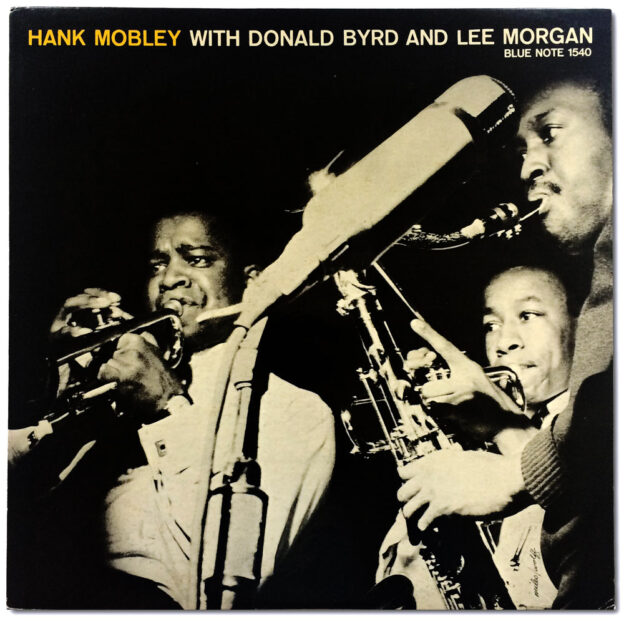
Vinyl Spotlight: Hank Mobley with Donald Byrd and Lee Morgan (Blue Note 1540) Toshiba Reissue
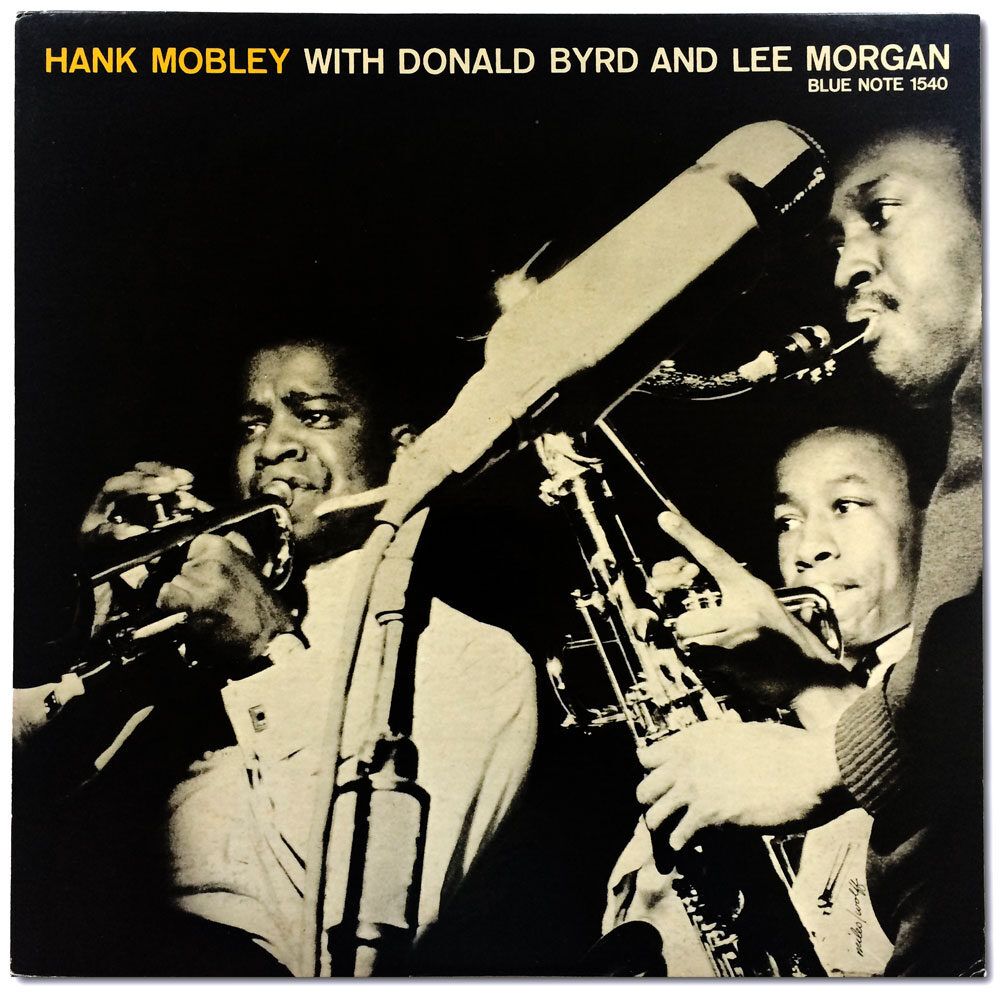
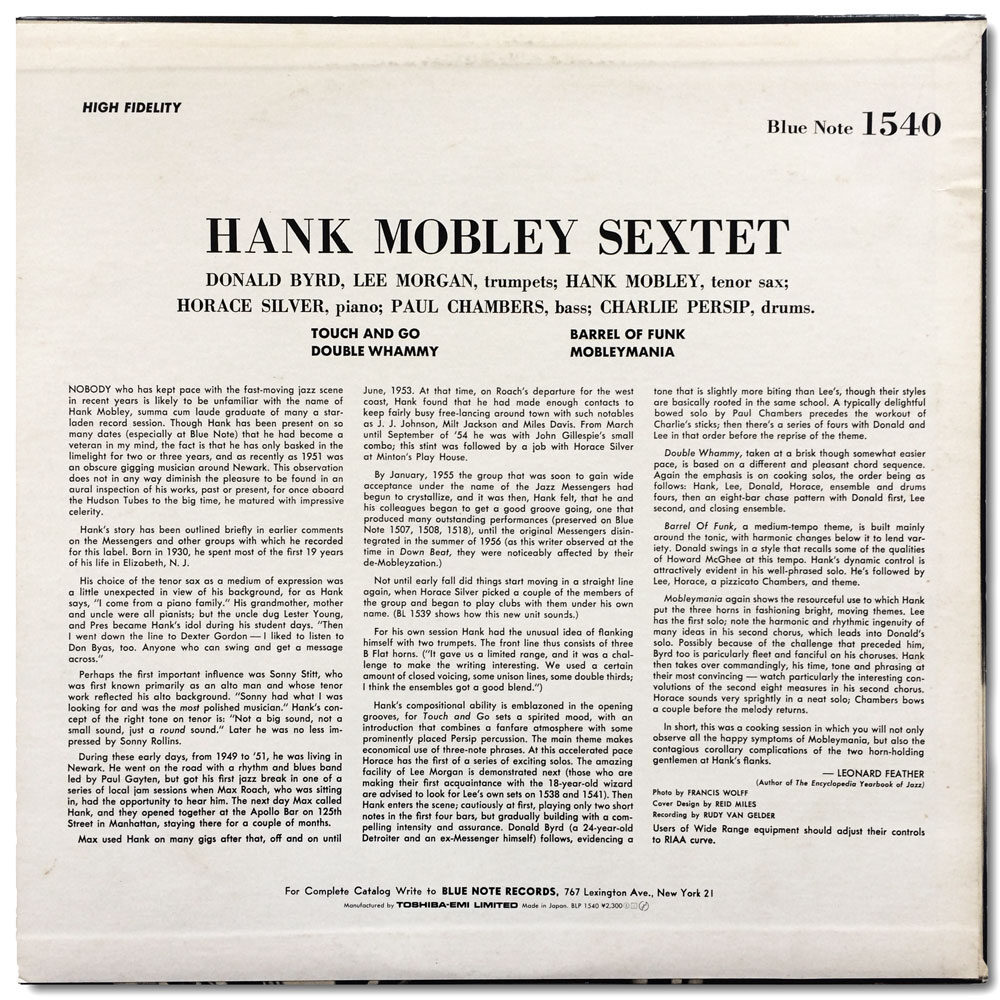
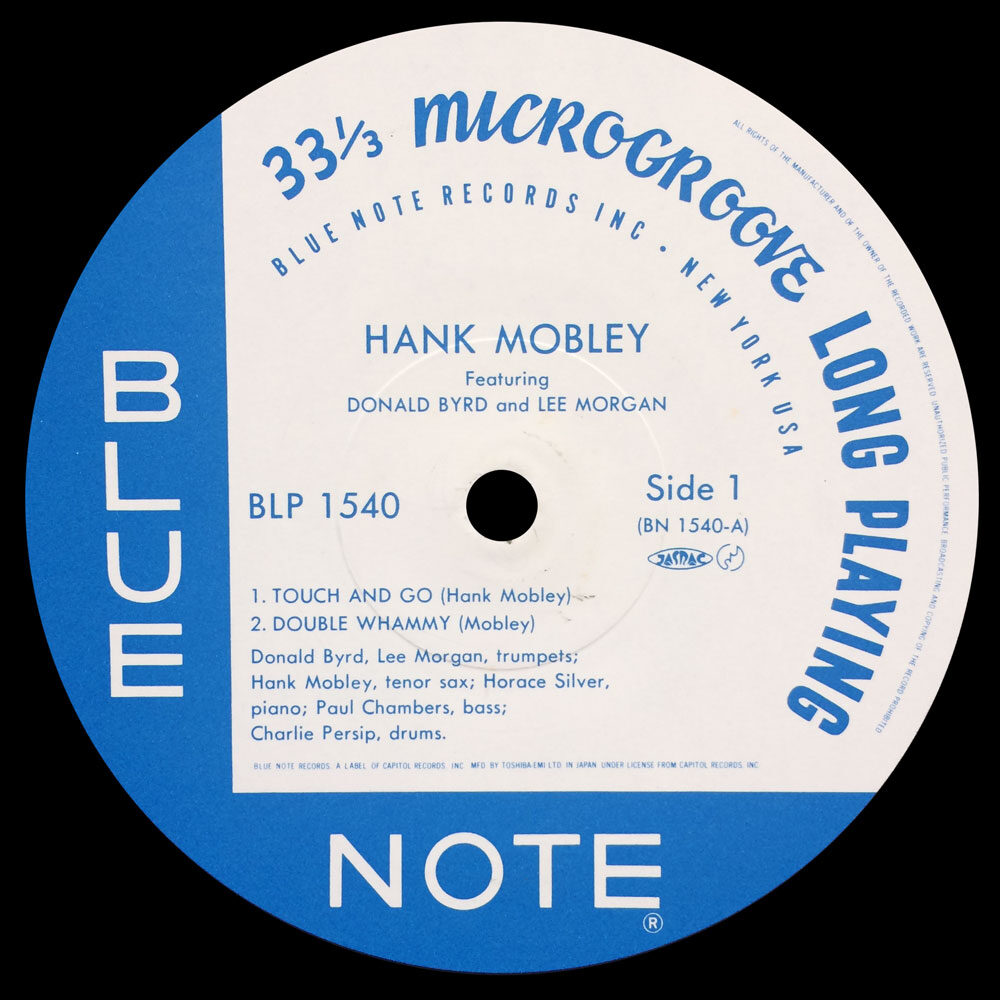
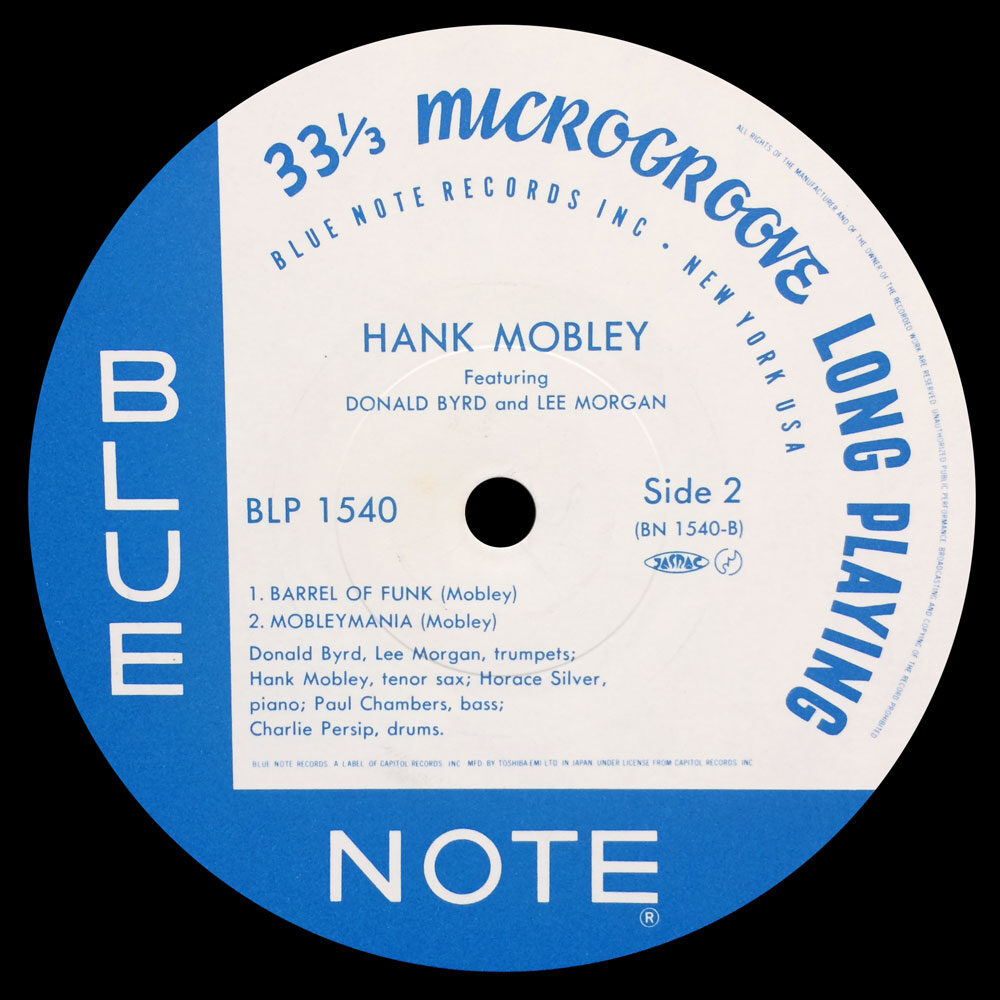
- Japanese Toshiba reissue circa 1983 (BN 1540)
Personnel:
- Donald Byrd, trumpet
- Lee Morgan, trumpet
- Hank Mobley, tenor saxophone
- Horace Silver, piano
- Paul Chambers, bass
- Charlie Persip, drums
Recorded November 25, 1956 at Van Gelder Studio, Hackensack, New Jersey
Originally released January 1957
Selection: “Touch and Go” (Mobley)
Selection: “Double Whammy” (Mobley)
There was something different about this sound, though. The horns had a tremendous sonic impact. The unique arrangement of two trumpets and one tenor saxophone was certainly playing a role, but recording engineer Rudy Van Gelder had clearly found a rare synergy with his equipment that day and I have yet to hear this horn sound topped by any other jazz recording. It is intense, smooth, and cohesive all at once. Van Gelder was getting a similar sound on other albums in late 1956 but perhaps the particular combination of Mobley, Byrd, and Morgan sets this album apart. The engineer’s choices regarding microphone positioning, preamplifier gain, compression, and instrument balance certainly played a role in the creation of this monumental sound as well.
The album’s compositions, all written by leader Hank Mobley, are consistently menacing. The haunting harmonies of “Touch and Go” and “Double Whammy” carry a sense of foreboding, and while “Barrel of Funk” has a rather upbeat “A” section, the tune ultimately transforms into an intriguing progression of minor-key origins at its bridge. Even the album’s most upbeat tune, “Mobleymania”, manages to keep listeners on the edge of their seats with harmonic tension.
Blue Note catalog number 1540 features Mobley’s characteristic sweet, smooth tone throughout. As a youthful pair of trumpeters, Donald Byrd and Lee Morgan are difficult to tell apart. Horace Silver does little to detract from this star-studded frontline, and the forefather of bop humbly yet tastefully blends into the background for much of the program. Silver’s comping is never boastful here, but at the same time it falls short of embodying the pianist’s big musical personality and signature funk (it wouldn’t be long before Silver would ditch sideman work for good and become the leader of his own legendary quintet). To round things out, drummer Charlie Persip sits at the throne behind his drum kit in the far corner of Rudy Van Gelder’s living room studio. I cannot get enough of the beautiful simplicity of Van Gelder’s mono drum sound at Hackensack in the late ’50s. Persip sounds just as good as anyone in that room and his straight-ahead timekeeping compliments Van Gelder’s technique exceedingly well.
Beyond a repress in the late ’60s after Blue Note had been sold to Liberty Records (the proof of which lies in the existence of copies with “RVG” etchings but no “ear”), this album has never been reissued in the United States, not even on compact disc (it has, however, appeared on numerous compilations including Mosaic’s box set of Mobley’s ’50s Blue Note recordings). The Japanese almost never left a Blue Note stone unturned though and this album is no exception, having been reissued by Toshiba-EMI five times in various formats. I was also considering the King reissue from the same year when I bought this 1983 Toshiba copy on eBay from a Japanese seller but ultimately chose the Toshiba not only because it was cheaper but I also noticed that the fonts used on the Toshiba cover more accurately portrayed those of the original artwork (King album covers also often admit an unnaturally high level of contrast). This was my first Japanese Blue Note vinyl reissue venture and I remember being stunned by how dead-quiet this pressing was.
My dream is to someday own a vintage copy of this album with RVG etchings. Until then, this Toshiba reissue is sure to get lots of turntable time in my house.
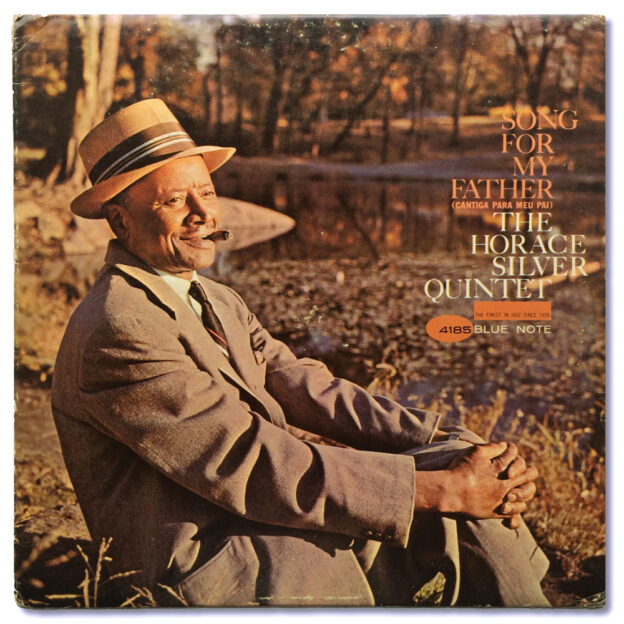
Vinyl Spotlight: The Horace Silver Quintet, Song for My Father (Blue Note 4185) Original Mono Pressing
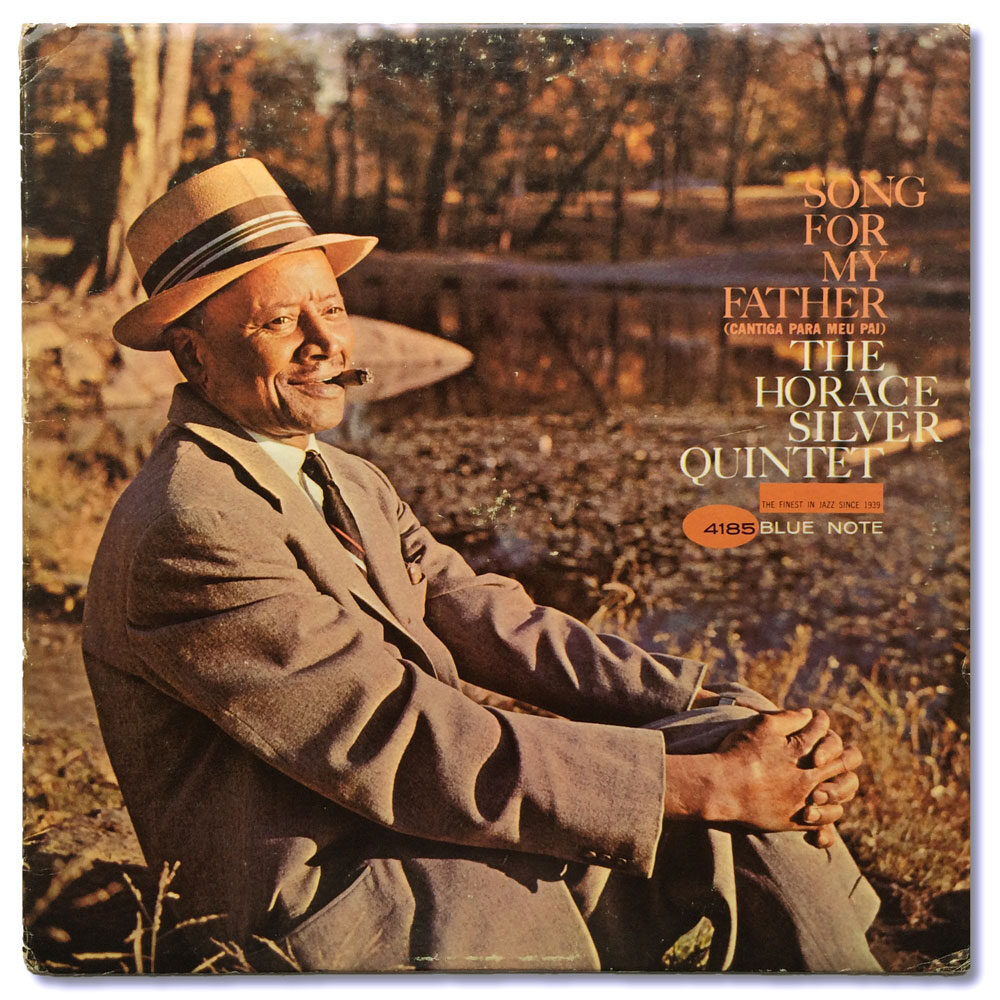
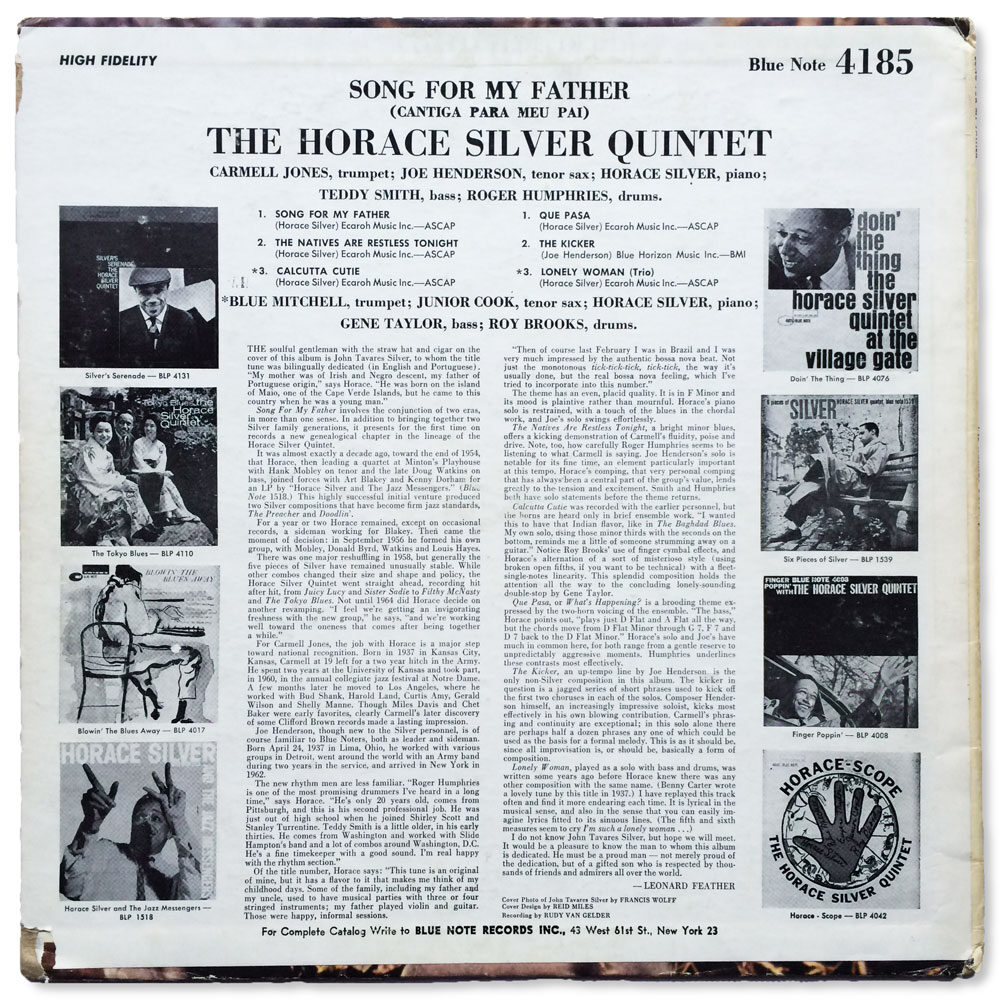
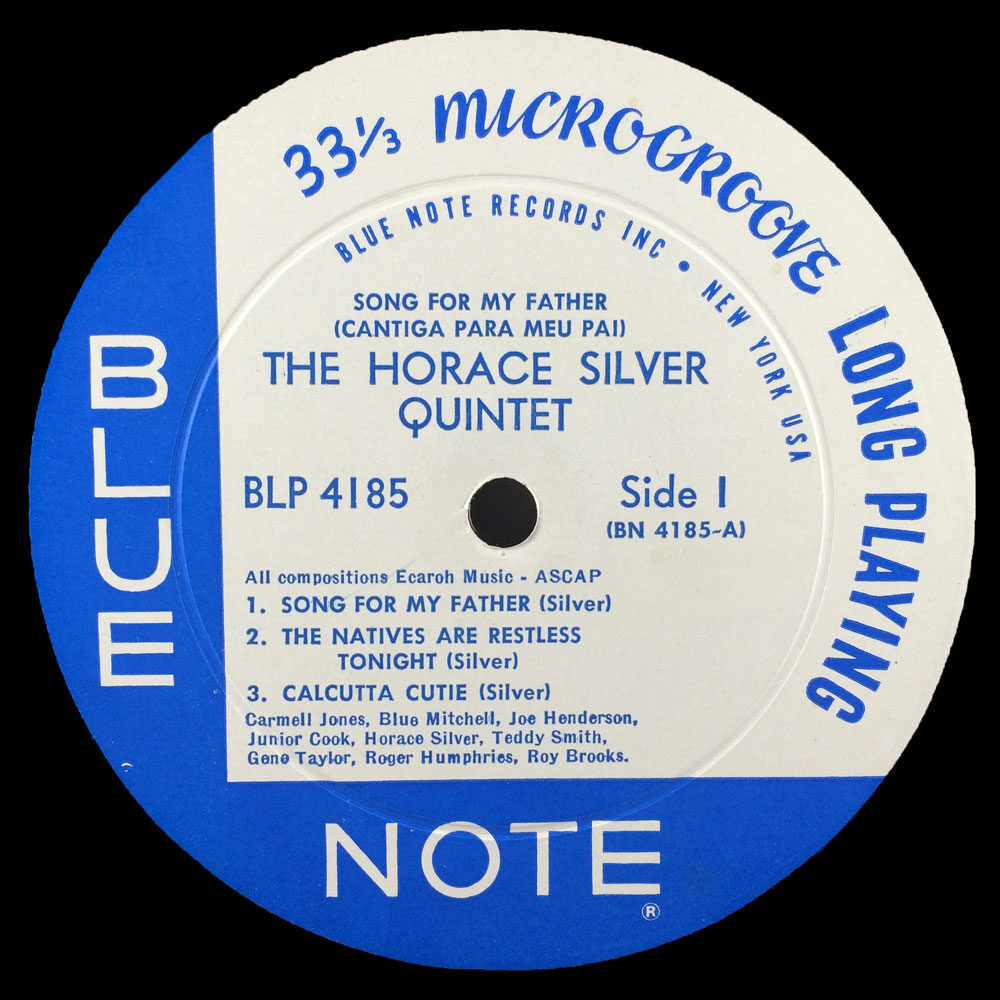
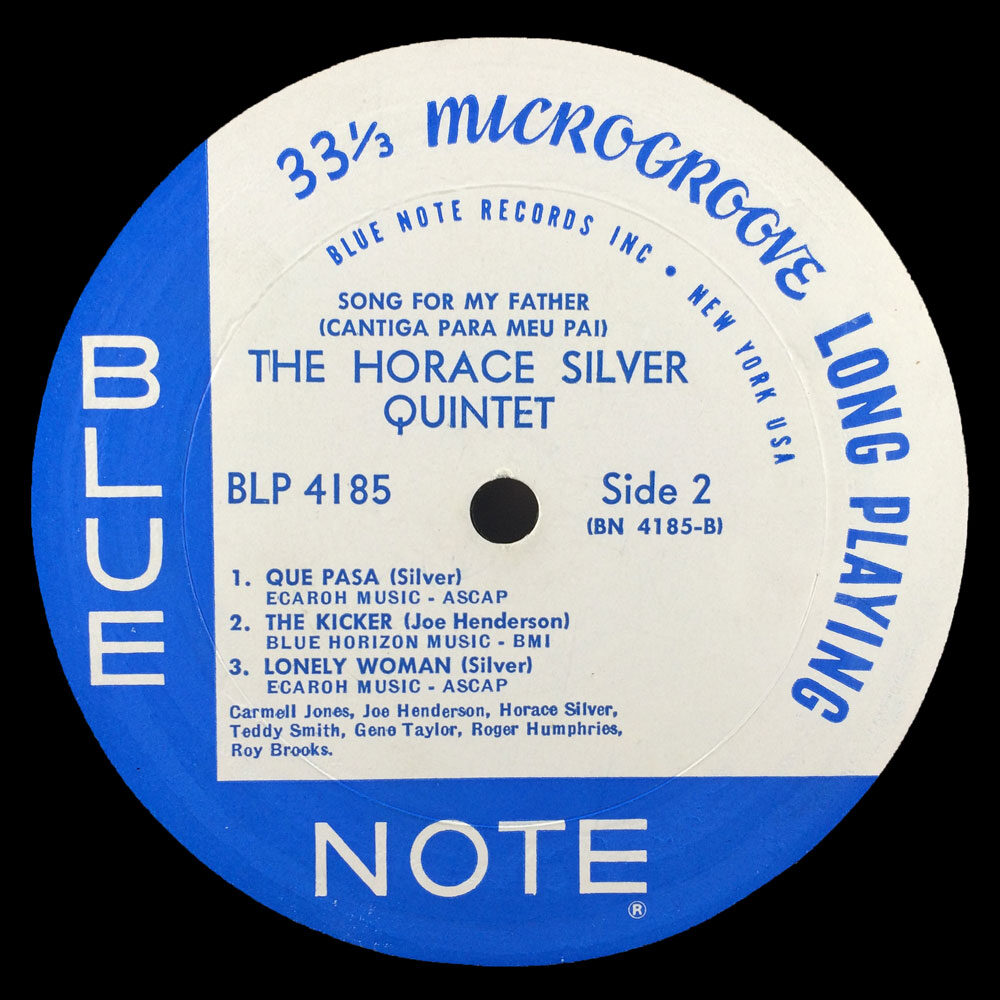
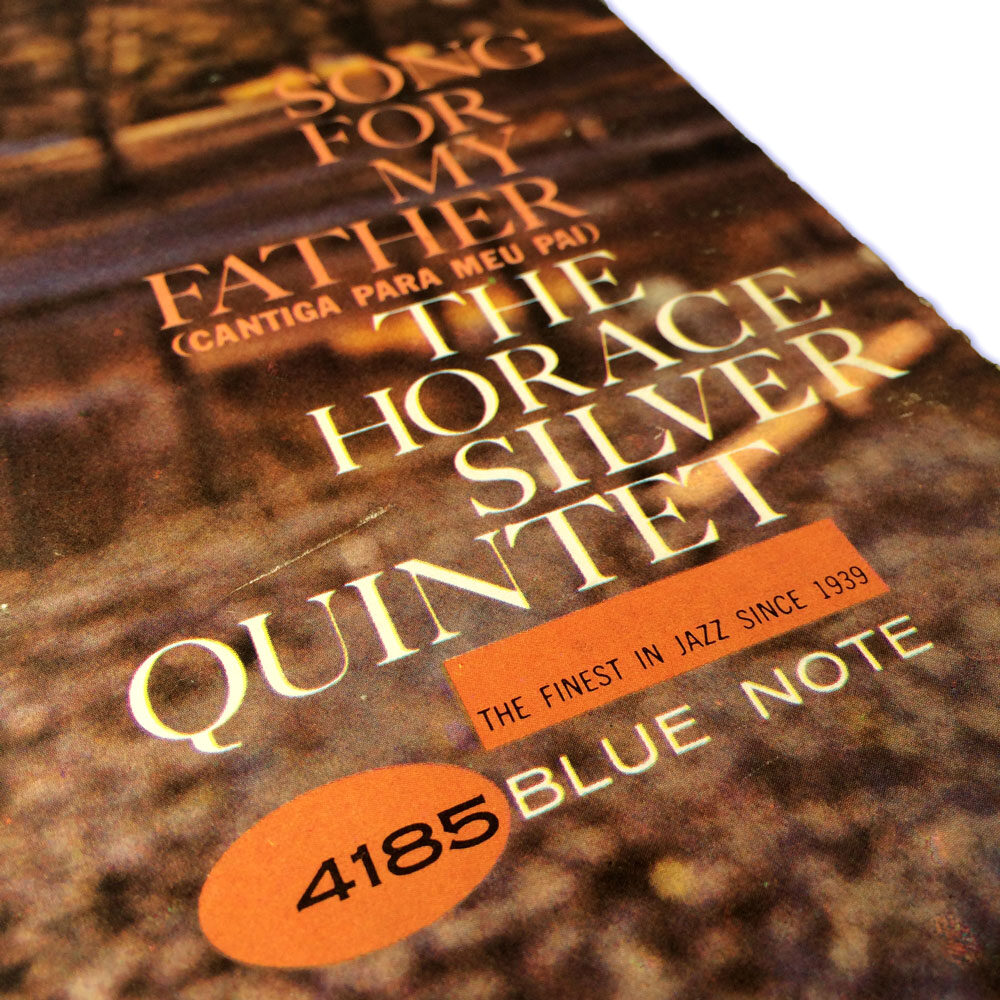
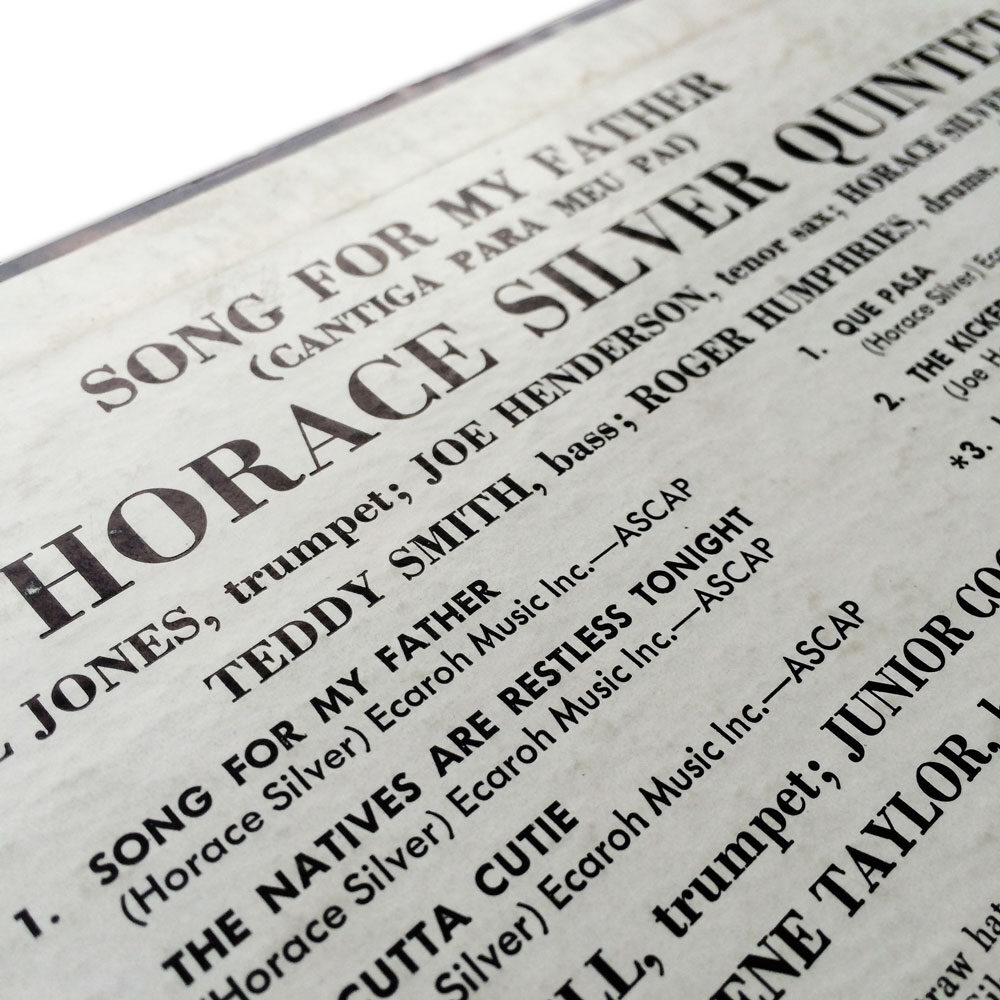
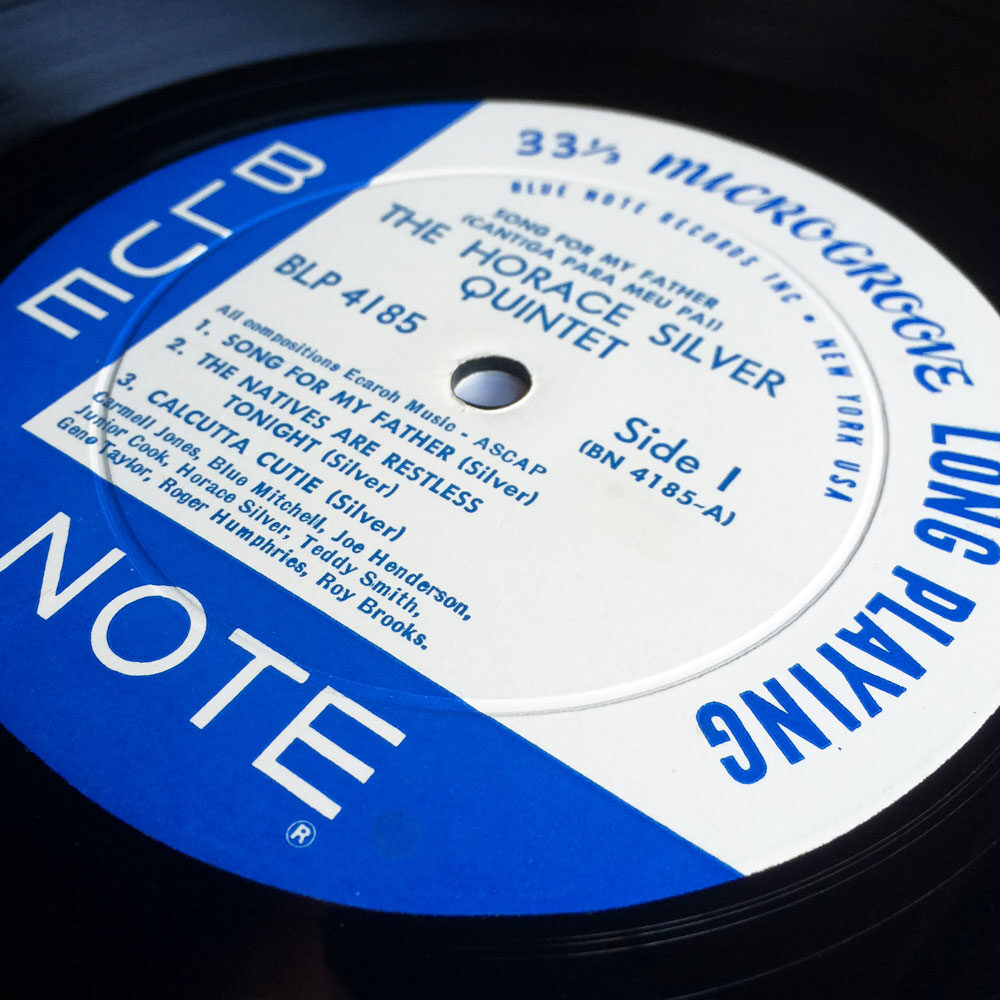
- Original 1964 mono pressing
- “NEW YORK USA” on both labels
- Plastylite “P” etched and “VAN GELDER” stamped in dead wax
- Deep groove on side 1
- “43 West 61st St., New York 23” address on jacket without “Printed in U.S.A.”
Personnel:
All but “Calcutta Cutie”, “Lonely Woman”:
- Carmell Jones, trumpet
- Joe Henderson, tenor saxophone
- Horace Silver, piano
- Teddy Smith, bass
- Roger Humphries, drums
“Calcutta Cutie”, “Lonely Woman” only:
- Blue Mitchell, trumpet (“Calcutta Cutie” only)
- Junior Cook, tenor saxophone (“Calcutta Cutie” only)
- Horace Silver, piano
- Gene Taylor, bass
- Roy Brooks, drums
“Calcutta Cutie” and “Lonely Woman” recorded October 31, 1963
All other tracks recorded October 26, 1964
All selections recorded at Van Gelder Studio, Englewood Cliffs, New Jersey
Originally released December 1964
| 1 | Song for My Father | |
| 2 | The Natives are Restless Tonight | |
| 3 | Calcutta Cutie | |
| 4 | Que Pasa | |
| 5 | The Kicker | |
| 6 | Lonely Woman |
Selection: “Lonely Woman” (Silver)
It makes sense that Song for My Father is part of many peoples’ introduction to the jazz genre. It is not only an essential part of the classic jazz canon, it is also a very accessible album. The minimalist structure of “Calcutta Cutie” and “Que Pasa” should cause just about anyone’s ears to perk up and listen. The album has everything: accessible tunes, a radio-friendly title track, two cooking sessions, and a gorgeous ballad. It certainly was one of the first albums I sought out. I first had the Rudy Van Gelder Edition CD, but when I started collecting jazz vinyl, this album was definitely near the top of my wish list.
The first time I came across an original pressing was at the Jazz Record Center in New York City. It was pretty exciting: I had just recently begun collecting and they had both original mono and stereo copies; I went for the mono. Though the record looked pretty darn clean when I bought it, to my dismay I later discovered that it suffered from audible groove wear. I bought another original mono copy on eBay with the same result before I got this copy via Buy It Now from a German seller. Although its visual condition is really only VG+, this copy is one of those rare instances where a vintage jazz record is scuffed up but free from groove wear and thus plays better than it looks.
My favorite song on this record is perhaps my favorite ballad of all time, “Lonely Woman”. It’s the last song on side 2, and because it’s the last song on the side I was faced with a particular dilemma. The phenomenon of inner groove distortion makes the innermost tracks on each side of a record more susceptible to groove wear, and this is exactly why my first two copies ended up for sale on eBay. Piano is an instrument especially prone to causing mistracing in the presence of groove wear, and on a ballad like this, that distortion is going to be easier to notice if it’s there. If you can find a Rudy Van Gelder-mastered original that’s free from groove wear like this one, the plus side to the engineer’s aggressive mastering techniques is that the music usually overpowers surface marks even in the most excessive of instances; listen above to hear the results.
Whereas my copy of this album has a deep groove on side 1 only, Fred Cohen’s Blue Note guide indicates that copies exist with deep grooves on both sides. But note that Cohen is very clear on page 77 of his guide when he explains the significance of deep grooves when evaluating the vintage of a Blue Note record:
“After a certain point, it can never truly be known whether similar pressings for the same record, whose only difference is the presence or absence of a deep-groove on one, both, or neither labels, is actually the original FIRST pressing. But since collectors have a natural bias for any detail that suggests an early or original issue, the presence of a deep-groove has been treated in this guide as an indication of an original, but ONLY an indication.”
Each of us is free to agree or disagree with him (I happen to think his scientific approach to the issue is exactly right) but I discourage the interpretation of the deep groove data in his guide as a definitive end-all-be-all as to what constitutes a first pressing for Blue Note albums released after the appearance of the first non-deep groove copies in 1961. There is no hard evidence suggesting that either deep groove or non-deep groove pressings of these albums always came first. For someone like myself, this means that in the event that all the other appropriate indicators are there, both deep groove and non-deep groove pressings should be considered first pressings. So if you have a copy of this album with the Van Gelder stamp and the “P” but no deep grooves, my advice is to consider it a first pressing.
The sound of this album is characteristic of Rudy Van Gelder’s work in the mid-1960s. As early as 1963 (see Lee Morgan’s The Sidewinder), one can hear Van Gelder pushing his compressors harder than ever, resulting in a saturated, thick sound. Horns meld together like glue, piano notes come thundering down like hammers, and drums have an in-your-face presence where each and every nuance is amplified to cut through the mix. Of the sides presented here, “Song for My Father” embodies this sound the most.
This album is a bonafide classic. It is yet another Blue Note staple filled with brilliant music, an album that beckons to be listened to from start to finish every time.
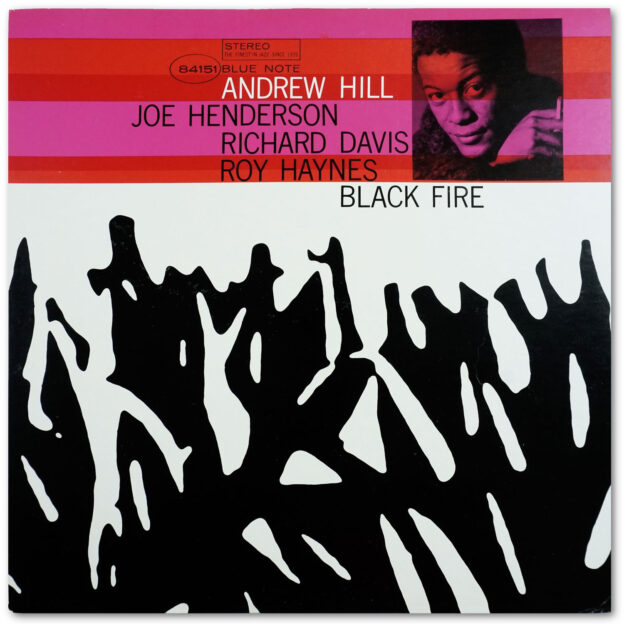
Vinyl Spotlight: Andrew Hill, Black Fire (Blue Note 84151) Liberty RVG Stereo Pressing

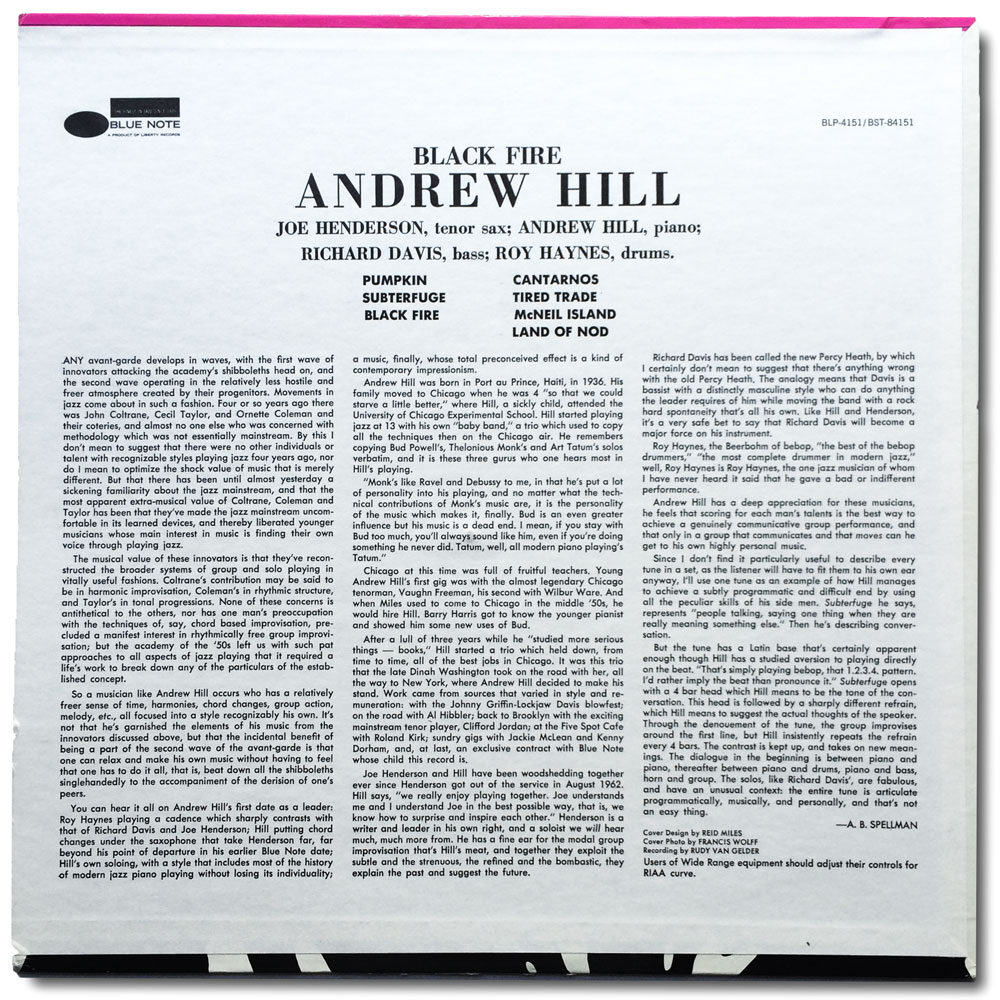
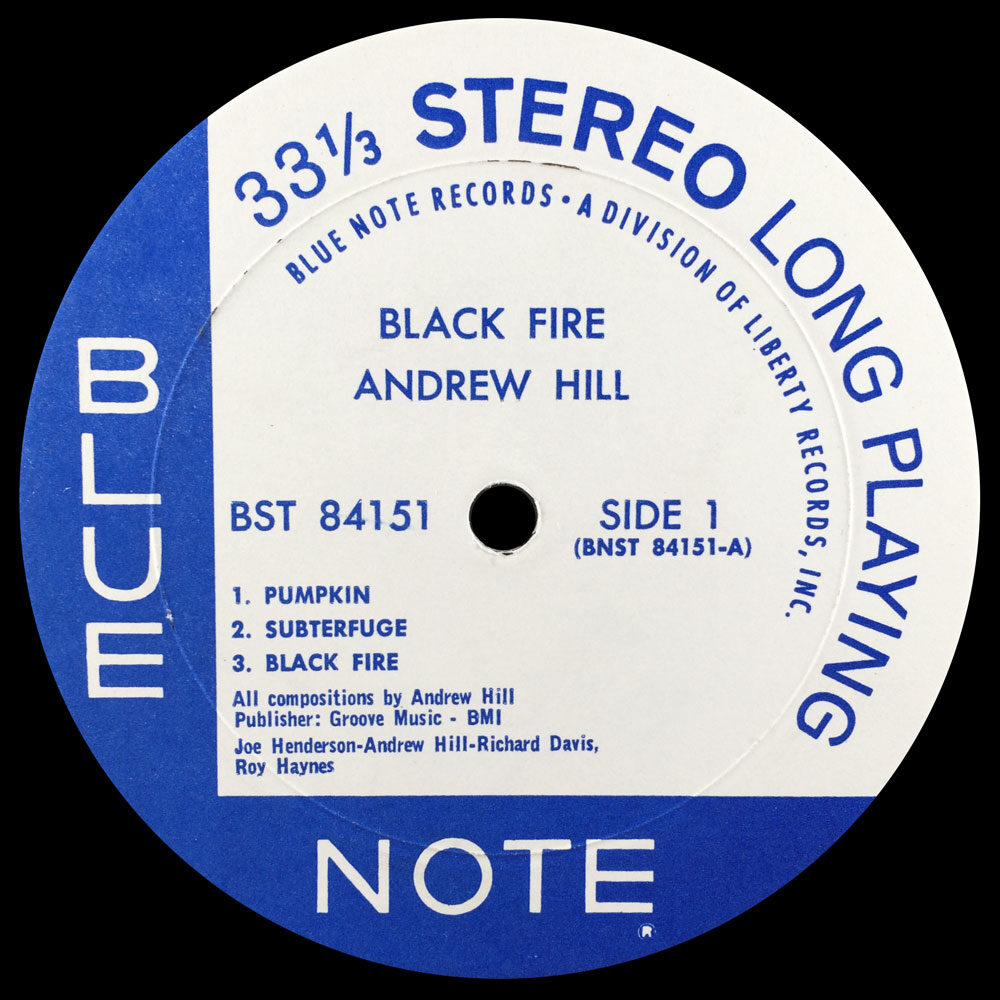
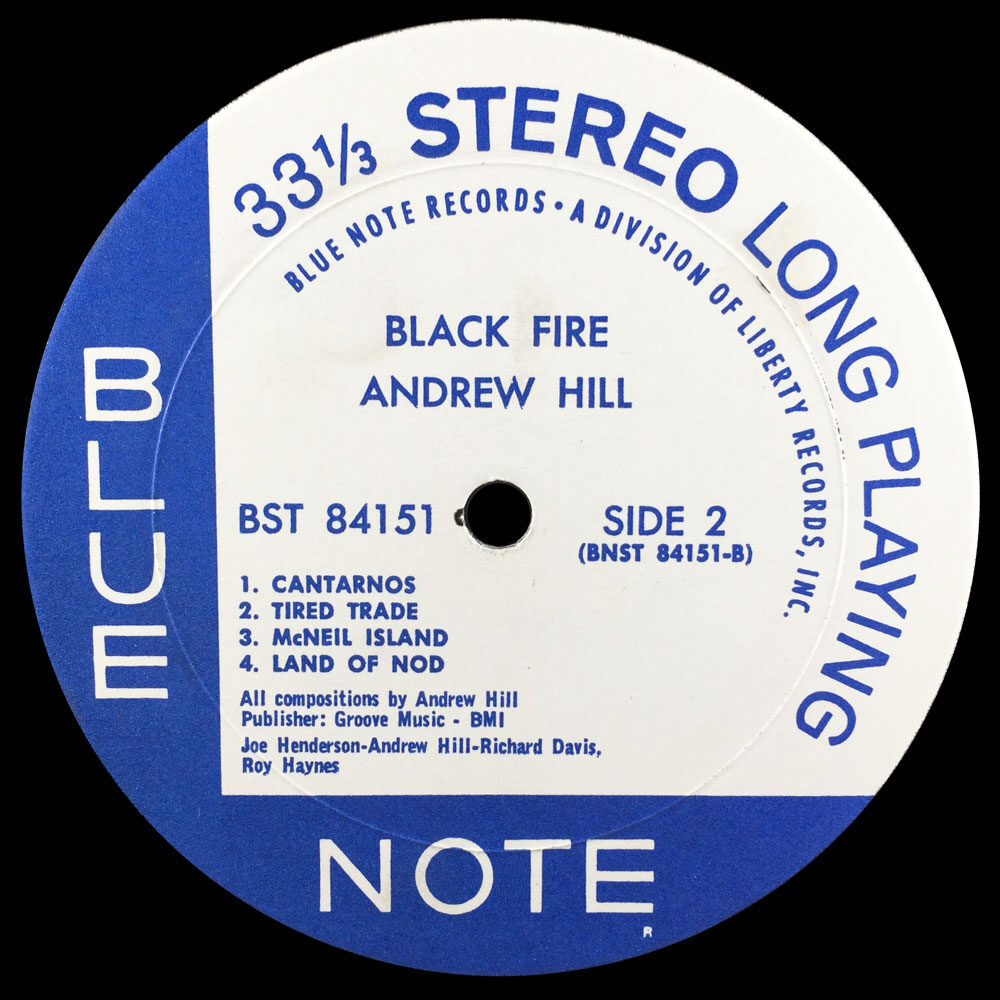
- Stereo Liberty reissue circa 1966-1970
- “A DIVISION OF LIBERTY RECORDS, INC.” on both labels
- “VAN GELDER” stamped in dead wax
Personnel:
- Joe Henderson, tenor saxophone
- Andrew Hill, piano
- Richard Davis, bass
- Roy Haynes, drums
Recorded November 9, 1963 at Van Gelder Studio, Englewood Cliffs, New Jersey
Originally released March 1964
| 1 | Pumpkin | |
| 2 | Subterfuge | |
| 3 | Black Fire | |
| 4 | Cantarnos | |
| 5 | Tired Trade | |
| 6 | McNeil Island | |
| 7 | Land of Nod |
Selections:
“Pumpkin” (Hill)
“Black Fire” (Hill)
First and foremost, I think this is one of the greatest album covers of all time. I love the juxtaposition of the bold strips of various red hues with the cartoony black-and-white illustration of fire beneath. Reid Miles’ cover design speaks volumes and yet again complements the music incredibly well.
From the time Andrew Hill arrived at Blue Note in 1963, it didn’t take long for the pianist-composer to venture “out” and away from bop. Hill first recorded for the label in September of that year with Joe Henderson (Our Thing, Blue Note 4152), then with Hank Mobley the following month (No Room for Squares, Blue Note 4149). Black Fire, Hill’s first album as a leader for Blue Note, was recorded in November 1963 and gives us an early glimpse at Hill loosely conforming to the higher degree of harmonic and melodic structure commonly found in bop. Blue Note would continue to document Hill’s musical explorations in the coming months, laying to tape Smokestack, Judgment!, then finally Hill’s avant-garde classic Point of Departure in March 1964 — the same month that Eric Dolphy recorded his landmark album Out to Lunch! for the label.
This album is about as far out as I’m willing go into the free jazz sea. I’m not a fan of free jazz and don’t know much about it, but from the little I do know I’m willing to say that Black Fire tows the line between post bop and the avant-garde. The sounds here tend to invoke a subtle feeling of panic, but much like another favorite mid-sixties quartet album of mine, Black Fire maintains a surprising degree of calm and quietude through all of the chaos. We also get to hear Roy Haynes on an uncommon Blue Note date and he doesn’t disappoint, demonstrating his patented pinpoint precision and tight snare drum work throughout.
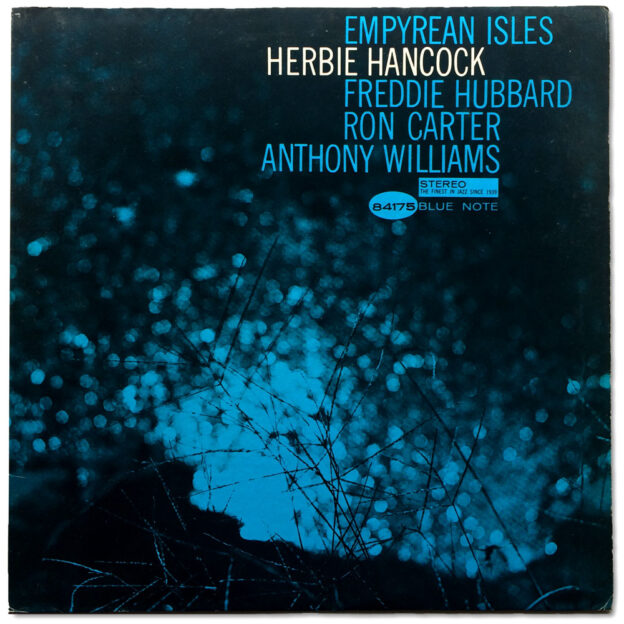
Vinyl Spotlight: Herbie Hancock, Empyrean Isles (Blue Note 4175) UA RVG Stereo Pressing
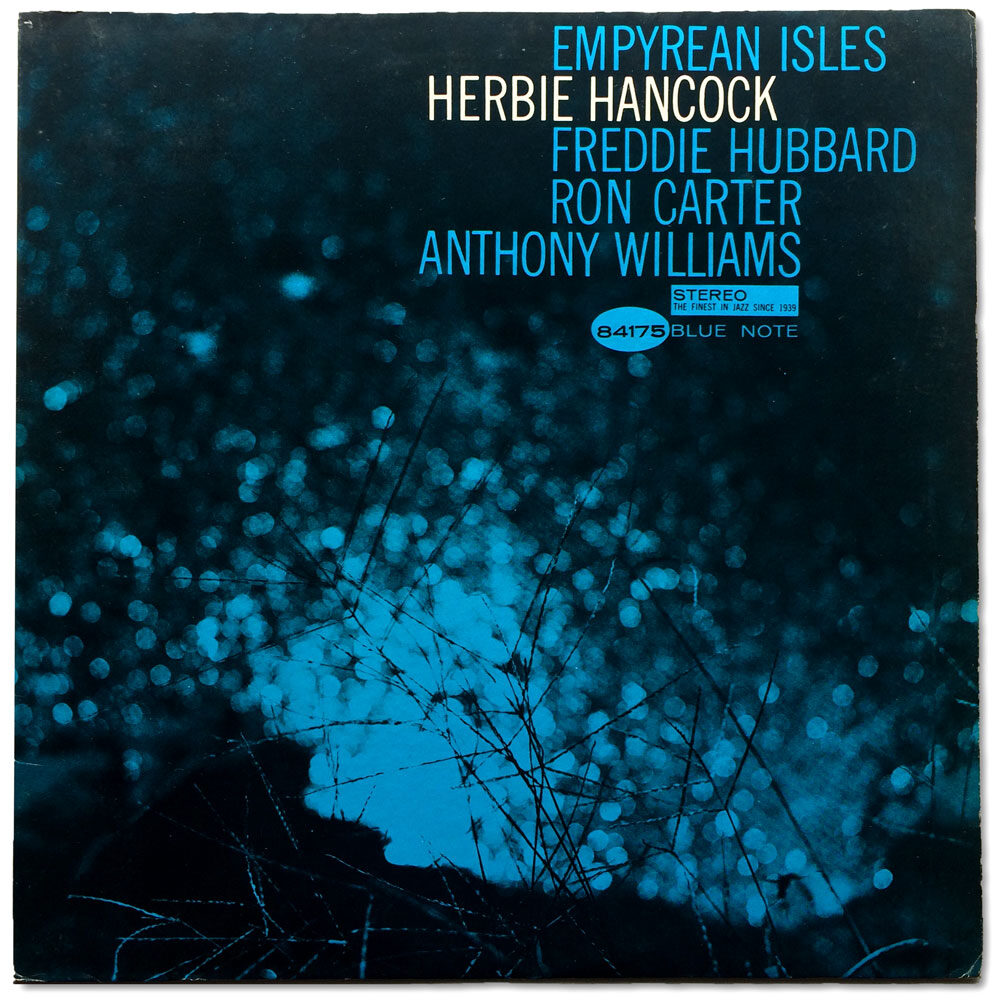
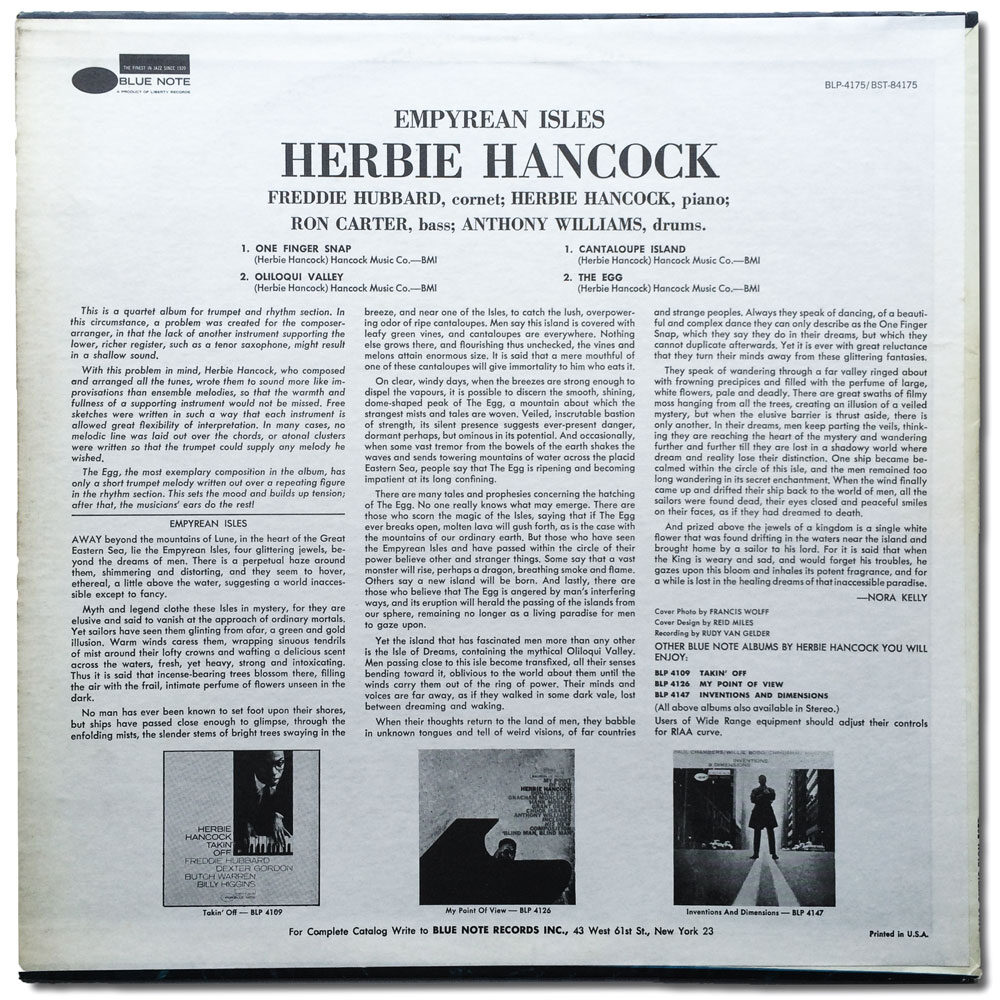
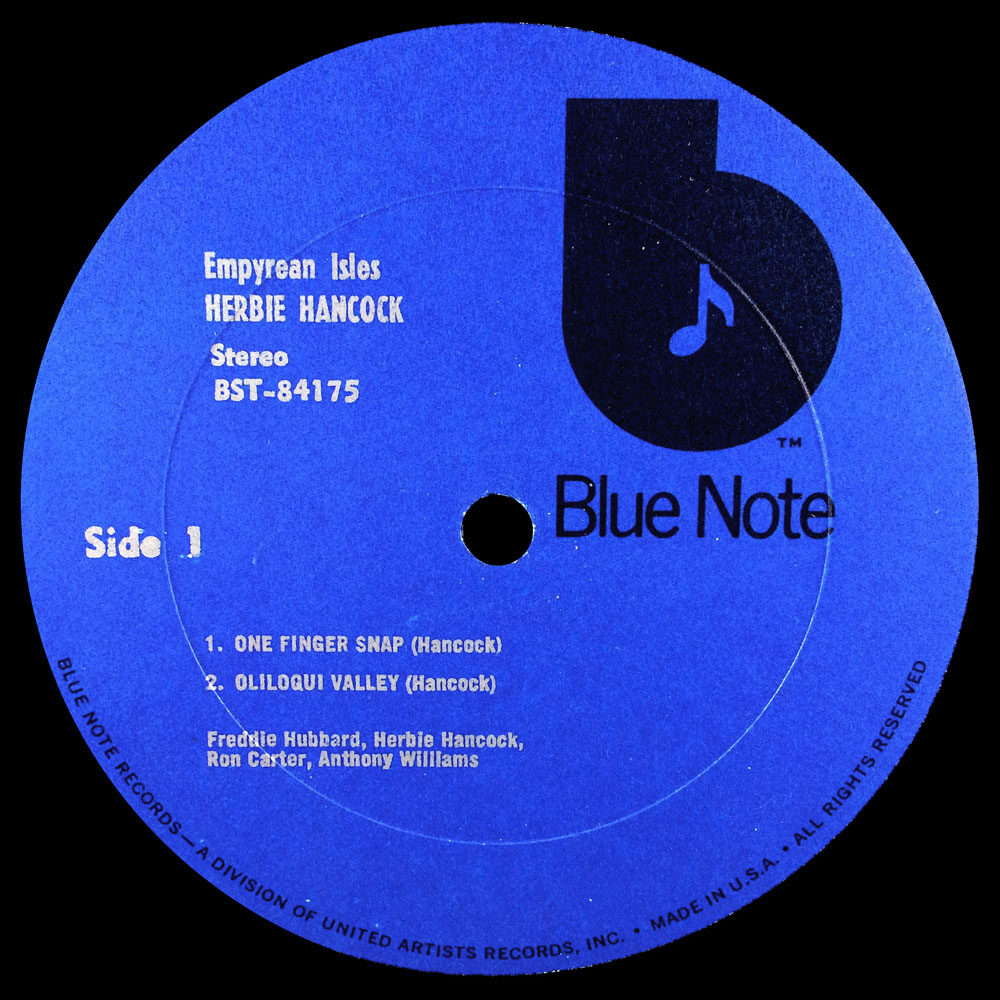
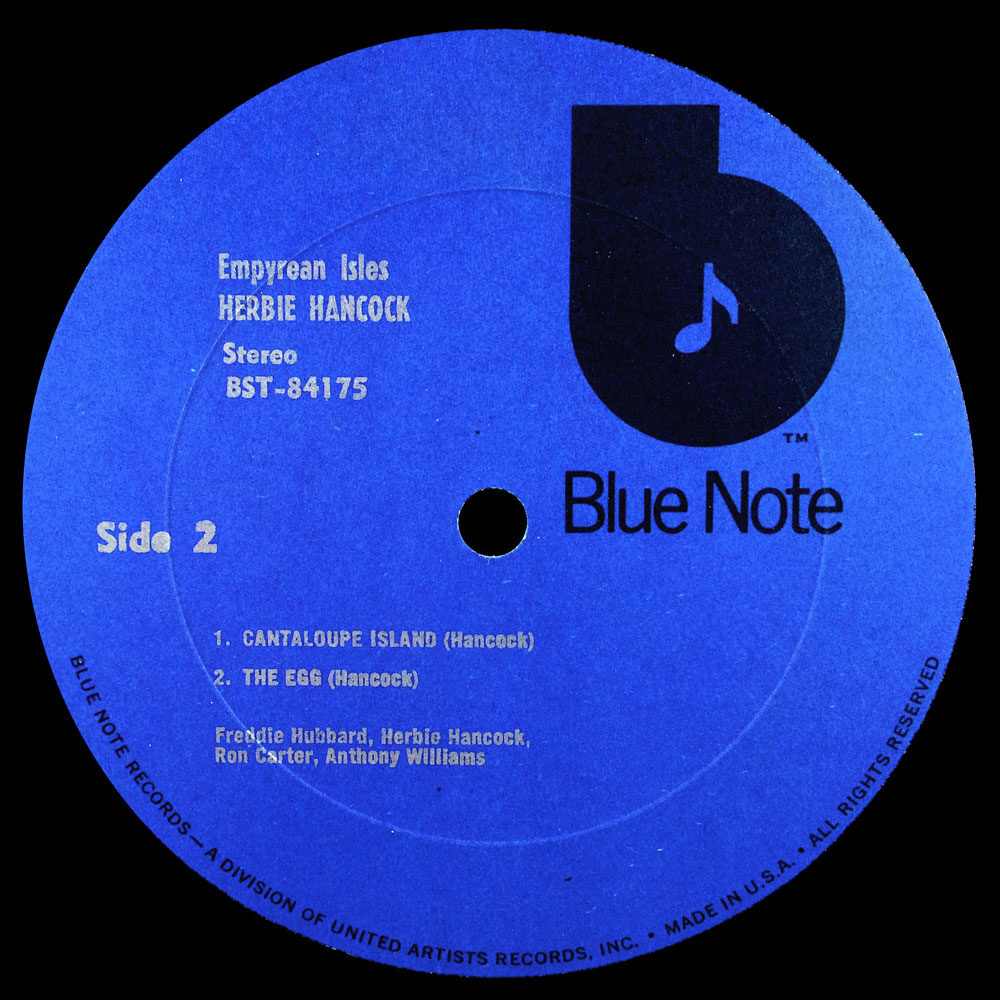
- United Artists stereo reissue circa 1972-1975
- “VAN GELDER” stamped in dead wax
Personnel:
- Freddie Hubbard, trumpet
- Herbie Hancock, piano
- Ron Carter, bass
- Tony Williams, drums
Recorded June 17, 1964 at Van Gelder Studio, Englewood Cliffs, New Jersey
Originally released November 1964
Selections:
“One Finger Snap” (Hancock)
“Oliloqui Valley” (Hancock)
This is one of my favorite Herbie Hancock albums. It has a soft, gentle vibe that I return to time and time again when I want to listen to something quiet. The quartet with trumpet seems like the perfect minimal arrangement for this album, and even though I’m not the biggest Freddie Hubbard fan, I find that he fits in with the rest of the group like a glove here. I love the cover too. Reid Miles had a way of making album art reflect the music contained within, and with this album, the simple, out-of-focus image of shimmering water cast in a teal blue tint complements the music extremely well…even the pronunciation of the title has a calming sort of effect (“Em-PEE-ree-in”).
Although the album’s closing track, “The Egg”, ventures out a bit too far for my taste, the other three compositions are all favorites. “Cantaloupe Island” sounds like part three in a trilogy of soulful, radio-friendly Hancock compositions that began with “Watermelon Man” and “Blind Man, Blind Man”, but side 1 consists of sixteen of my favorite minutes in music. Eighteen-year-old (Eighteen!) Tony Williams’ drumming is fiery, imaginative and expressive. His kit sounds incredible here as well, especially his ride cymbal. Engineer Rudy Van Gelder’s spacious Englewood Cliffs studio had a way of making drum kits sound colossal when they needed to, which can be heard during Williams’ solo on “One Finger Snap”. Who would have ever thought that Blue Note darling Freddie Hubbard would pair with the rhythm section of Miles Davis’ Second Great Quintet so well?