Tag Archives: Original Pressing

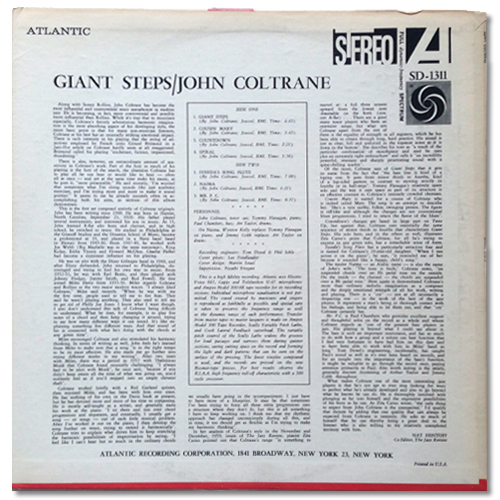
Vinyl Spotlight: John Coltrane, Giant Steps (Atlantic 1311) Mono vs. Stereo Edition

  • Fifth mono pressing circa 1966
  • Orange & purple label
  • Box logo side 1; black fan logo side 2
  • Side 1/2 matrix: 11637-A “AT” / 11638-A “AT”

VERSUS!
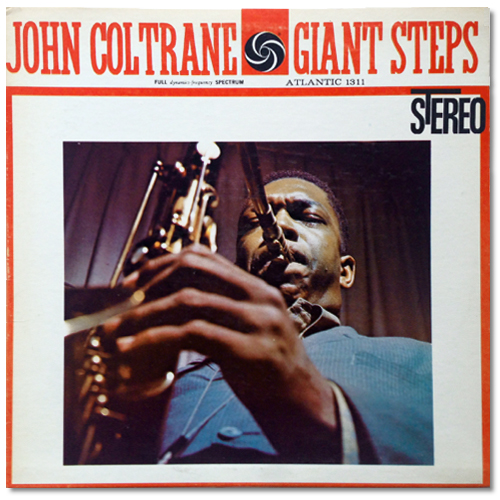
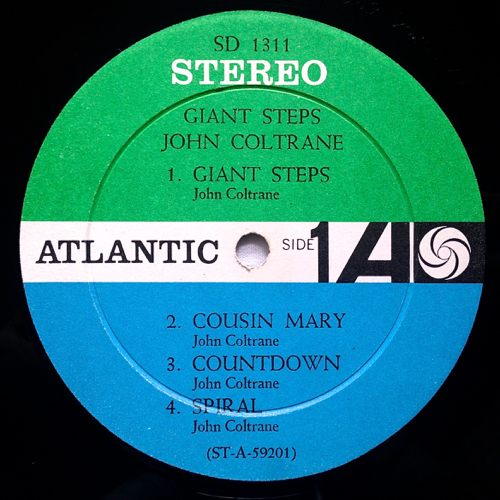
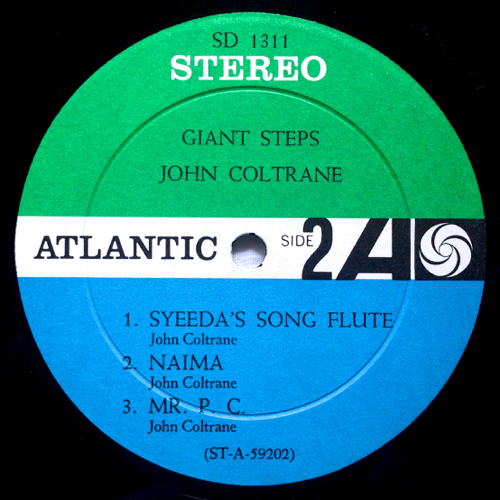
  • Second stereo pressing circa 1960-1962
  • Green & blue label
  • Deep groove on both sides
  • White fan logo on both sides
  • Side 1/2 matrix: AVCO ST-A-59201 / AVCO ST-A-59202

Personnel:

All but “Naima”:

  • John Coltrane, tenor saxophone
  • Tommy Flanagan, piano
  • Paul Chambers, bass
  • Art Taylor, drums

“Naima” only:

  • John Coltrane, tenor saxophone
  • Wynton Kelly, piano
  • Paul Chambers, bass
  • Jimmy Cobb, drums

All but “Naima” recorded May 4-5, 1959; “Naima” recorded December 2, 1959
All selections recorded at Atlantic Records’ 56th Street studio, NYC
Originally released January 1960

1 Giant Steps
2 Cousin Mary
3 Countdown
4 Spiral
5 Syeeda’s Song Flute
6 Naima
7 Mr. P.C.
Behold! Deep Groove Mono offers up its first ever head-to-head comparison. Here we take a listen to vintage mono and stereo pressings of the classic John Coltrane album Giant Steps. I had the mono LP first, but I liked the original stereo CD so much that when I saw this stereo LP for a great price I couldn’t pass it up.

Tom Dowd

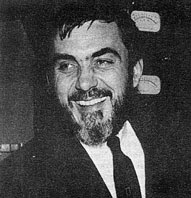
Giant Steps was recorded at Atlantic’s infamous 56th Street “office studio” under the supervision of legendary recording engineer Tom Dowd. According to the album’s liner notes, it was recorded to an Ampex 300-8R eight-track tape recorder, the results of which are two distinct i.e. ‘dedicated’ mixes, meaning the mono mix is not a ‘fold-down’.

The mono: Coltrane is front and center in this dark, bass-y mix. Trane and pianist Tommy Flanagan sit in good relationship to each other, though Paul Chambers’ bass doesn’t have a whole lot of definition, and Art Taylor’s drums get a bit buried behind Coltrane’s screaming presence.

The stereo: No instruments are presented center here, which for better or worse takes something away from Trane’s presence. (I doubt that Dowd was not yet privy to the theory of the ‘phantom center image’, and I can’t help but wonder why he was still not utilizing the center at this time.) Chambers’ bass still lacks good definition, though the spread gives Taylor more room to cut through. My first version of this album was the original 1990 stereo CD and I always appreciated how well I could hear the nuances in Taylor’s drumming in the stereo mix (I especially love the detail of the ride cymbal).

Head-to-head: On speakers, both mixes sound quite full, but in headphones the stereo version’s wide spread and its emphasis on the bass and treble leaves the mono feeling quite thin. However, Coltrane commands more presence in the mono mix, not only because he has been shifted from the far left to the center, but the mono also seems to favor the midrange, where the saxophone’s timbre is largely defined. This is probably why I feel that Coltrane sounds a bit muffled in the stereo mix when compared to the mono.

The verdict: Through speakers, both mixes sound great to me and I’d be happy to own either copy if I didn’t have a choice. But while I can only assume that most die-hard Coltrane fans will prefer the leader’s stronger presence in the mono mix, I personally love hearing all the nuances of Taylor’s kit in the stereo mix through headphones, which is probably why this is my favorite listening experience overall.

To play us out, I have included “Naima” as an added bonus because it is simply one of my favorite ballads of all-time. I chose the mono version because I find that the tune’s sparse composition works better without all the ‘empty space’ inherent in the stereo mix.

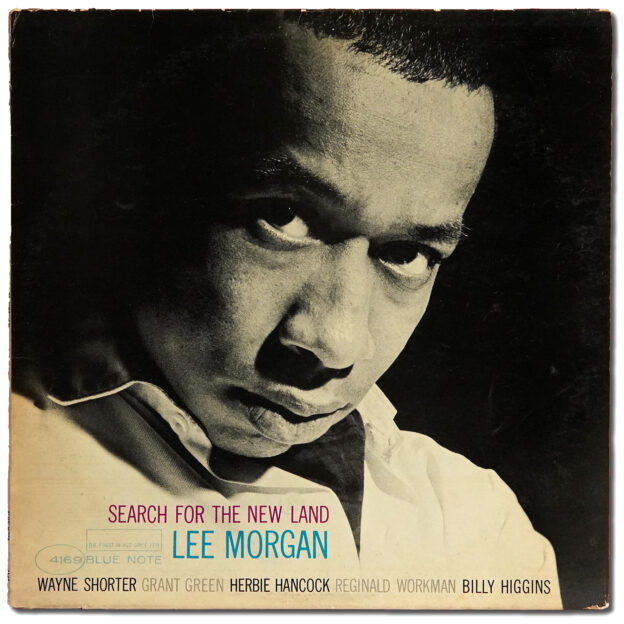
Vinyl Spotlight: Lee Morgan, Search for the New Land (Blue Note 4169) “Earless NY” Mono Pressing

  • Second mono pressing circa 1966
  • “NEW YORK USA” on both labels
  • “VAN GELDER” stamped in dead wax
  • “43 West 61st St., New York 23” address on jacket

Personnel:

  • Lee Morgan, trumpet
  • Wayne Shorter, tenor saxophone
  • Grant Green, guitar
  • Herbie Hancock, piano
  • Reggie Workman, bass
  • Billy Higgins, drums

Recorded February 15, 1964 at Van Gelder Studio, Englewood Cliffs, New Jersey
Originally released August 1966

1 Search for the New Land
2 The Joker
3 Mr. Kenyatta
4 Melancholee
5 Morgan the Pirate

For Collectors

This record is especially hard to find with the Plastylite “P”, though it does exist. I have had good experiences with Liberty pressings though, so I’m not hung up on finding an original pressing of this album. The first copy I had, also a Liberty pressing, was cheap but it had a few loud pops and clicks, which prompted me to seek out this replacement, which I think was fairly graded VG+.

For Music Lovers

It’s difficult to discuss a Lee Morgan album without considering where and how it fits into the dramatic and tragic story of his life. At the age of 20, Morgan first recorded as a member of Art Blakey’s Jazz Messengers in October 1958 for the classic album Moanin’. His residency with Blakey would continue until the summer of 1961 when Morgan and fellow Philadelphian Bobby Timmons made the decision to retreat to their hometown for relief from the heroin-infested New York jazz scene. Morgan would only step in the studio once over the course of the next two years for producer Orrin Keepnews (Take Twelve, Jazzland 980), but would eventually make his official return to the New York recording scene in the fall of 1963 for a date with Hank Mobley (No Room for Squares, Blue Note 4149). After taking an uncharacteristic date with the progressive Grachan Moncur III the following month (Evolution, Blue Note 4153), Morgan recorded The Sidewinder in December 1963. The smash hit wouldn’t be released until the following summer, however. In the meantime, Morgan entered the studio again in February 1964 to record Search for the New Land, which would ultimately be shelved until 1966 – perhaps as a result of the tremendous commercial success of Sidewinder.

While Morgan and Shorter had been bandmates in The Jazz Messengers for years before Morgan’s hiatus, this would be the first of only a handful of occasions where the trumpeter would record with Herbie Hancock. (I was surprised to learn that this was only the second time that Shorter and Hancock had recorded together.) Billy Higgins returned from the Sidewinder date – which would prove to be the start of a lengthy partnership between he and Morgan – while Grant Green and Reggie Workman rounded out the sextet.

For all the Blue Note sessions Lee Morgan had led since he began recording for the label in 1956, this would only be the second where the entire program was penned by Morgan himself (The Sidewinder being the first). As such, Search for the New Land is a beautiful contemplation of the then looming and uncertain future of jazz. It is not a desperate exodus out of bop; it can be better likened to a child on the ocean’s shoreline standing knee-deep in the waves, hesitant to submerge themself in the water. Search thus pushes the boundaries of hard bop just enough to keep within the sub-genres inherent structure.

The album is consistent and cohesive. The dreamy, somber choruses of the title track are flanked by improvisational sections fashioning a minimal harmonic structure that compliments the modal leanings of Hancock and Shorter (this session would predict their uniting with Miles Davis as members of his “second great quintet” later that year). Hancock especially shines on the take with a crisp solo exemplifying his clear and acute thinking at the piano. “Mr. Kenyatta” bounces between moods in much the same way as the title track, swaying back and forth between feelings of angst and playfulness. And while The Penguin Guide to Jazz Recordings refers to the closing pair of songs as “more than makeweights” but “more off-the-peg” in comparison to the rest of the material, this ironically is my favorite sequence of the album. “Melancholee” is a gorgeously despondent composition that gives us a hard, honest look at the inner workings of Morgan, and the uplifting melody of “Morgan the Pirate” follows closely behind to conclude the album with an air of optimism.

One can’t help but wonder if the aforementioned session with Moncur had a profound impact on Morgan. Perhaps his experimentation at this time was actually a rebellion against the avant-garde manifesto, an attempt to push the boundaries of the institution of bop without succumbing to the full-blown chaos of free jazz. Either way, Search for the New Land is an expressive journey to the edges of an idiom, and it stands as an important work created at a pivotal crossroad in the evolution of the jazz art form.

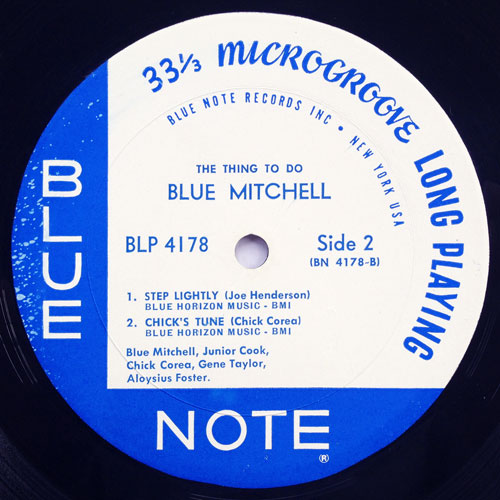
Vinyl Spotlight: Blue Mitchell, The Thing to Do (Blue Note 4178) Original Mono Pressing

  • Original 1965 mono pressing
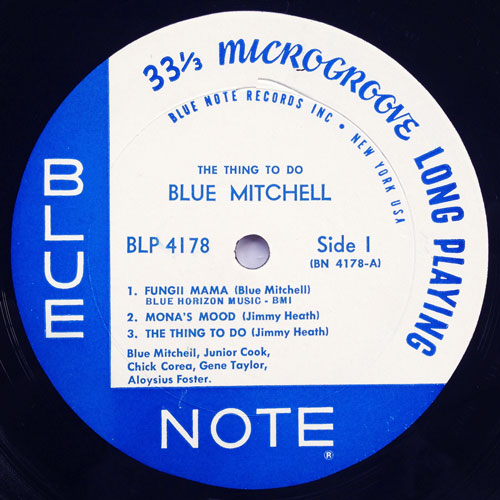
  • “NEW YORK USA” on both labels
  • Plastylite “P” etched and “VAN GELDER” stamped in dead wax
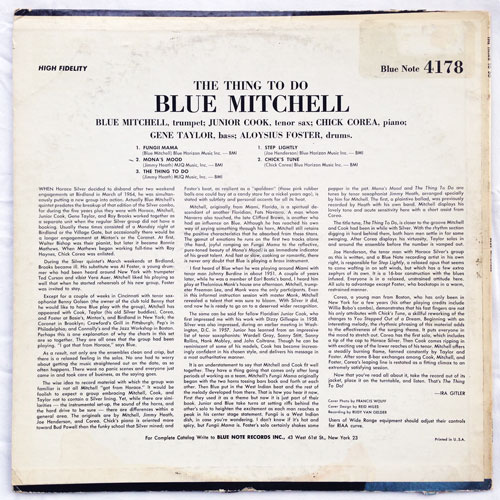
  • “43 West 61st St., New York 23” address on jacket

Personnel:

  • Blue Mitchell, trumpet
  • Junior Cook, tenor sax
  • Chick Corea, piano
  • Gene Taylor, bass
  • Al Foster, drums

Recorded July 30, 1964 at Van Gelder Studio, Englewood Cliffs, New Jersey
Originally released May 1965

For Collectors

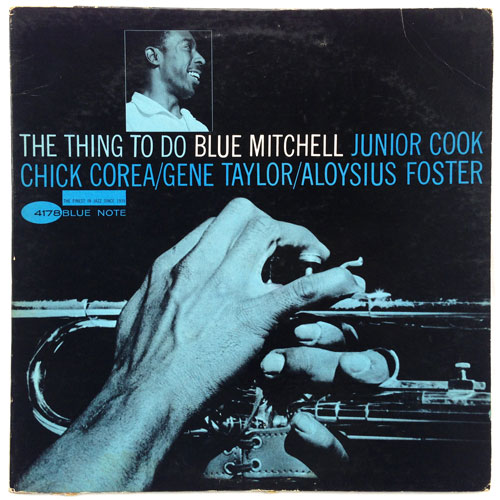
If you’ve read my first “Perspective” article here on Deep Groove Mono, you already know the story of how I acquired this record, which is special to me because it was the first vintage Blue Note album I ever heard that truly embodied the legendary “Blue Note sound”. And how about that cover? The symmetry, the cool blue on the dead black background, and the detailed shot of Blue’s hands on his trumpet make for a winning combination in my book.

For Music Lovers

I’m a huge Horace Silver fan, and I have always enjoyed the work of Blue Mitchell and tenor saxophonist Junior Cook as members of the Horace Silver Quintet. Mitchell had been working with Silver for four solid years the first time he entered the studio as a leader for Blue Note in August 1963 for a session including Joe Henderson and Herbie Hancock (for some reason, the recordings were shelved for nearly two decades). Two months later in the fall of ’63 though, Blue, Junior, and Quintet bassist Gene Taylor would have their last hurrah recording with Silver on a date producing two takes which would eventually find their way to Song for My Father. I haven’t read anything regarding the musicians’ parting of ways, but one can only guess it was peaceful, especially in light of the fact that Blue had jammed with Henderson, Cook’s replacement, before Silver.

Nine months later in the summer of 1964, Blue, 34 at the time, got Cook and Taylor together with a couple bright and budding musicians who would go on later to obtain global exposure with Miles Davis. 23-year-old Chick Corea had only recorded a handful of times when he arrived at Englewood Cliffs that day, and the 21-year-old Al Foster had yet to even set foot in a recording studio. But the pair rose to the challenge of this big-league outing with grace and poise, and their youthful energy ultimately steal the show on The Thing to Do.

If you think the head of the album opener, “Fungii Mama”, sounds zany or perhaps even corny, don’t let it deter you so quickly. Cook leads off with an inspiring solo, and Blue provides a fun improvisation of his own songwriting work. Corea eventually delivers a solo that is both fun and ambitious, and Foster follows with a challenging juxtaposition of the downbeat that causes the head to make a startling and exciting return. It’s a real treat to hear the young drummer’s rock-solid, driving latin rhythm throughout, and the tension created by each return to the bridge is a most welcome harmonic excursion.

My personal pick though is “Step Lightly”. The song was first recorded on the aforementioned 1963 date with Henderson and Hancock, but the overall vibe remains the same here. This track never really stood out to me until I recently heard it on a cloudy weekday afternoon off from work. The lazy tempo and bluesy melody complemented the mood so perfectly I instantly felt like I understood Henderson’s intentions as the song’s composer.

Sonically, this album is an example of Rudy Van Gelder at his best. The recording giant got a very nice piano sound here, and the natural reverberation of the Englewood Cliffs studio sounds heavenly, especially during Foster’s solo on “Fungii”. For those who don’t know, I’m a drum guy, and as such I recommend paying close attention to how tight and well-tuned Foster’s tom-toms sound here. (That’s one thing I love about classic jazz: the drum kits were made with care, the drummers took their craft seriously enough to tune their kits regularly, and you can hear the difference!)

Overall, I think the songwriting on this album is solid (Jimmy Heath’s title track included), and it gives us a rare glimpse of the vigorous, hungry duo of Corea and Foster on a straight-ahead bop date preceding their respective moves into free jazz and fusion. I personally need to be in the right mood to enjoy a record like The Thing to Do with its don’t-take-yourself-too-seriously-type attitude. But when I’m in that mood, these sides are as good as any.

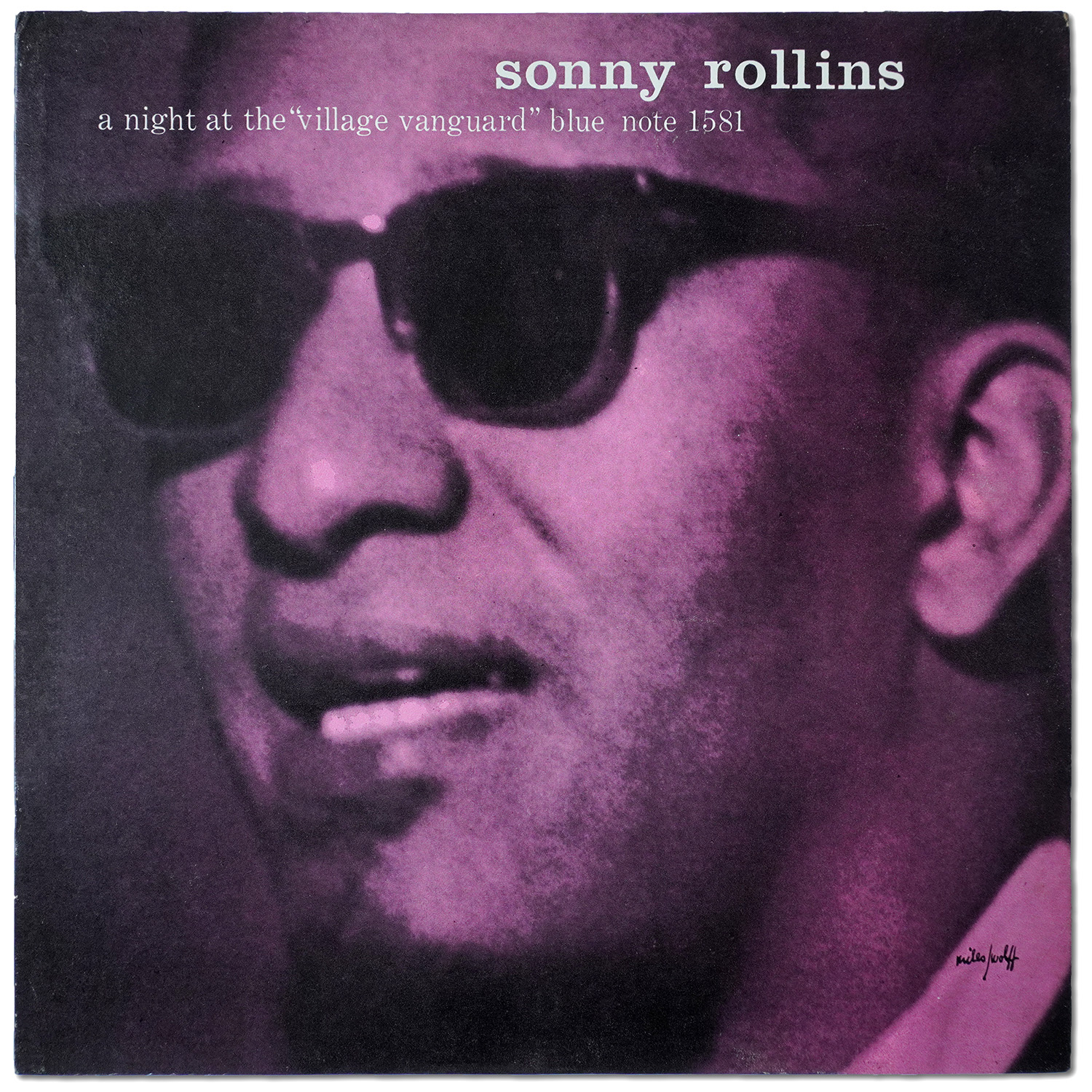
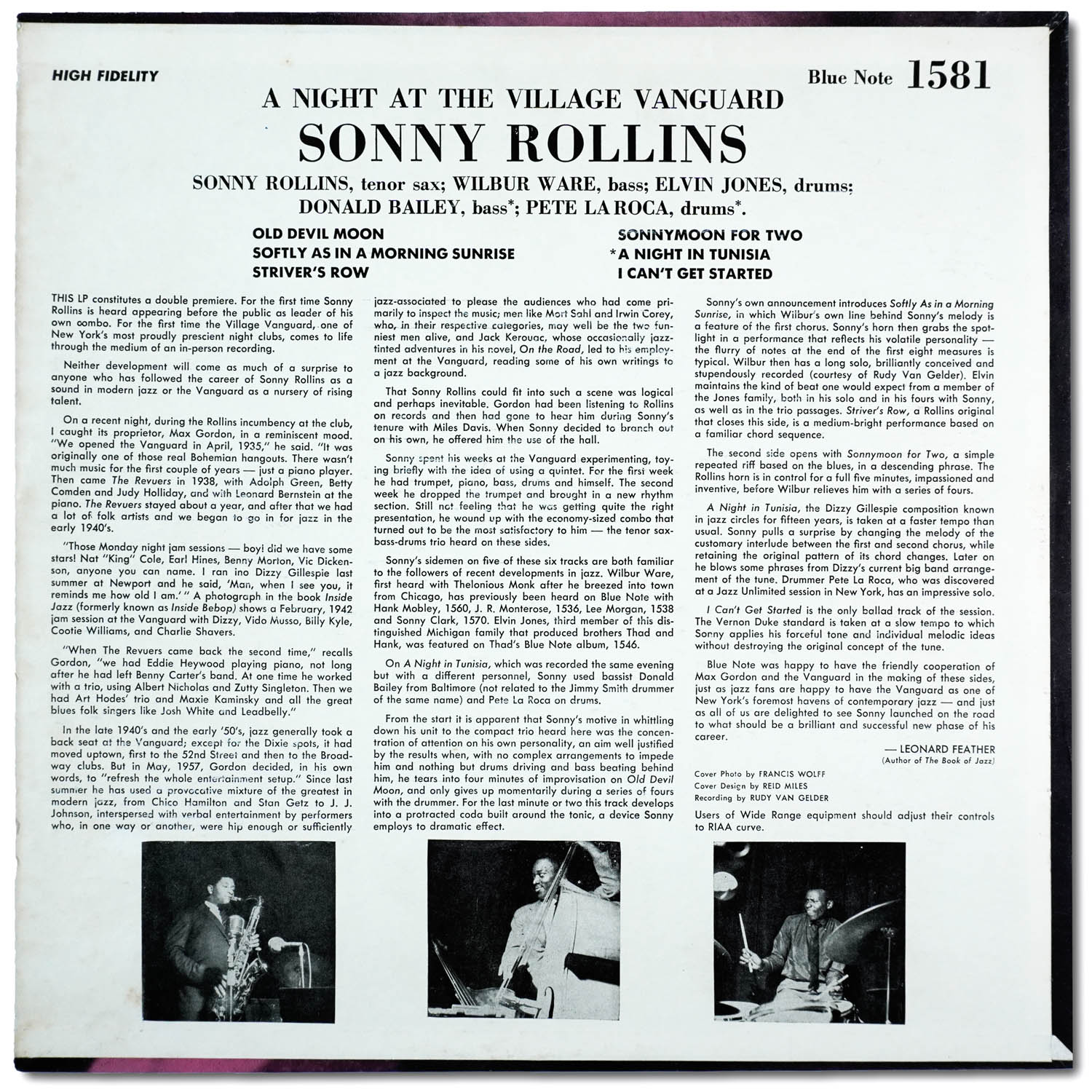
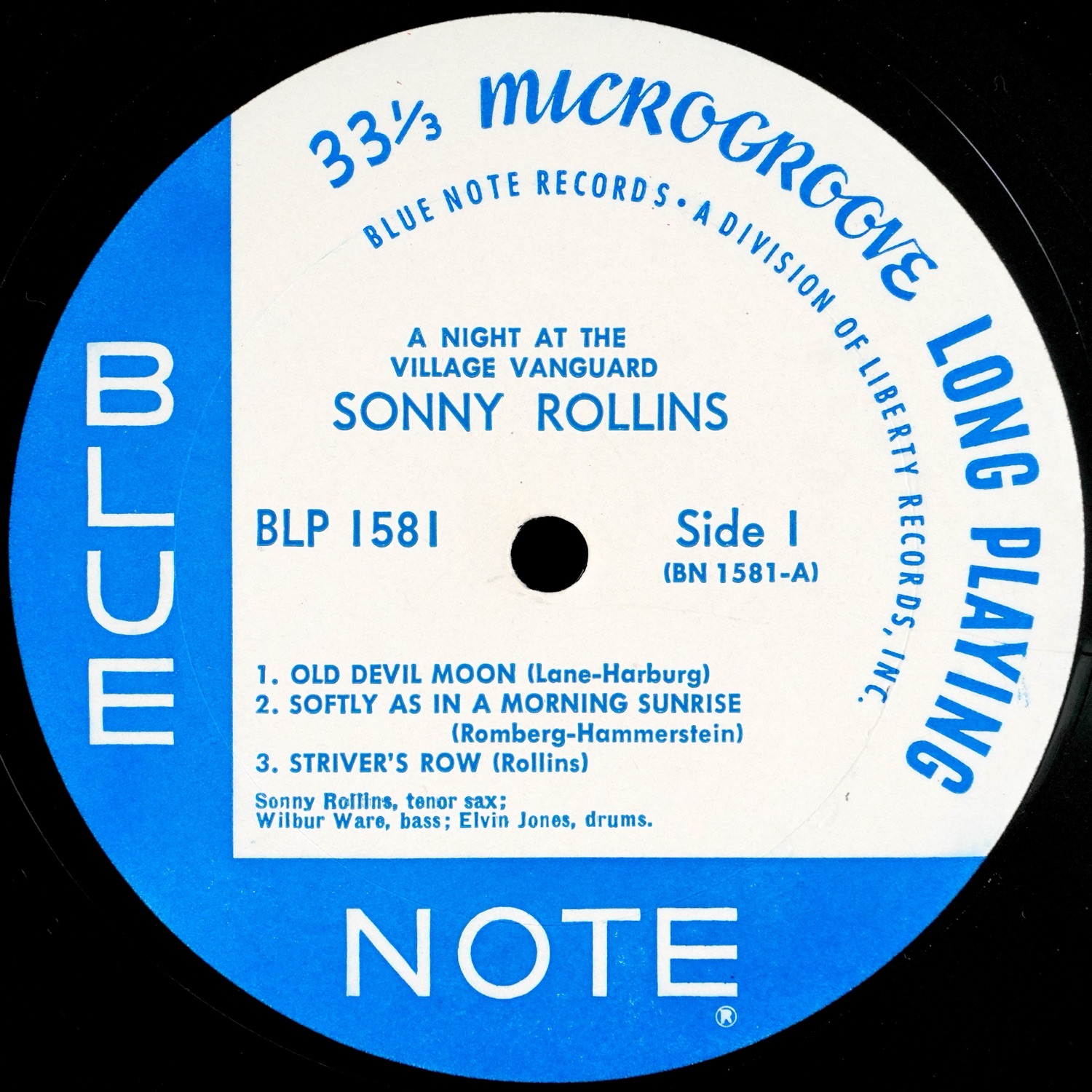
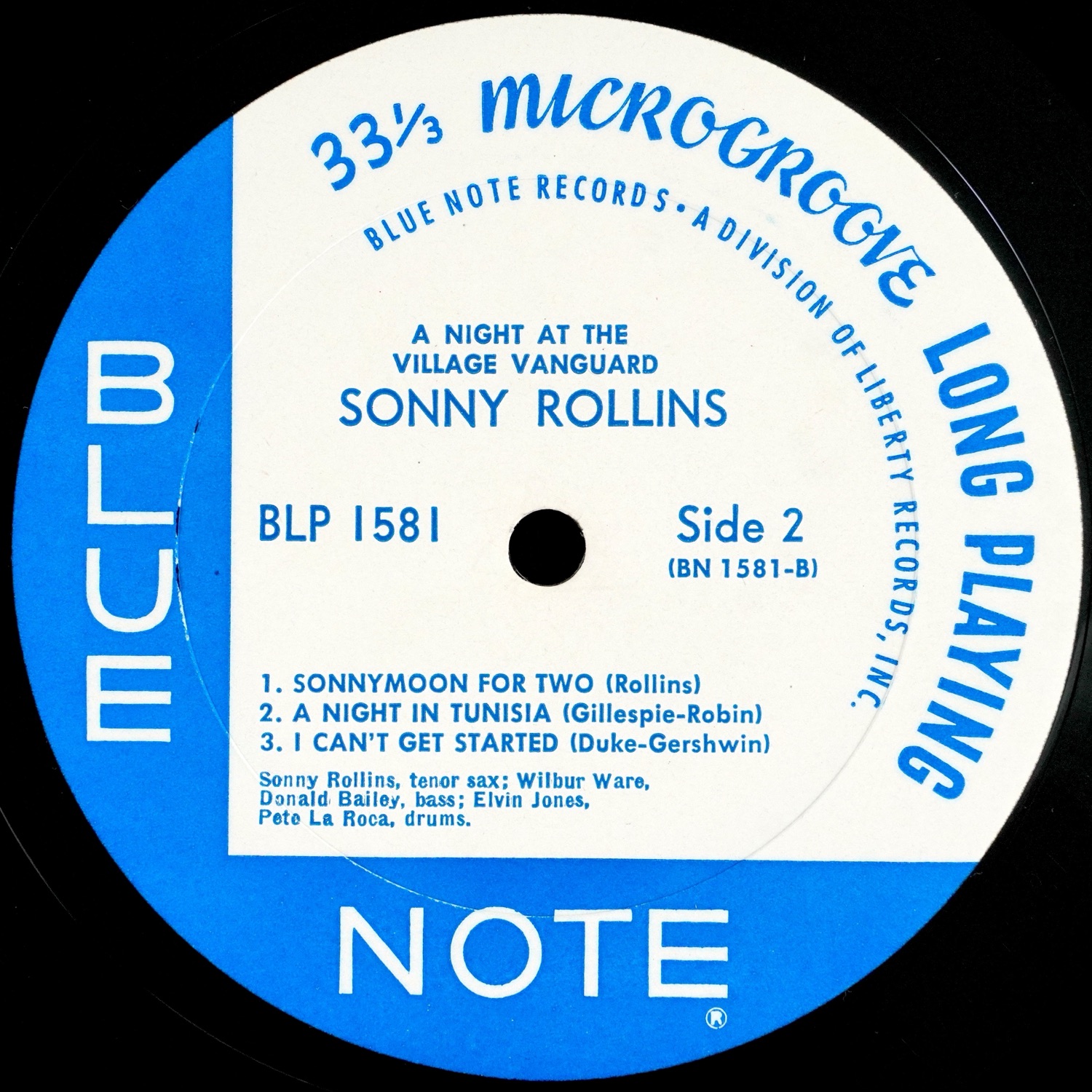
Vinyl Spotlight: Sonny Rollins, A Night at the Village Vanguard (Blue Note 1581) Liberty Mono Pressing

  • Liberty pressing ca. 1966-70 (mono)
  • “RVG” stamped in dead wax

Personnel:

All but “A Night in Tunisia”:

  • Sonny Rollins, tenor saxophone
  • Wilbur Ware, bass
  • Elvin Jones, drums

“A Night in Tunisia” only:

  • Sonny Rollins, tenor saxophone
  • Donald Bailey, bass
  • Pete La Roca, drums

Recorded live at The Village Vanguard, New York City, November 3, 1957
Originally released December 1957

1 Old Devil Moon
2 Softly, as in a Morning Sunrise
3 Striver’s Row
4 Sonnymoon for Two
5 A Night in Tunisia
6 I Can’t Get Started
Thelonious Monk once said that he thought of his studio albums as advertisements for his live performances. John Coltrane expressed a similar sentiment during a radio interview in Japan when he said, “Some of (my best music) hasn’t been recorded. Recordings always make you, just a little bit, tighten up.” Though we all know that the recording sessions responsible for our favorite classic jazz albums captured phenomenal studio performances, it makes sense to me that a live performance might — according to the artist — guarantee a slightly greater degree of authenticity.

Perhaps Monk and Trane are offering some insight into why an album like A Night at the Village Vanguard sounds so real and so raw. Rollins was a music rebel: I like to think of him as the most “punk rock” of all the bop greats (he even sported a mohawk over a decade before the inception of punk). He was also an insatiable innovator, so much that he went on a three-year hiatus from public and studio appearances because he was dissatisfied with his own progress as an artist. By 1957, it was apparent that Rollins felt confined to the underlying harmonic structure naturally imposed on him by piano accompaniment. His solution as a leader? Get rid of the piano player. Rollins recorded his first entire LP without keys in March of that year (Way Out West, Contemporary 3530), and on this November Vanguard date he decided to expand on the idea with two different rhythm duos during the afternoon and evening sets, respectively.

“Softly As in a Morning Sunrise” is a standout tune not only for the refreshingly humble solos from all three members of the evening trio (Rollins, Wilbur Ware, and Elvin Jones), but also for its sonic brilliance. I love how immediate and direct Rollins’ horn sounds (partly due to the lack of piano), and things are quiet enough during the bass and drum solos (audience included) for us to hear each and every nuance. I’ve always had a thing for drums, and Jones’ kit is astonishingly tight, tuned, and clear here — especially the bass drum. The only shortcoming is that the overhead miking of the drums tends to overload from time to time, resulting in the occasional distorted cymbal crash.

The complete survived takes from this session were first issued in 1999 on double-CD. Numbering triple the amount of songs here, this can be a daunting listen. I was first exposed to A Night at the Village Vanguard through the reissue, and as a record collector who has always approached music with a “less is more” mentality, I just focused on the original track listing anyway — which in all likelihood was carefully curated by Blue Note founder Alfred Lion. Someday I will probably get to a point where I feel familiar enough with this LP to move on to the rest of the reissue. But until then, I like that the record’s concise program naturally encourages me to focus more on the details of a smaller amount of material.