Tag Archives: miles davis

Origins of Bop: Charlie Parker / Miles Davis, “Ah-Leu-Cha”

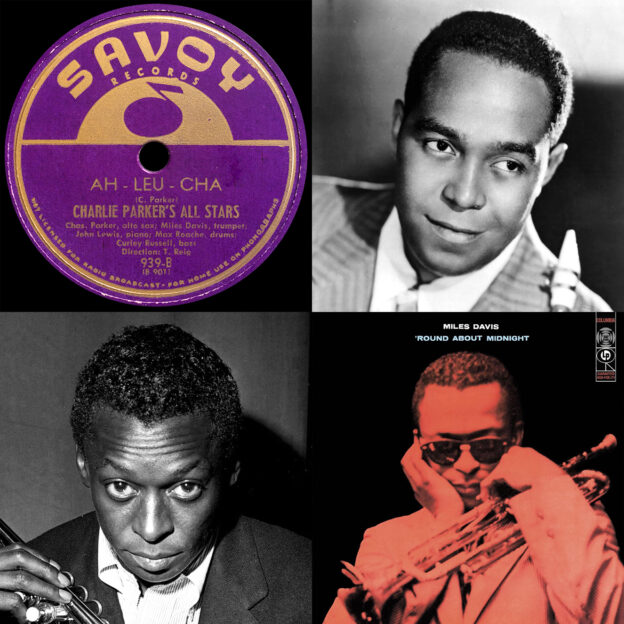
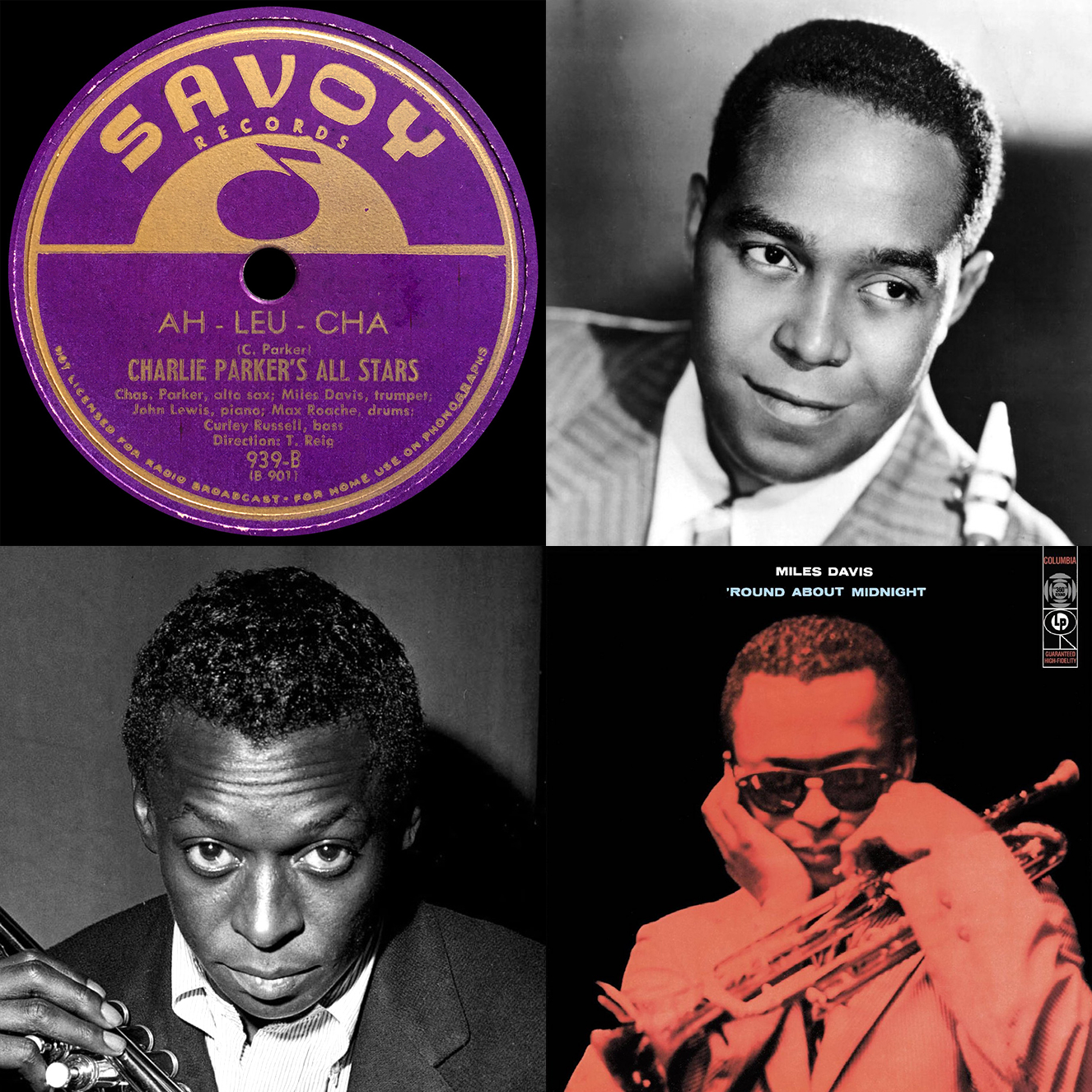
Charlie Parker, “Ah-Leu-Cha” (Original 78)

Savoy Records Cat. No. 939 (Side B) | 1948

Personnel:

  • Miles Davis, trumpet
  • Charlie Parker, alto saxophone
  • John Lewis, piano
  • Curley Russell, bass
  • Max Roach, drums

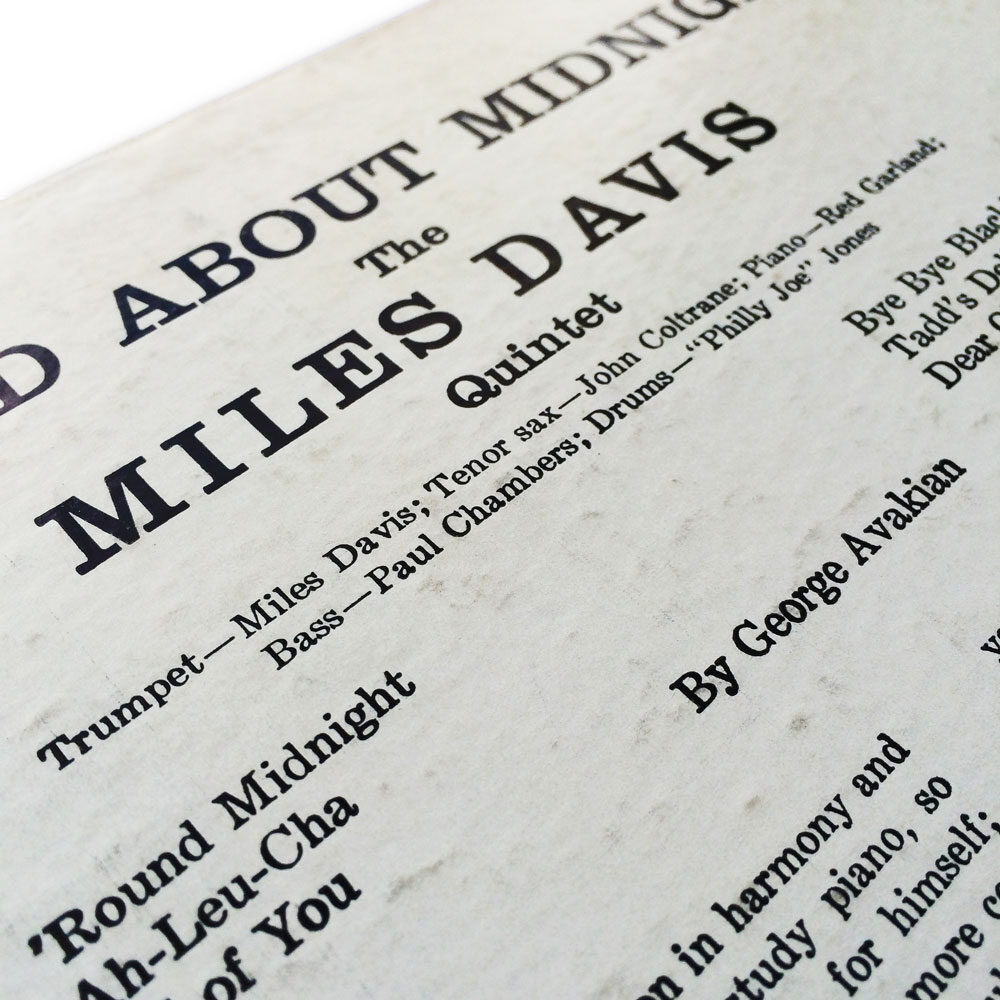
Miles Davis, “Ah-Leu-Cha” (Original LP)

Columbia Records Cat. No. 949 | 1955

Personnel:

  • Miles Davis, trumpet
  • John Coltrane, tenor saxophone
  • Red Garland, piano
  • Paul Chambers, bass
  • Philly Joe Jones, drums
Welcome to Origins of Bop, a new Deep Groove Mono series aiming to explore the lineage of some of my favorite hard bop recordings. I have always been interested in music history, and with jazz, that has meant finding out more about where my favorite compositions came from. This series is therefore intended to provide some backstory for many of the hard bop performances that we as collectors of twelve-inch vinyl LPs have come to love so much. Quite often, these songs date back to the 78-R.P.M. era of shellac disks, and in many cases I will be happy to feature 78s from my own collection.

This first installment features a tune composed by one of the founding fathers of bebop. I was introduced to Charlie Parker’s “Ah-Leu-Cha” back in 2001 through the first jazz LP I ever bought: Miles & Monk at Newport. One rainy afternoon in Albany, New York I had a break between my college classes, so I decided to hop in my car and venture downtown to Last Vestige, a local record shop. With a musical background largely focused on hip hop and rock at the time, my experience with jazz was limited. All I had was a cassette tape from a friend with Kind of Blue on one side and My Favorite Things on the other. But as a DJ, I had been seeing lots of cool covers for jazz albums popping up on the Turntable Lab website, and I had recently gotten interested in Madlib’s new electronic jazz project, Yesterday’s New Quintet. I was also DJing with an R&B cover band, and I befriended the group’s saxophonist, who was a locally-renowned jazz musician and composer.
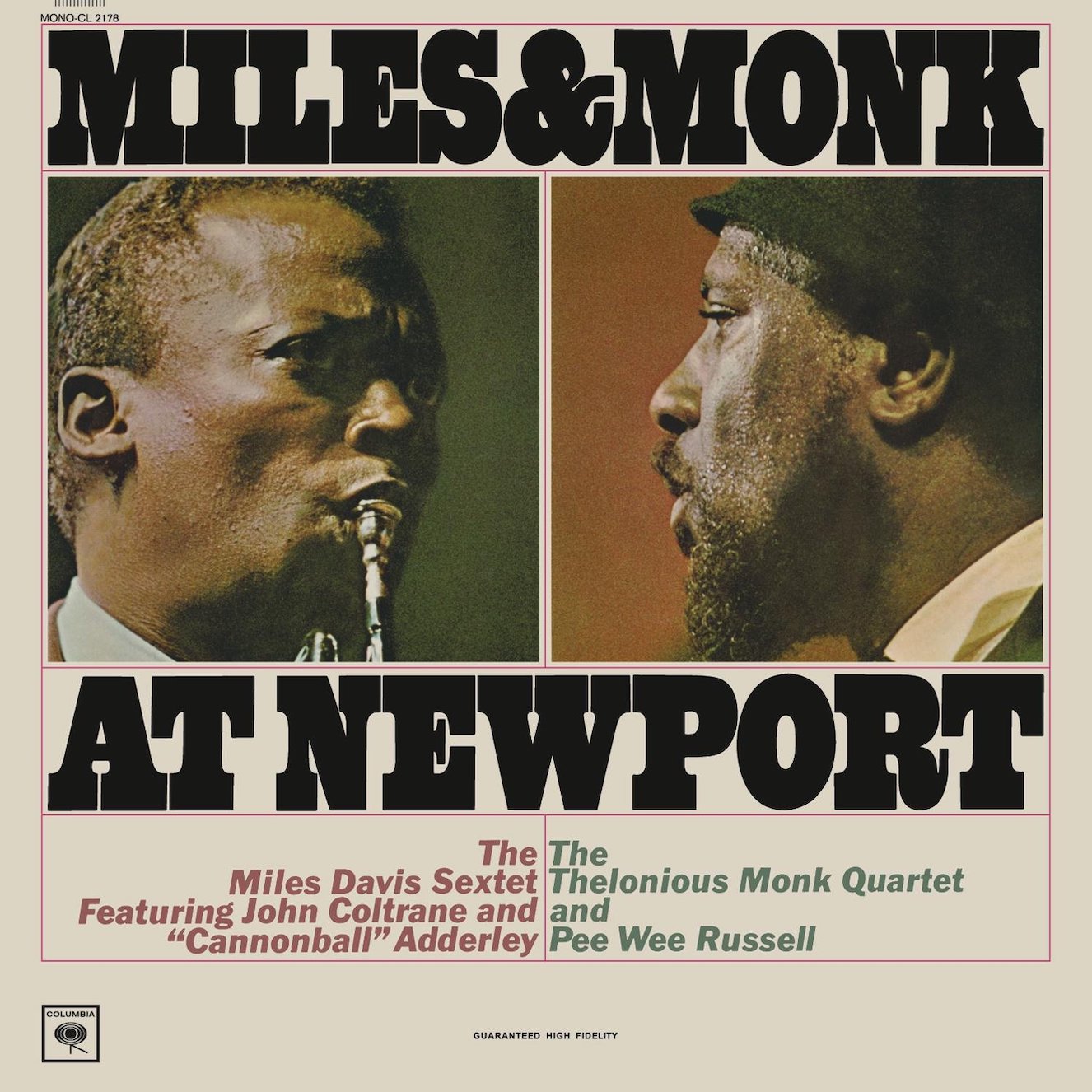
My first-ever jazz vinyl purchase

This all had an influence on me when I decided to check out the jazz section of that shop for the first time. The copy of Miles & Monk I found was a stereo ‘70s reissue, it costed six dollars, and I pretty much bought it solely on the strength that I had heard of both leaders before. Side 1 was the Miles side. “Ah-Leu-Cha” was the first track, and it wasted no time ripping my face off. Miles liked to play fast live, and this Newport Festival reading was taken at a blistering pace, nearly twice as fast as Parker’s original 1948 recording, which by no coincidence also featured Davis. If I’m being honest, I remember wondering if I would even like jazz if this was what most jazz sounded like! Today I love that recording for its tenacity, high fidelity, and airtight performances. But back then, knowing nothing about jazz and being quite unfamiliar with such high levels of musicianship, I felt utterly confused.

Many years later when I discovered Davis’ classic ‘Round About Midnight, I was pleasantly surprised to find a slower, more accessible version of “Ah-Leu-Cha”. It was recorded three years before the Newport date in 1955 and features Miles’ First Great Quintet. Philly Joe Jones sounds snappy, his patented loose-wrist cymbal work creating an inimitable groove for each soloist to work with. The exceptional fidelity of this recording needs to be noted as well.
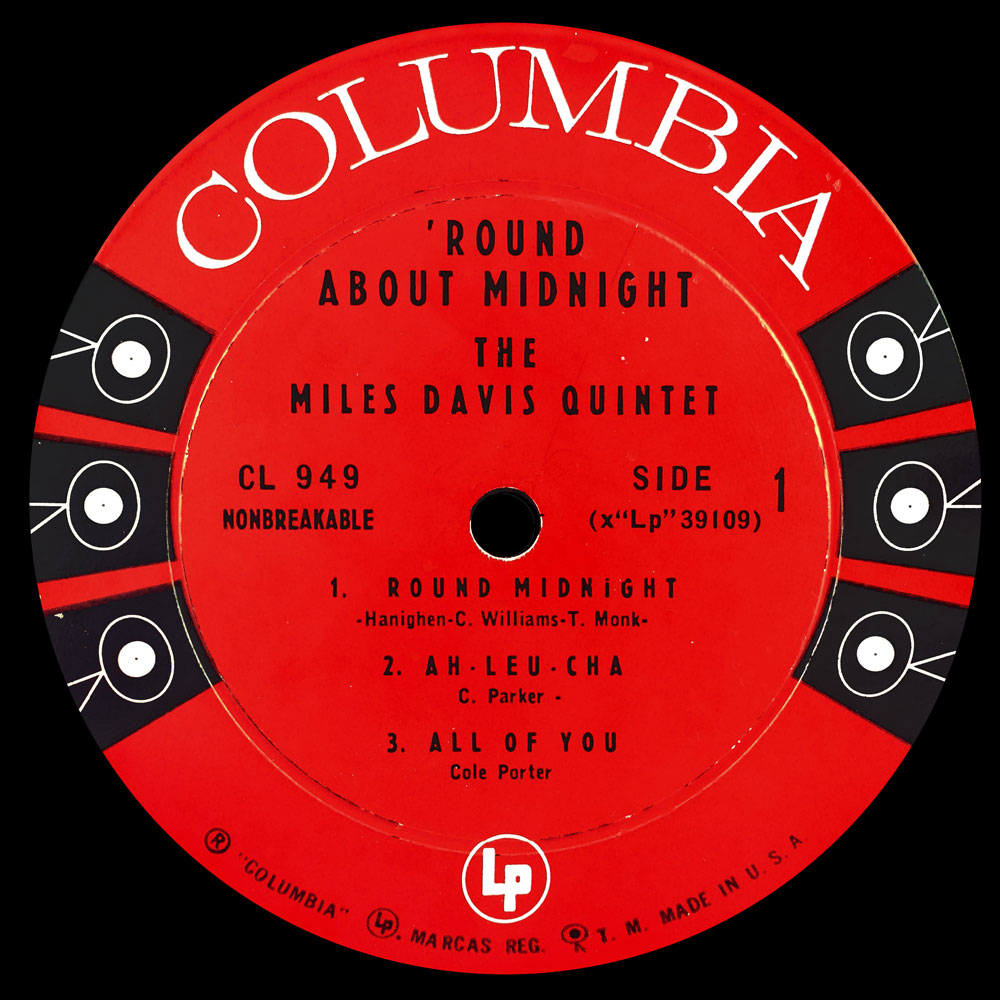
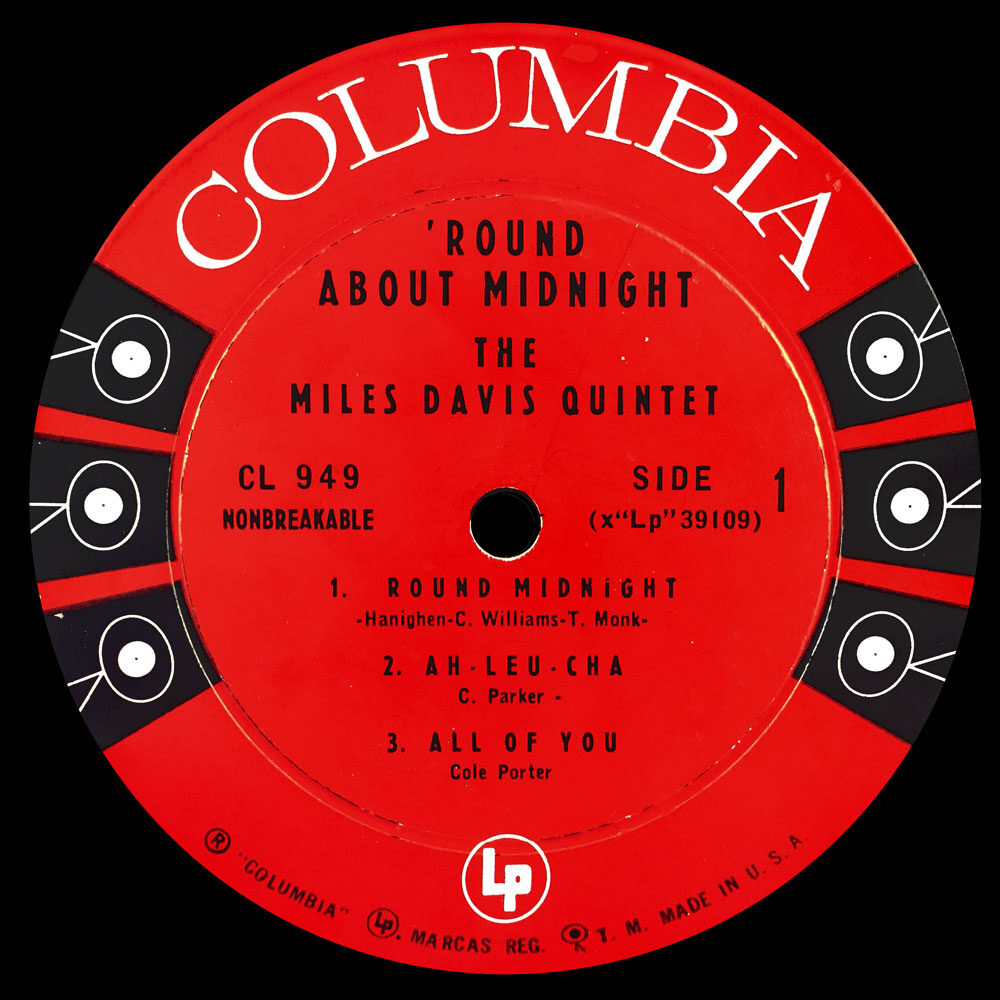
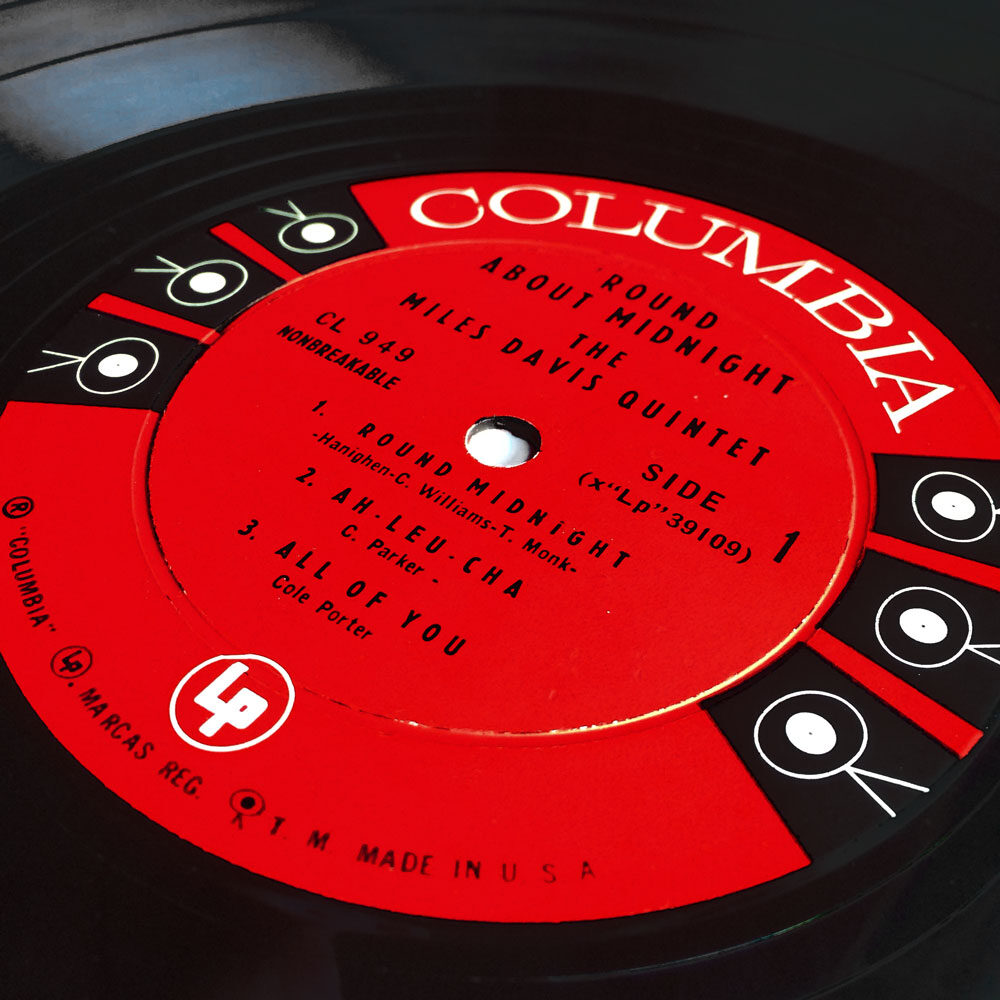
Side 1 label for CL 949

Prior to reviewing ‘Round About Midnight for my blog several years ago, I had never noticed Parker as the composer of “Ah-Leu-Cha”, and when I listened to Bird’s version for the first time I was caught off-guard by its syrupy tempo. Recorded for Savoy Records at Apex Studios in New York City (mentioned last week in a blog post here), engineer Harry Smith set the rhythm section back a ways behind a very present front line. This was a standard mixing aesthetic in the 1940s, and it makes jazz recordings from that period unmistakably of-the-era. Max Roach could tear it up like no one else in 1948, but he’s much tamer here. Peppering the backbeat with gentle fills throughout, the drummer manages to quickly trade two half-bar solos with bassist Curley Russell before the track’s closing. As a composition, the counterpoint of Bird and Miles creates exciting harmonic motion that makes my ears smile every time I hear it.
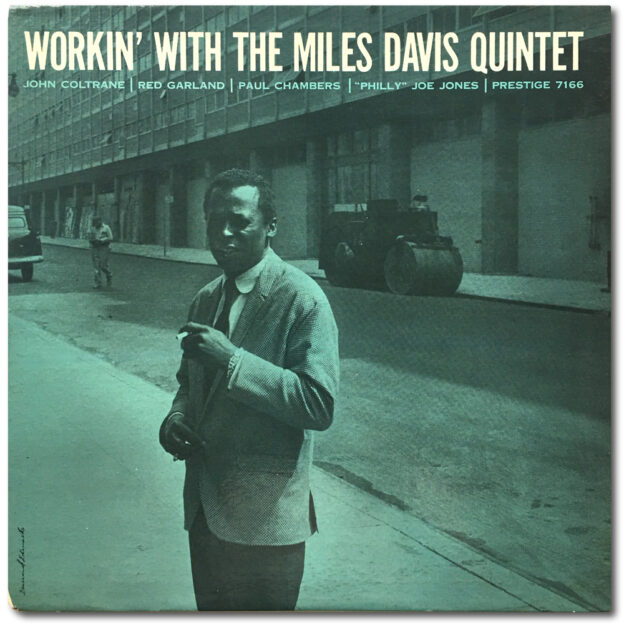
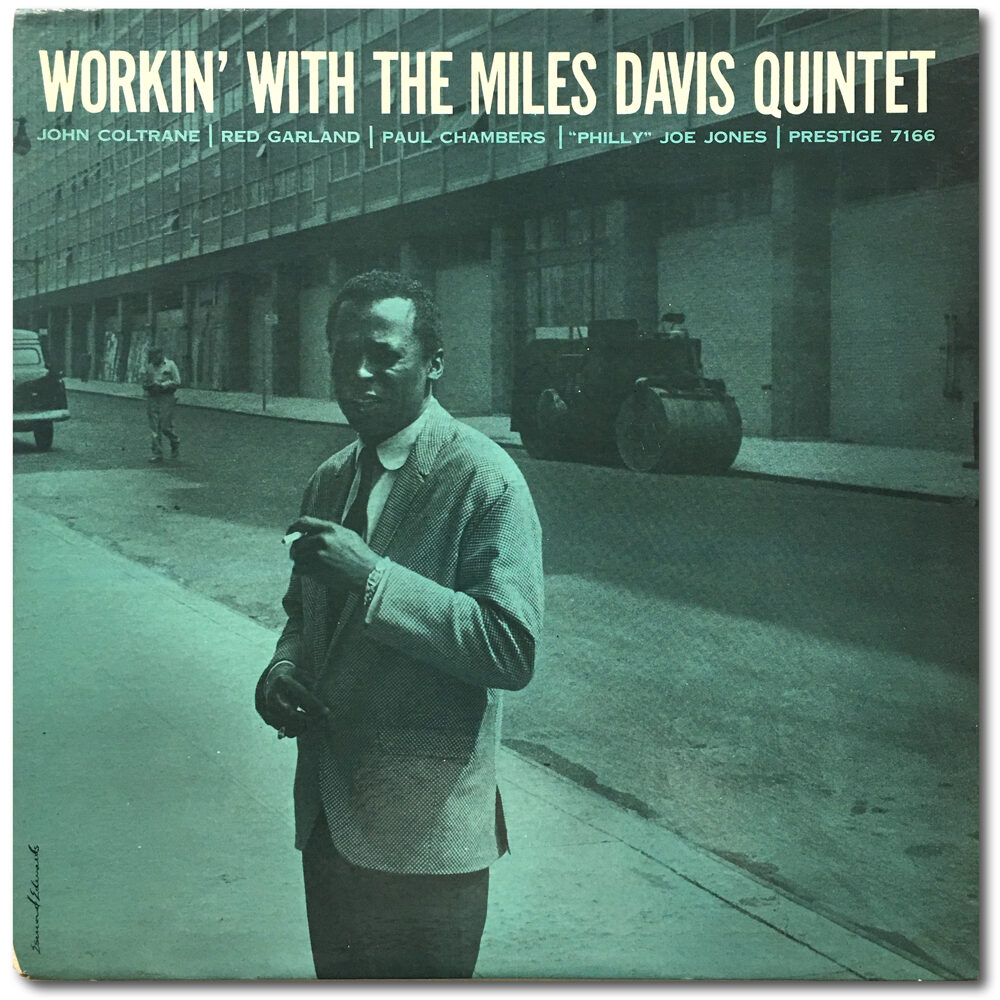
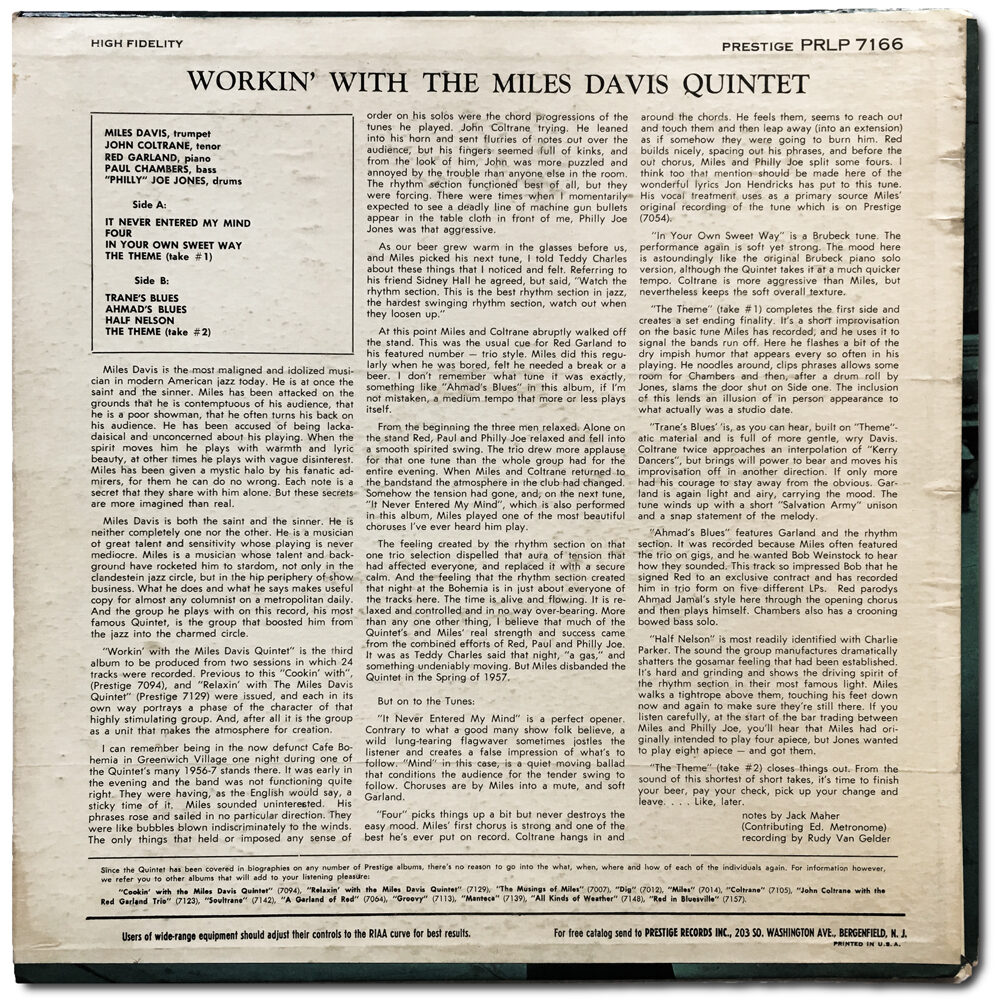
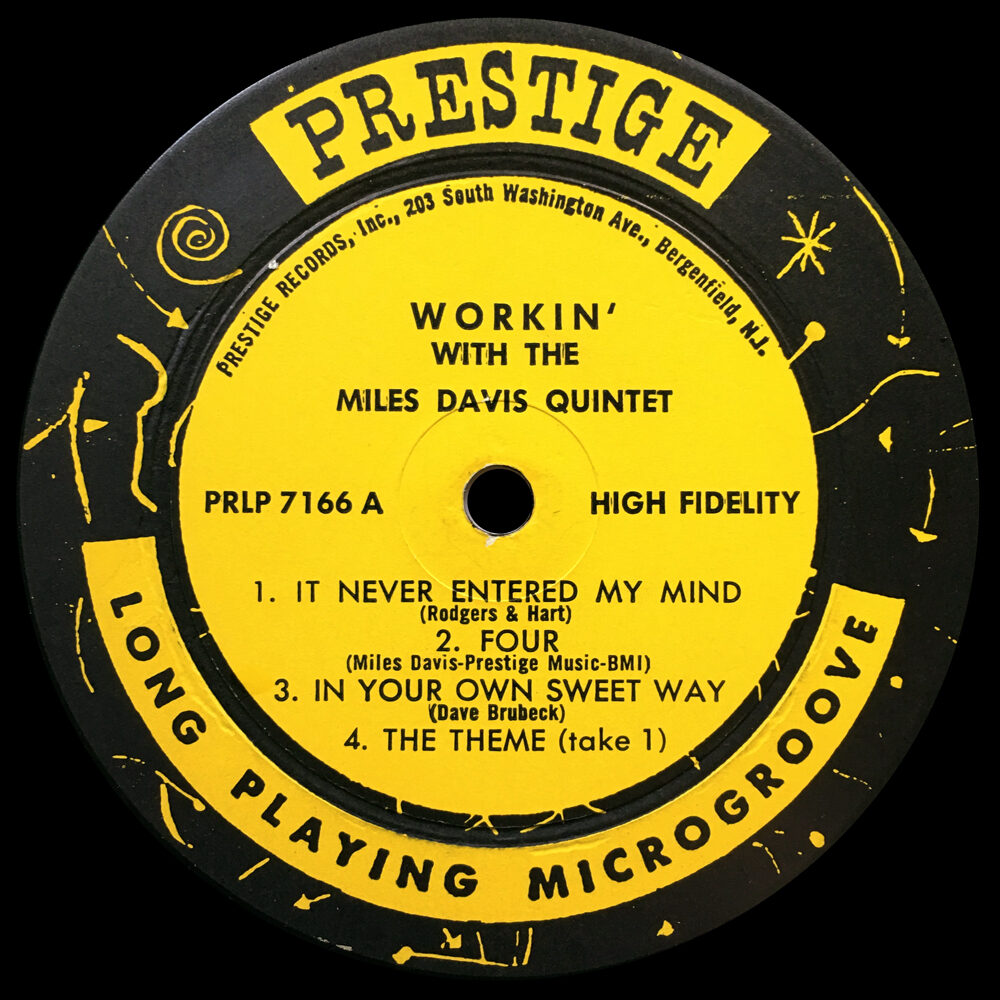
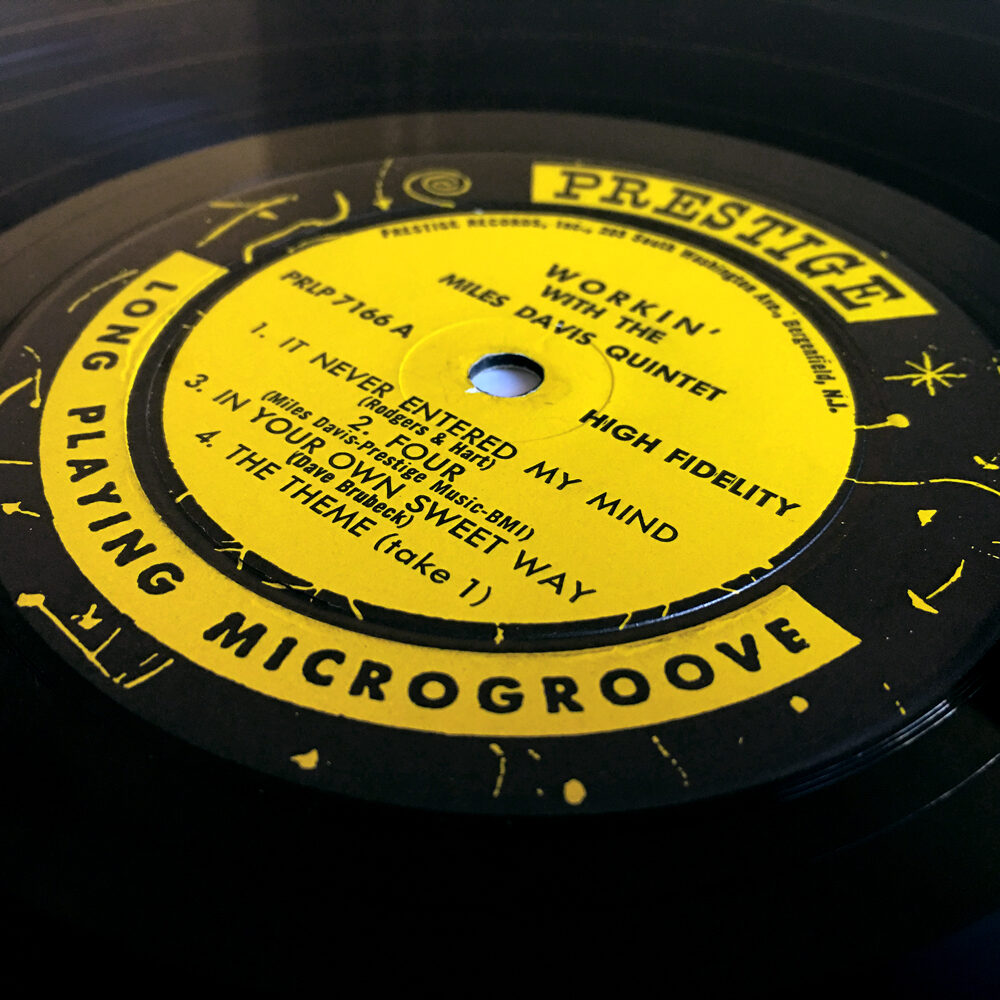
Vinyl Spotlight: Workin’ with the Miles Davis Quintet (Prestige 7166) Original Pressing

  • Original 1959 pressing
  • “Bergenfield, N.J.” address on both labels
  • Deep groove both sides
  • “RVG” stamped in dead wax

Personnel:

  • Miles Davis, trumpet
  • John Coltrane, tenor saxophone
  • Red Garland, piano
  • Paul Chambers, bass
  • Philly Joe Jones, drums

All tracks except “Half Nelson” recorded May 11, 1956
“Half Nelson” recorded October 26, 1956
All tracks recorded at Van Gelder Studio, Hackensack, New Jersey
Originally released December 1959

1 It Never Entered My Mind
2 Four
3 In Your Own Sweet Way
4 The Theme [Take 1]
5 Trane’s Blues
6 Ahmad’s Blues
7 Half Nelson
8 The Theme [Take 2]
This hobby is all about patience. Several years back, a friend of mine who is almost exclusively a collector of rock and disco twelve-inches randomly scored an EX original pressing of this album for 30 bucks at a shop in Troy, New York, just a 15-minute drive up the Hudson from my native Albany. Try as I have to pry it from his hands over the years, he’s never budged. A pinch of jealousy toward his steal may have then influenced me in the coming years to pass up countless copies of this album that I felt weren’t the right combination of condition and price (I don’t think I’ve ever seen a copy of this album for $30 in any condition). Recently I finally found a VG+ copy that, while priced over double what my friend paid, was still fair nonetheless. Upon previewing playback at the store, I found a passage of very light ticks in one spot, but after running the record through my Spin Clean, I was astonished to find that the ticks went away. (As much as I adore the Spin Clean, this was a first!)

Being one of four legendary albums Miles and company recorded for Prestige in 1956 in order to quickly fulfill his contract with the label before moving over to Columbia, this copy of Workin’ now complements my copy of Cookin’ (Relaxin’ and Steamin’ I can take or leave). These recordings represent a “sweet spot” in engineer Rudy Van Gelder’s tenure at his Hackensack, New Jersey home recording studio: lifelike mono sound that creates a natural sense of space with instruments balanced to perfection. “It Never Entered My Mind”, a patented, gorgeous Miles ballad complete with the sweet sounds of the leader’s muted trumpet, will perk up the ears of just about any music lover (my rock-and-disco-collecting friend included), and “Four” has all the ingredients of a hard bop classic. As with Cookin’, Philly Joe Jones’ drums sound incredibly natural at times and thunderous at others, and I don’t think I’ll ever grow tired of the more structured style of improvisation John Coltrane sported in 1956. This combination of world-class musicianship paired with a charming, minimalist monophonic presentation firmly places these sessions near the top of my list of favorites.

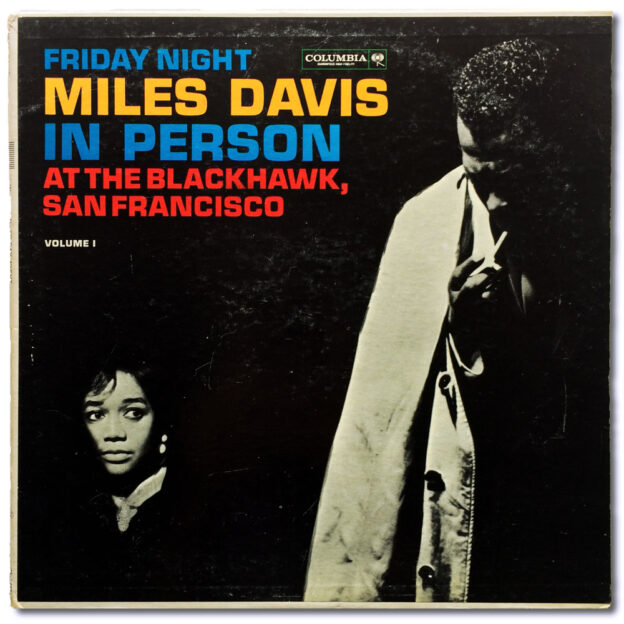
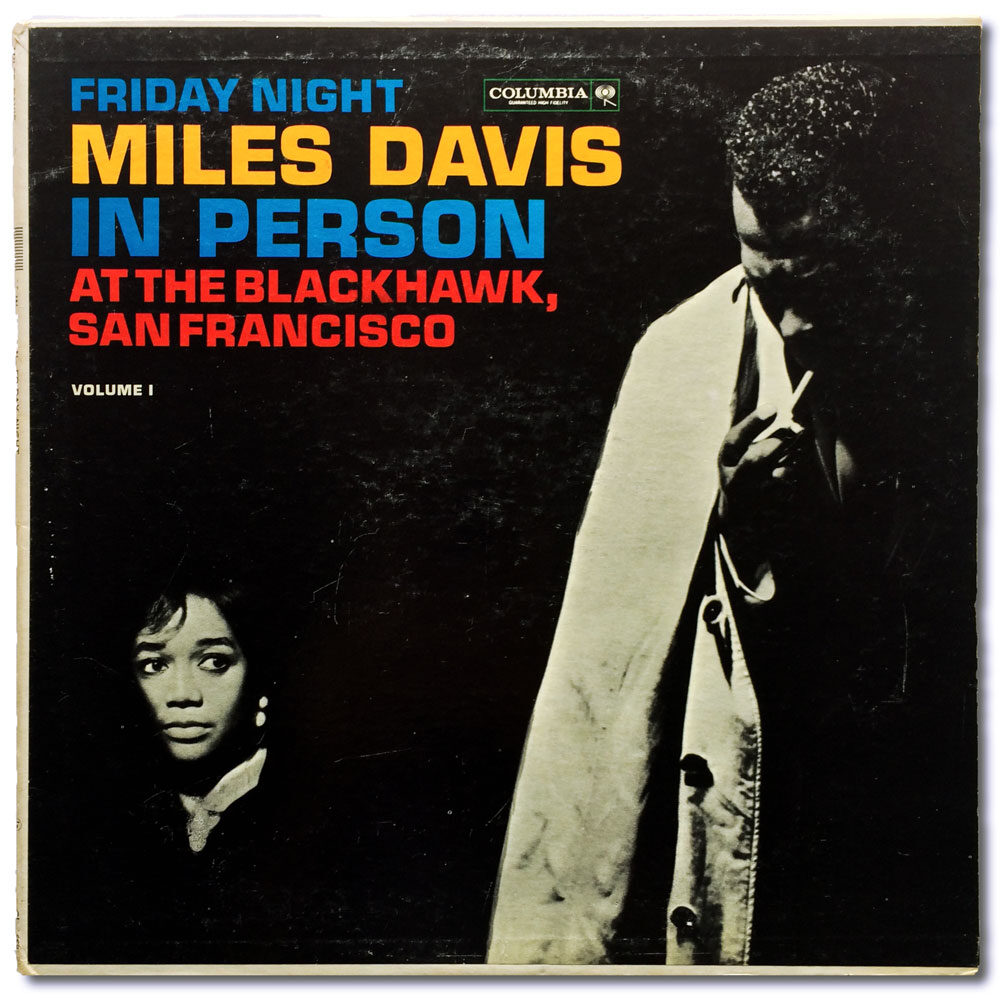
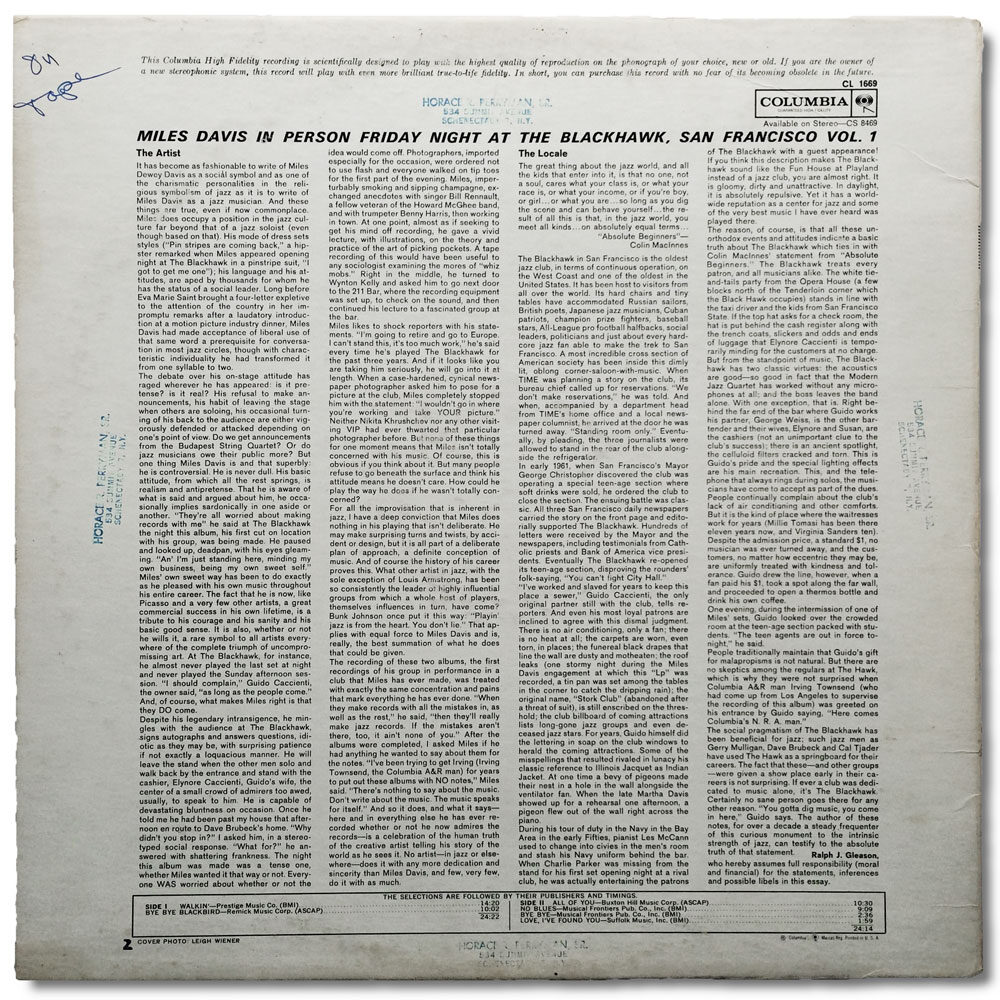
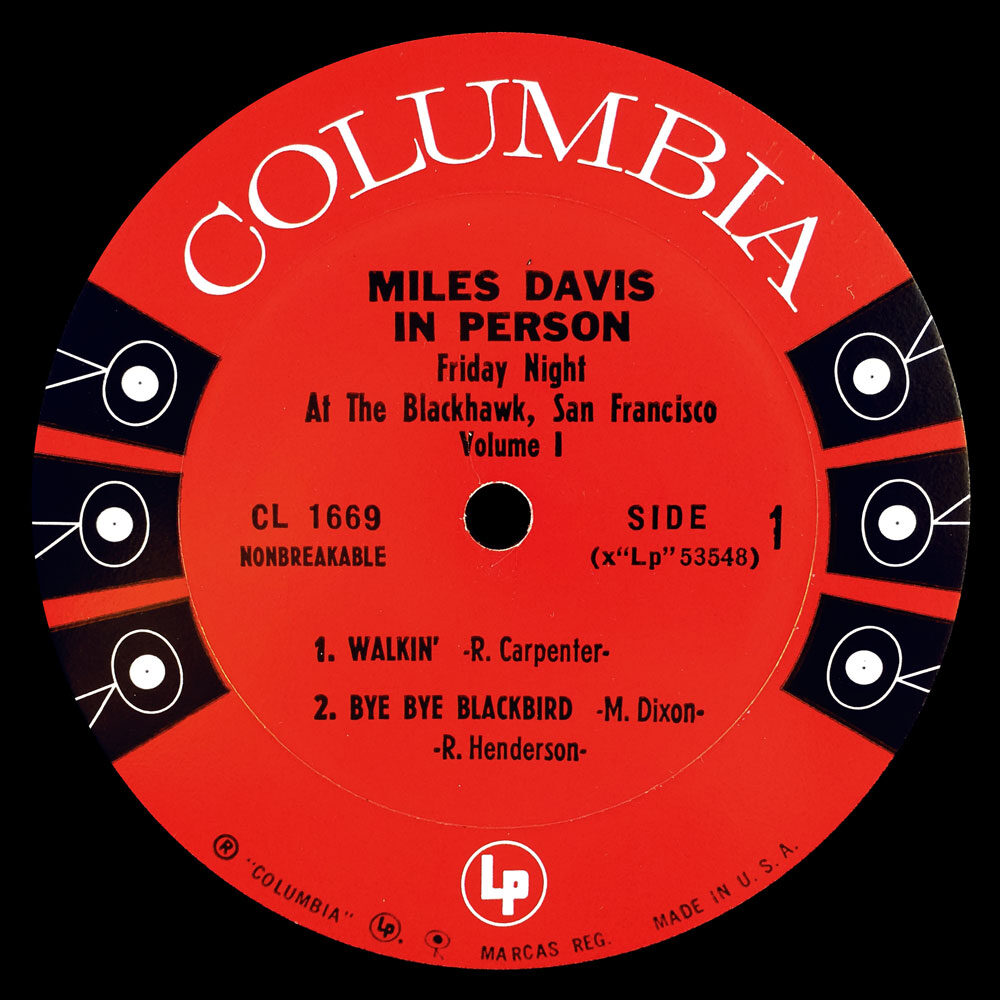
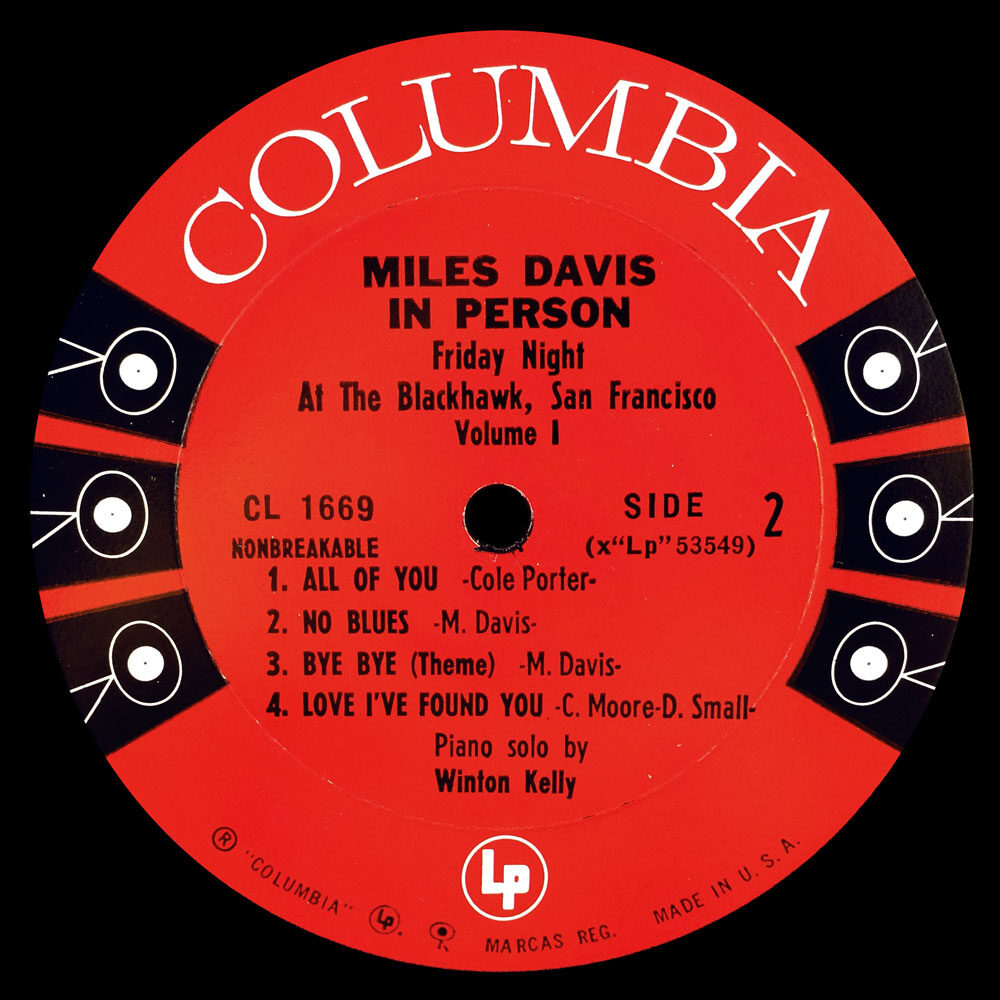
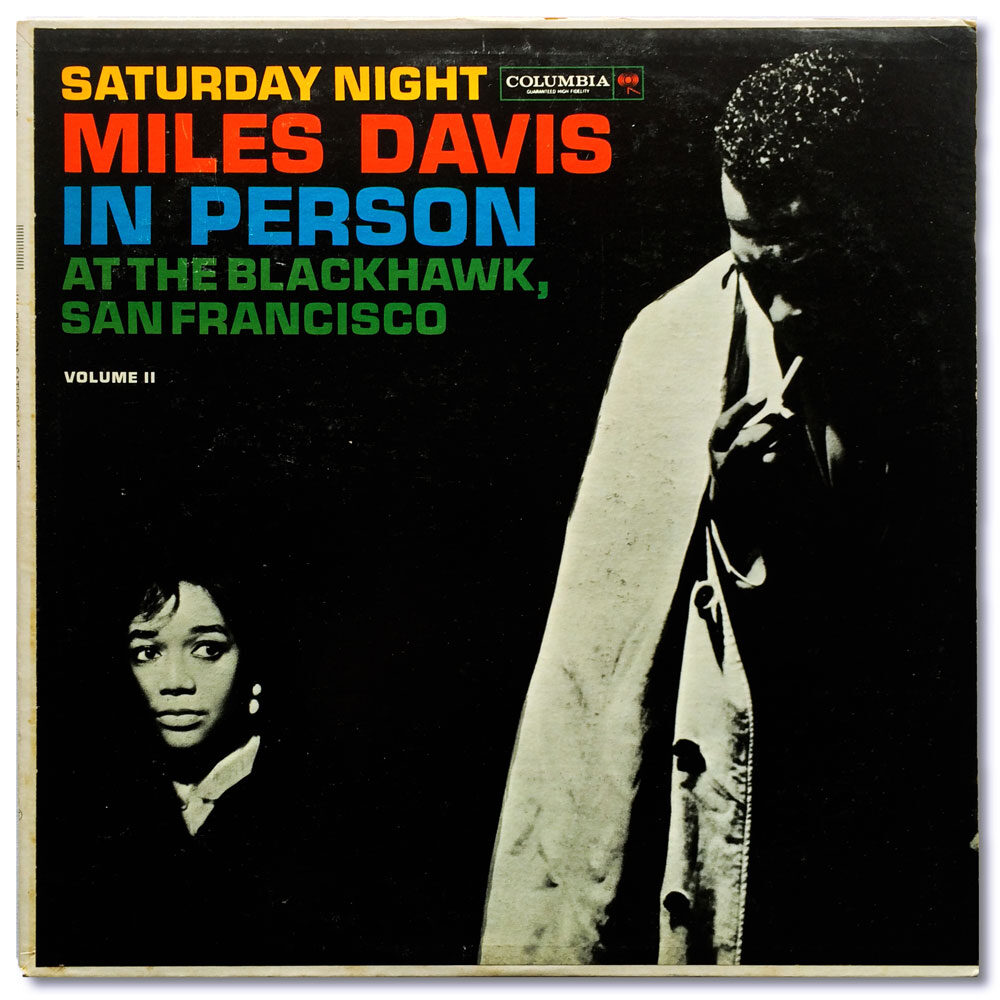
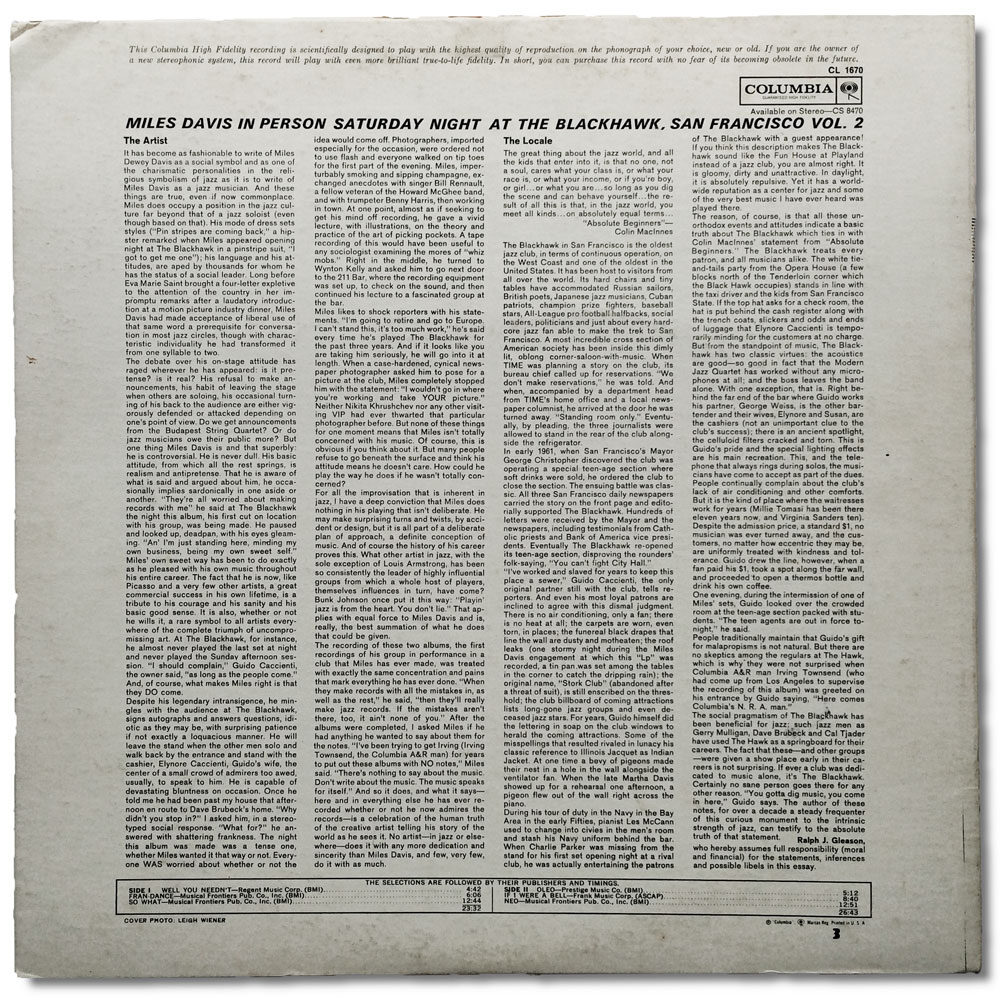
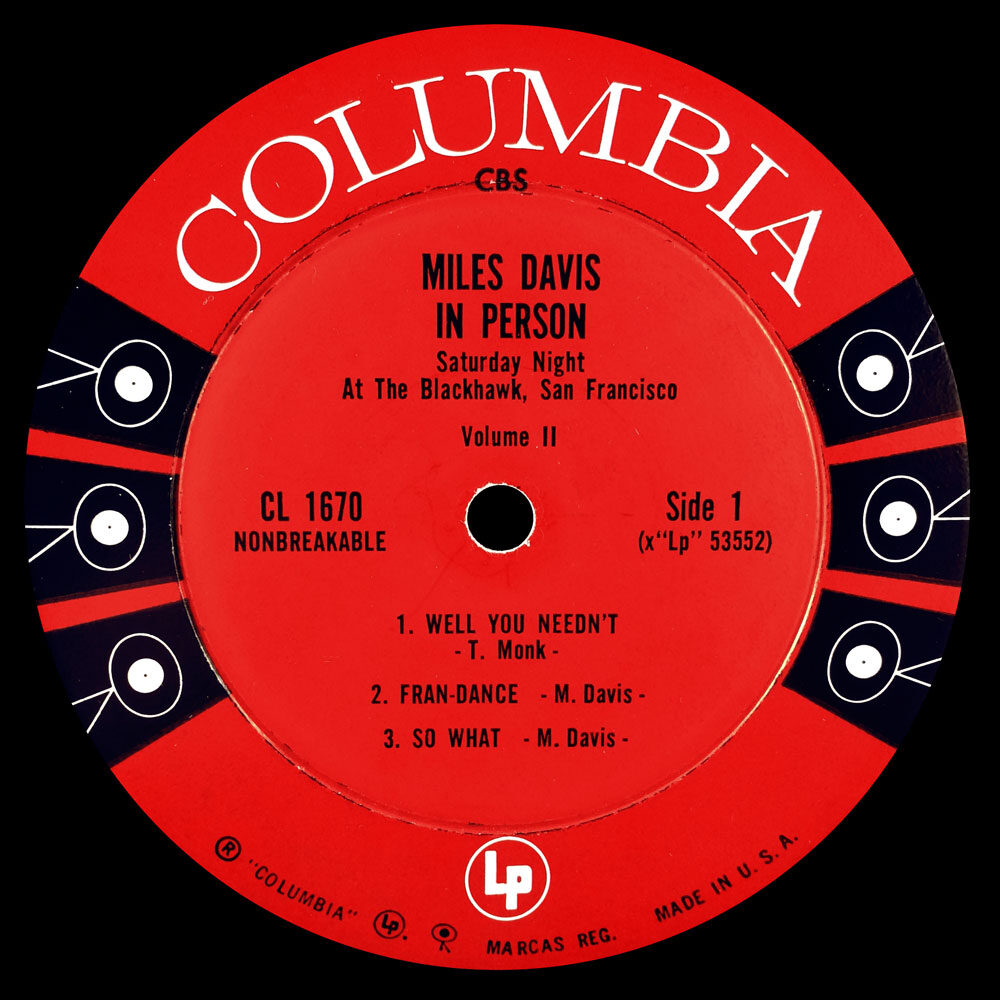
Vinyl Spotlight: Miles Davis In Person at the Blackhawk (Columbia 1669/1670) “6-Eye” Mono Pressings

Friday Night (CL 1669):

  • Original 1961 mono pressing
  • “Six-eye” labels

Saturday Night (CL 1670):

  • Second mono pressing circa 1961-1962
  • “Six-eye” labels

Personnel:

  • Miles Davis, trumpet
  • Hank Mobley, tenor saxophone
  • Wynton Kelly, piano
  • Paul Chambers, bass
  • Jimmy Cobb, drums

Recorded April 21-22, 1961 at the Blackhawk, San Francisco, California
Originally released September 1961

1 Walkin’
2 Bye Bye Blackbird
3 All Of You
4 No Blues
5 Bye Bye (Theme)
6 Love I’ve Found You
7 Well You Needn’t
8 Fran-Dance
9 So What
10 Oleo
11 If I Were a Bell
12 Neo

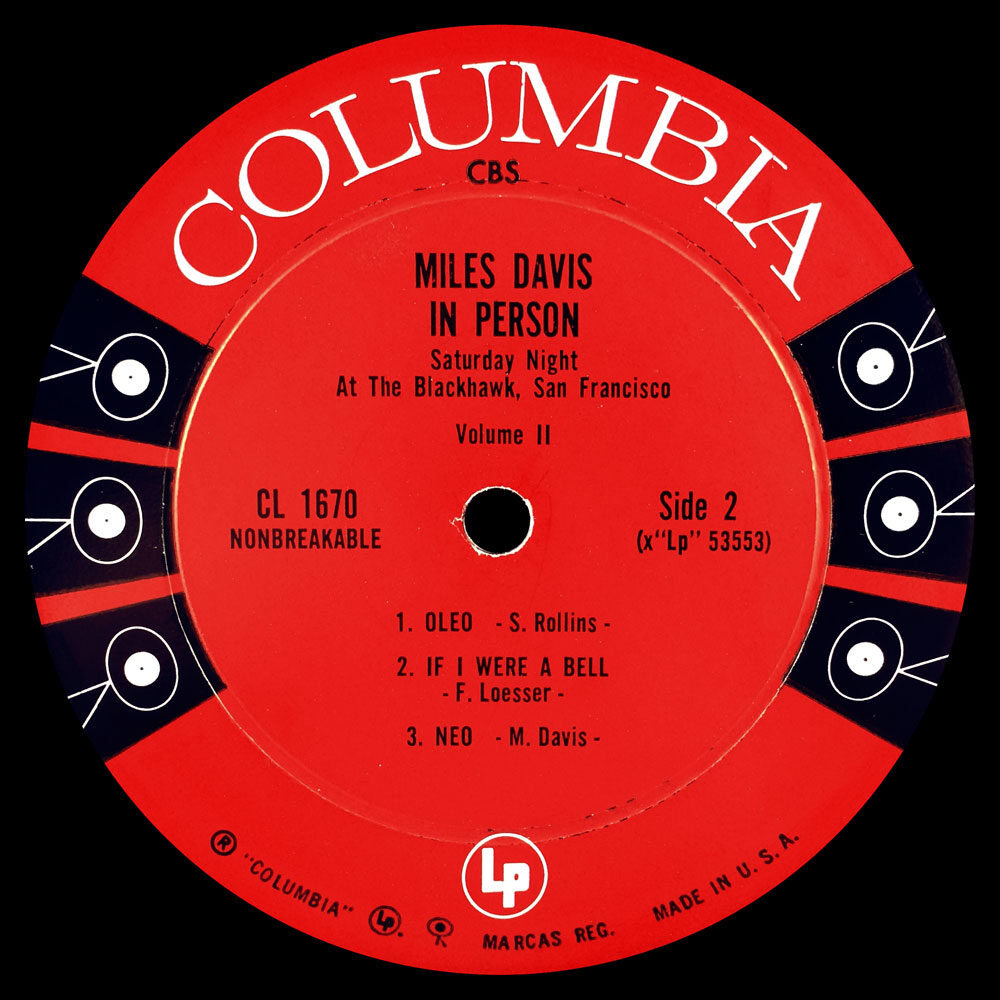
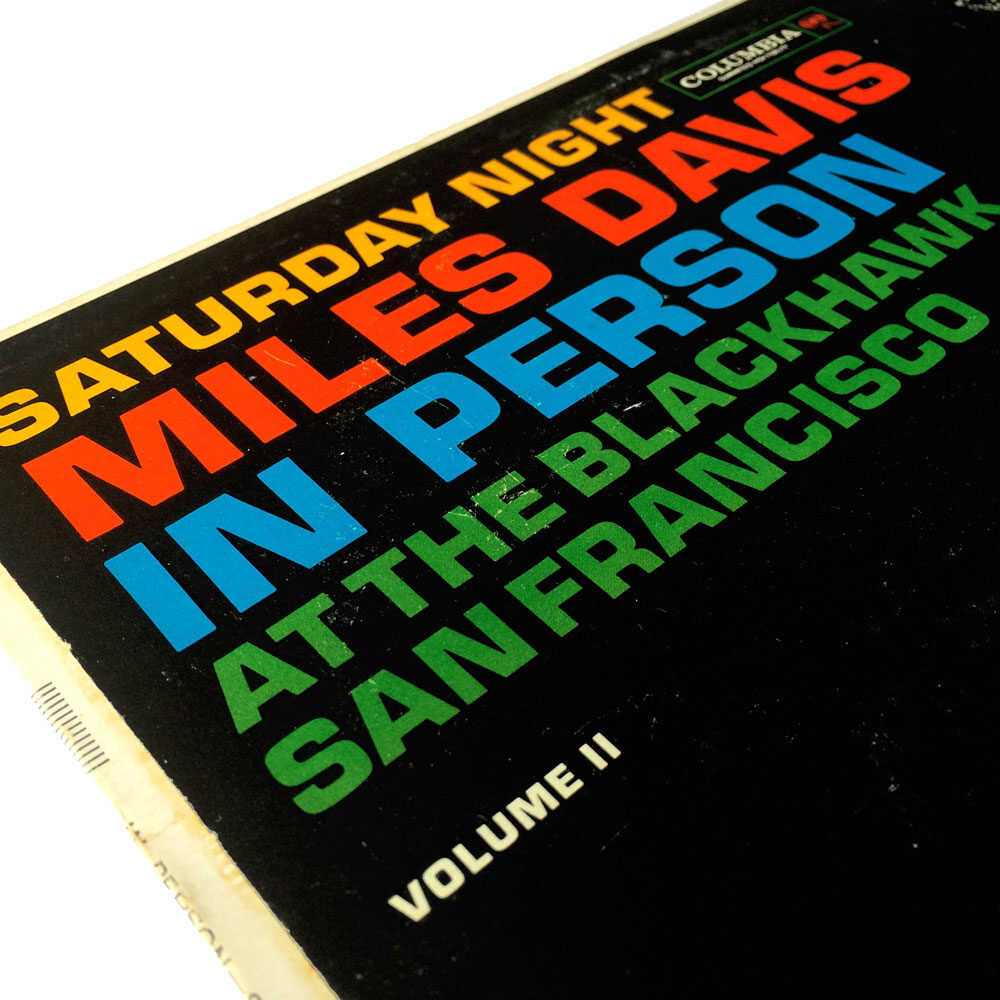
My Friday Night copy is considered an original pressing by most collectors but my Saturday Night copy is not due to the “CBS” marking on the labels. This is where I diverge from the record collecting consensus. I would agree that the CBS copy is not a first pressing but I would argue that there’s nothing wrong with referring to it as an “original pressing”. Being as specific as possible seems the honorable thing to do when it comes to selling, but my feeling is that in everyday conversation any copy of an album that would have been released in the era the album was originally released can rightfully be called an original (certainly, “in the era” is open to interpretation). Seeing that my CBS copy of Saturday Night was in all likelihood pressed in either the same year or the year after a first pressing, I don’t hesitate to think of this as an “original pressing”.

Live recording is by and large a more challenging endeavor when compared to the higher degree of control typically obtained in a recording studio. That being said, this Miles Davis album is an exceptional example of a live recording. Every instrument has its own space, even in mono, and the level of detail and accuracy here is a welcome break from the smeared, distorted sound of many live albums. Not only does Jimmy Cobb’s drum kit sound incredible here, his playing has a captivating and energetic sense of forward motion that seems to predict Tony Williams’ inclusion in Davis’ lineup shortly after. These albums also present a rare opportunity to hear how tenor saxophonist Hank Mobley, a mainstay of Blue Note records, holds up under the intense scrutiny of the date’s superstar bandleader.

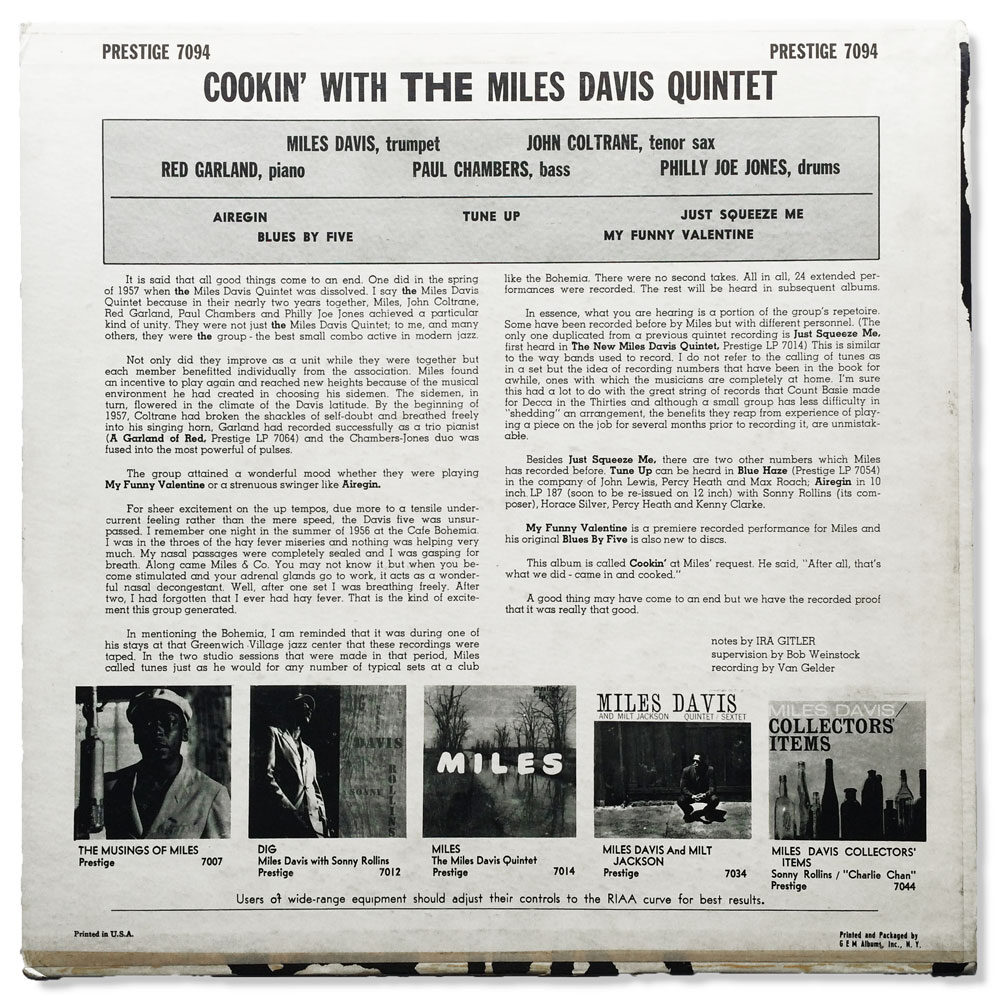
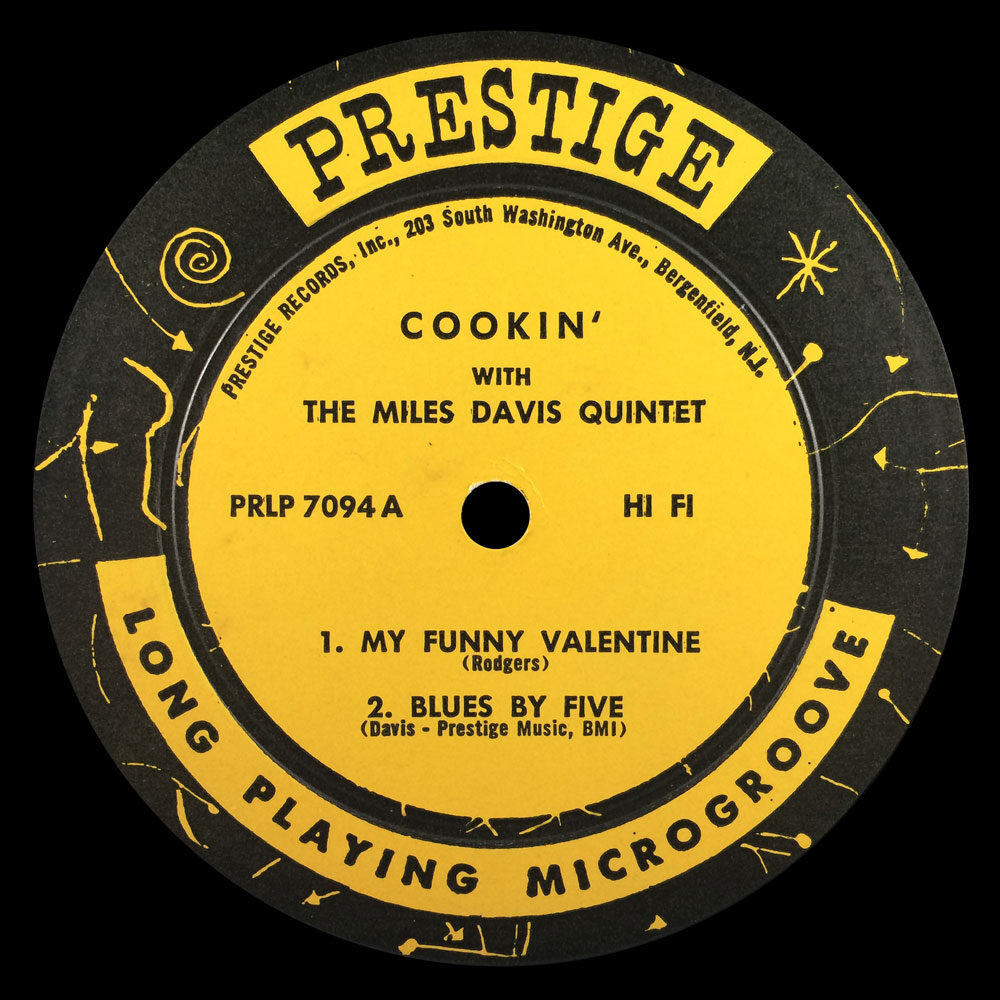
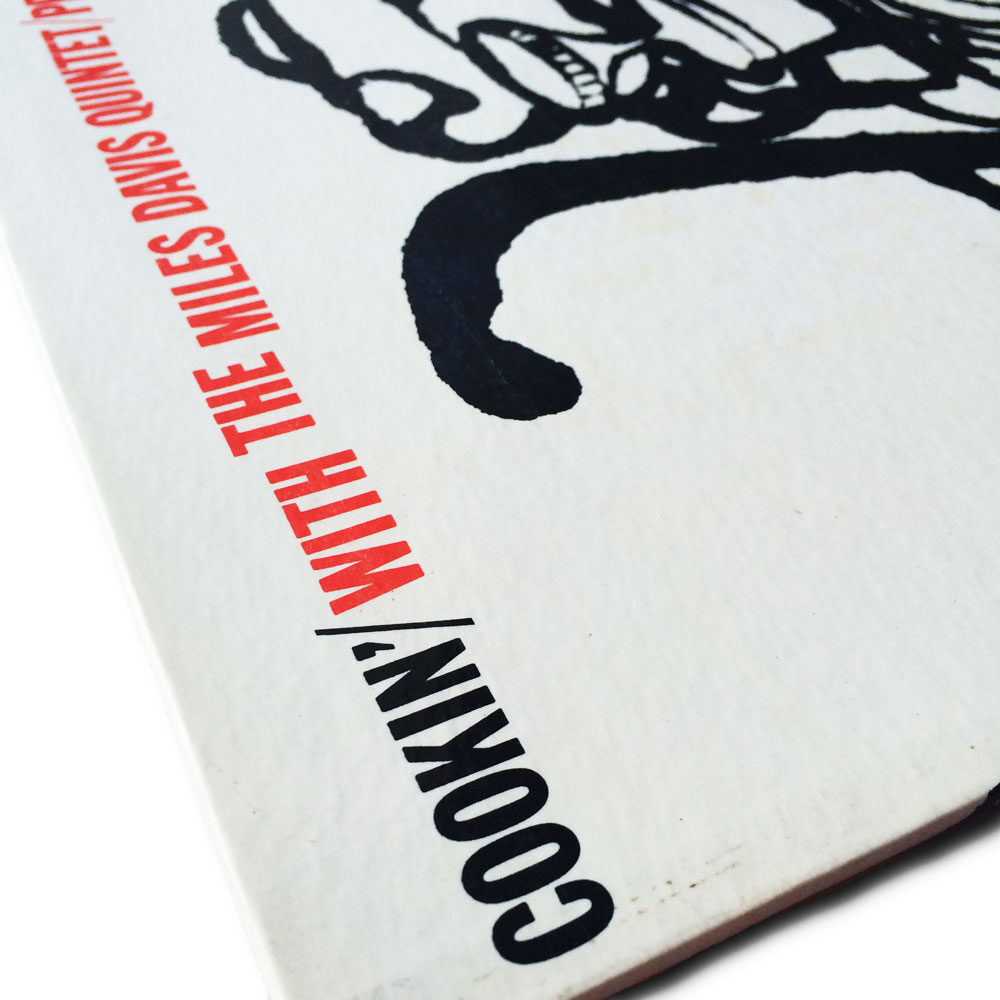
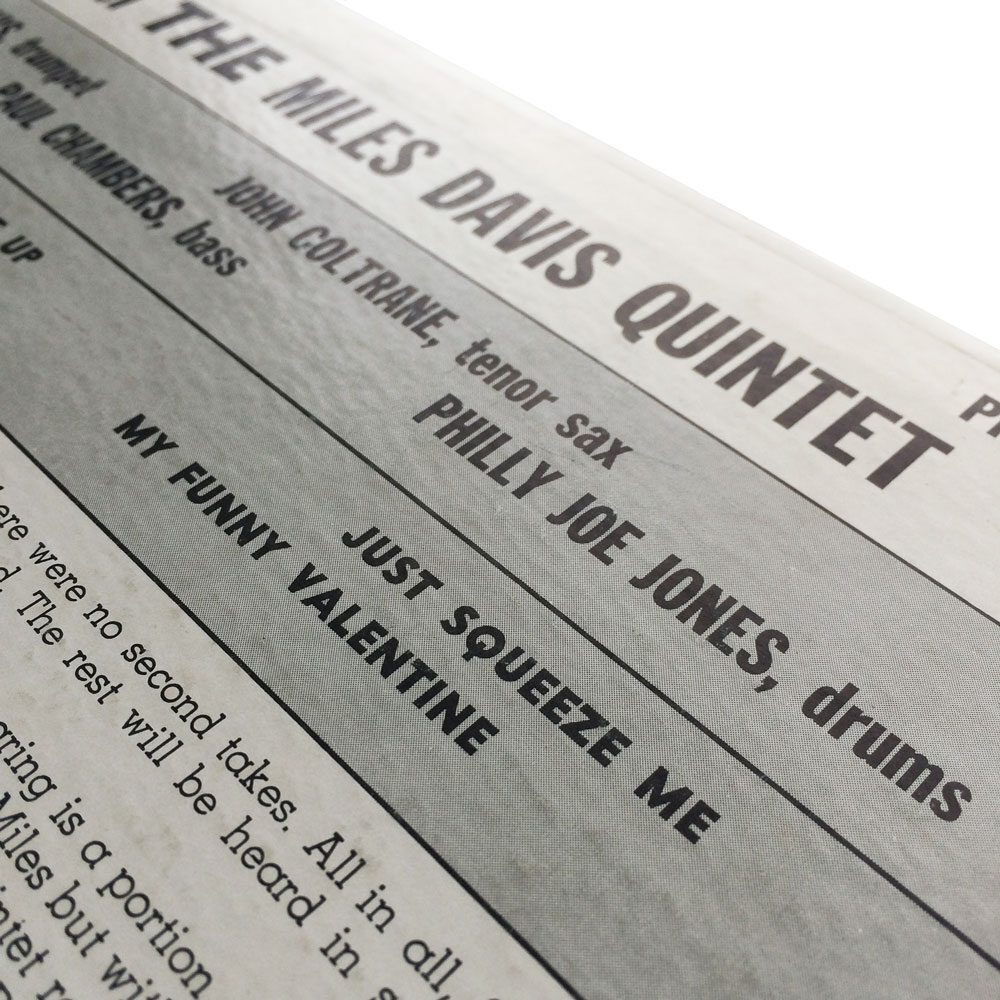
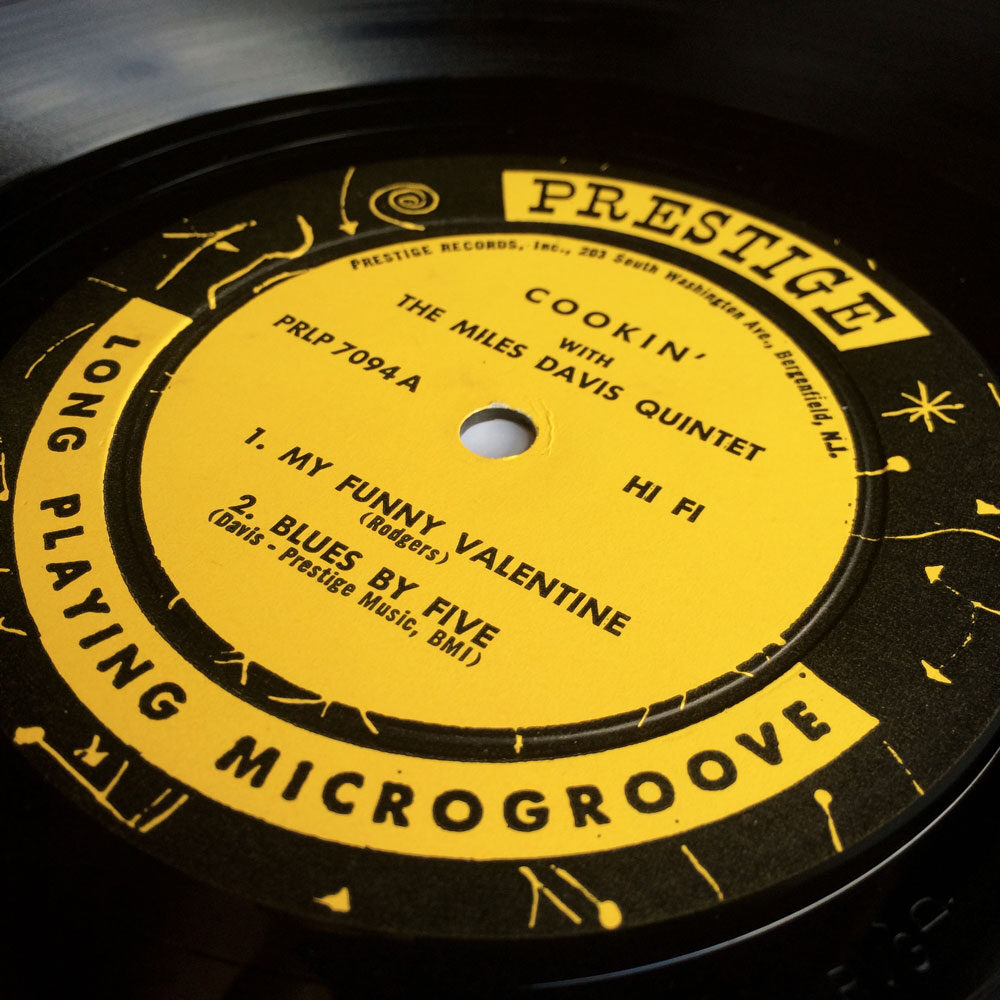
Vinyl Spotlight: Cookin’ with the Miles Davis Quintet (Prestige 7094) Second “Bergenfield” Pressing

  • Second pressing circa 1958-1964 (mono) with small Abbey pressing ring
  • “Bergenfield, N.J.” on both labels
  • Deep groove on both sides
  • “RVG” stamped in dead wax

Personnel:

  • Miles Davis, trumpet
  • John Coltrane, tenor saxophone
  • Red Garland, piano
  • Paul Chambers, bass
  • Philly Joe Jones, drums

Recorded October 26, 1956 at Van Gelder Studio, Hackensack, New Jersey
Originally released in 1957

1 My Funny Valentine
2 Blues by Five
3 Airegin
4 Tune Up/When the Lights Are Low

Selections:

“My Funny Valentine” (Rodgers)

“Tune Up” (Davis) / “When the Lights are Low” (Carter)

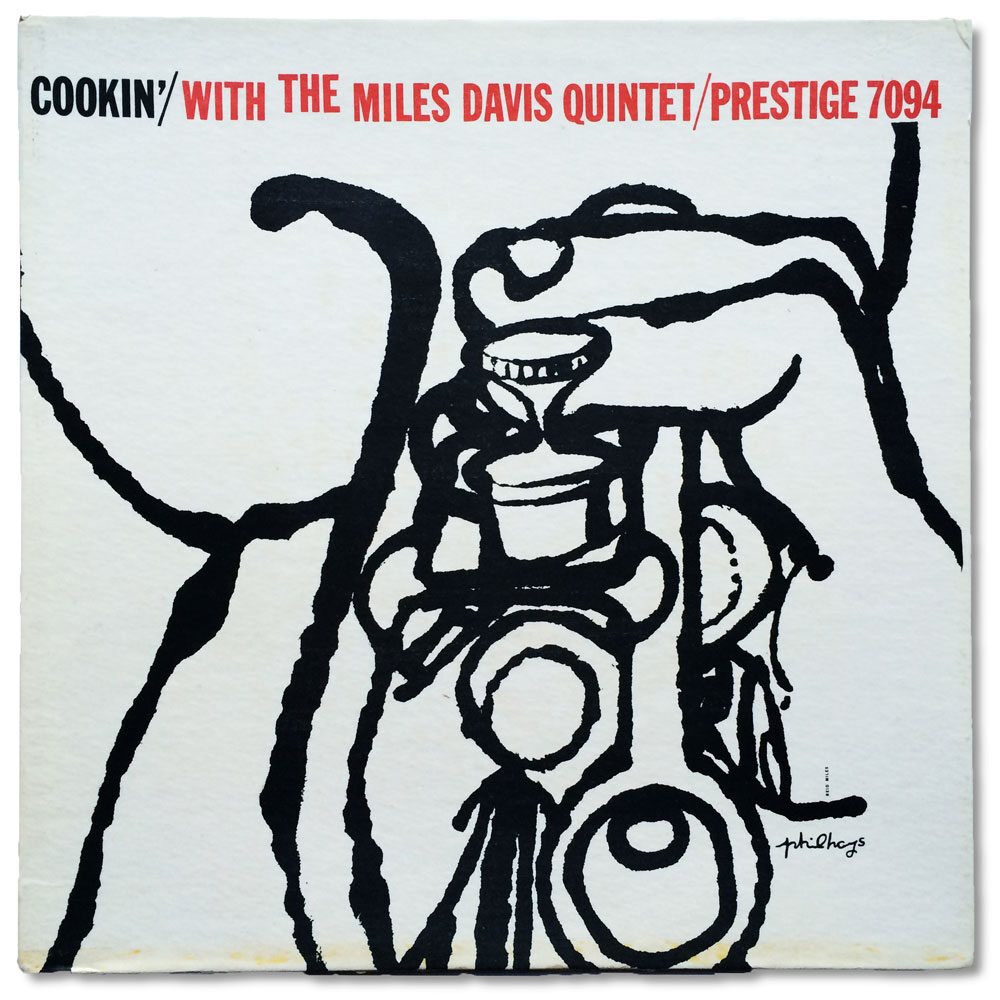
I found this record several years back at the first WFMU record fair I ever attended in New York City. It’s not an “original original” pressing in the sense that it lacks the “NYC” address on the labels, but it’s still made from original Van Gelder mastering. On the ballad “My Funny Valentine” especially, you should be able to hear that this is a very clean copy I was fortunate to find for the price I paid.

Much of what I might say about the history of this album I’ve already said in my review of Davis’ ‘Round About Midnight, which shares the same lineup. I originally bought this record mainly because it was a vintage copy in great shape and because I love this version of “My Funny Valentine”, but I eventually came to appreciate the entire second side of the album just as much (“Blues by Five” remains a ho-hum listen for me). Philly Joe Jones’ drum kit sounds thunderous here, and overall we get a glimpse of engineer Rudy Van Gelder in one of his finest hours at his Hackensack studio.

It would appear that this album and Relaxin’ (Prestige 7129) are the two most popular LPs of the four that Davis’ First Great Quintet recorded for Prestige, the others being Workin’ (Prestige 7166) and Steamin’ (Prestige 7200). I find something to like in all of them, but Cookin’, the first of the four to be released, is definitely my favorite. All four albums were recorded on just two dates in 1956. Renowned audiophile mastering engineer Steve Hoffman has claimed in his online forum that Van Gelder did a better job of recording the second date (which just so happened to produce all the takes present on Cookin’), claiming that Van Gelder made excessive use of spring reverb on the earlier of the two dates; I can’t say I agree. I think Cookin’ has the best program start to finish but I think all four albums are representative of how brilliant Van Gelder was under the restrictions of the mono format.

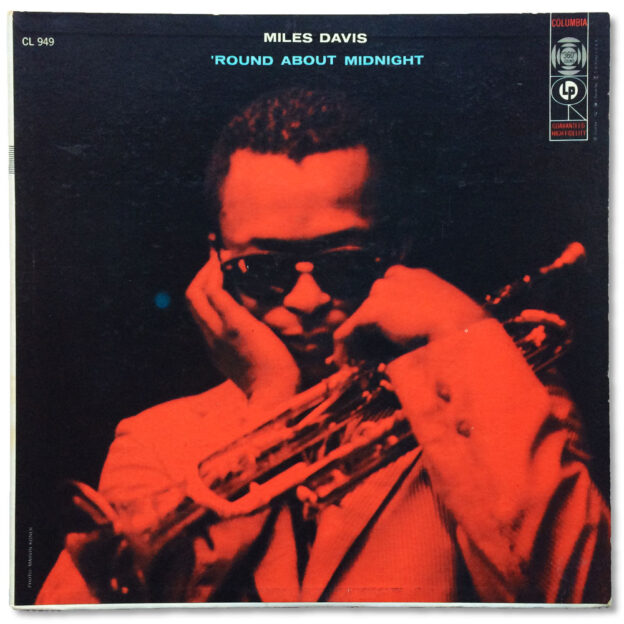
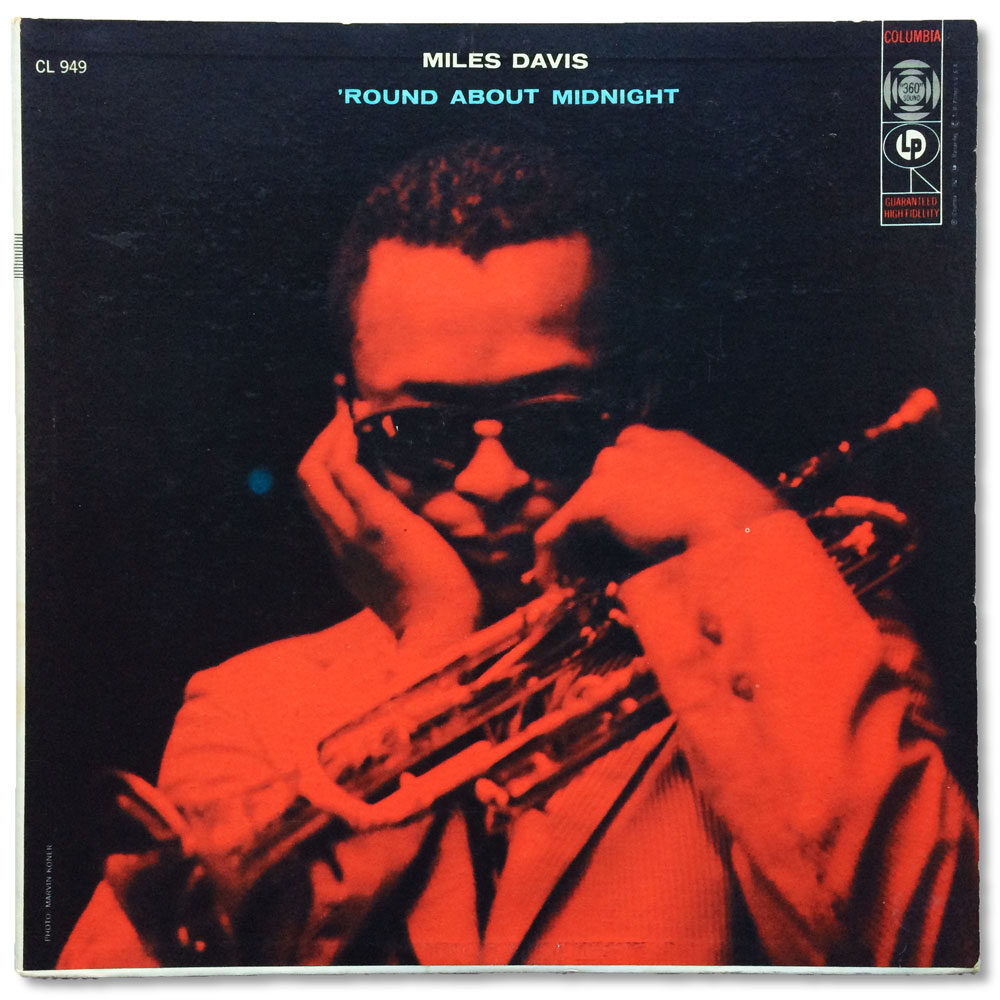
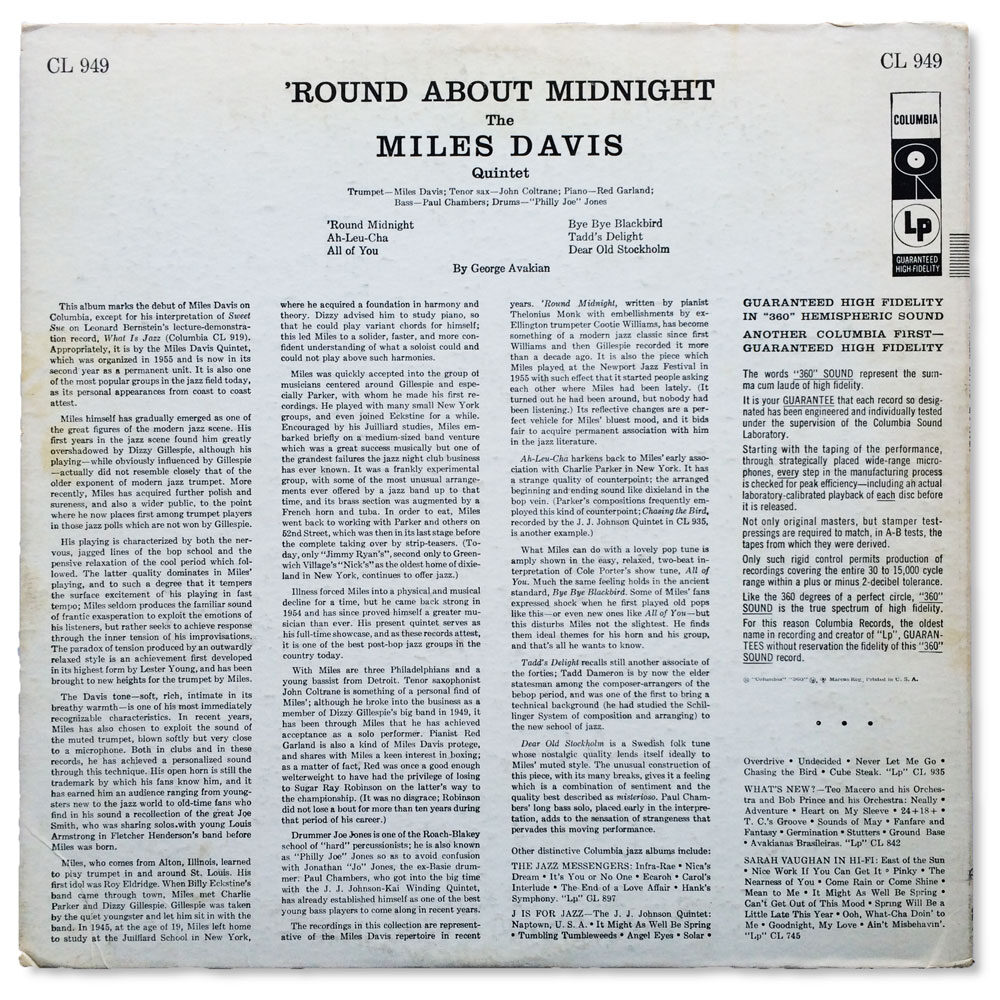
Vinyl Spotlight: Miles Davis, ‘Round About Midnight (Columbia 949) Original Pressing

  • Original 1957 pressing
  • “Six-eye” labels
  • Deep groove on both sides

Personnel:

  • Miles Davis, trumpet
  • John Coltrane, tenor saxophone
  • Red Garland, piano
  • Paul Chambers, bass
  • Philly Joe Jones, drums

All tracks recorded at Columbia 30th Street Studio, New York, NY
“Ah-Leu-Cha” recorded October 26, 1955
“Bye Bye Blackbird”, “Tadd’s Delight”, “Dear Old Stockholm” recorded June 5, 1956
“‘Round Midnight”, “All of You” recorded September 10, 1956
Originally released March 1957

1 ‘Round Midnight
2 Ah-Leu-Cha
3 All Of You
4 Bye Bye Blackbird
5 Tadd’s Delight
6 Dear Old Stockholm

For Collectors

Technically the third copy of this I’ve owned, my first copy was acquired on eBay, overpriced, and in rough shape. The second wasn’t much better, but this copy, acquired at the WFMU Record Fair in New York City a few years ago for a very reasonable price, is in fantastic condition, as you will hear!

Original pressing all around — I don’t personally get caught up in the matrix code game. For labels like Columbia, a matrix code can be used to identify the stamper and other metal parts used to press a particular copy of an album. The idea is that the quality of these parts deteriorates to some degree as each part is used in the manufacturing process, and thus that copies fashioning lower part numbers in the inner run-out section of each side have the potential to sound better (for more info on the vinyl manufacturing process, check out Deep Groove Mono’s links page).

From the information I’ve gathered, however, this difference will typically be so minuscule that it would be difficult to hear the difference between two records made from different parts (provided both copies were sourced from the same master lacquer disk). This is why I’ve chosen to stay away from the matrix code melee. In any event, for all you stamper geeks out there, this particular copy of Miles Davis’ classic ‘Round About Midnight was made from a “1C” stamper for side 1 and a “1A” stamper for side 2.

For Music Lovers

“The First Great Miles Davis Quintet” would have begun formulating around spring 1955 when pianist Red Garland and drummer Philly Joe Jones first joined the trumpeter for a recording session at Van Gelder Studio in Hackensack, New Jersey (The Musings of Miles, Prestige 7014). A few months later, bassist Paul Chambers and the harmonically curious yet ever-precise tenor saxophonist John Coltrane would complete the combo.

In addition to leading his new band, Miles was simultaneously eager to make the move from Prestige to Columbia Records. But the rising star still owed Prestige label head Bob Weinstock four more albums under contract. So before Columbia could release any material under the Davis moniker, Miles would need to fulfill his agreement with Weinstock. What then commenced in 1956 for the newborn quintet was a mash-up of Prestige and Columbia dates, all of which have since been heralded as classics.

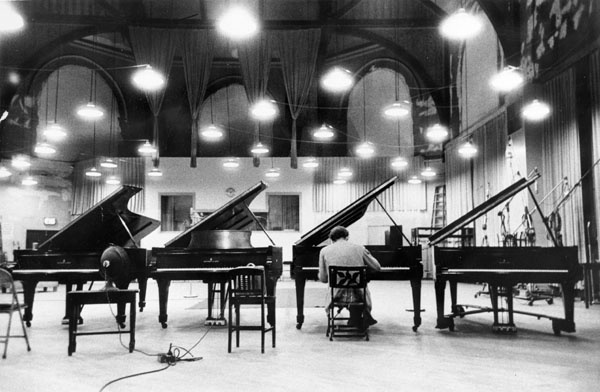
‘Round About Midnight, Davis’ Columbia Records debut, was recorded in three sessions between October 1955 and September 1956 at Columbia’s historic 30th Street Studio in New York City. Many of you will already be familiar with the legendary sound of this studio. I find the sound on this particular album to be more immediate and up-front than the roomier sound heard on later Miles albums recorded here (Kind of Blue, for example). Nonetheless, the cathedral-turned-studio’s sonic blueprint is committed to tape here and the results are simply gorgeous.

Columbia Records’ 30th Street Studio

Davis’ inaugural Columbia release is a highly consistent effort. On the album’s second tune, Miles takes Charlie Parker’s “Ah-Leu-Cha” at a faster tempo than the composer did on his own leisurely-paced 1948 recording (yet nowhere near as fast as Davis did at Newport in 1958), and though the leader opts for the bolder sound of an open horn here and on “Tadd’s Delight”, Davis’ signature muted trumpet sound dominates the album and is ultimately immortalized on ‘Round About Midnight. (It’s a shame that the quintet’s version of “Sweet Sue, Just You” didn’t make it to the original album release — a stellar take that could have only been left off as a practical matter of space — though fortunately it does appear on the 2001 Sony Legacy CD reissue.)

No sooner than alto saxophonist Julian “Cannonball” Adderley joined the group in early 1958 did Red Garland leave, unable to tolerate the leader’s sky-high standards. Jones would soon follow, and the First Great Quintet’s short reign would come to a close after the recording of Milestones. ‘Round About Midnight is thus one of the few examples of this iconic ensemble’s explosive power, and the album has stood the test of time as a rare combination of brilliance and accessibility equally fitting for attentive listening and unwinding.