Tag Archives: John Coltrane

Vinyl Spotlight: John Coltrane, Coltrane’s Sound (Atlantic 1419) Second “Orange/Purple Label” Mono Pressing

  • Second 1966 mono pressing
  • Orange & purple labels with black fan and “Atlantic” written vertically
  • Non-laminated cover with “NEW YORK, NEW YORK 10023” and “copyright 1966” on back of jacket

Personnel:

  • John Coltrane, tenor & soprano saxophones
  • McCoy Tyner, piano
  • Steve Davis, bass
  • Elvin Jones, drums

“Central Park West”, “Body and Soul”, and “Satellite” recorded October 24, 1960
“Liberia”, “The Night Has a Thousand Eyes”, and “Equinox” recorded October 26, 1960
All selections recorded at Atlantic Records’ 56th Street studio, NYC
Originally released in 1964

1 The Night Has a Thousand Eyes
2 Central Park West
3 Liberia
4 Body and Soul
5 Equinox
6 Satellite
Before I started collecting vintage jazz records, a friend of mine who also happens to be a jazz drummer let me borrow a bunch of jazz CDs to rip to my computer and this was one of them. At the time, I pretty much took all the John Coltrane he had, not having any idea of what was what. But a couple songs on this album, “Central Park West” and “Equinox”, immediately stood out to me, and this has been one of my favorite Trane albums since.

Released after Coltrane had already moved over to Impulse and his contract with Atlantic had expired, Coltrane’s Sound was compiled from three 1960 recording sessions (two in one day on October 24, 1960), which also produced tracks for My Favorite Things and Coltrane Plays the Blues. (Fun fact: I’ve heard that Coltrane disapproved of this cover art, believing that the way it made his face look like it was melting was morbid.) The separation on stereo versions of this album is typical of that on all the Atlantic Coltrane albums: an empty center and all instruments panned either hard left or right. After ripping this album from my friend but before I acquired this copy, I got a hold of the same 1999 stereo CD my friend had, and the extreme separation made me especially interested in hunting down an original mono pressing. A copy evaded me for years (stereo originals of this album seem to outnumber mono copies by a wide margin), but a couple months ago I was elated to find this copy at a local shop.

I had a bit of fun determining the vintage of this pressing. Almost convinced that it was a first pressing, I noticed a copy for sale on eBay that appeared to sport a laminated cover. Upon further inspection I noticed that, despite the labels being identical on both copies, the bottom of the eBay jacket read, “NEW YORK 23, NEW YORK”, followed by “copyright 1964”. My copy is therefore clearly a second pressing, but what’s to complain about when the mastering is identical, my copy is in top condition, and I paid the price of a sealed reissue?

As previously stated, “Central Park West” and “Equinox” are the moody standouts here. The former, a sweet ballad written by Coltrane and played with soprano sax, conjures imagery of a romantic couple strolling the namesake Upper West Side street on a cloudy autumn day. The latter is a blues with a dark, foreboding underpinning whose happier “B” section ultimately gives way to solos of a more playful nature. These two songs are really the sole reason I hold this album in such high regard. The rest of the tracks don’t appeal to me enough to play this album all the way through every time (I’ve never been a big fan of the standard “Body and Soul”), though the controlled chaos of the pianoless trio on “Satellite”, which serves as one of numerous Atlantic-era predictors of Trane’s future direction at Impulse, has steadily grown on me.

Vinyl Spotlight: John Coltrane, Blue Train (Blue Note 1577) “Earless NY” Mono Pressing

  • “Earless NY” mono pressing ca. 1966
  • “RVG” stamped in dead wax

Personnel

  • Lee Morgan, trumpet
  • John Coltrane, tenor saxophone
  • Curtis Fuller, trombone
  • Kenny Drew, piano
  • Paul Chambers, bass
  • Philly Joe Jones, drums

Recorded September 15, 1957 at Van Gelder Studio, Hackensack, New Jersey
Originally released November 1957

1 Blue Train
2 Moment’s Notice
3 Locomotion
4 I’m Old Fashioned
5 Lazy Bird

For Music Lovers

I’m surprised by how many people recommend this album to jazz novices because I don’t necessarily find it to be an “accessible” listen. Slowly it has become one of my favorite jazz albums but I didn’t like it initially and ignored it for quite some time. I find Coltrane’s solos here challenging, and this next comment may not be something most people can identify with, but I initially found many of the melodies to sound “major” in terms of scale and thus maybe a little old-fashioned (no pun intended) at a time when I was looking for something more edgy and “minor”.

Growing out of my fashionable pessimism phase, I’ve come to appreciate older-sounding jazz numbers. But there’s a sort of hidden darkness looming in between the heads of the songs here. “Moment’s Notice”, an album favorite of mine, is the prime example of this: its happy, soulful theme seems to deceitfully change from major to minor key at the renewal of each chorus.

One by one, I grew to adore every song on this album. “I’m Old Fashioned”, a standard written by songwriting juggernauts Jerome Kern and Johnny Mercer, initially sounded like a cookie-cutter ballad but ultimately won me over. On “Lazy Bird”, trumpeter Lee Morgan’s quiet introductory proclamation of the theme is a welcome break from the sheer power of this all-star sextet. But what hasn’t already been said about the album’s mega-classic title track? The simple 24-bar theme is one of the most famous intros in all of jazz, and Coltrane’s solo has been exhaustively picked apart by scholars. No more than forty seconds after the album’s first notes sound, the leader launches this Molotov cocktail at the listener. It was too intense for me as a jazz newcomer, but over the years I feel I have grown to better understand Coltrane’s music, and today I marvel at the flurry of notes played here. In my view of jazz history this marks the beginning of Coltrane’s revolution: uninspired by what he was hearing at the time, it is the moment when the saxophonist took his instrument and proclaimed to the jazz world, “Enough is enough, it’s time to push this music forward.”

John Coltrane approaching Rudy Van Gelder’s Telefunken U47 microphone

On a side note, two weeks prior to the recording of this album in mid-September 1957, Coltrane was in the studio as a sideman for the recording of Sonny’s Crib (Blue Note 1576). That album’s title track bears a striking resemblance to the minimal, bluesy progression in “Blue Train”. Was Coltrane inspired by Sonny Clark? Had he taken Clark’s idea and ran with it? We may never know if there was a conscious connection between the two songs in Coltrane’s mind (“Sonny’s Crib” was not necessarily written first just because it was recorded first) but I found it worth mentioning.

BLP 1576, Sonny’s Crib

The choice of lineup on Blue Train is interesting. Coltrane was not known to have a regular working relationship with either Kenny Drew or Lee Morgan (he had recorded with each of them once on separate occasions prior to this date), which leaves open the possibility that Drew and Morgan were suggested by Blue Note producer Alfred Lion. This seems more plausible in the case of Morgan, a regular leader with the label. Though the album proved a grand slam for Blue Note in terms of sales, it was ultimately a one-off recording Trane did for them.

Coltrane, Morgan, and Curtis Fuller (off camera) rehearsing before a take

Critics seem split as to the brilliance of Blue Train. Beyond the title track, I have read reviews suggesting that the album amounts to little more than a run-of-the-mill bop date. The Penguin Guide to Jazz Recordings, while awarding it four stars, also manages to call it “an overvalued record”. I personally find the music jubilant and adventurous. The pairing of Trane with Morgan doesn’t create a seamless fusion to me, but it’s interesting to hear how Morgan responds to being thrown into such a foreign situation.

For Collectors

My experiences with vinyl versions of this album began many years ago with the 2005 Classic Records mono reissue. Though visually near mint, that copy had significant surface noise (a problem I’ve sadly run into again and again with Classic reissues — not all, but most). After ditching that copy, I spent several years getting more familiar with the material by listening to the 2003 stereo RVG Edition CD before I acquired the 2014 Music Matters mono reissue. I’m not nearly as fanatical about Music Matters as most jazz fans, but the fact that they released this as a single 33 R.P.M. disc in mono got my attention. Mastered by Kevin Gray, it is sonically astonishing. Through all this, I’ve always kept my eye on auctions for the rarer “NEW YORK USA” mono reissues of this with the RVG stamp and ear. These pressings sell for much less than copies displaying some form of the “West 63rd NYC” address on the labels, but I was always outbid.

Speaking of pressings, there is a hotly-contested debate over what constitutes a “first pressing” of this album. While fundamentalists will insist that only copies brandishing the “NEW YORK 23” address on one side should be considered first pressings, these copies are so rare that many collectors are left to conclude that “WEST 63RD” copes without the “INC” or registered trademark “R” must have also been part of that initial run. I side with the latter camp, considering all of these copies firsts, which would make this copy a second pressing (notice my quotes around the word “second” in the description above). Some collectors, including the venerable Larry Cohn, even go as far as suspecting that the New York 23 copies are second pressings. Semantics aside, this is an absolutely stunning copy of this classic and one of the cleanest vintage jazz records in my collection.

The elusive “NEW YORK 23” label

I’m not usually one to sweat the details when it comes to various runs of album jackets, but through a bit of recent research I have come to realize that there is a small difference between the first and second pressings of this jacket despite the “West 63rd Street” address appearing on both: while second jackets have black printing artifacts on the photo of Curtis Fuller, first jackets do not.

Original (left) and second edition (right) jackets

Though engineer Rudy Van Gelder is famous for his high level of sonic consistency, careful inspection will expose a multitude of different approaches both he and producer Alfred Lion took to the recording and mixing processes. Blue Train is an ideal example of this. The dead-black background depicted on the cover compliments the “nighttime” vibe of this recording exceedingly well. This is partly due to the fact that the album was laid to tape not long after Van Gelder acquired his new EMT plate reverb unit. This replaced his old (and frankly, cheap-sounding) “spring” reverb unit, which to the dismay of many jazz fans plagues numerous earlier Hackensack recordings by saturating the soundstage with choppy echoes of horns and drums. And while stereo versions of Blue Train present a rather disjointed soundstage (instruments on the far left and right with the reverb alone in the center), the unified mono presentation of the music here coupled with the roomy decay of the mono EMT plate succeeds at creating a spacious, dark soundstage that’s as far as one might imagine from the natural characteristics of a makeshift living room studio. And while the true-to-life sonic character of that room has appeared on countless jazz recordings and been celebrated for decades, this is a shining example of a time when Van Gelder and Lion decided that the music and temperaments of the artists required a fresh approach.

EMT reverb plate

It really doesn’t get any better than this when it comes to a vintage jazz listening experience: a clean copy of a classic album with a star-studded, exceptionally recorded cast being presented in monophonic fidelity as originally intended. It’s a time machine back to that cool autumn day in 1957 when jazz giants roamed Rudy Van Gelder’s New Jersey living room, expressing themselves the best way they knew how. This is an album I will cherish when I’m old and grey, and it is sure to get lots and lots of plays from now until then.

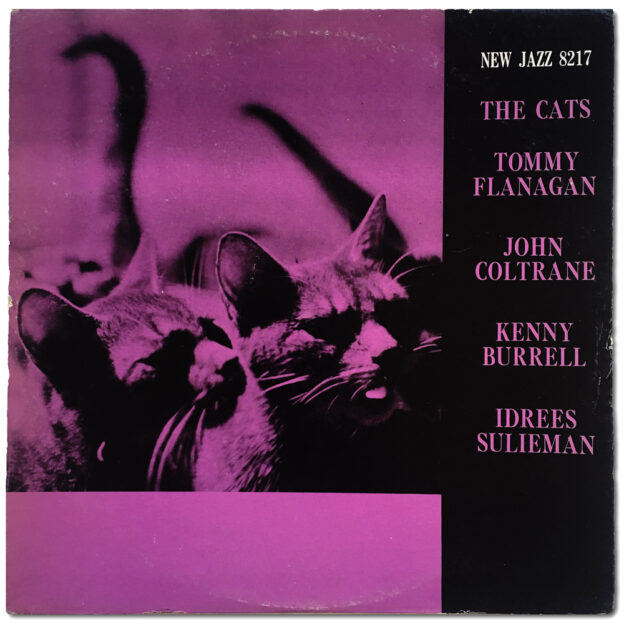
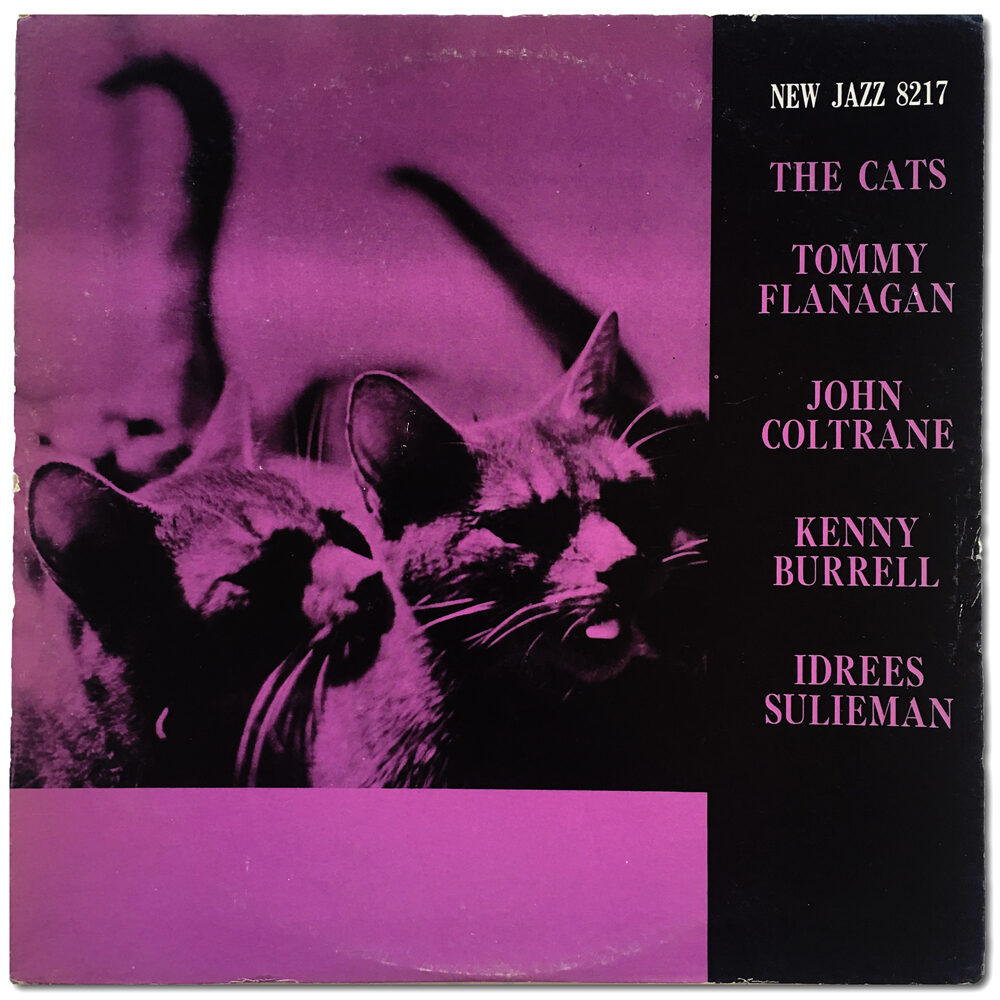
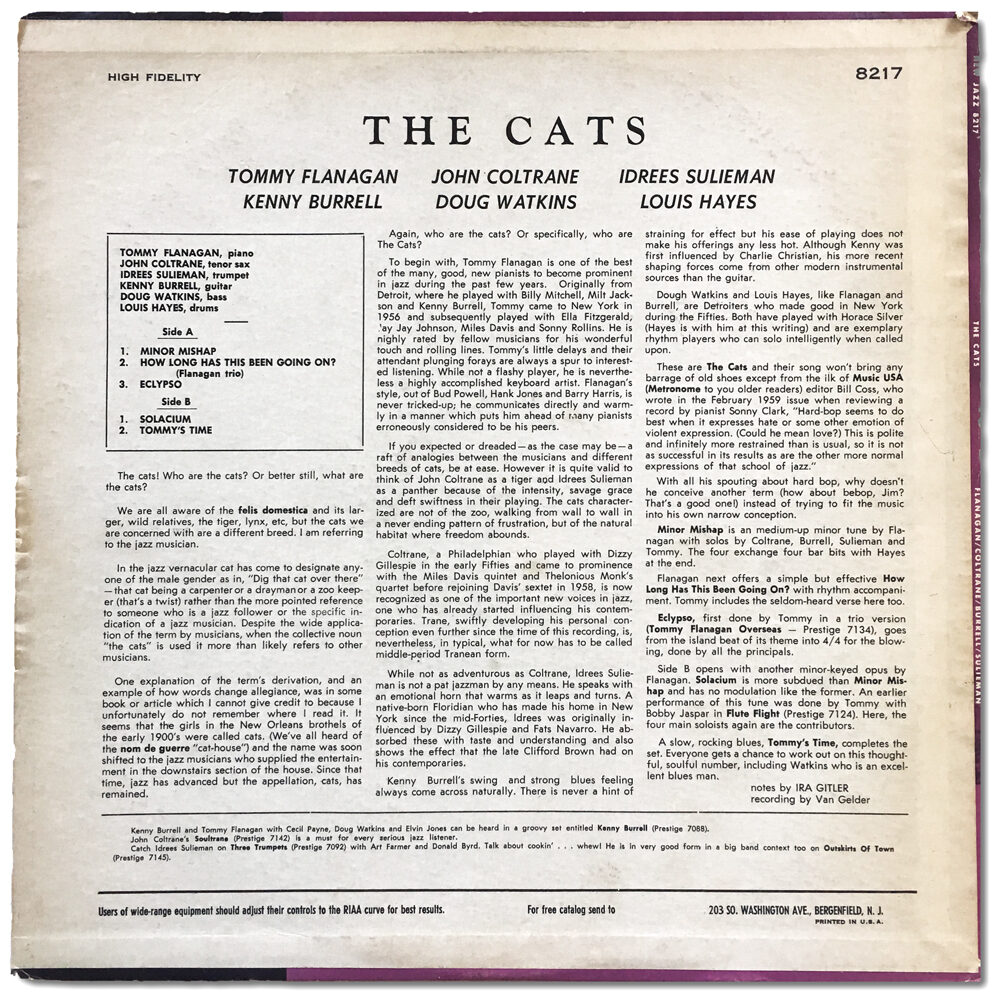
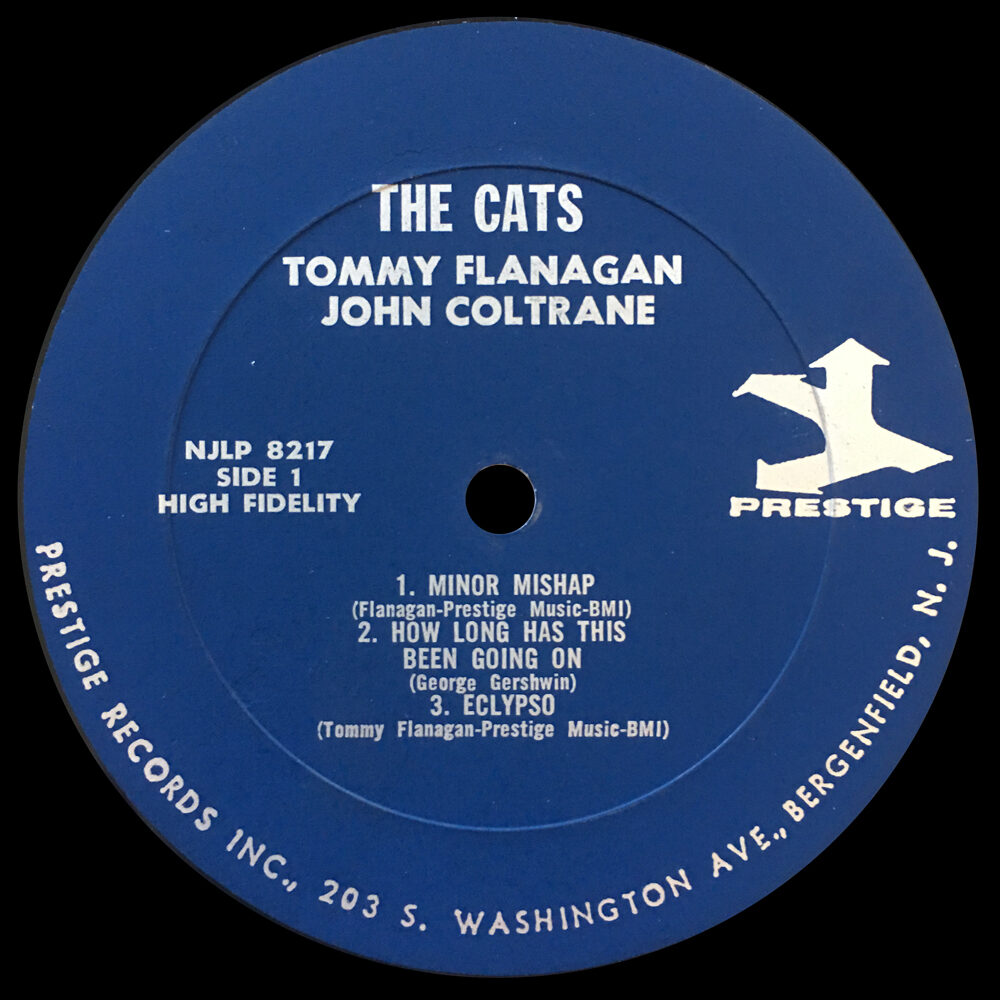
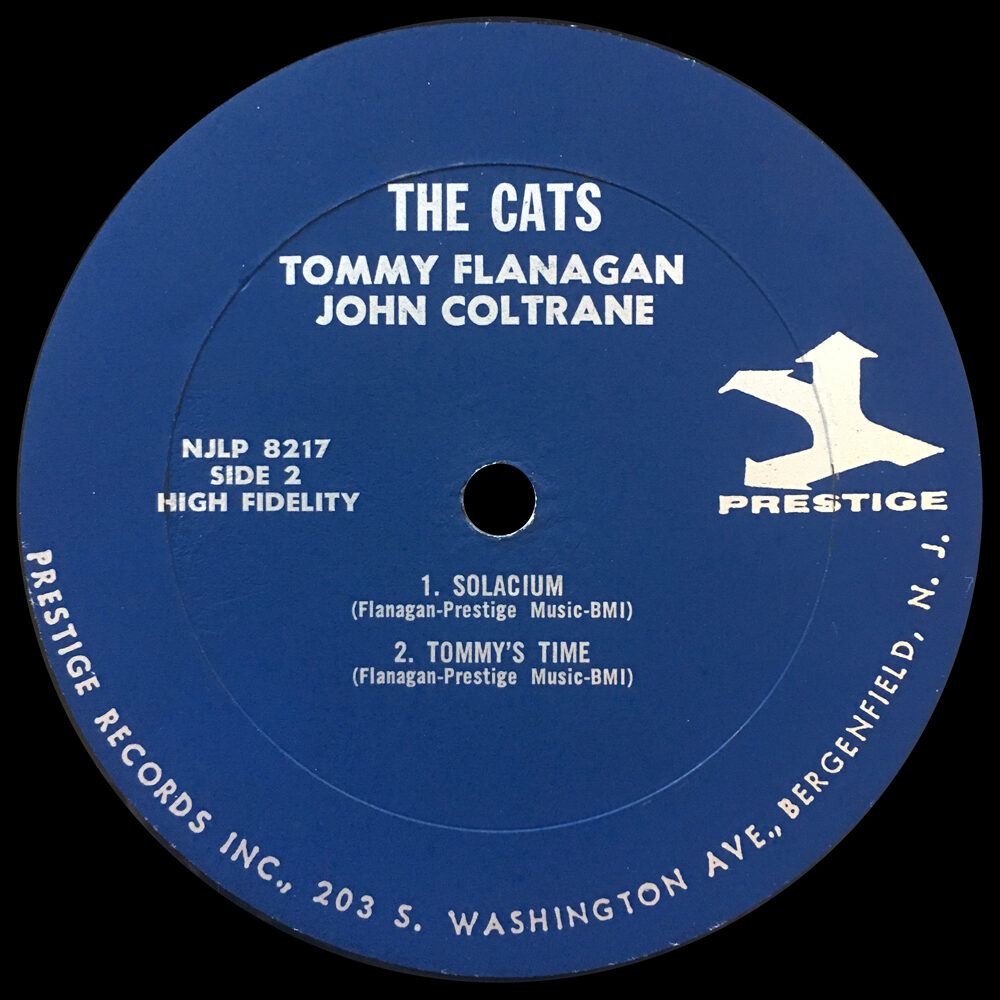
Vinyl Spotlight: The Cats (New Jazz 8217) Second “Blue Label” Pressing

  • Second (Prestige) pressing with blue labels circa 1964
  • “RVG” stamped in dead wax

Personnel:

  • Idrees Sulieman, trumpet
  • John Coltrane, tenor saxophone
  • Tommy Flanagan, piano
  • Doug Watkins, bass
  • Louis Hayes, drums

Recorded April 18, 1957 at Van Gelder Studio, Hackensack, New Jersey
Originally released in 1959

When I lived in Albany, New York, the East Greenbush library had a killer selection of classic jazz CDs, and the 1989 Original Jazz Classics reissue of this album was one of them. Flipping through the racks, this album piqued my interest because of its super-hip cover and the name “John Coltrane”. I became more familiar with this album over the years and acquired the Original Jazz Classics LP a few years ago through Discogs.

Then recently on one of my periodic trips to New York’s East Village record shops, I was doing my flip-through-the-jazz-bins routine, panning for gold and expecting to turn up nothing but the usual rocks. But then in the Kenny Burrell section, the deep purple of this cover peeked out from the tightly-packed row. I assumed this was another OJC reissue, but when I slid the record out of the jacket I was surprised to see the early ’60s blue Prestige label. Things were starting to heat up. The next crucial step was examining the dead wax. With any luck I’d find the initials of Mr. Rudolph Van Gelder stamped there, and sure enough, I did.

I then examined the vinyl, which looked solid VG+. The price tag made it seem like this one slipped by whatever staff member priced it, and strangely, the numbers on the sticker indicated that it had been priced for sale three months prior. I had to believe that it sat behind the counter for months before it made its way to the racks because this record at this price would never last in a store for more than a week. Finally, I brought it over to the listening station for the final leg of my inspection routine and was humbly blown away by how quiet and clean it sounded. So I didn’t hesitate to bring it to the front and I slammed my cash down on the counter: “It’s a deal.”

In the past I’ve expressed disbelief in the commonly uttered collector sentiment that “vintage jazz records sound better than they look”. But this record wasn’t just providing evidence to the contrary, it was proving me dead wrong. I don’t think I’ve ever encountered a record that looked more marked up and sounded so quiet. In fact, this record sounds cleaner than a lot of records I own that are visually EX.

Recorded in the spring of 1957, we hear John Coltrane in a less adventurous but more accessible mood characteristic of the saxophonist before he began his ferocious onslaught of scales later that year with the release of Blue Train (Blue Note 1577). “Minor Mishap” and “Eclypso” are two favorites, but the ultimate mood-setter is “Solacium”, a somber, quiet tune that will perfectly complement a rainy afternoon spent indoors. Available in bold, straight-down-the-middle Hackensack mono only — no stereo option here.
Vinyl Spotlight: John Coltrane, My Favorite Things (Atlantic 1361) Second “Black Fan” Mono Pressing

  • Second mono pressing circa 1962-1966
  • Orange & purple label
  • Black fan logo on both sides
  • Side 1/2 matrix: 11755-A “AT” / 11756-B “AT”

Personnel:

  • John Coltrane, soprano & tenor saxophones
  • McCoy Tyner, piano
  • Steve Davis, bass
  • Elvin Jones, drums

“My Favorite Things” recorded October 21, 1960
“Summertime” recorded October 24, 1960
“Everytime We Say Goodbye” and “But Not for Me” recorded October 26, 1960
All selections recorded at Atlantic Records’ 56th Street studio, NYC
Originally released March 1961

1 My Favorite Things
2 Everytime We Say Goodbye
3 Summertime
4 But Not For Me

Selection: “My Favorite Things” (Rodgers-Hammerstein)

At the tender age of twenty, my introduction to jazz came by way of a cassette tape that the guitarist in my band let me borrow. Side one was Kind of Blue and side two was My Favorite Things. At that time, the tape was little more than something I put on when I wanted to relax, but both albums have stuck with me and both have endured as crucial parts of my music collection to this day.

My Favorite Things is a magical album that is up at the top of my favorite Coltrane records. Those of you who read along here on a regular basis have probably picked up on the fact that I often favor “quieter” sounding jazz. My Favorite Things is no exception. Coltrane plays the soprano saxophone with great passion but it’s never overbearing. I also appreciate the accompaniment of Elvin Jones and McCoy Tyner, a brave young combo playing with less abandon on the eve of their leader’s ascent into the heavens of the avant-garde.

This record has a really unique, sweet sound. Engineer Tom Dowd had a way of making pianos sound soft and even ghostly with just a touch of tube amplifier overdrive. We heard that sound on Giant Steps for Tommy Flanagan and we hear it again here with Tyner, a most welcome coloring of the piano’s sonic palette.

Before I stole this original mono pressing on eBay in a weeknight-ending auction, I had heard this album in stereo my entire life. I’m not one to overhype differences in various versions of an album usually but hearing the original mono pressing of this album for the first time was profound. None of these four brilliant musicians are competing to be heard here, and the mono presentation succeeds at unifying the music without sacrificing each player’s individuality. As warm as this recording sounds even in its digital stereo incarnation, this pressing accentuates that. It’s one of the most dramatically different listening experiences I’ve had comparing a record to its digital counterpart, sonically making this one of my favorite LPs to listen to.

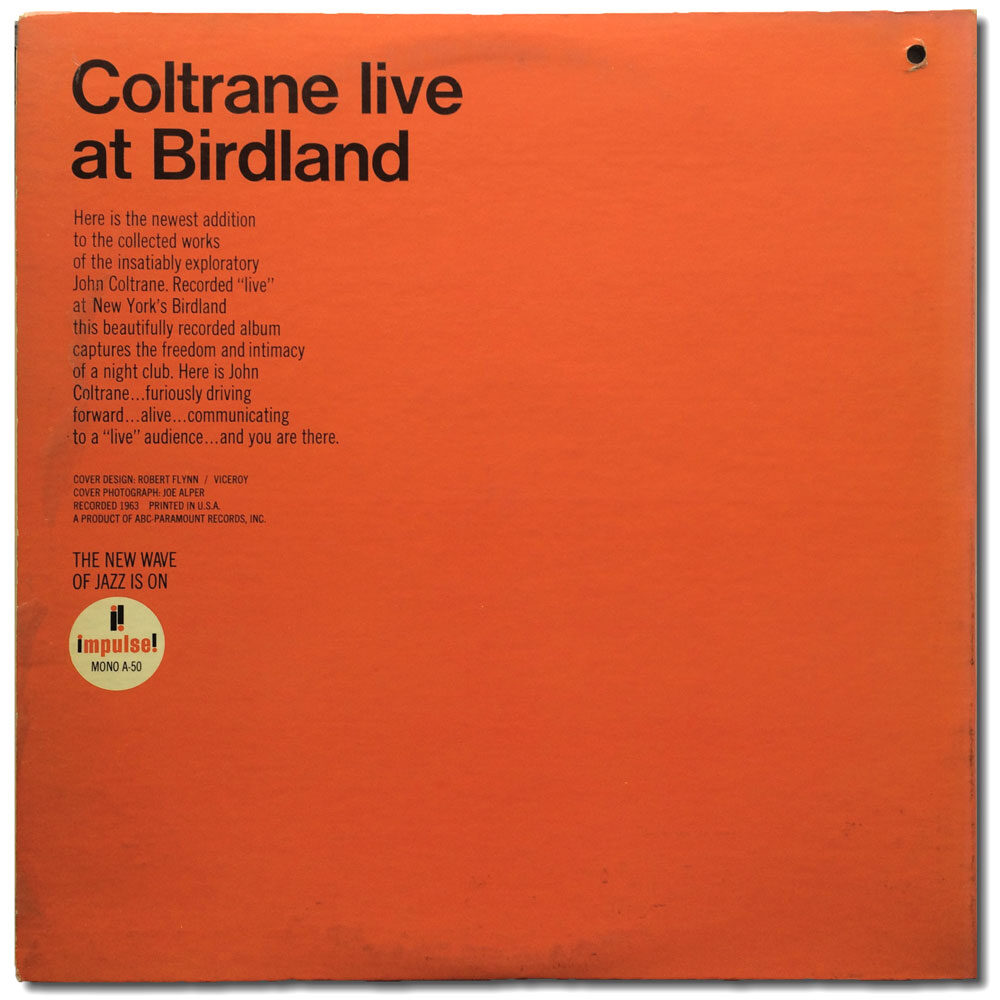
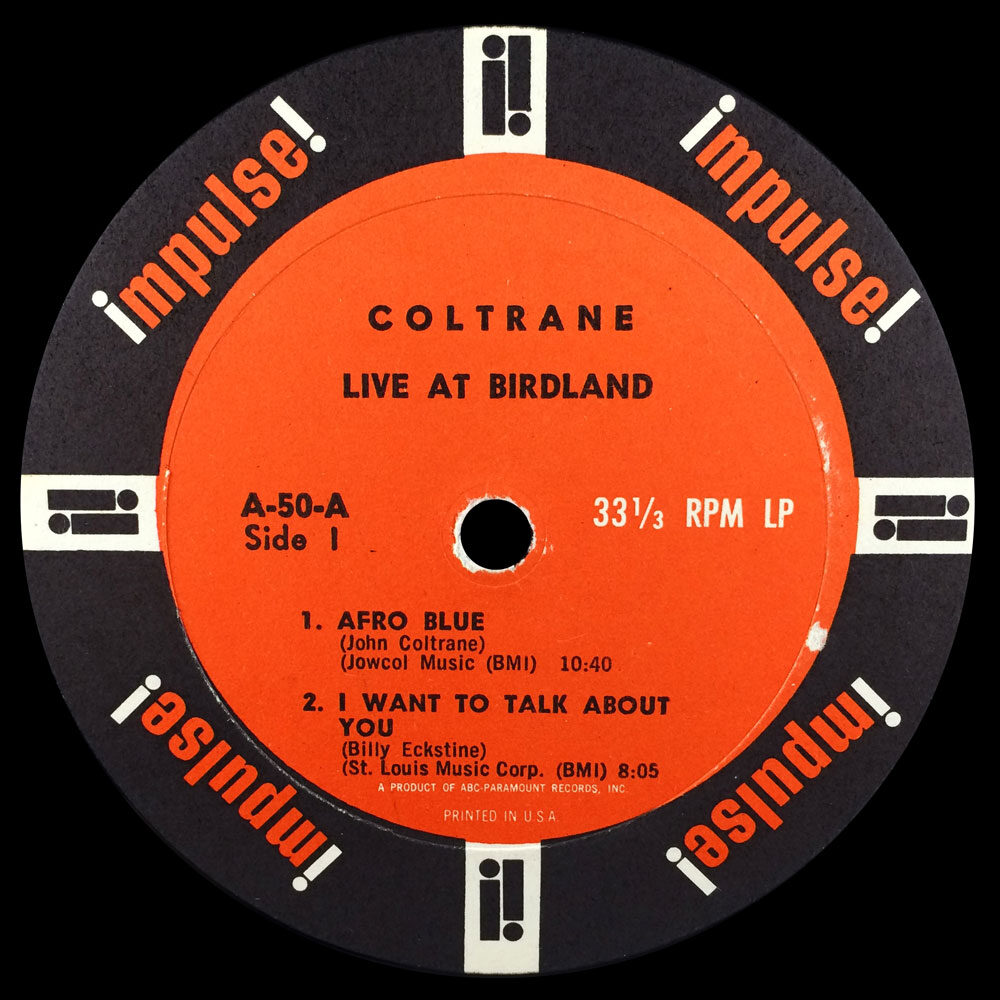
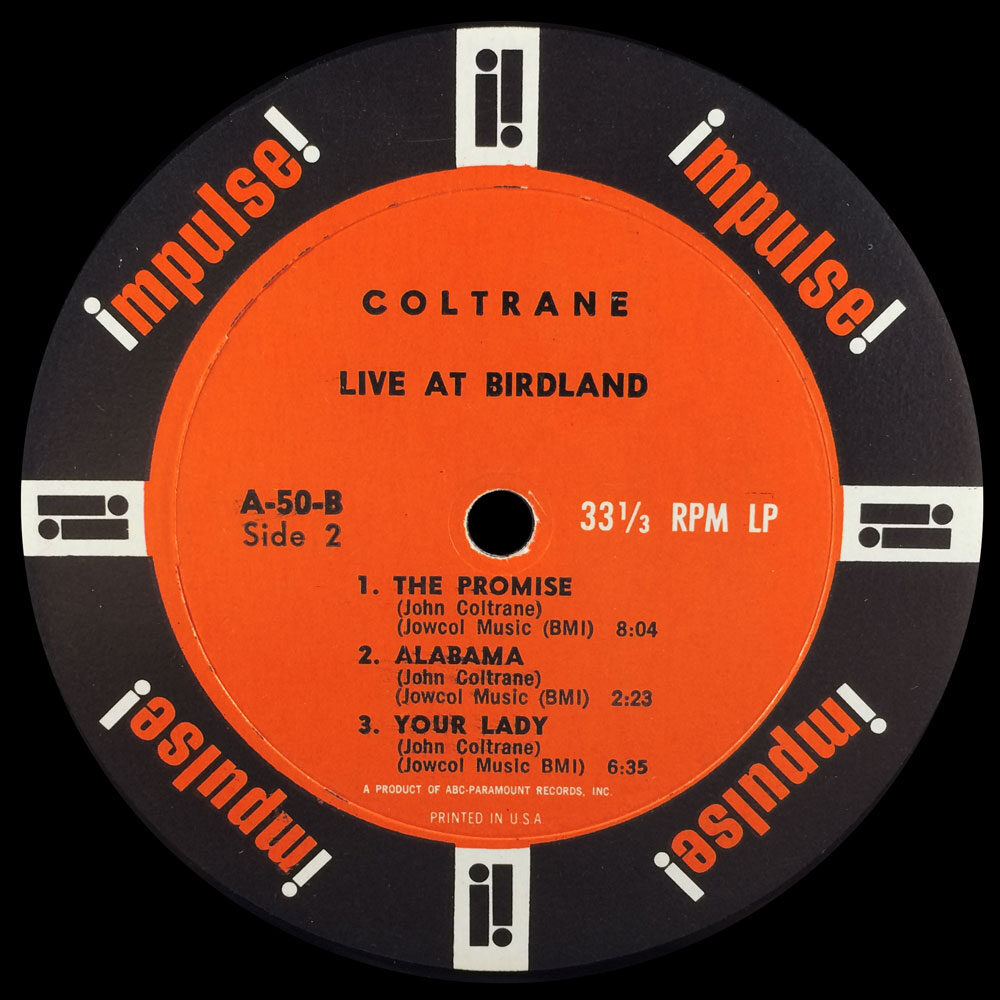
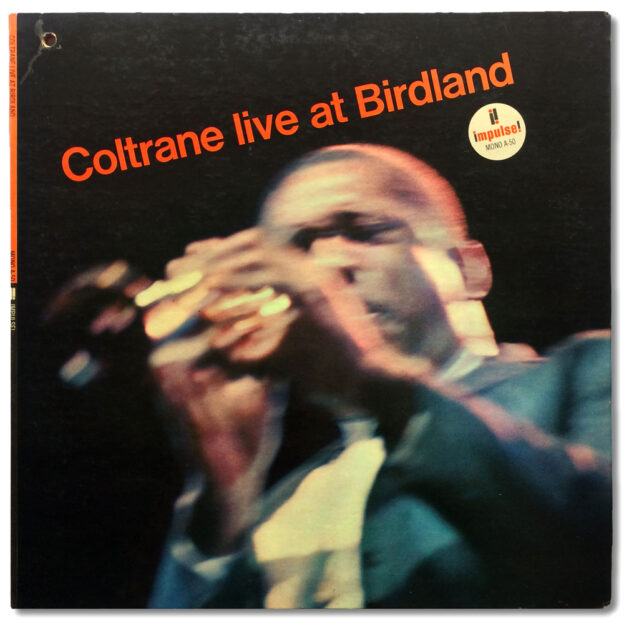
Vinyl Spotlight: John Coltrane, Coltrane Live at Birdland (Impulse 50) Original Mono Pressing
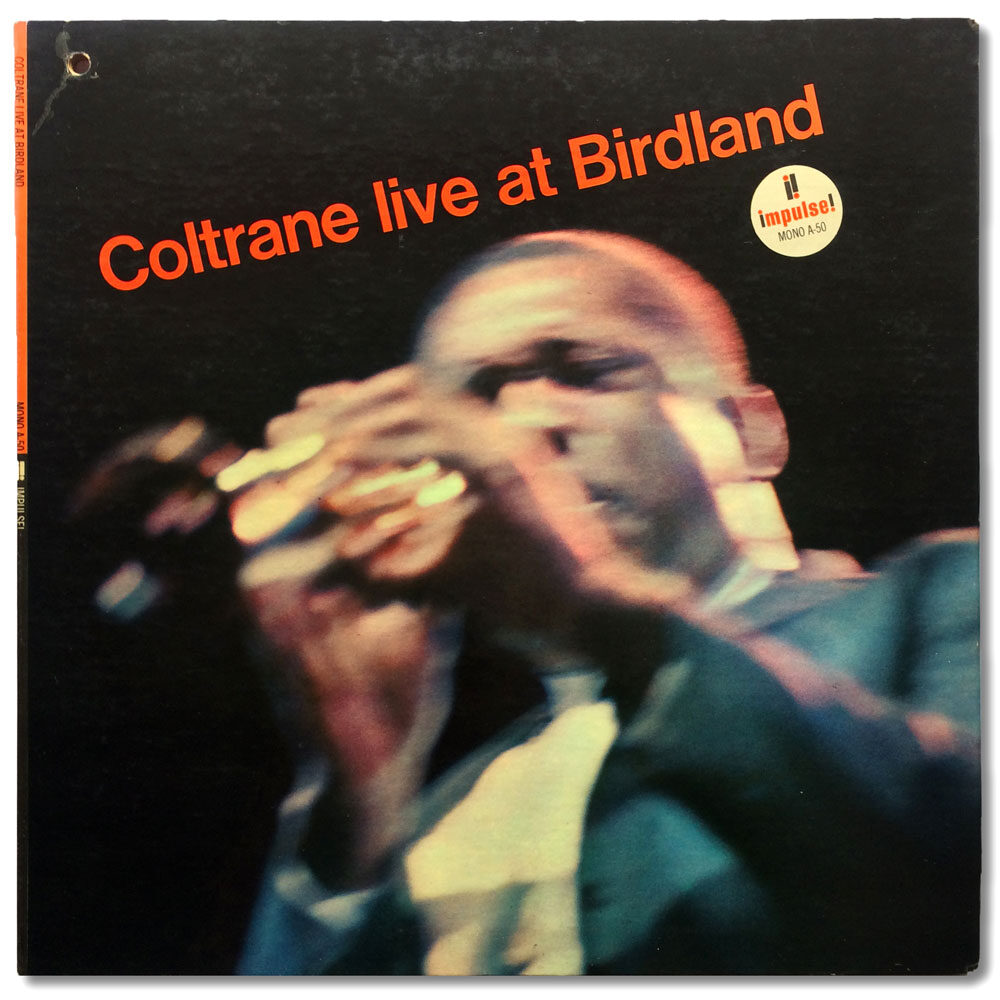
  • Original 1964 mono pressing
  • “ABC-Paramount” on labels
  • “VAN GELDER” in dead wax

Personnel:

  • John Coltrane, tenor and soprano saxophone
  • McCoy Tyner, piano
  • Jimmy Garrison, bass
  • Elvin Jones, drums

All but “Alabama”, “Your Lady” recorded October 8, 1963 at Birdland, New York, New York
“Alabama”, “Your Lady” recorded November 18, 1963 at Van Gelder Studio, Englewood Cliffs, NJ
Originally released April 1964

Generally speaking, I don’t know the Impulse catalog very well, and accordingly I have a harder time keeping track of the ‘first-first pressing’ melee associated with the label. Thus I’m not really sure if this is a ‘first-first pressing’ or just a ‘first pressing’, but it has the Van Gelder stamp of approval and, more importantly, it plays through without the hideous artifacts of groove wear so I’m a happy camper. This copy had a lot of light scuffs when I first looked at it, which is probably what kept the price down, but by the time I got it home and gave it a listen I was happy to find that this was a rare case of a record ‘playing better than it looked’. I am so inspired by the intensity with which John Coltrane played the soprano saxophone during this time period, and “Afro Blue” is a fine example of that passion and vigor.

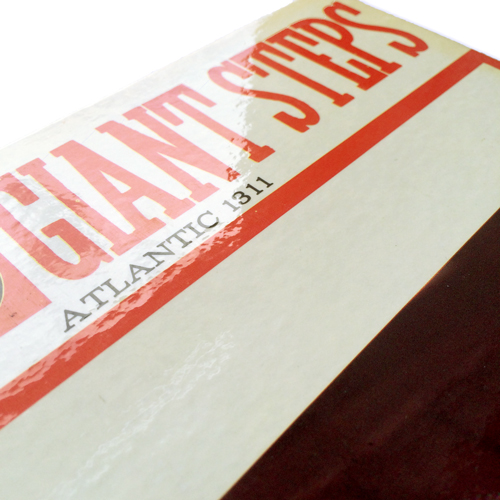
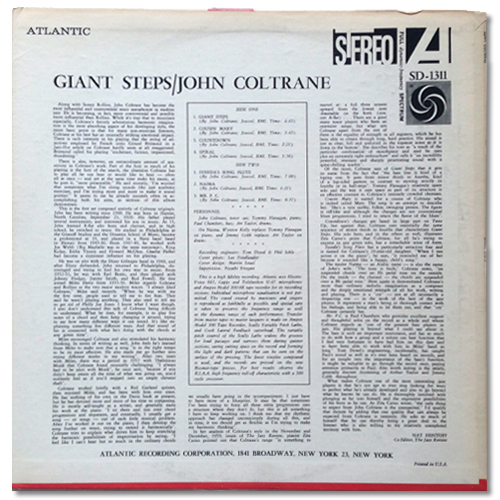
Vinyl Spotlight: John Coltrane, Giant Steps (Atlantic 1311) Mono vs. Stereo Edition

  • Fifth mono pressing circa 1966
  • Orange & purple label
  • Box logo side 1; black fan logo side 2
  • Side 1/2 matrix: 11637-A “AT” / 11638-A “AT”

VERSUS!
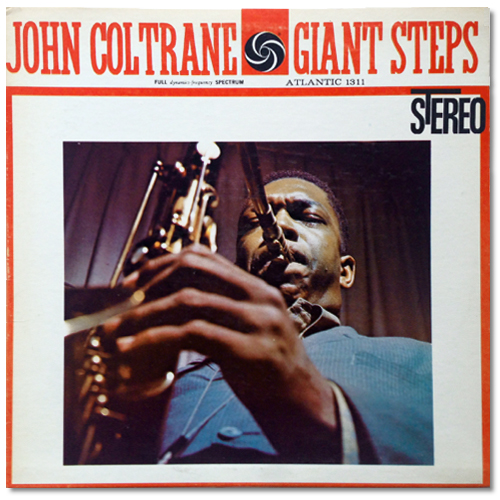
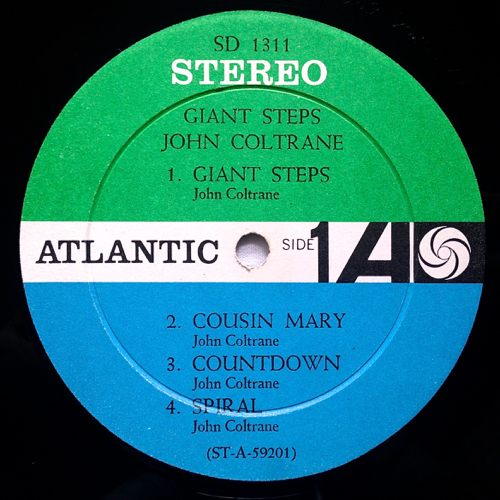
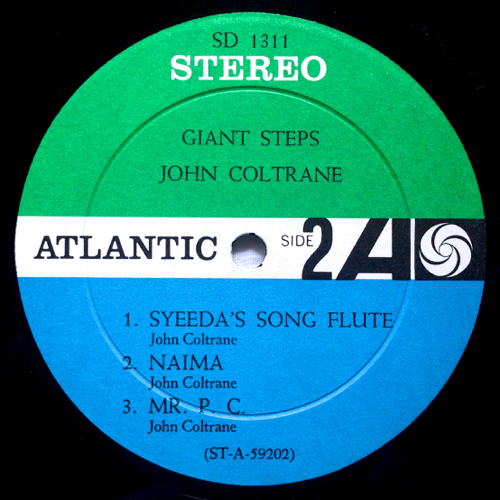
  • Second stereo pressing circa 1960-1962
  • Green & blue label
  • Deep groove on both sides
  • White fan logo on both sides
  • Side 1/2 matrix: AVCO ST-A-59201 / AVCO ST-A-59202

Personnel:

All but “Naima”:

  • John Coltrane, tenor saxophone
  • Tommy Flanagan, piano
  • Paul Chambers, bass
  • Art Taylor, drums

“Naima” only:

  • John Coltrane, tenor saxophone
  • Wynton Kelly, piano
  • Paul Chambers, bass
  • Jimmy Cobb, drums

All but “Naima” recorded May 4-5, 1959; “Naima” recorded December 2, 1959
All selections recorded at Atlantic Records’ 56th Street studio, NYC
Originally released January 1960

1 Giant Steps
2 Cousin Mary
3 Countdown
4 Spiral
5 Syeeda’s Song Flute
6 Naima
7 Mr. P.C.
Behold! Deep Groove Mono offers up its first ever head-to-head comparison. Here we take a listen to vintage mono and stereo pressings of the classic John Coltrane album Giant Steps. I had the mono LP first, but I liked the original stereo CD so much that when I saw this stereo LP for a great price I couldn’t pass it up.

Tom Dowd

Giant Steps was recorded at Atlantic’s infamous 56th Street “office studio” under the supervision of legendary recording engineer Tom Dowd. According to the album’s liner notes, it was recorded to an Ampex 300-8R eight-track tape recorder, the results of which are two distinct i.e. ‘dedicated’ mixes, meaning the mono mix is not a ‘fold-down’.

The mono: Coltrane is front and center in this dark, bass-y mix. Trane and pianist Tommy Flanagan sit in good relationship to each other, though Paul Chambers’ bass doesn’t have a whole lot of definition, and Art Taylor’s drums get a bit buried behind Coltrane’s screaming presence.

The stereo: No instruments are presented center here, which for better or worse takes something away from Trane’s presence. (I doubt that Dowd was not yet privy to the theory of the ‘phantom center image’, and I can’t help but wonder why he was still not utilizing the center at this time.) Chambers’ bass still lacks good definition, though the spread gives Taylor more room to cut through. My first version of this album was the original 1990 stereo CD and I always appreciated how well I could hear the nuances in Taylor’s drumming in the stereo mix (I especially love the detail of the ride cymbal).

Head-to-head: On speakers, both mixes sound quite full, but in headphones the stereo version’s wide spread and its emphasis on the bass and treble leaves the mono feeling quite thin. However, Coltrane commands more presence in the mono mix, not only because he has been shifted from the far left to the center, but the mono also seems to favor the midrange, where the saxophone’s timbre is largely defined. This is probably why I feel that Coltrane sounds a bit muffled in the stereo mix when compared to the mono.

The verdict: Through speakers, both mixes sound great to me and I’d be happy to own either copy if I didn’t have a choice. But while I can only assume that most die-hard Coltrane fans will prefer the leader’s stronger presence in the mono mix, I personally love hearing all the nuances of Taylor’s kit in the stereo mix through headphones, which is probably why this is my favorite listening experience overall.

To play us out, I have included “Naima” as an added bonus because it is simply one of my favorite ballads of all-time. I chose the mono version because I find that the tune’s sparse composition works better without all the ‘empty space’ inherent in the stereo mix.