Tag Archives: Jazz

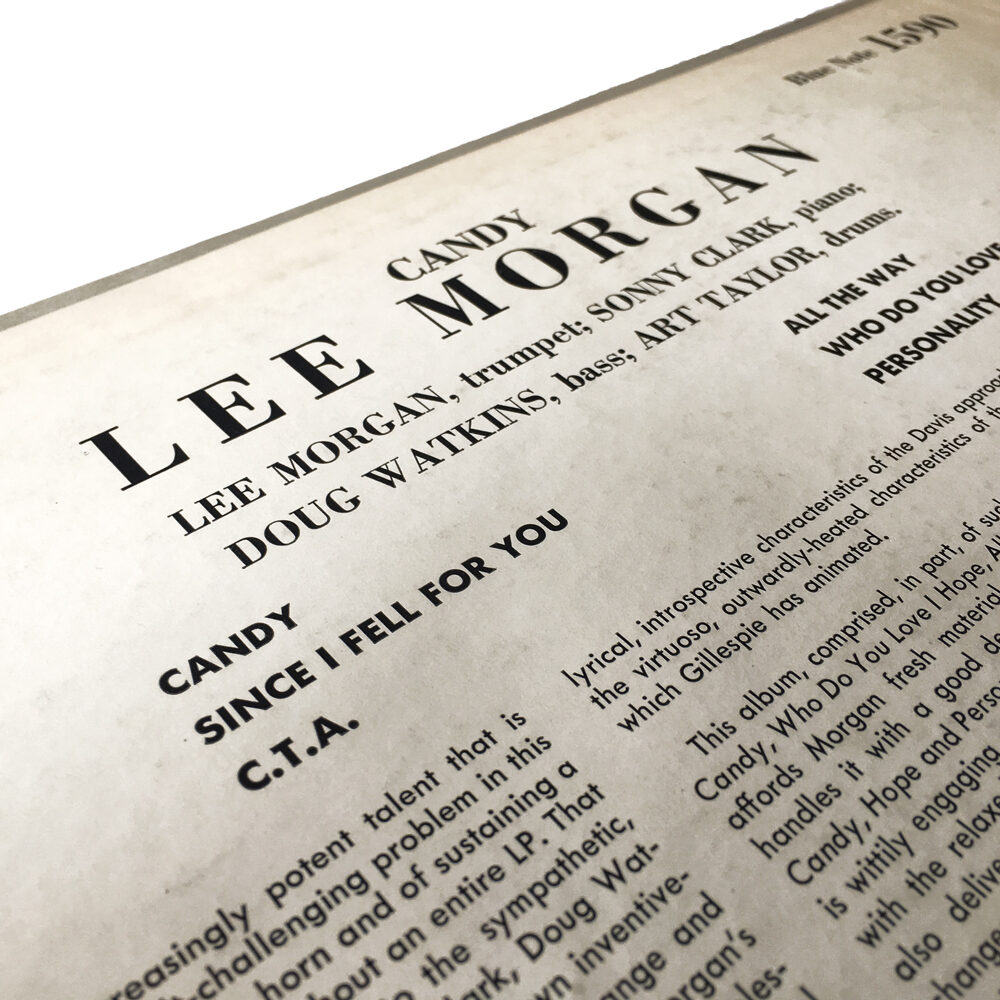
Vinyl Spotlight: Lee Morgan, Candy (Blue Note 1590) Original Pressing

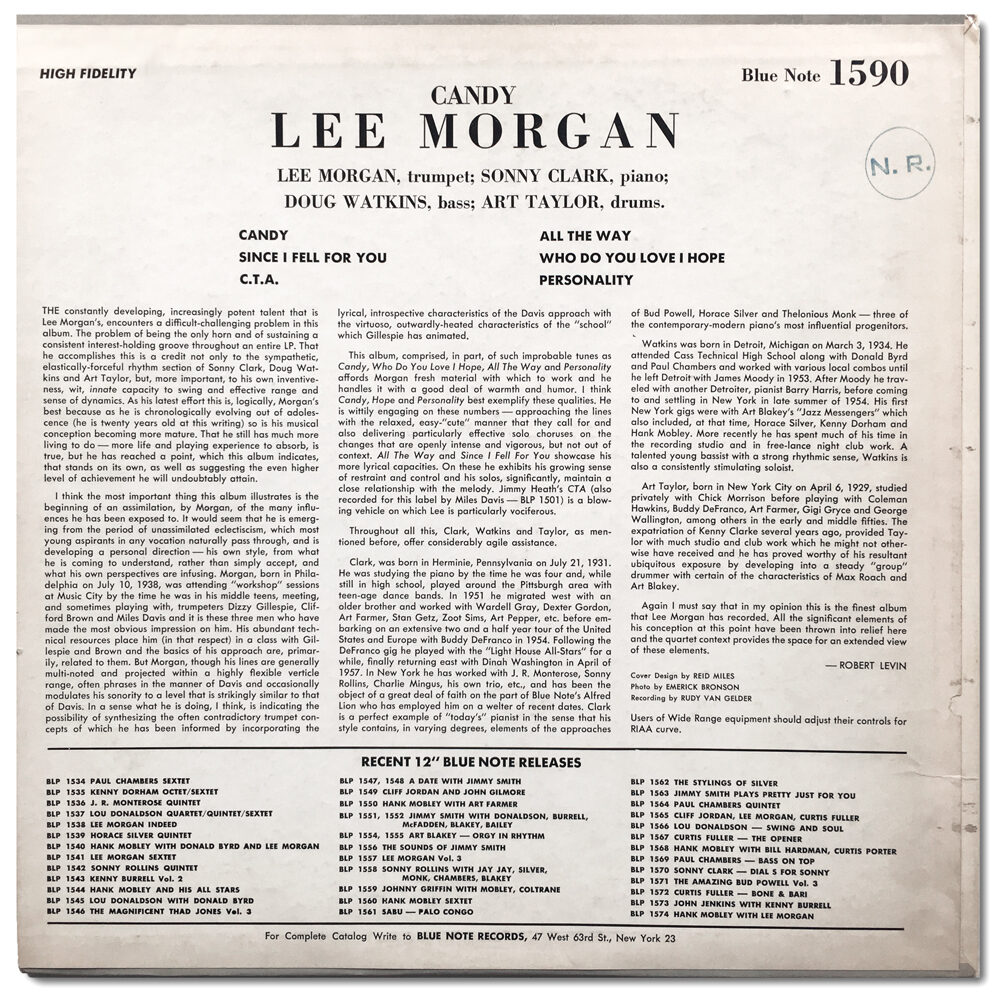
  • Original 1958 mono pressing
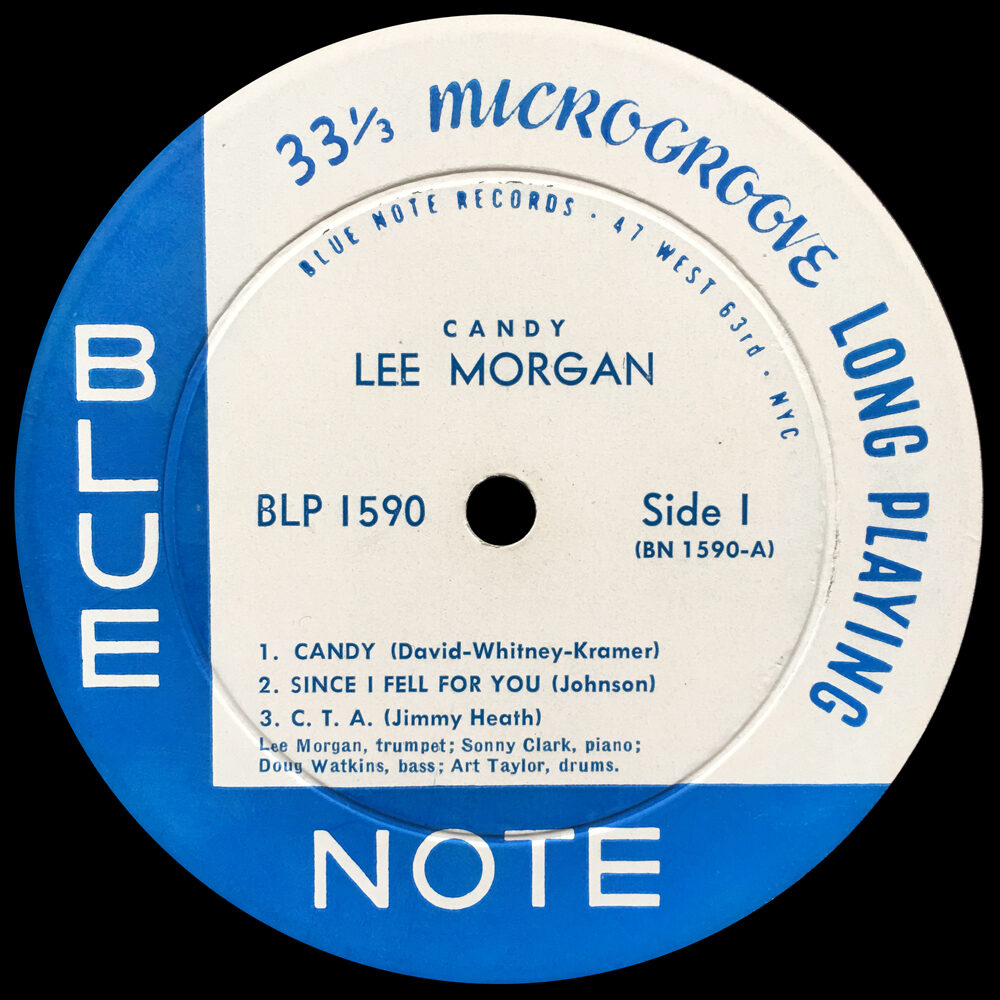
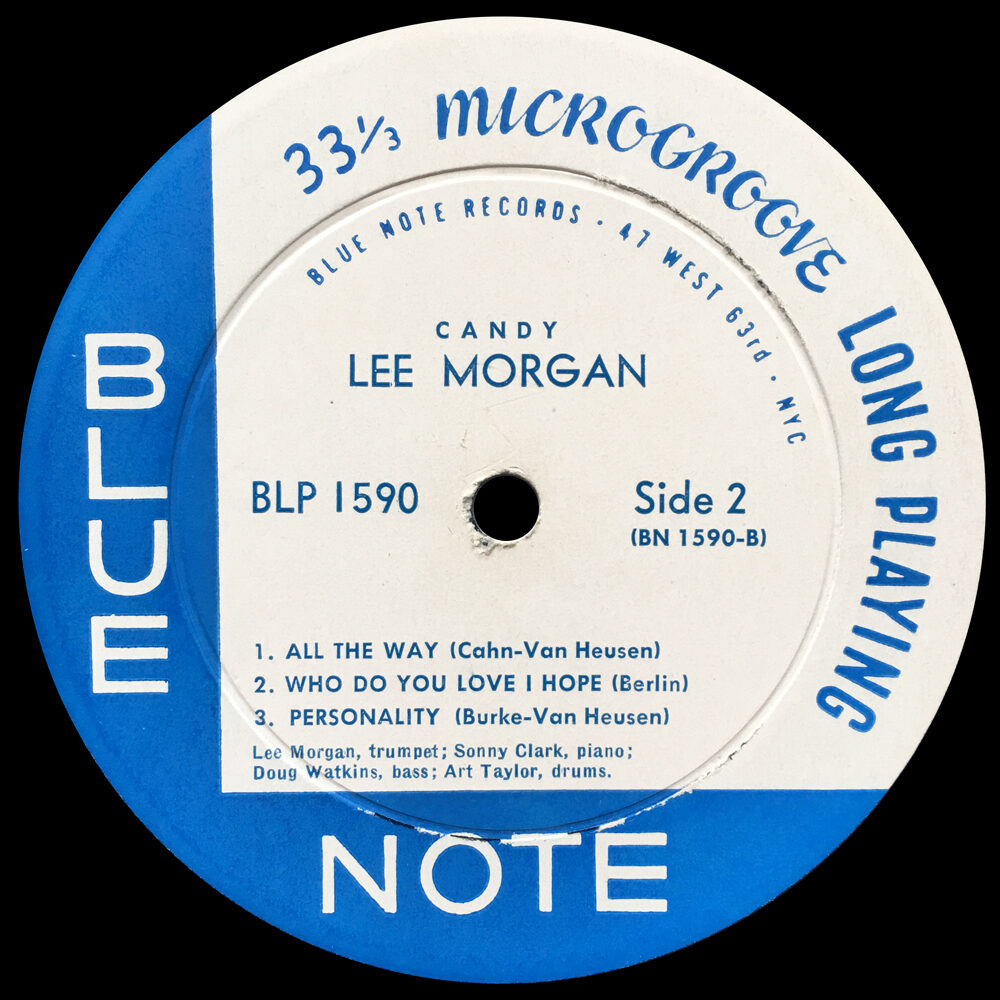
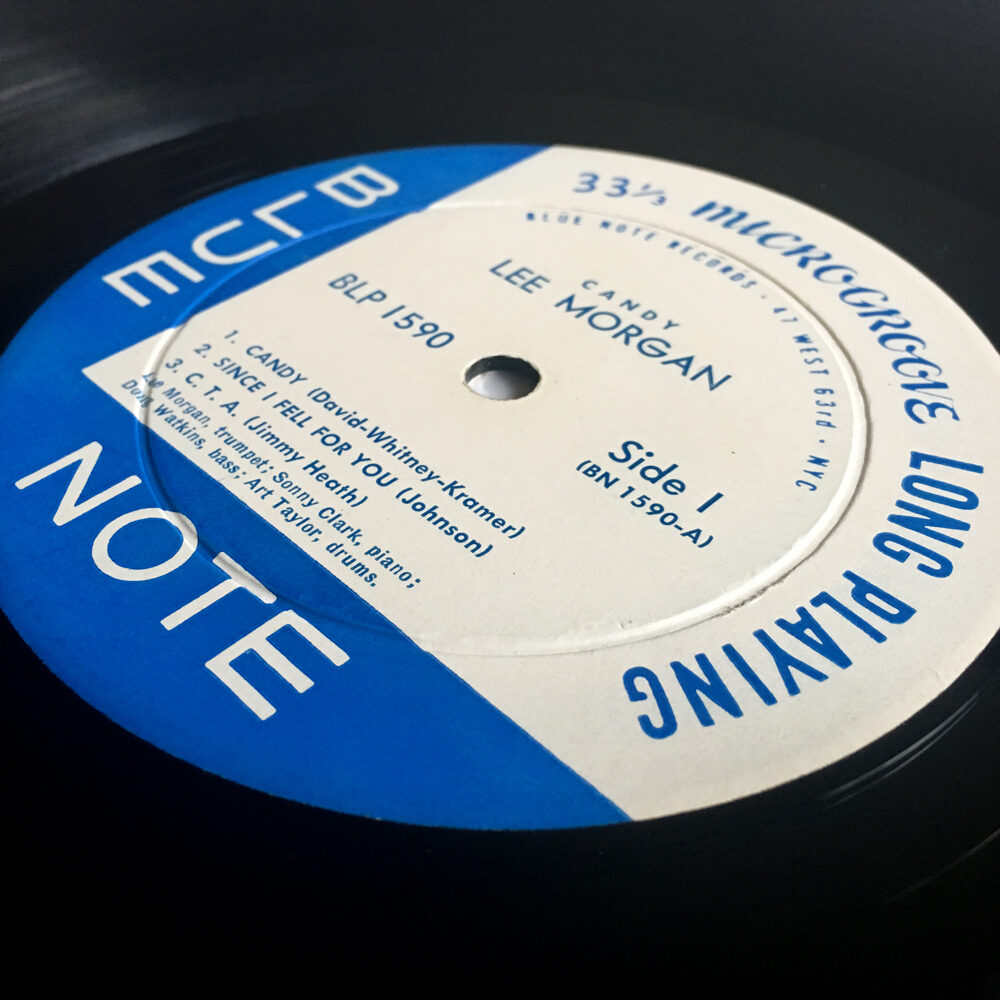
  • West 63rd address on both labels
  • Deep groove on both sides
  • Plastylite “P” etched and “RVG” stamped in dead wax

Personnel:

  • Lee Morgan, trumpet
  • Sonny Clark, piano
  • Doug Watkins, bass
  • Art Taylor, drums

Recorded November 18, 1957 and February 2, 1958 at Van Gelder Studio, Hackensack, New Jersey
Originally released September 1958

It appears that along with a recent change in my philosophy of collecting has also come a change in my luck. I recently decided to go all in on creating the most authentic vintage mono jazz LP listening experience I could. This meant a new turntable (a gorgeous Garrard 301 which I have already secured), a separate component tonearm fitted to a plinth, and the Ortofon CG 25 mono cartridge. But before I could gather all the components for this new rig, an opportunity presented itself to me that I would have been a fool to ignore.

As a result of my change in philosophy, I have worked to put myself in a position where original pressings of my favorite jazz albums are more within my reach financially. Not too long after making this decision, this copy of Lee Morgan’s Candy popped up in a friend’s Instagram feed. “That seems like a very fair price for that Morgan,” was my first text to my friend, sent without any serious intent to buy. But 24 hours later the record was still on my mind, so I worked on my financials and decided I could make it work — if the record checked out — and two days later I made the 90-minute trip upstate on the Metro North railroad to look at the record first-hand and give it a listen.

Once I had it in my hands, the jacket was indeed a strong VG+ with no splits, and the labels were clean with the assumed deep grooves, “47 West 63rd NYC” address, and lack of registered trademark “R”. I listened to the record in its entirety before making a decision. Overall I would have play graded it VG+ with light surface noise that could be heard more during some of the quieter passages, but no loud or repetitive clicks and no distortion from wear. The record came from the original owner, an Upper West Side native who, according to my friend, remembered it as the first record he ever bought.

After making payment, I got on the train home with reserved excitement. I was honestly banking on the noise quieting down after running it through my Spin Clean (one of the greatest dollar-to-value purchases a collector can make, in my humble opinion). After one cleaning the surface noise settled down and I was quite pleased. But after a few plays I wondered if the simple act of playing the LP may have loosened some of the dirt, so why not run it through the machine one more time and see what happens? And I was happy to find that the surface noise had virtually disappeared in many places.

As for holy grails, I’d say Quiet Kenny, Jutta Hipp with Zoot Sims, and Overseas are near the top of my wish list, but Candy is really my number one, mainly because I find the entire program to be so great. When I first got into jazz, the atypical arrangement of trumpet quartet stood out to me. I love how playful sounding the music is, and the ballads are some of my favorites of all time.

I think Candy is marginalized by jazz critics for its lack of original compositions, but I could care less when the songs are played with such beauty and brilliant execution. It turns out that most of the songs have their origins in the mid-1940s when Morgan was between the ripe ages of seven and eight. The title track was first recorded by Johnny Mercer and Jo Stafford for Capitol Records and reached number 2 on Billboard’s Best Seller chart in 1945. That same year, “Since I Fell for You” was written and recorded by Buddy Johnson for Decca Records. “Who Do You Love I Hope” is a lesser known song written by Irving Berlin for Annie Get Your Gun in 1946, and “Personality”, penned by Jimmy Van Heusen and Johnny Burke for the play Road to Utopia, also premiered in 1946 with a film starring Dorothy Lamour to follow in 1950.

The remaining two songs completing the tracklist would have been more readily recognized by their respective audiences in 1958. “C.T.A”, the only cut on the album with modern jazz origins, was written by saxophonist Jimmy Heath and first recorded by Miles Davis with Heath on sax for Blue Note in 1953 (according to Miles, “C.T.A.” were the initials of Heath’s then-girlfriend Connie Theresa Ann). “All the Way”, the 1957 Academy Award winner for Best Original Song, was written by Van Heusen and Sammy Cahn for The Joker Is Wild, a film about the life of comedian/singer Joe E. Lewis starring Frank Sinatra. Scroll down to hear a Spotify playlist featuring the original recordings of all of these great songs.
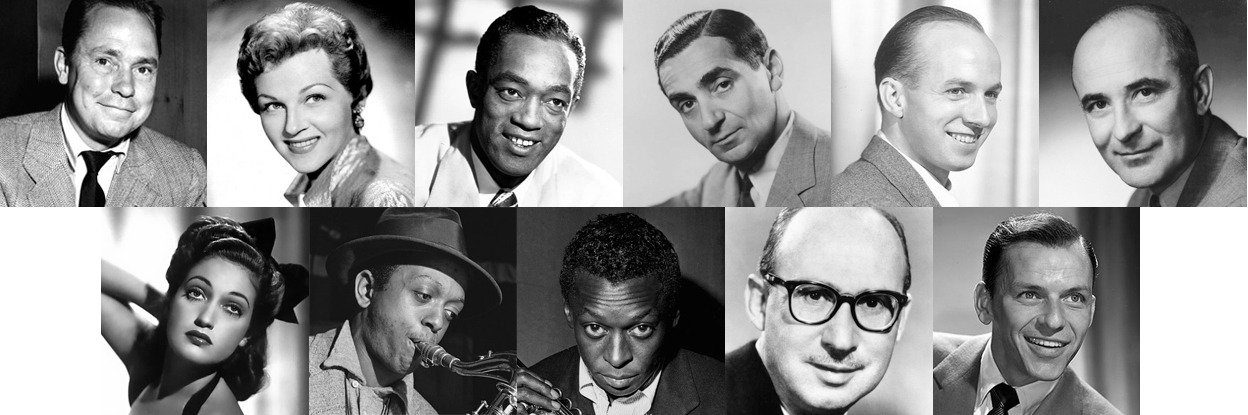
Top: Johnny Mercer, Jo Stafford, Buddy Johnson, Irving Berlin, Jimmy Van Heusen, Johnny Burke
Bottom: Dorothy Lamour, Jimmy Heath, Miles Davis, Sammy Cahn, Frank Sinatra

Candy immortalizes the legend of Rudy Van Gelder’s Hackensack home studio, with the album’s sparse arrangement leaving plenty of room for the sound of the engineer’s living room to make its mark on the recording. Sonny Clark’s piano playing takes center stage here and can be heard with startling clarity, and Art Taylor’s drum kit embodies the gorgeous drum sound Van Gelder would regularly get at Hackensack in the 1950s: a slightly roomy, unified sound with soft cymbals and lifelike accuracy in the bass, snare, and tom toms (for this session, perhaps a little too accurate at times: most collectors are aware of Taylor’s infamous squeaky hi-hat pedal during Clark’s leading solo on the title track).
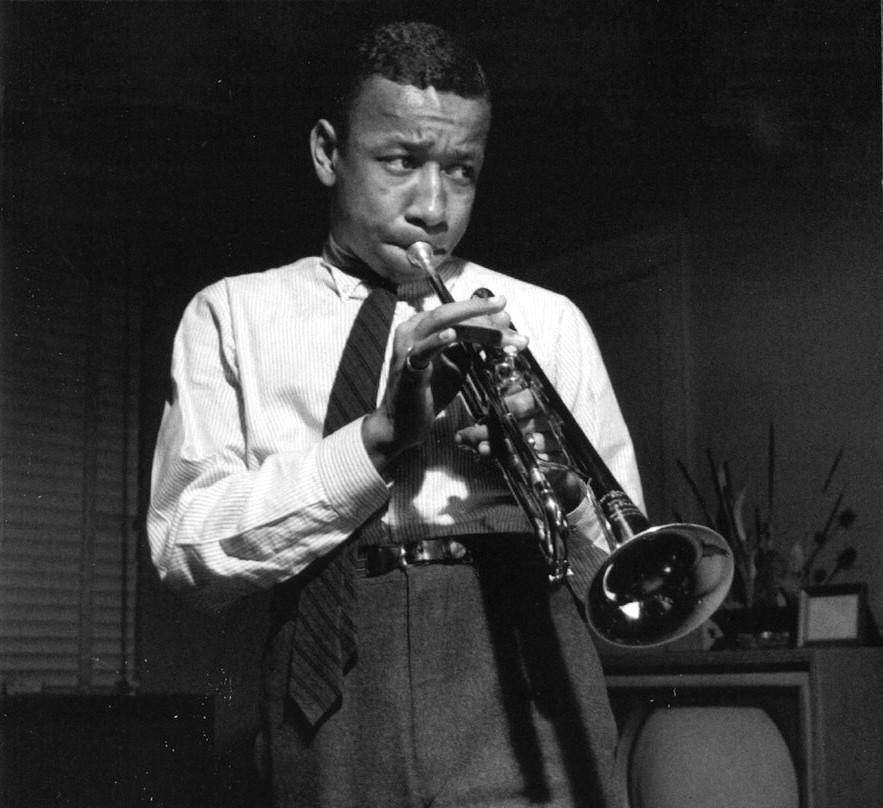
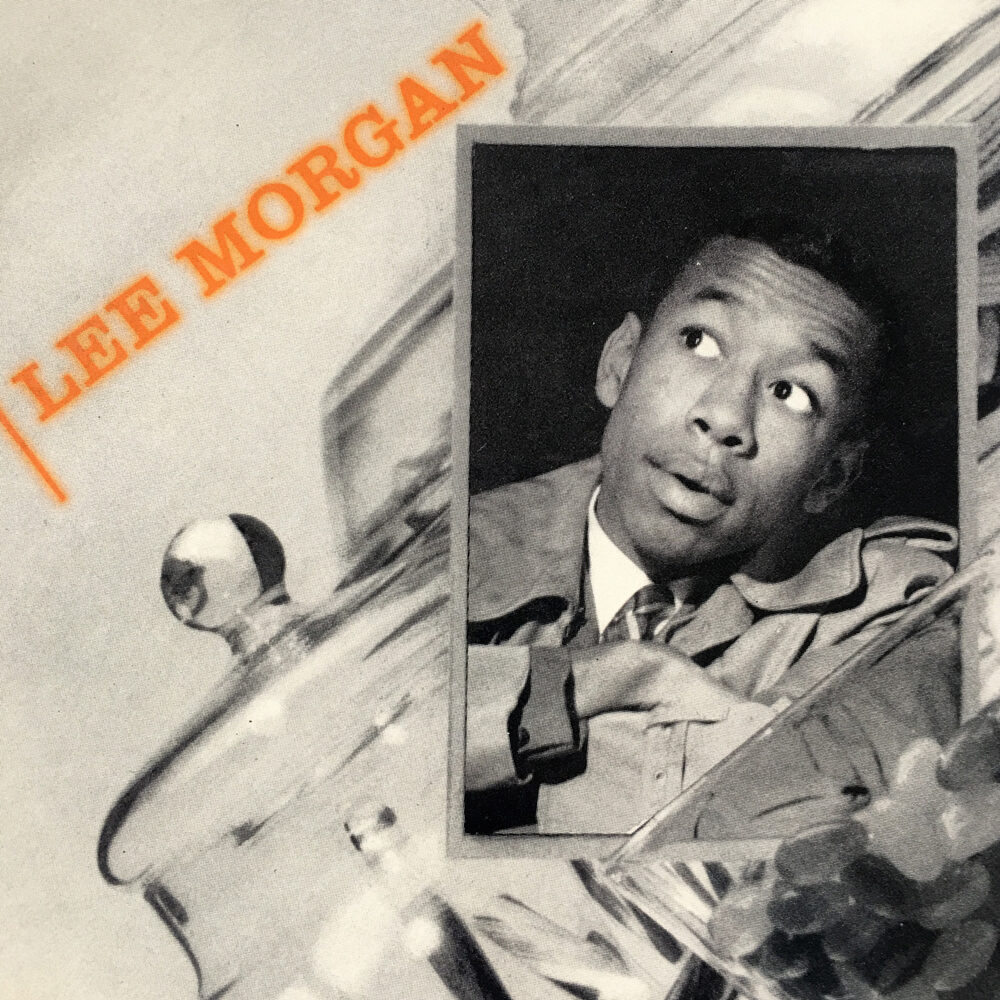
Morgan dressed to impress while recording Candy in February 1958 at Hackensack

The mono presentation of the music, while not exclusively found on the original LP, is less than common. In stereo the music sounds as full as primitive stereo can with Lee’s regular presence on the far left of the spread, but the sparse arrangement here never leaves me feeling that the mono presentation of the band is “crammed into the center image”, as critics of the format often object. What’s more, there does appear to be some tape degradation on my stereo 1987 Capitol/Manhattan CD during “Who Do You Love I Hope”, though this is a nonstarter on all mono issues of the album. Apparently Music Matters did find some sort of a two-track “safety tape” of Candy that was in better condition than the old master, and as a result decided to release the album in stereo for their 33 1/3 R.P.M. series after releasing it in mono for their original 45 R.P.M. campaign.

Other interesting variations in the mono and stereo releases of this album include different piano lines played by Sonny Clark for the intro of “All the Way”. The intro of a different take must have been preferred by the team and thus spliced into the full-track master reel by Rudy Van Gelder. Why the two-track reel did not receive similar treatment is testament to the fact that Candy was only released in mono originally, with stereo being a mere afterthought for Blue Note producer Alfred Lion in early 1958. Additionally, the 1987 stereo CD boasts a reading of “All at Once You Love Her” that is noticeably absent from the original tracklist, which I have to believe was a decision made solely as a consequence of the temporal limitations of the LP format.

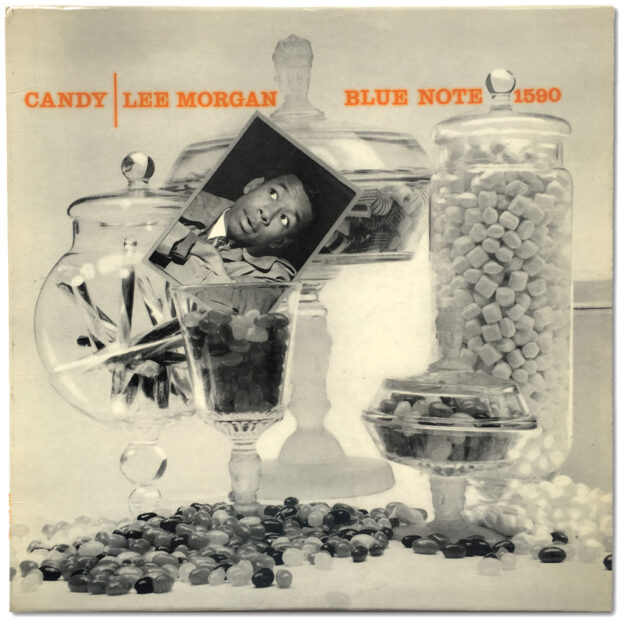
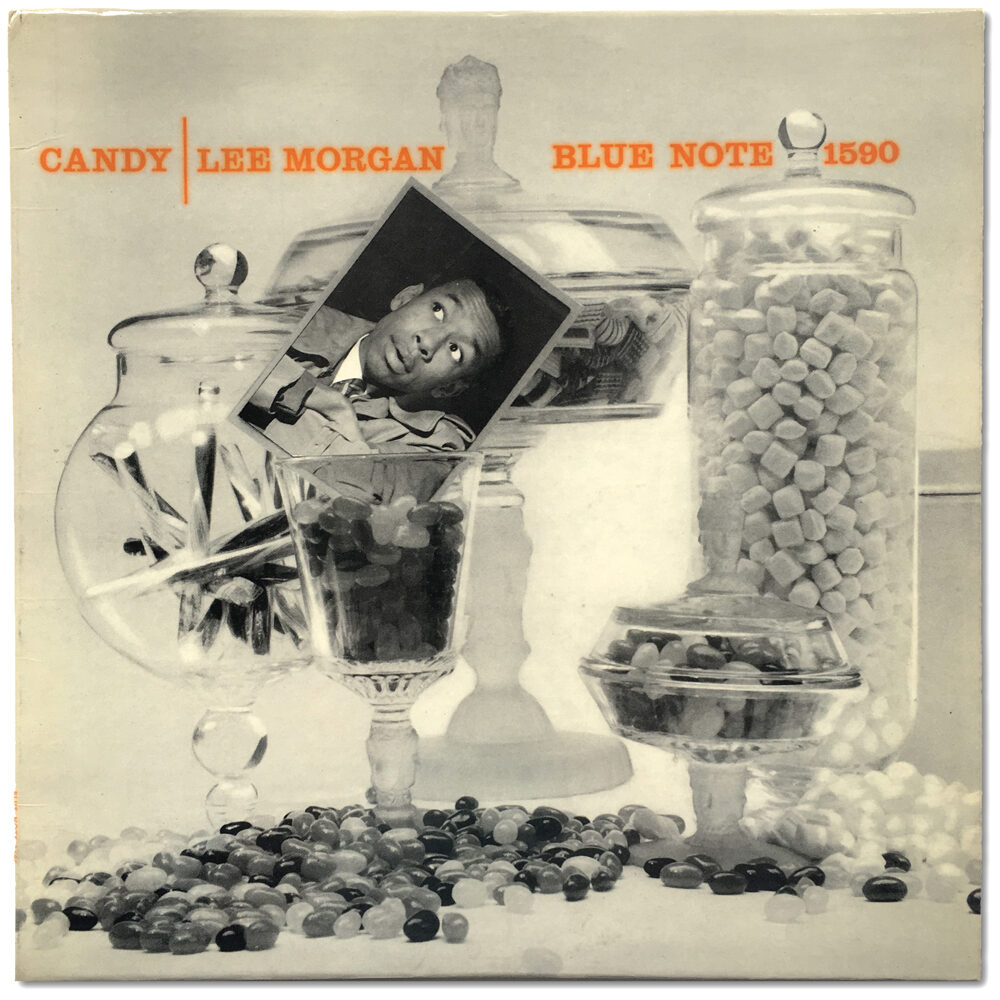
Finally, I admit that I understand when collectors express their distaste for this album cover, but I can’t help but love it. As Lee mischievously glances upward at his name hovering above, the young trumpeter’s boyish innocence conveys a sense of awe toward his newfound fame (side note: though it appears to be a shot from the same sequence of photos as the original, Music Matters used a slightly different photo of Morgan for their reissues). Not being sure why Reid Miles opted to neutralize the potentially explosive rainbow of colored candy pieces depicted here with a black-and-white overlay — perhaps he felt it would be too much of a departure from Blue Note’s two-tone theme — it is a juxtaposition that nonetheless succeeds, with the help of Morgan’s presence, at communicating the playful nature of the musical themes within.
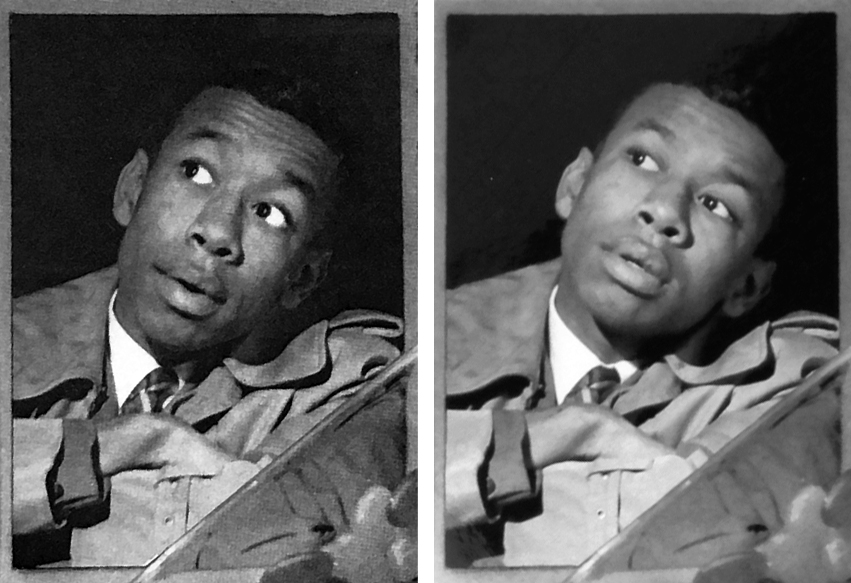
Photos used for the original release (left) and Music Matters reissue (right) of Candy

When I first started collecting, I gawked at the prices original pressings of this album would fetch, and I would have never guessed I’d be in possession of a copy so early on in my collecting years. So the collector saying goes, music comes first. I have always cherished the gorgeous music presented here, but I can’t deny that listening to an original mono pressing has caused my ears to perk up and listen more intently, specifically to the charming solos of all the instrumentalists. I couldn’t be more satisfied with this acquisition, and this copy of Candy is now, obviously and without question, the crown jewel of my collection.


Spotify Playlist: Songs That Inspired Candy

Note: If you are not logged in to Spotify on your web browser, clicking the “play” icon above will only play 30-second clips of the songs. Click “Play on Spotify” or the Spotify logo to launch the app on your computer. Click here to open this playlist in your web browser.
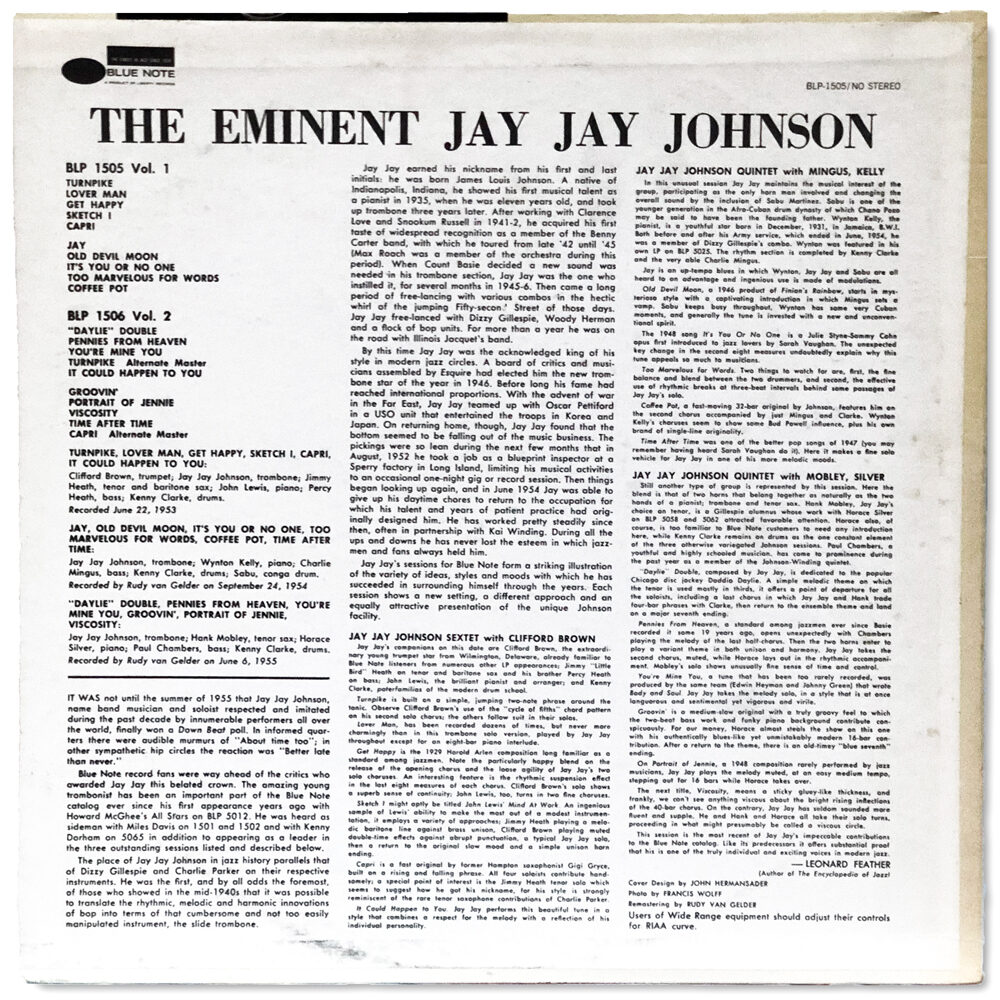
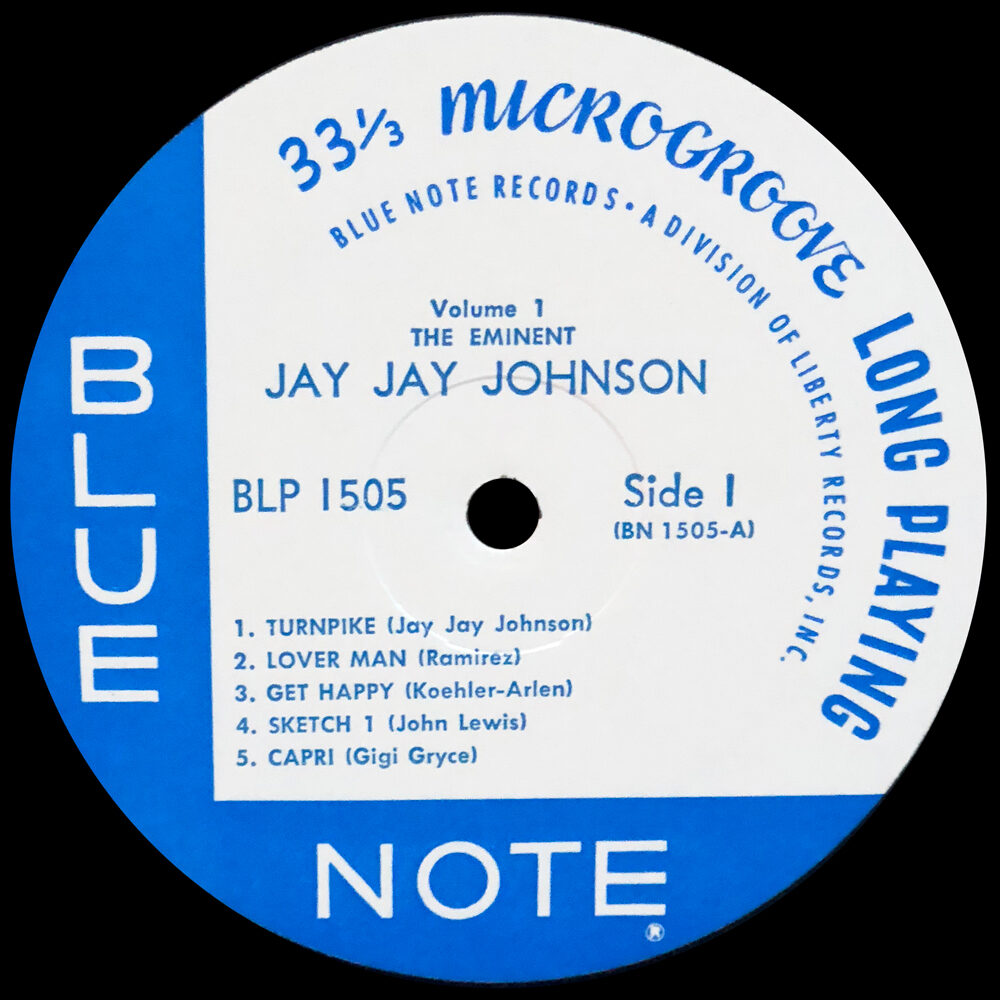
Vinyl Spotlight: The Eminent Jay Jay Johnson, Volume 1 (Blue Note 1505) Liberty Mono Pressing

  • Liberty mono pressing circa 1966-1970
  • RVG etched in dead wax

Personnel:

Side 1:

  • Clifford Brown, trumpet
  • J.J. Johnson, trombone
  • Jimmy Heath, tenor & baritone saxophone
  • John Lewis, piano
  • Percy Heath, bass
  • Kenny Clarke, drums

Side 2:

  • Jay Jay Johnson, trombone
  • Wynton Kelly, piano
  • Charles Mingus, bass
  • Kenny Clarke, drums
  • Sabu Martinez, congas

Side 1 recorded June 22, 1953 at WOR Studios, New York City
Side 2 recorded September 24, 1954 at Van Gelder Studio, Hackensack, New Jersey
Originally released in 10″ format (BLP 5028/5057) in 1953/1954 (BLP 1505 released January 1956)

Selection: “Old Devil Moon” (Lane-Harburg)

Note: This is a guest post by Charles Strong.

As with many of these compilations of earlier Blue Note material, there are several different configurations of musicians on each track of this album. But, unlike many of those compilations of 10” and 78 RPM material, this collection of sides contains some of the finest musicians in early bebop. Led by arguably the greatest trombonist in modern jazz, J.J. Johnson, the lineups play fast and furious on the first side with the talismanic Clifford Brown trading very quick riffs with Johnson and Jimmy Heath on the opening track, “Turnpike”. If the song was named after fast traffic on a New Jersey toll road, it is very appropriate. The three horns pound out a hard-driving, repeating riff to open the song. Per usual, Clifford Brown and Jimmy Heath continue the furious pace as they often do on most of the recordings featuring them at the time.

But what is most impressive about fast-paced bop numbers like “Turnpike” that feature a trombonist or tubist is each player’s ability to keep pace with the other soloists. During a short period of time in junior high school, I chose trombone as my first instrument. In those six months, the only thing I learned on the trombone was that it was extremely difficult to play anything fast. My young muscles struggled to play even quarter notes fluidly. I simply could not move the slide into the different positions fast enough to be in key. Having to do that all while breathing in sync with finger motions is very difficult. Knowing what it’s like to move that slide into the perfect position and then hearing J.J. Johnson fly through a solo, playing notes in rapid fire succession with the ease of a trumpeter or saxophonist impresses me every time I play this LP.

On the next song, the same band plays the standard “Lover Man”. Like many standards, it is a classic that has seen very creative interpretation by several musicians. But what sets this reading apart is the bottom end sound of Johnson’s trombone. The other trombonist that I (and frankly, most other collectors) revere most is Curtis Fuller. For me, Fuller always has a somber tone to his trombone sound even in songs such as the classic “Blue Train”, which is a very uptempo song. But Johnson’s tone, though low like Fuller’s, has a very swinging yet casual kind of sound. It seems to dare the audience to sway but not quite dance to the music. Also, Johnson seemed to embrace the wide use of trombones in the new and exciting latin salsa music that was emerging from New York at the time; his music can sometimes have a latin tinge that adds a unique sound to the typical bebop track.
The latin influence is most present on the song that I most enjoy on this LP. Johnson turns the Broadway standard “Old Devil Moon” into a cool, relaxing latin jam. Johnson plays his trombone with a kind of warble, like a guitarist with a wah-wah pedal for a special effect. As he plays the familiar riff, time is kept by one of the most influential drummer of the early days of bebop, Kenny Clarke. As worthy as he is of the praise he receives, for me the most exciting percussionist of the whole compilation is the conguero, Sabu Martinez. I’ve always been a fan of the conga on classic jazz sessions, whether it’s Ray Barretto on such influential recordings as Blues Walk, Manteca, and Midnight Blue, or Martinez, who is very lively on this LP. It is a rare treat to hear Sabu (who had a short life and career due to drug abuse), and he is the perfect fit to a latinized song such as this one.

Strangely enough, Charles Mingus, the biggest name on the session and one of the greatest composers, bassists, and personalities in the history of music, fails to make any kind of impression on me here. Mingus always seemed, to me, to enjoy playing and writing his own material most. Perhaps he felt restrained by playing music composed by others, and in this case maybe he had grown tired of exploring these standards. It is also documented that Mingus did not like the way that Blue Note’s house engineer, Rudy Van Gelder, recorded his sound. I notice the bass of Percy Heath far more on the record than I do Mingus.

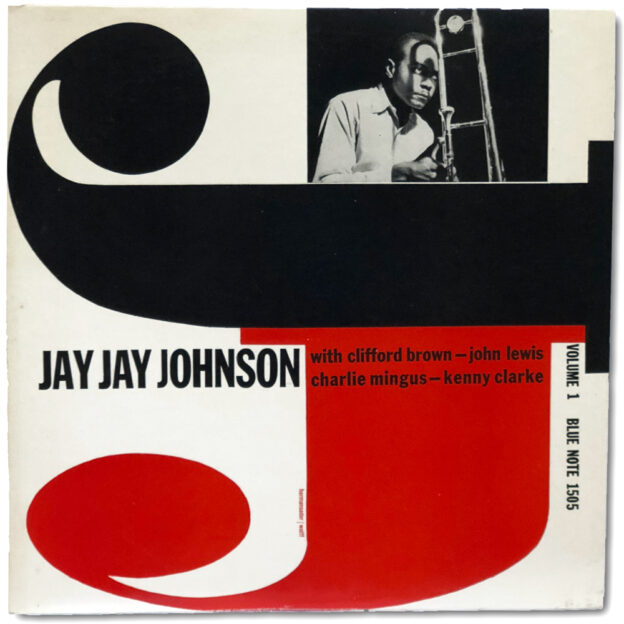
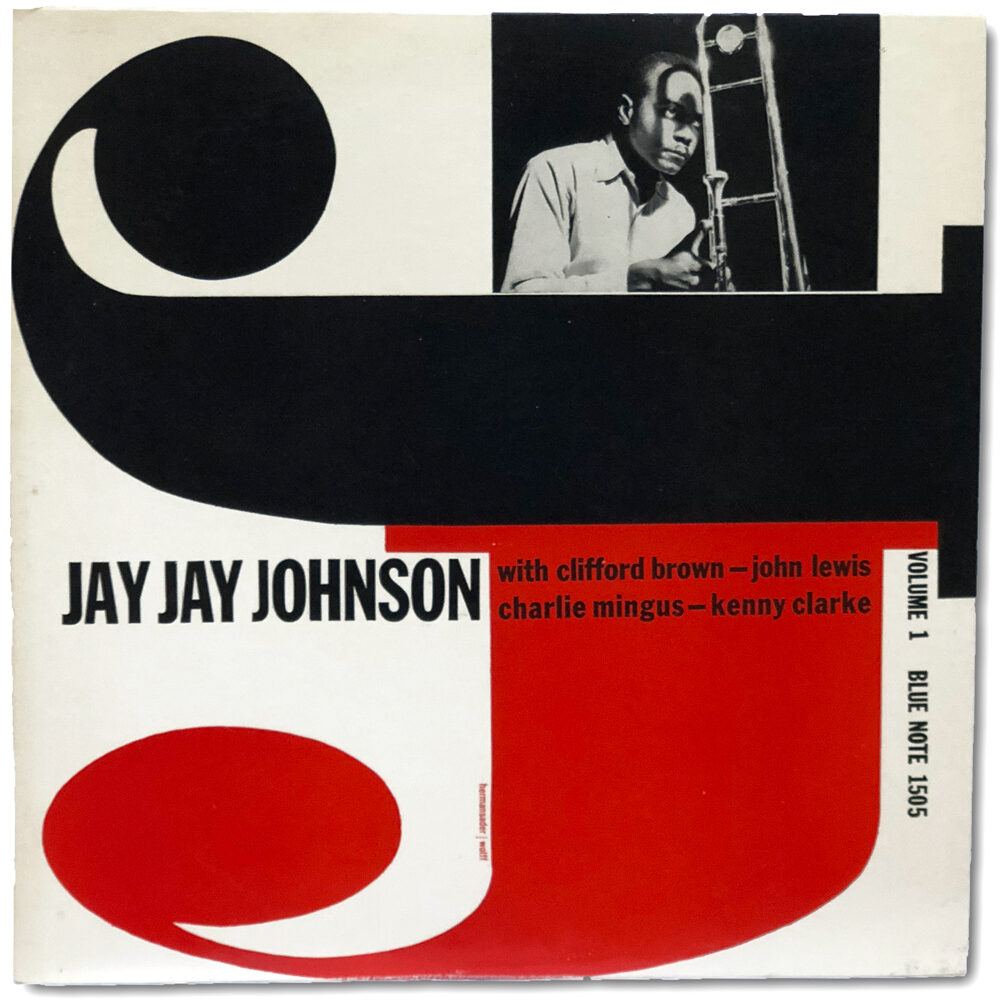
Lastly and aside from the phenomenal music laid to tape here, the thing I enjoy most about this LP is probably the cover. The color scheme of the bright red, black, and white pops out at one’s eyes, and the neatly placed photo of J.J., looking serious and a bit menacing, is fitting. It is a perfect example of all of the things that Blue Note covers were known for at the time: an excellent photograph juxtaposed with some of the most clever, aesthetically pleasing typography of the day. The cleanliness of this record, the jacket, and most importantly, the music makes me feel fortunate to have it in my collection.
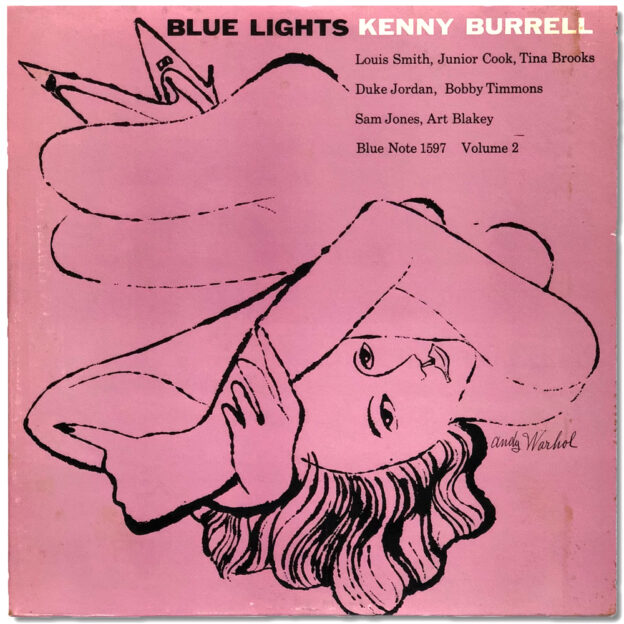
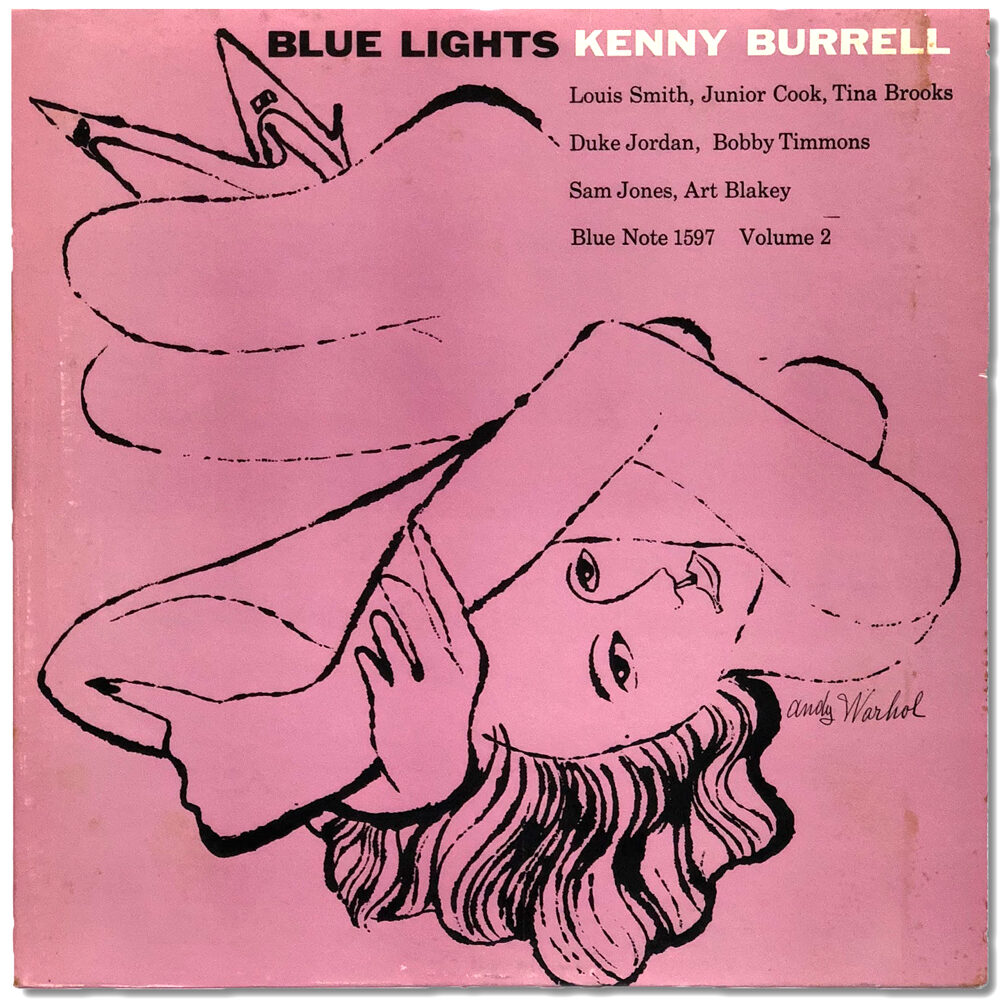
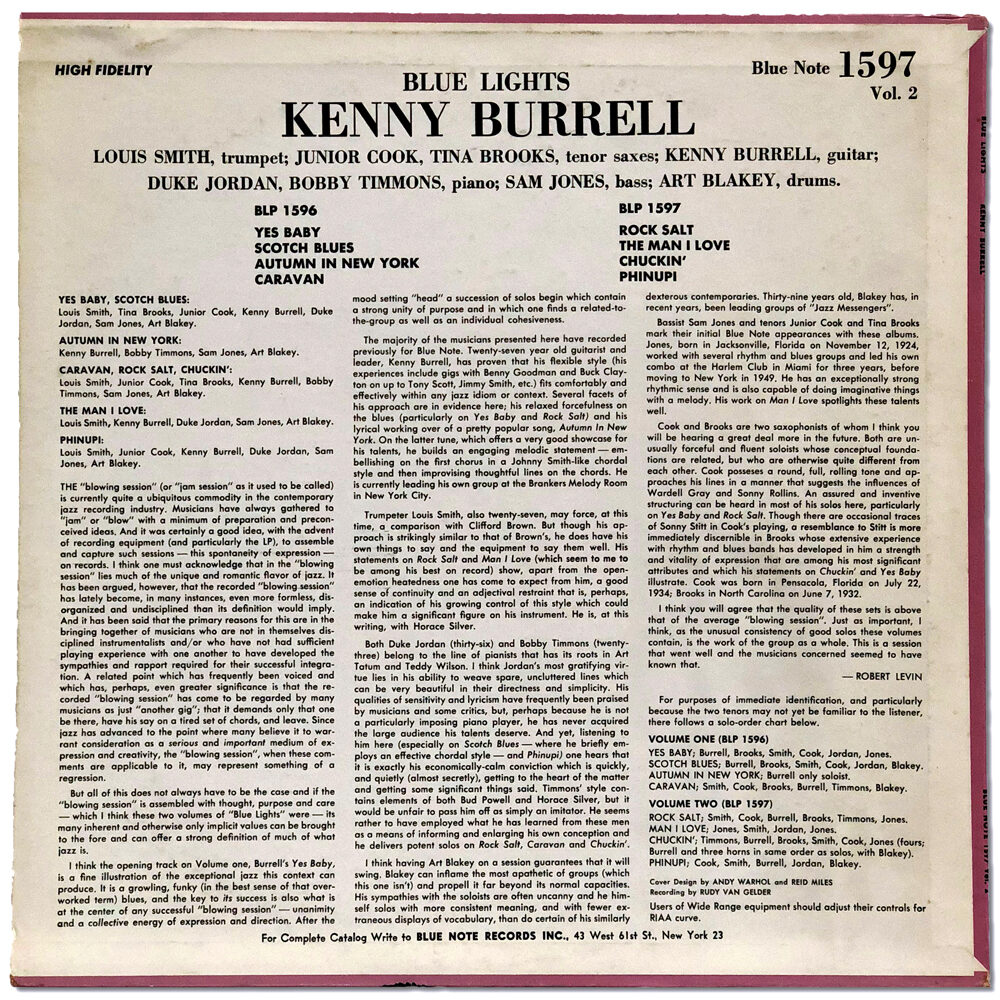
Vinyl Spotlight: Kenny Burrell, Blue Lights, Vol. 2 (Blue Note 1597) Liberty Mono Pressing

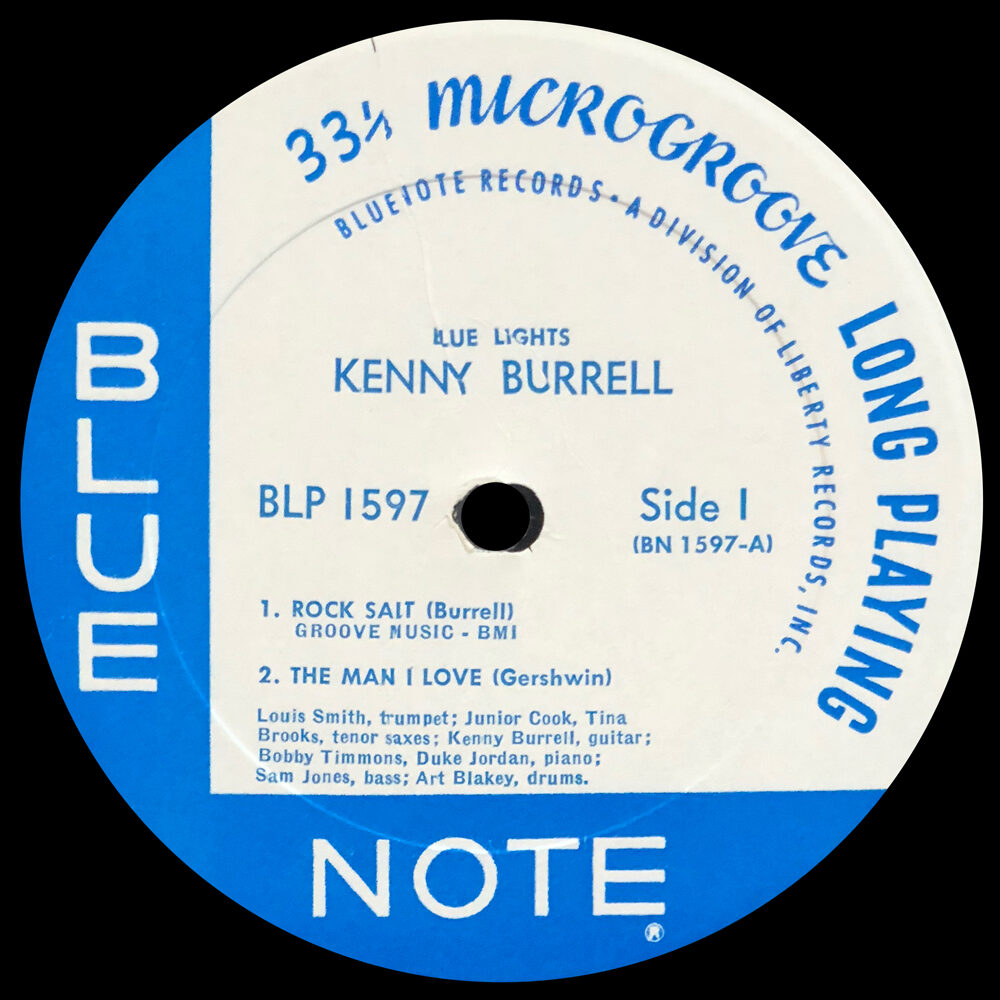
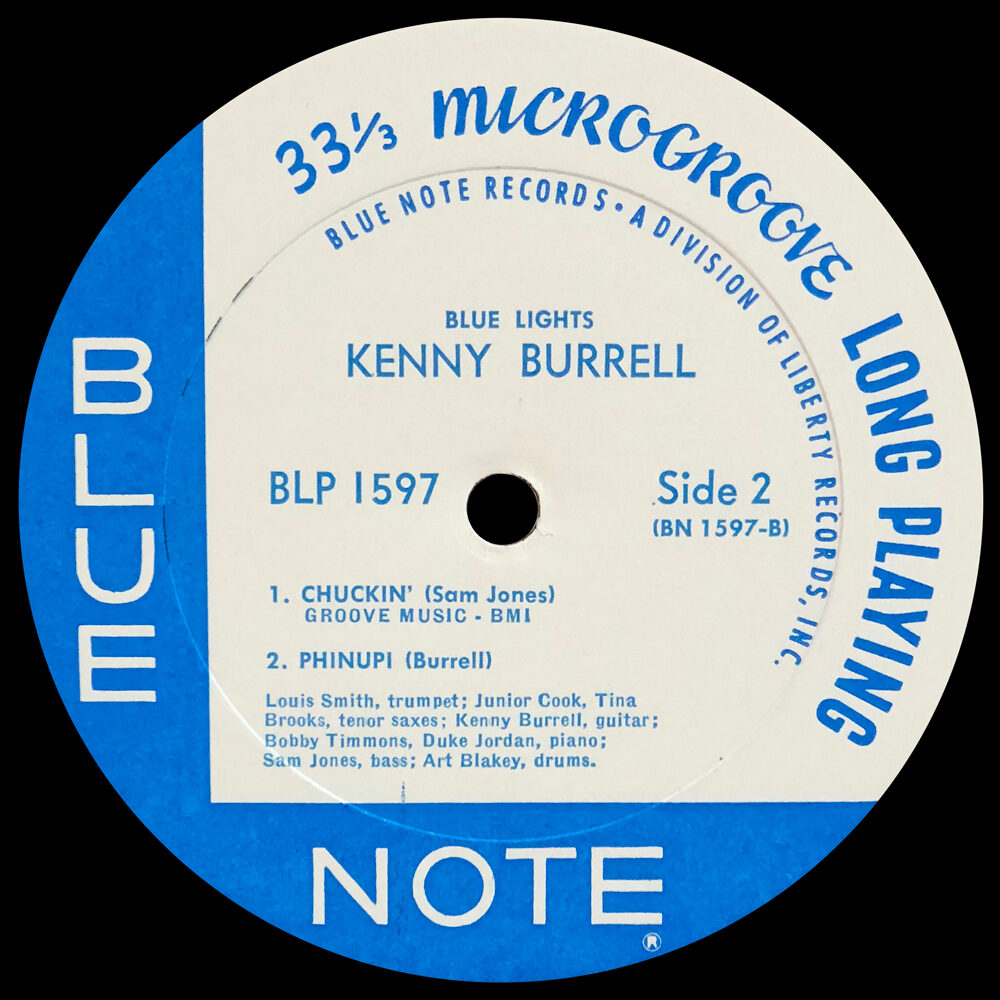
  • Liberty mono pressing circa 1966-1970
  • RVG etched in dead wax

Personnel:

  • Louis Smith, trumpet
  • Junior Cook, tenor saxophone (all but “The Man I Love”)
  • Tina Brooks, tenor saxophone (“Rock Salt”, “Chuckin'” only)
  • Kenny Burrell, guitar
  • Duke Jordan, piano (“The Man I Love”, “Phinupi” only)
  • Bobby Timmons, piano (“Rock Salt”, “Chuckin'” only
  • Sam Jones, bass
  • Art Blakey, drums

Recorded May 14, 1958 at Manhattan Towers, New York City
Originally released in October 1961

Selection:

“The Man I Love” (Gershwin)

For music lovers:

Continuing with the theme of mono Liberty Blue Notes, this is one of my favorite records by the prolific guitarist Kenny Burrell. In reading about this LP, I find that most of the discussion related to the album deals with its cover art. It is, of course, one of the three titles that the artist Andy Warhol drew for Blue Note. While the cover art is very beautiful, especially when seen on a clean, crisp copy, it was the sheer amount of talent on this record that sold me. The two bands that play on Blue Lights are a who’s-who of the bop era with an exciting player at every instrument.

Truly there is something for every fan of each player, and having them play on the same record provides for an interesting comparison in the styles of the musicians sharing an instrument. The opening track, “Rock Salt”, is a perfect showcase of each group member’s talent. Burrell opens with a familiar sounding, repeating blues riff that is echoed by the other instruments on repeated choruses. But the most exciting moments here involve the track’s two tenors. I always appreciate when Tina Brooks appears in a lineup because his tendency to play many minor notes with a Latin influence is right up my alley. But for this record, it was Junior Cook who first got my attention. For many years I have appreciated Cook in one of the most popular jazz groups of all time, The Horace Silver Quintet, and I was very excited to hear him at a young age in a different setting. Cook holds his own with legendary bandmates here, all while maintaining his own distinctive tone shoulder-to-shoulder with the uniquely-voiced Brooks.

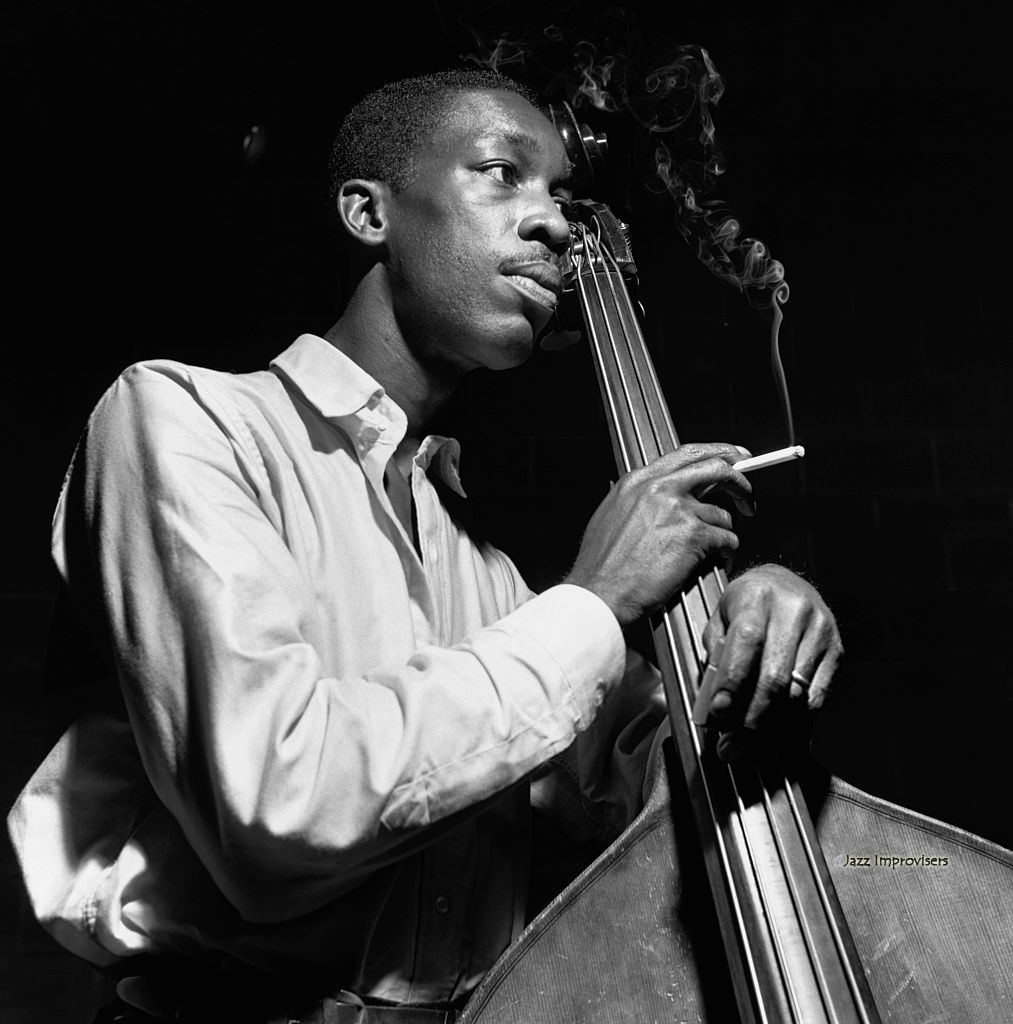
Though the tenors are what drew me to this album, an unassuming player impresses me on every play. Sam Jones, though very well known as a bop player, was not known to me as an acclaimed virtuoso of the bass when I acquired this LP. I had seen his name on many recordings of the era but heard nothing in his playing on those records that would make me elevate him to the level of, say, Paul Chambers or Ron Carter. And on this recording, surrounded by such dominant and loud (Art Blakey!) musicians, you might expect Jones’ bass to be buried under crashing drums, the volume of an (at times) three-man frontline, and Burrell’s rhythmic chords. But Jones’ bass stays at the forefront throughout and drives the rhythm section to a point where he virtually assumes the role of a leader. With such strong rhythm players and timekeepers as Blakey, Bobby Timmons, and Duke Jordan, I was impressed that the bassist was the one who had the greatest impact on the overall sound of the band. Jones has several bass solos both here and on the preceding volume, but the riffs bookending “The Man I Love” are two of my favorite bass passages in jazz.

Sam Jones

In mentioning all the date’s sidemen thus far I have not forgotten the person for without whom this session would not be possible. To me Kenny Burrell has always been the epitome of consistency in his Blue Note recordings. Along with Silver, Jimmy Smith, and Stanley Turrentine, no other artist has recorded so many quality records over such a long period of time for the label. He plays just as well on this album as he does on any other, with an equally impressive display of chords, quick flourishes, and solid organization of his band. To this day (Burrell has survived the stereotypical turbulence of the bop lifestyle), he is considered the best guitarist in jazz by many. There were many other greats in the genre like Wes Montgomery or Grant Green, but many of them either had very short careers or were enticed by more commercial music. (Barring a single Christmas album) Burrell has consistently been dedicated to playing respectable music throughout his career. As it was for me with Junior Cook, part of the appeal of this recording was to hear a great player in the early stages of his career.

For collectors:

One of the only drawbacks to coveting such an all-star session with a notoriously famous cover was of course the challenge of acquiring a copy. Though recorded to both full-track and two-track tape, both volumes of Blue Lights would only be released in mono initially. My introduction to this LP was by way of a United Artists stereo pressing, but for one thing that copy had such muffled bass that Sam Jones’ incredible talent was not even on my radar at the time. It was equally dissatisfying that United Artists decided to release both volumes with the blue background of Volume 1. The scarcity of the pink second cover, the inferior stereo presentation, and the presence of deep grooves all seem to drive the high demand for first pressings.

In searching for an affordable copy, I saw that even the second and third pressings (West 63rd labels with no deep groove and New York USA labels, respectively) were still out of my price range. I had started looking for more modern alternatives in mono (Japanese pressings) when I noticed this Liberty copy for sale in an online auction. Acquiring a top copy of this album with original mono Van Gelder metalwork all while keeping the lights on proved an attractive option and I wasn’t alone. I encountered a lot of competition, and though I paid over a thousand dollars less than what an original costs in similar condition, to this date it is the most I have ever paid for a Division of Liberty Blue Note. But it has proven to be worth every penny.

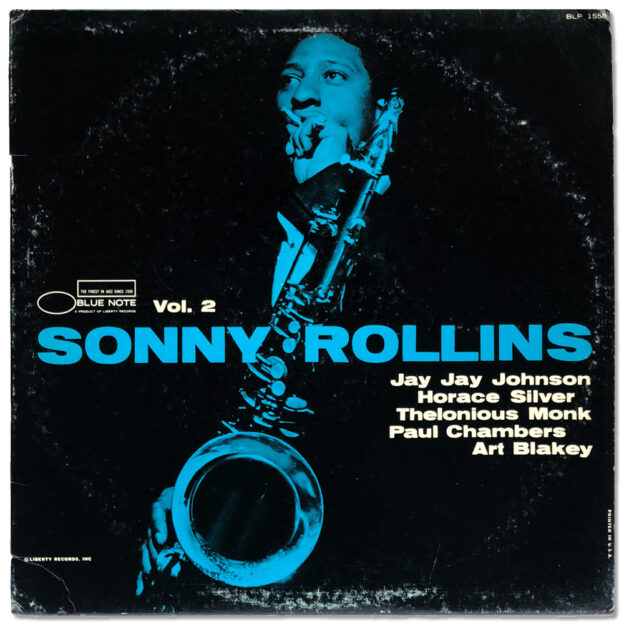
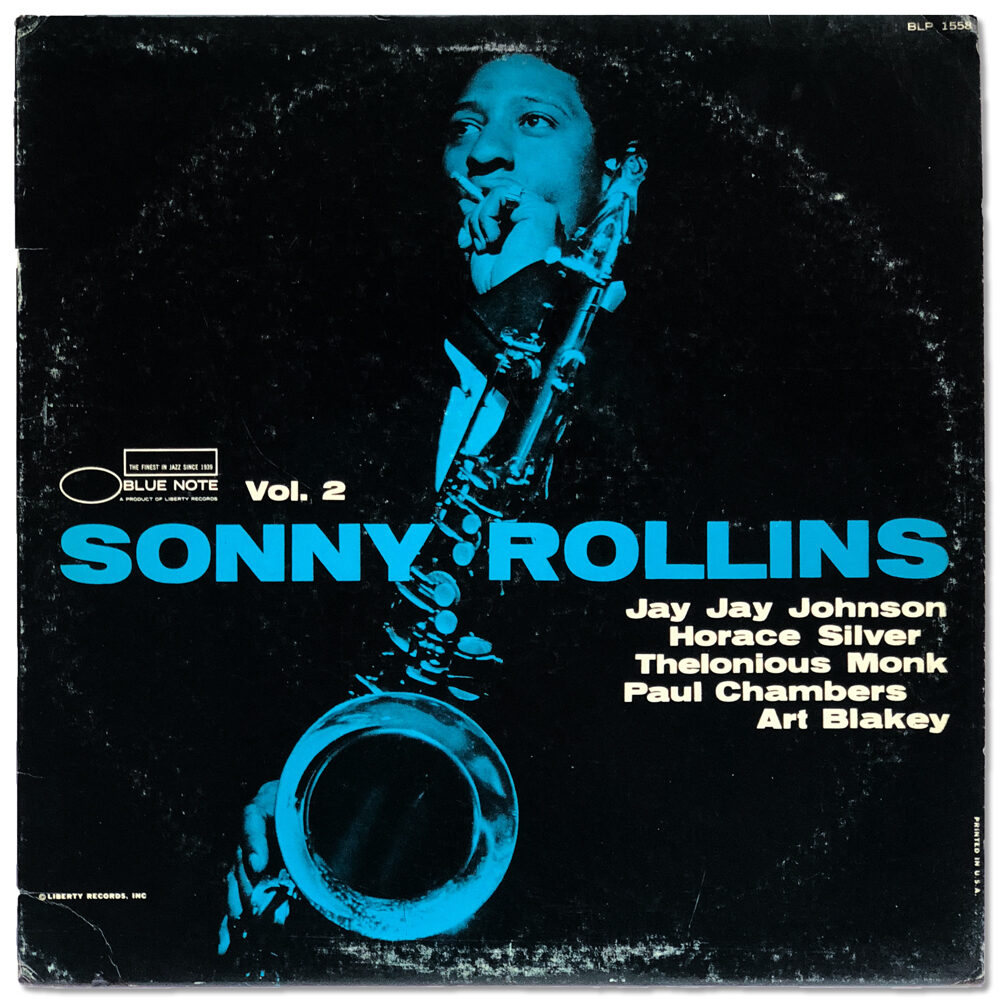
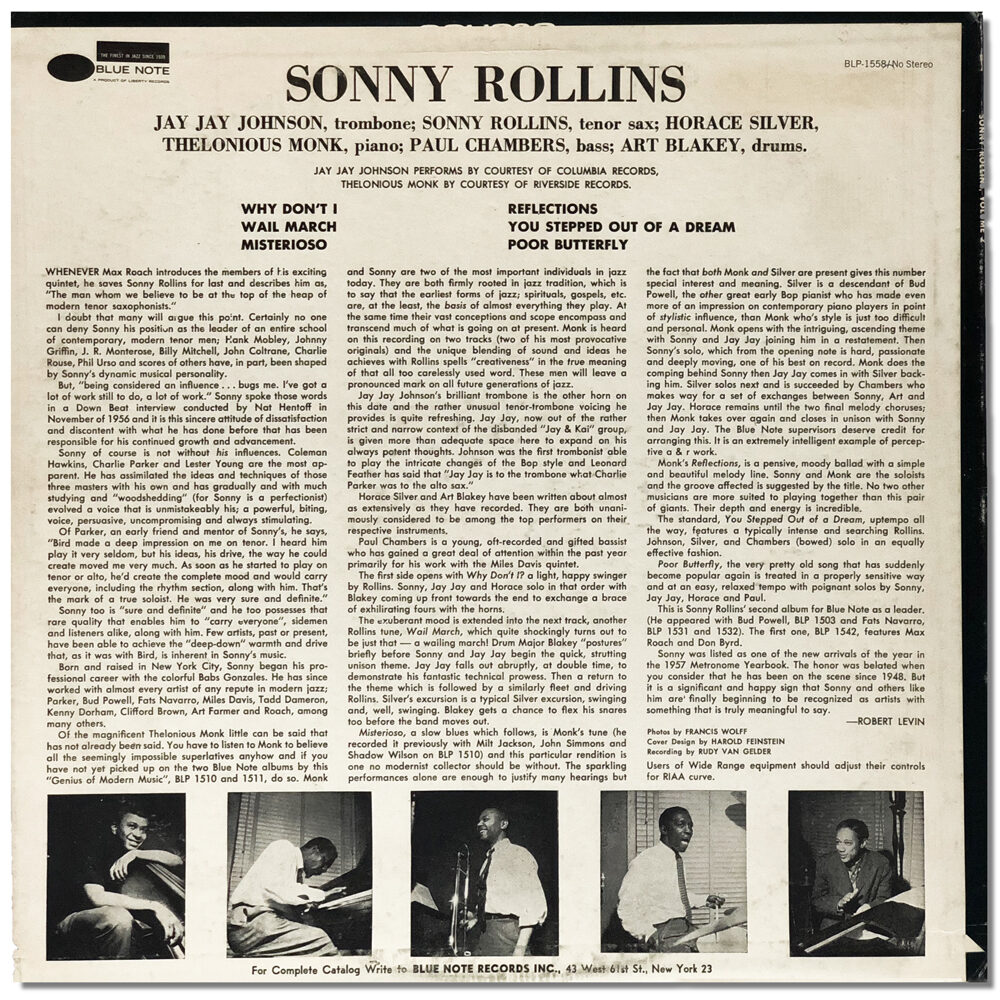
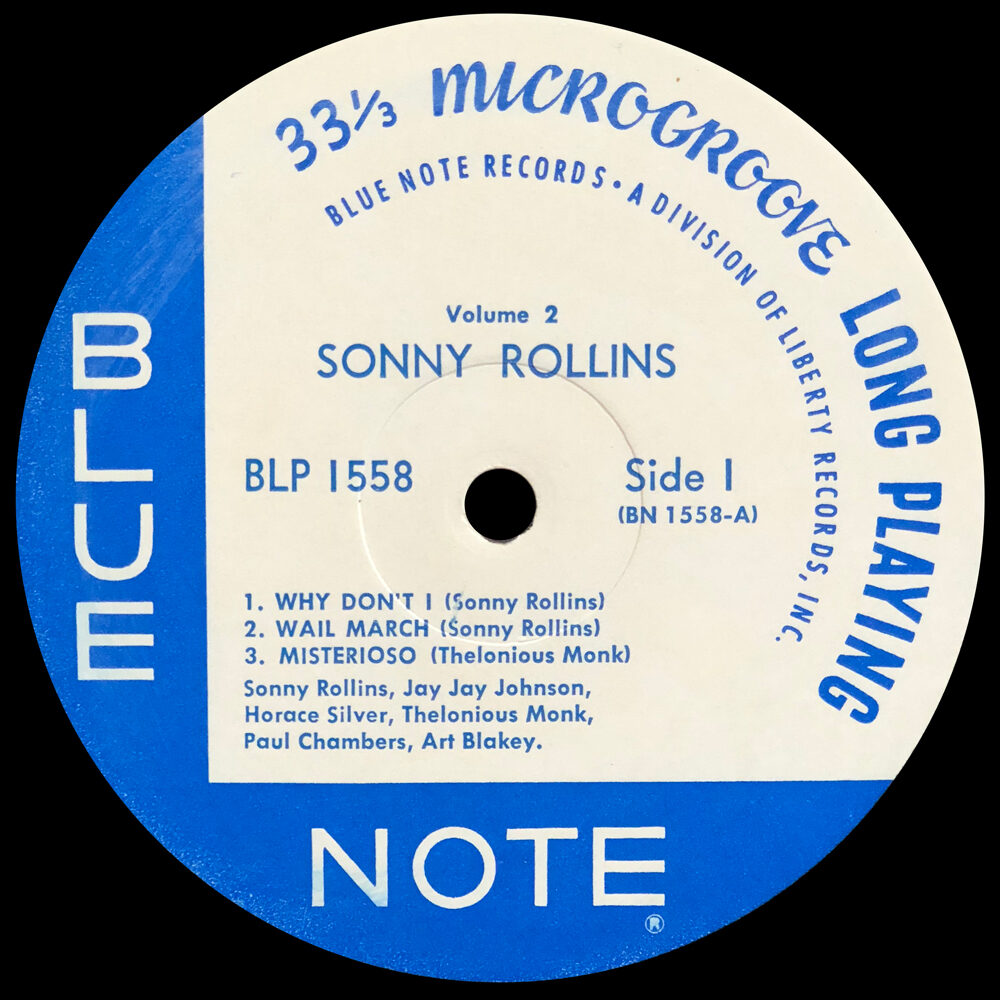
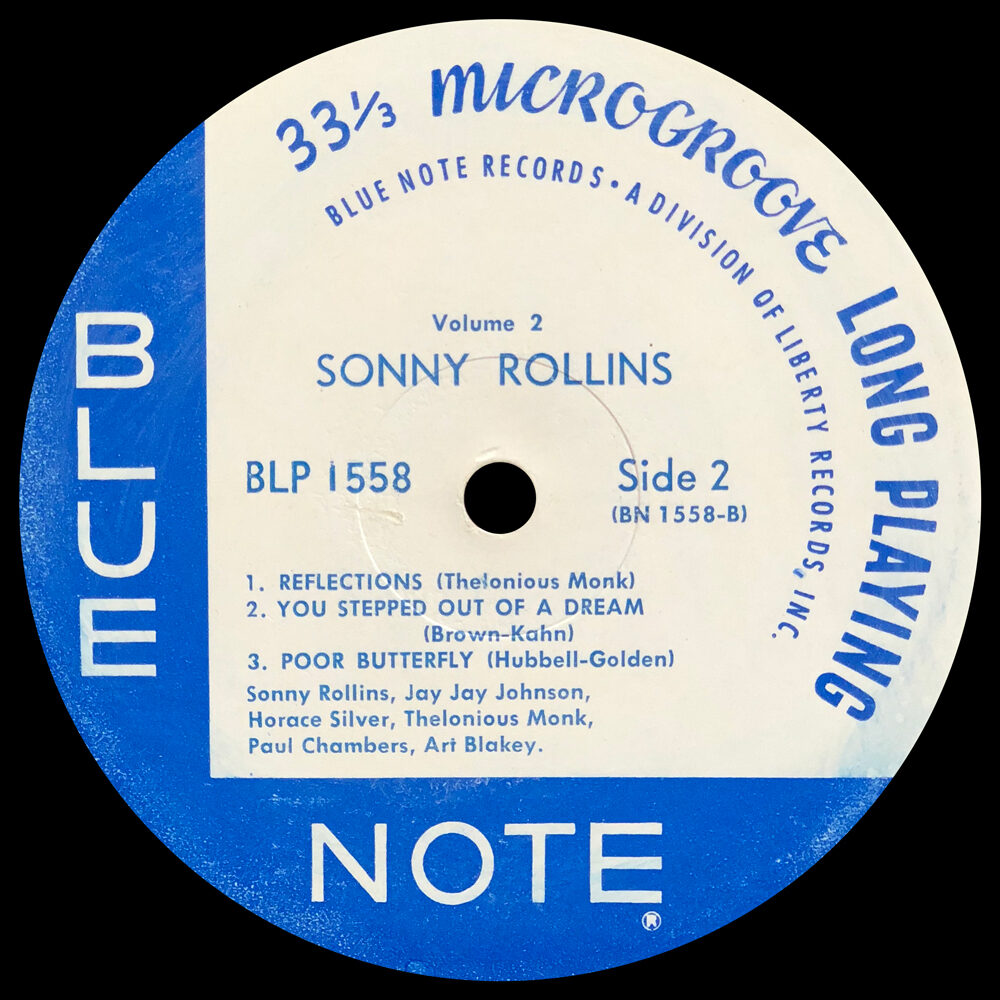
Vinyl Spotlight: Sonny Rollins, Volume 2 (Blue Note 1558) Liberty Mono Pressing

  • Liberty mono pressing circa 1966-1970
  • RVG etched in dead wax

Personnel:

  • Sonny Rollins, tenor saxophone
  • J.J. Johnson, trombone (all but “Reflections”)
  • Horace Silver, piano (all but “Reflections”)
  • Thelonious Monk, piano (“Reflections” and “Misterioso” only)
  • Paul Chambers, bass
  • Art Blakey, drums

Recorded April 14, 1957 at Van Gelder Studio, Hackensack, New Jersey
Originally released in September 1957

Note: This is a guest post by Charles Strong.

As a jazz lover and record collector, I am very fortunate to live near New York and its dusty record stores, as well as fellow collectors like the namesake of this blog, Mr. Mono himself. If we can’t hunt for LPs together in person, he will sometimes send me pictures of any records I might be interested in from the stores in the city — and sometimes be so kind as to snag some for me to be mailed later. A few months ago, he was in a store that has a very serious reputation for jazz sales when he sent me a few shots of some early pressing Blue Notes at pretty fair prices. One of the pics was of a glossy early pressing of Sonny Rollins Volume 2. The copy was not the first pressing but still had all the things that make collectors warm inside: a West 63rd Street label, Rudy Van Gelder’s initials in the dead wax, and the famous cursive ‘P’ indicative of a copy made in the company’s heyday. Best of all, the dealer did not want an arm and a leg for the copy, and it was payday Friday.

I was very tempted. Sonny Rollins is hands down my favorite artist in the entire genre, and in my quest to own the best possible copies of his LPs that I can afford, Volume 2 is a record I did not have an original of. I did own a copy of this album on Capitol and it had never made an impression on me. Despite its critical acclaim and my liking every artist on the date, it had never caused me to want to listen to it frequently. I do not attribute this to the record I had; the purpose of this post is not to downplay or argue the fidelity of other copies of an LP, but my Capitol copy certainly didn’t do anything to elevate the music of this album higher than A Night at the Village Vanguard or Way Out West, my two favorite Sonny records. So I texted Rich back a dismissive reply: “Nah, forget it — it’s never been my favorite Rollins LP,” to which he replied, “Mine either.” This made me feel two ways: pleased because a fellow collector had validated my opinion, but upset that one of the most celebrated records by my favorite musician was somehow dismissed by two knowledgeable jazz lovers.

Fast forward to a few weeks ago. I had just run into a nice string of luck with my favorite saxophonist on Blue Note. Within a two-week span, I had lucked out on copies of Volume One and the LP that has eluded me most in recent years, Newk’s Time. A few days after buying Newk’s, I was browsing eBay and a seller was selling Volume 2 as a Buy It Now. I usually avoid the Buy It Now sellers for rare records. However, this was a Liberty copy with some wear on the cover, and it was a later cover with the Division of Liberty lettering on the cover. In other words, this copy was not one that a high stakes collector or dealer would value.

However, as a listener of Sonny Rollins, it had some very good things going for it. For one, it was a monaural copy, which I’m not terribly picky over, except for these very early Blue Note recordings where the focus, at least for sales purposes and sound quality, was mono over the primitive stereo of the day. Secondly, it had the initials of Rudy Van Gelder in the dead wax which, without going into too many details, usually results in a high quality sound regardless of year of issue. Lastly, this thing was cheap! Relatively so, but at less than half the price of the copy that Mr. Mono showed me. I felt that if I was ever going to enjoy this record in its somewhat original form, this was going to be the most affordable way to do so.

After a busy few days of package receiving because of the other Rollins LPs I had just purchased, Volume 2 arrived almost as if it matched my opinion of it, as an afterthought. It was the last in a string of records that I had just purchased, and the two records that preceded it (Volume 1 and Newk’s Time) were two of my favorites. Well imagine my surprise when I dropped the needle. The opening riff of “Why Don’t I?” leapt out of the speaker with great urgency. To me it could have been an outtake from Volume 1 with its loud, honking Rollins riff announcing his unmistakable tone in a similar manner to the Volume 1 jams “Decision” and “Bluesnote”. Despite the presence of a piano here, Rollins hints at the legendary style of pianoless strolling he would perfect the following year, all while trading loud, fast riffs with Art Blakey in a conversation punctuated by the drummer’s own Elvin Jones-esque grunts and patented press roll. It all makes for an exciting conclusion to the take.

Another surprising highlight of the album that mirrored my expectations is the song “Wail March”. I am not usually a fan of marches, from the traditional bop march of “Blues March” by Blakey’s Messengers to the almost avant garde style of march found on Bobby Hutcherson’s “Les Noires Marchant”, but “Wail March” changed that quickly. Normally turned off by their corny, almost antiquated style of beat, “Wail March” is a freewheeling song with the driving snare of any classic march but also wild, reckless improvisation by Rollins and trombonist J.J. Johnson and an admittedly catchy chorus. I could not picture any of the stereotypically bland members of a T.V. sitcom marching band playing such a swinging tune at all. It is one of the myriad example of Rollins taking a theme or tune that was considered ‘corny’ or ‘overdone’ and using his dominating tone and knack for off-the-cuff improvisation to make it into something fresh and revolutionary.

The track on this record that most critics laud is the rendition of the Thelonious Monk standard “Misterioso”, instantly memorable because of a repeating, haunting piano riff played by Monk with a sporadic stabbing motion. It has been recorded on many other albums, but this version instantly became my favorite. Every member of the band plays to their strengths on this song. J.J. Johnson has a memorable solo where he fluidly recreates the opening riff while Rollins finds yet another way to insert “Camptown Races” into a song. Horace Silver and Monk appear on the track — a rarity — and they do a remarkable job of playing their own styles. So many musicians have tried to play Monk’s songs just like he did and failed. These guys all knew how to play with Monk. They all retain their own unique sounds all while paying respect to the song’s original theme.

A few weeks ago, Rich and I had one of our many conversations about our respective collections. We discussed what we believed in our opinion to be the best pressings of Blue Note records in terms of collectability, sound quality, condition, lack of wear, and value. The Division of Liberty Blue Notes, especially reissues of earlier Blue Note material in mono, continued to come up in our talks. When I mentioned to Rich that I had quite a few of these, he asked me to review and write about them for his blog, and in the next few posts I hope to demonstrate that these pressings are not just a mere runner-up to original pressings. They have the potential to provide collectors with a high-quality, affordable listening experience while maintaining many of the hallmarks that make originals so collectable.

Many people think that there is a mystique to the Blue Note sound captured by engineer Rudy Van Gelder. That, of course, is an unscientific way of saying that there is an unexplainable and unique sound to these records. The fact that a Liberty pressing purchased at a discount price can project the classic Blue Note sound so well speaks volumes. It essentially changed my opinion of the recording and also provides evidence that Blue Note’s new parent label was capable of preserving the sound of the original LPs to a tee.

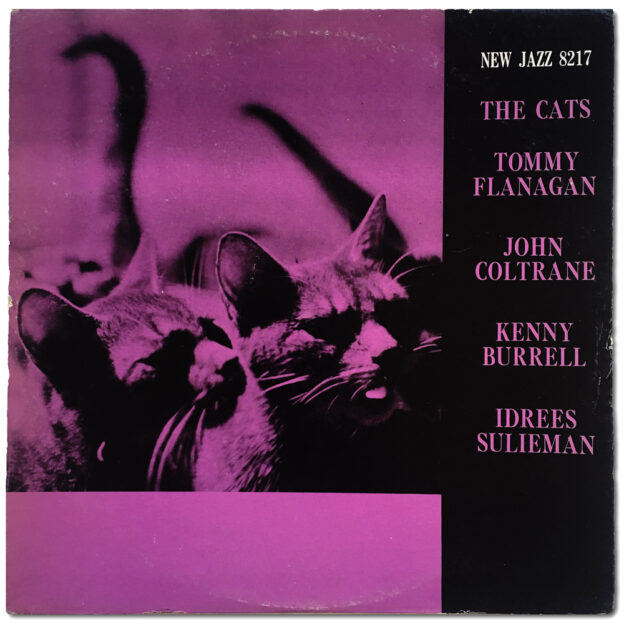
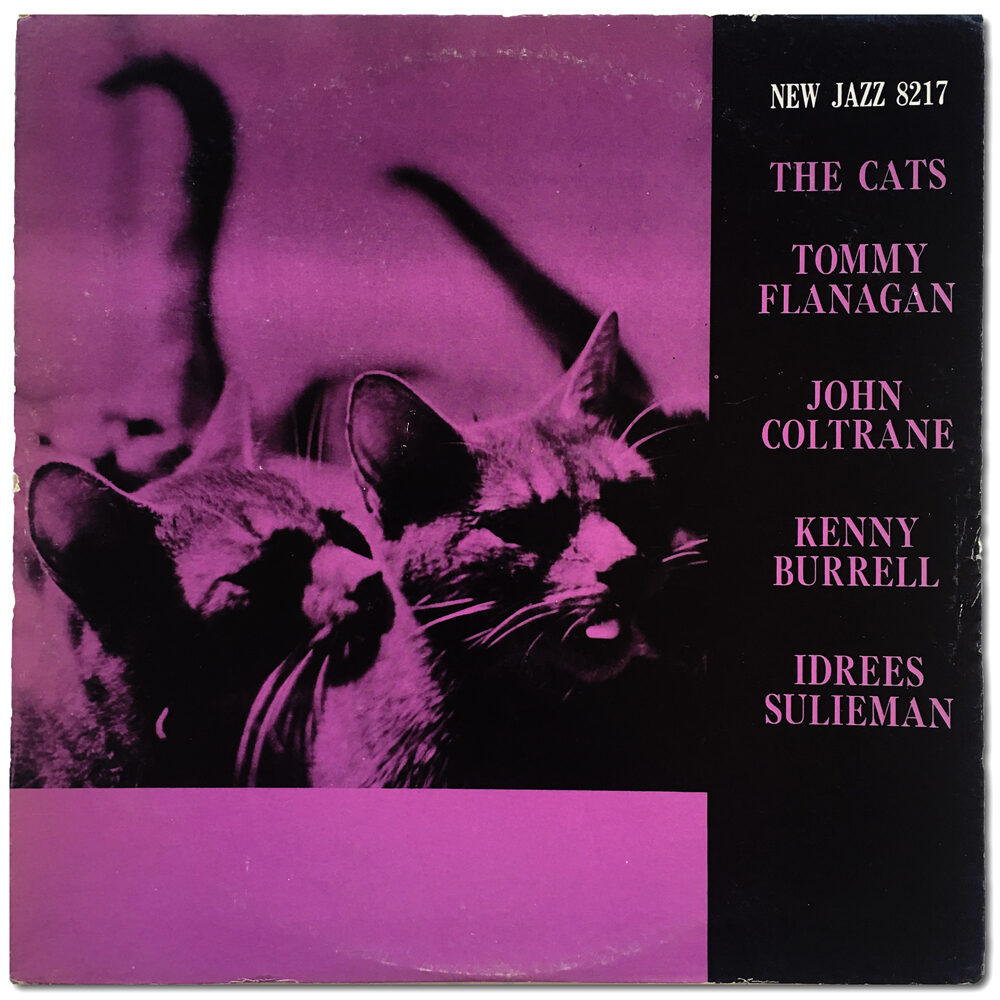
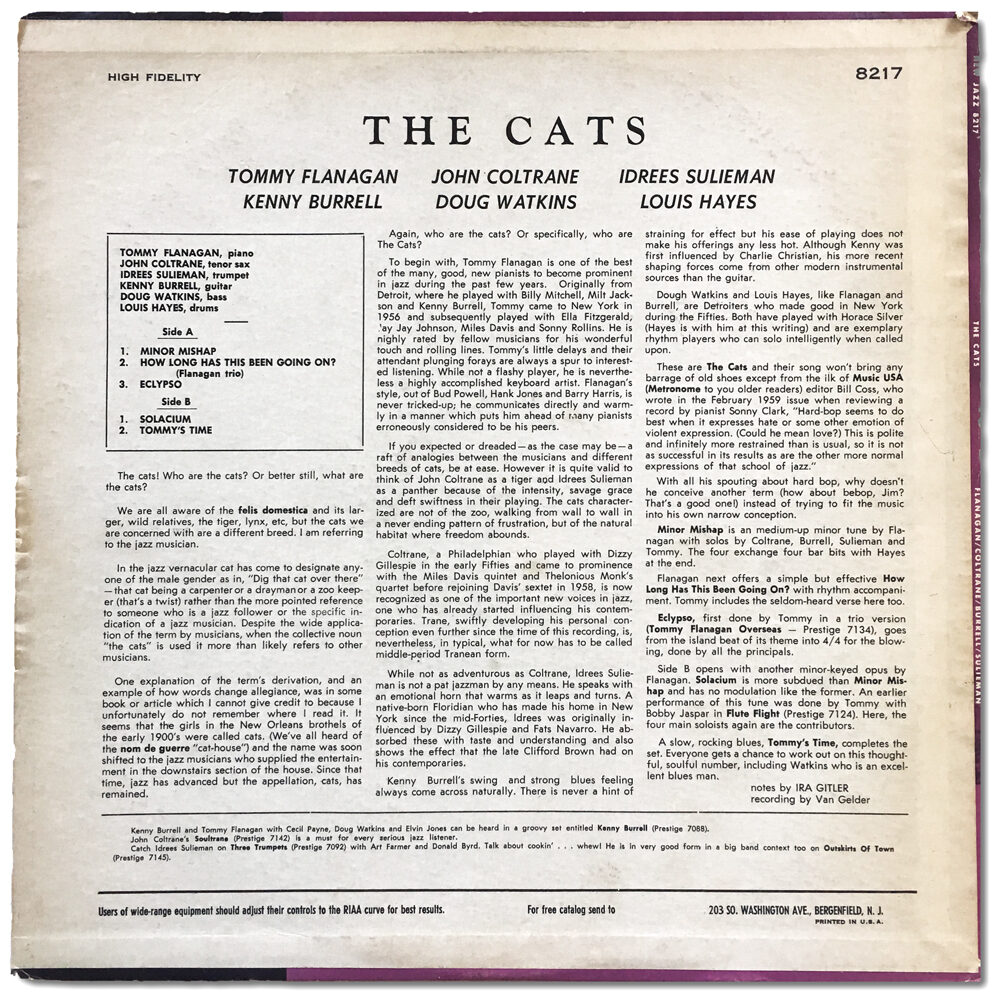
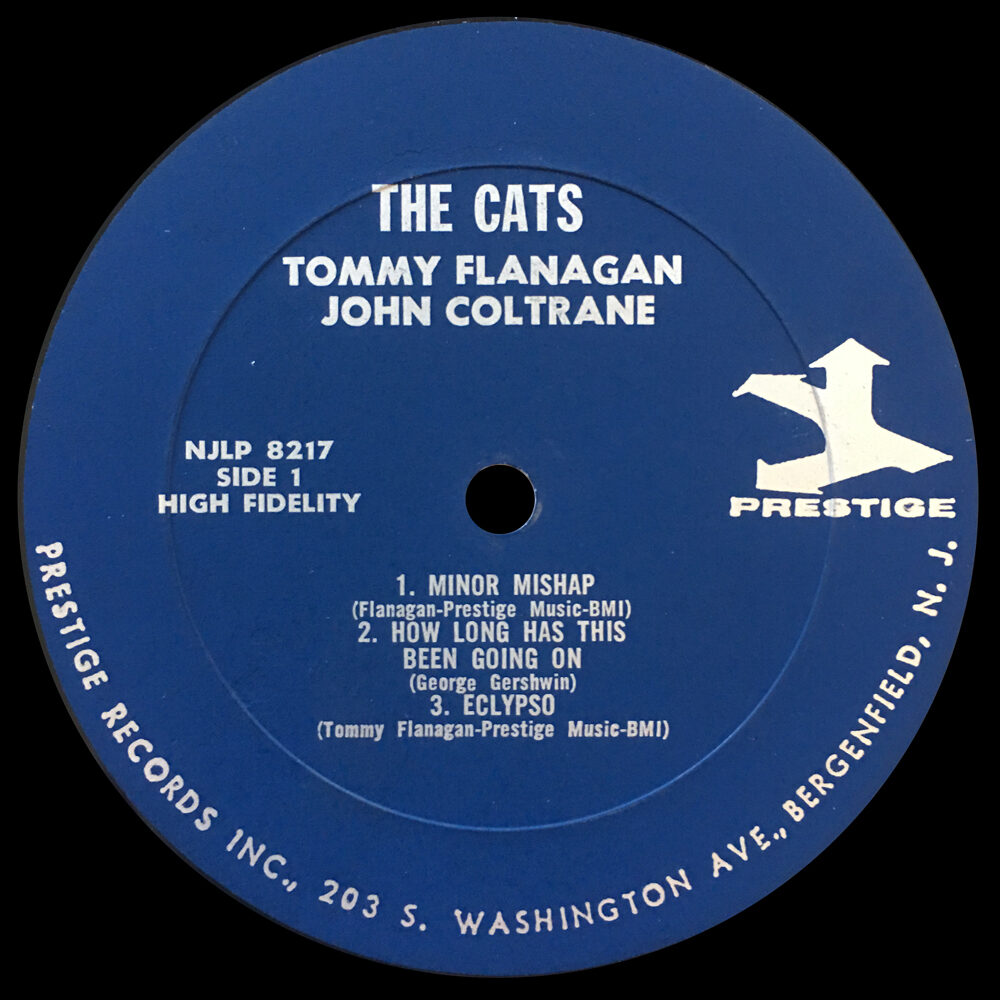
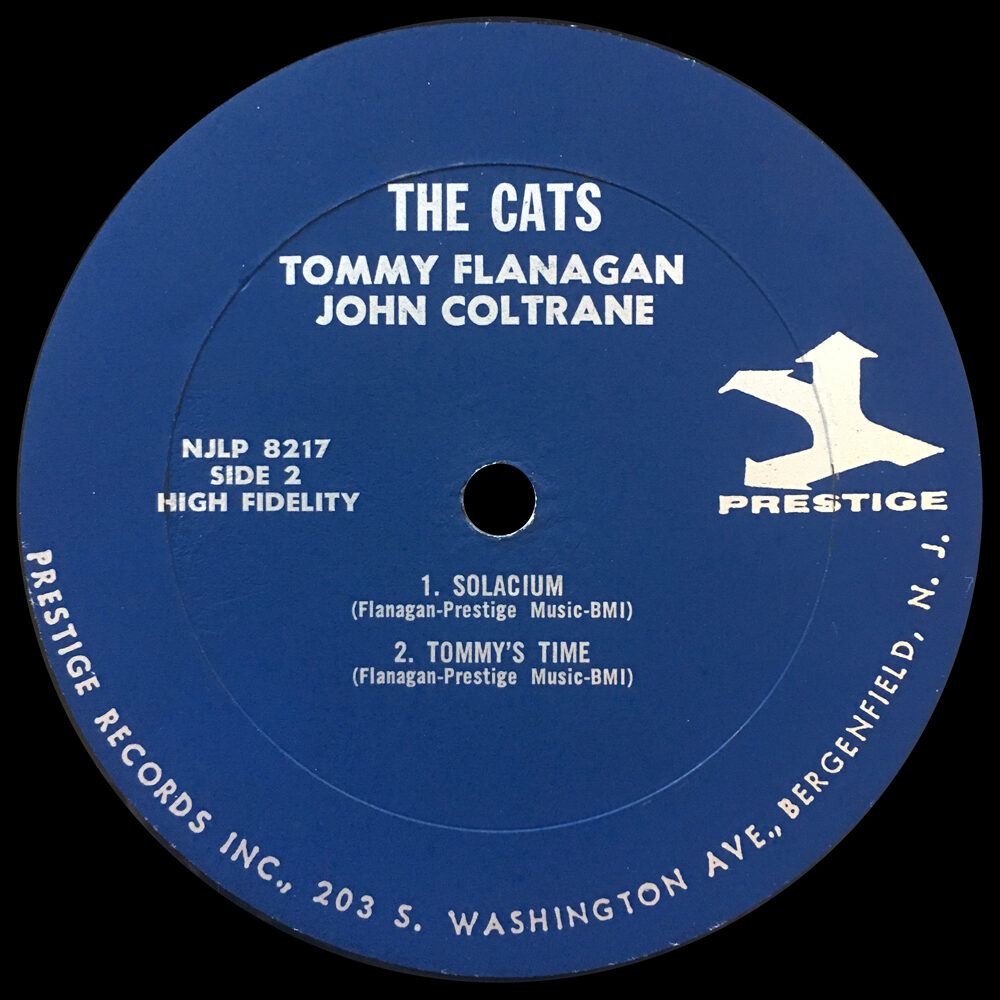
Vinyl Spotlight: The Cats (New Jazz 8217) Second “Blue Label” Pressing

  • Second (Prestige) pressing with blue labels circa 1964
  • “RVG” stamped in dead wax

Personnel:

  • Idrees Sulieman, trumpet
  • John Coltrane, tenor saxophone
  • Tommy Flanagan, piano
  • Doug Watkins, bass
  • Louis Hayes, drums

Recorded April 18, 1957 at Van Gelder Studio, Hackensack, New Jersey
Originally released in 1959

When I lived in Albany, New York, the East Greenbush library had a killer selection of classic jazz CDs, and the 1989 Original Jazz Classics reissue of this album was one of them. Flipping through the racks, this album piqued my interest because of its super-hip cover and the name “John Coltrane”. I became more familiar with this album over the years and acquired the Original Jazz Classics LP a few years ago through Discogs.

Then recently on one of my periodic trips to New York’s East Village record shops, I was doing my flip-through-the-jazz-bins routine, panning for gold and expecting to turn up nothing but the usual rocks. But then in the Kenny Burrell section, the deep purple of this cover peeked out from the tightly-packed row. I assumed this was another OJC reissue, but when I slid the record out of the jacket I was surprised to see the early ’60s blue Prestige label. Things were starting to heat up. The next crucial step was examining the dead wax. With any luck I’d find the initials of Mr. Rudolph Van Gelder stamped there, and sure enough, I did.

I then examined the vinyl, which looked solid VG+. The price tag made it seem like this one slipped by whatever staff member priced it, and strangely, the numbers on the sticker indicated that it had been priced for sale three months prior. I had to believe that it sat behind the counter for months before it made its way to the racks because this record at this price would never last in a store for more than a week. Finally, I brought it over to the listening station for the final leg of my inspection routine and was humbly blown away by how quiet and clean it sounded. So I didn’t hesitate to bring it to the front and I slammed my cash down on the counter: “It’s a deal.”

In the past I’ve expressed disbelief in the commonly uttered collector sentiment that “vintage jazz records sound better than they look”. But this record wasn’t just providing evidence to the contrary, it was proving me dead wrong. I don’t think I’ve ever encountered a record that looked more marked up and sounded so quiet. In fact, this record sounds cleaner than a lot of records I own that are visually EX.

Recorded in the spring of 1957, we hear John Coltrane in a less adventurous but more accessible mood characteristic of the saxophonist before he began his ferocious onslaught of scales later that year with the release of Blue Train (Blue Note 1577). “Minor Mishap” and “Eclypso” are two favorites, but the ultimate mood-setter is “Solacium”, a somber, quiet tune that will perfectly complement a rainy afternoon spent indoors. Available in bold, straight-down-the-middle Hackensack mono only — no stereo option here.

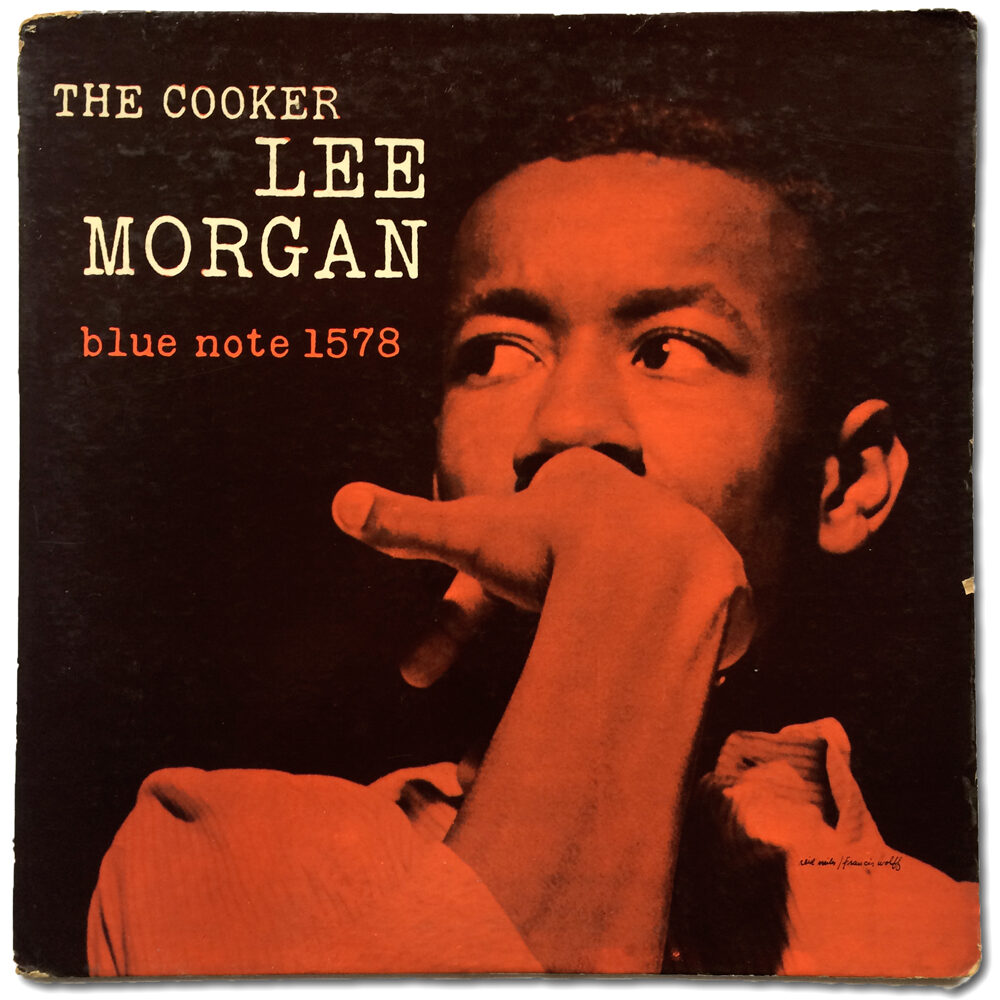
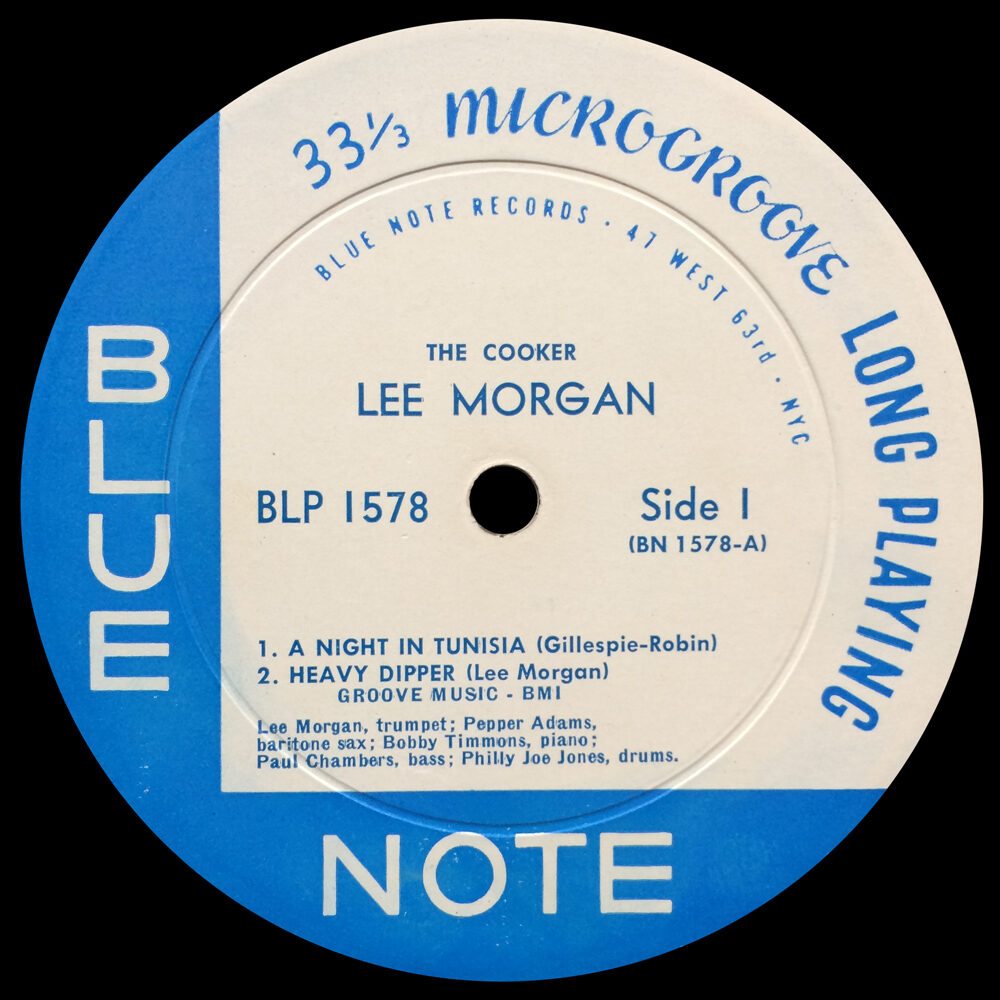
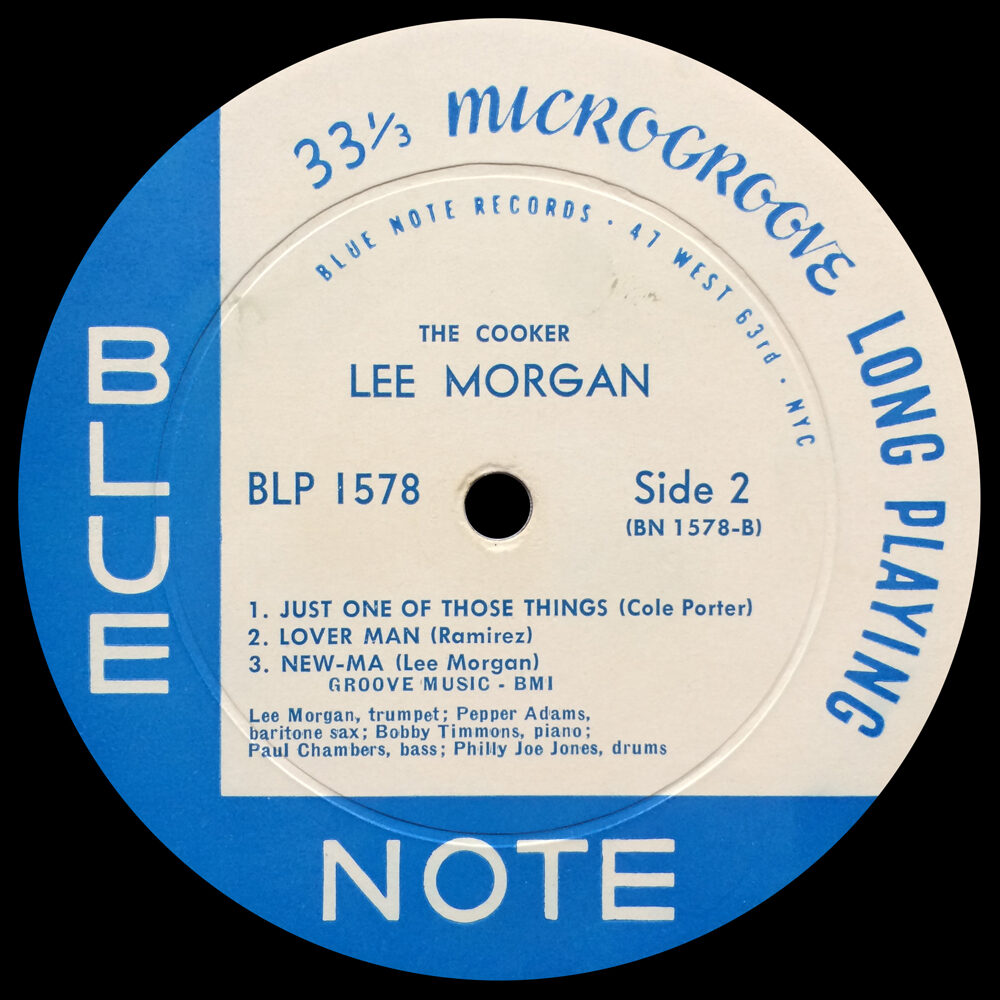
Vinyl Spotlight: Lee Morgan, The Cooker (Blue Note 1578) Original Pressing

  • Original 1957 mono pressing
  • West 63rd address on both labels without registered trademark “R”
  • Deep groove on both sides
  • Plastylite “P” etched and “RVG” stamped in dead wax

Personnel:

  • Lee Morgan, trumpet
  • Pepper Adams, baritone saxophone
  • Bobby Timmons, piano
  • Paul Chambers, bass
  • “Philly” Joe Jones, drums

Recorded September 29, 1957 at Van Gelder Studio, Hackensack, New Jersey
Originally released in November 1957

A while ago I happened upon the YouTube channel of “KoolKatJazz”, a collector who takes pride in finding cheap original pressings of vintage jazz records that, while perhaps grade VG or lower, sound great at times nonetheless. Being a collector on a pretty strict budget made me think that this might be a collecting strategy I could benefit from.

Then I came across this copy of The Cooker. It looked VG at best, and while I would normally pass on a record like this due to a personal intolerance of audible wear and loud pops and ticks, this time I had the opportunity to preview the playback before buying. Indeed, the record had its share of loud ticks and even a skip at one point, but no distortion, and at times the thing sounded undeniably brilliant. The price was more than fair so I decided to go for it.

Though I was originally under the impression that mono issues of this album are quite rare, collecting buddy Clifford Allen informed me that in addition to a West 63rd “R” repressing, mono pressings with New York USA and even United Artists “classic” labels exist. Shout out to Clifford for helping make this article more accurate!

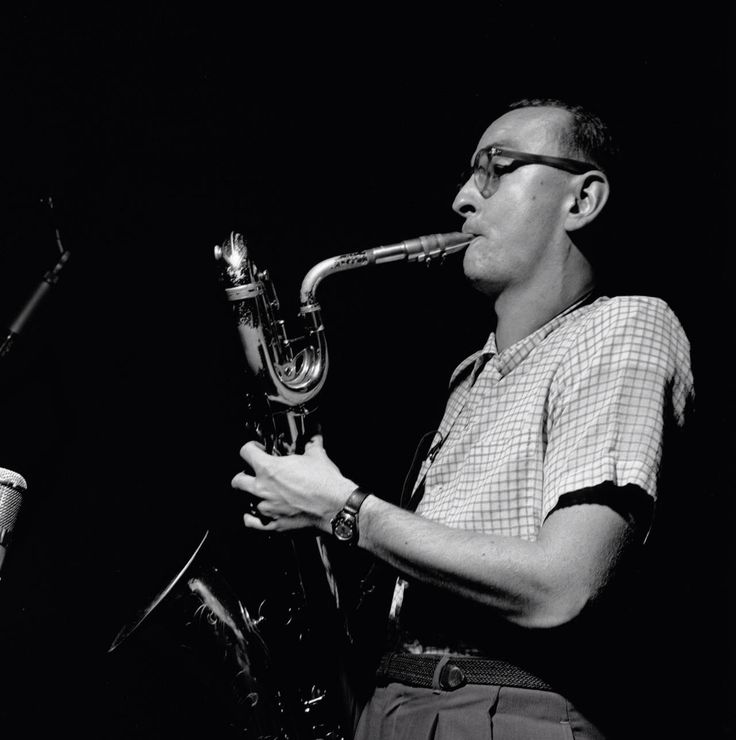
Pepper Adams during the recording of The Cooker in 1957

I had never heard these sides before I found this copy. I’m not the biggest fan of the mega-standard “A Night in Tunisia” and accordingly was a little underwhelmed by this epic reading. But just as I began to fear that the date would ultimately amount to no more than “another bop blowing session”, Pepper Adams’ quirky presence grew on me, and I soon came to appreciate this pleasantly odd frontline pairing of trumpet and baritone sax. Prior to the release of The Cooker, Morgan had never laid to tape any of his own compositions, and thus with “Heavy Dipper” and “New Ma”, the world got its first glimpse of the leader’s talents as a songwriter. And most collectors will be able to appreciate the magic contained in these fresh 1957 mono Plastylite grooves.

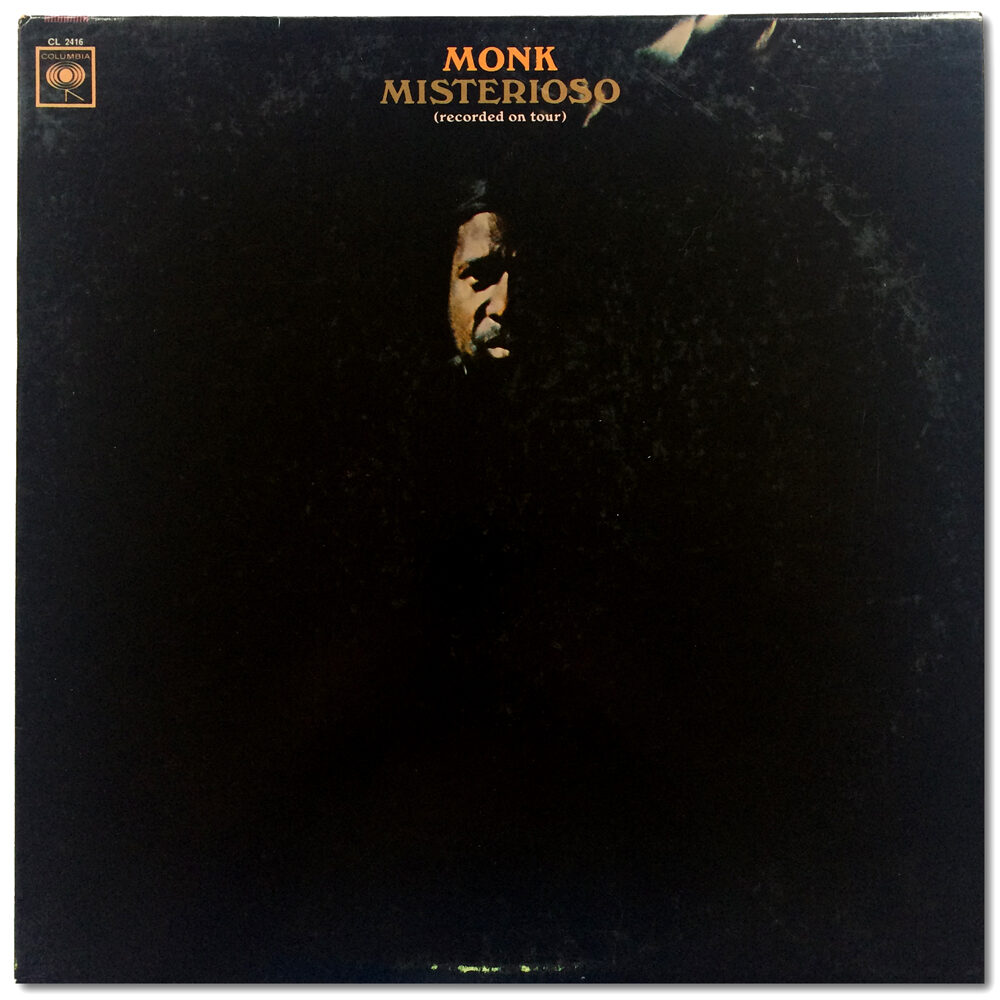
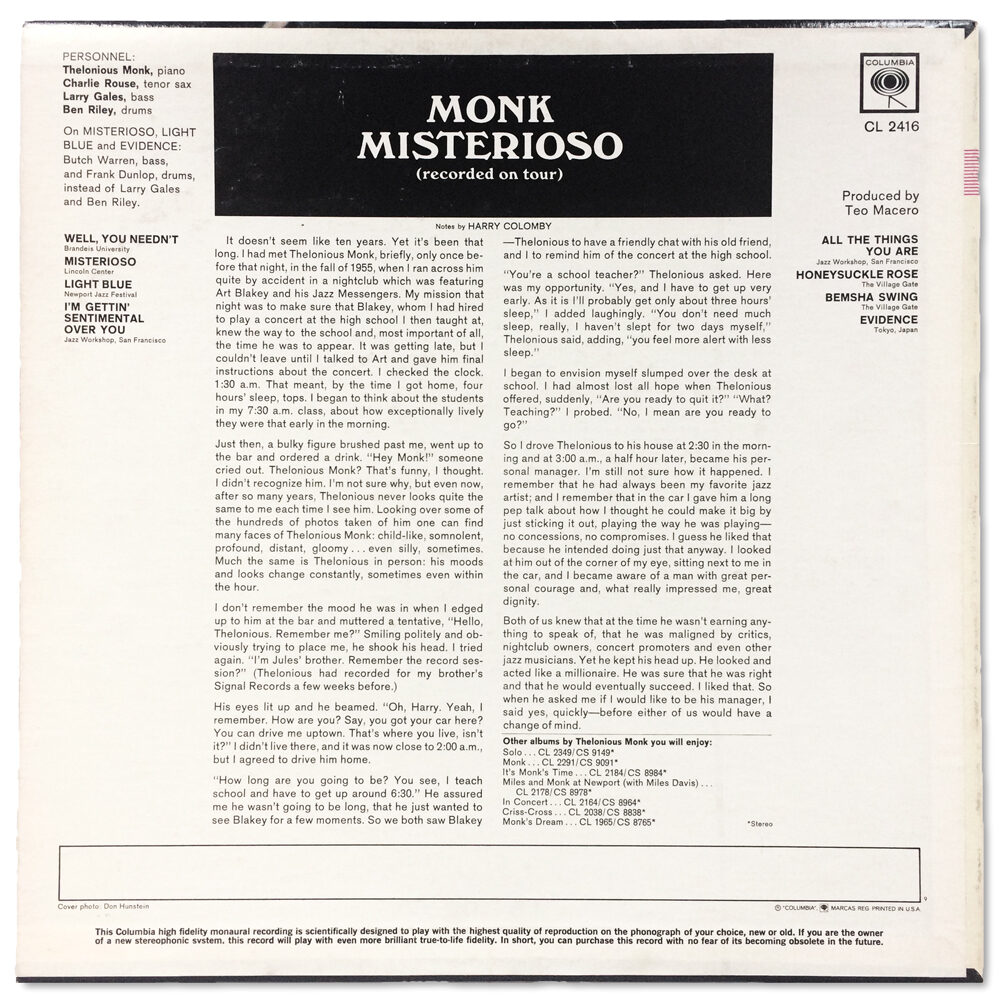
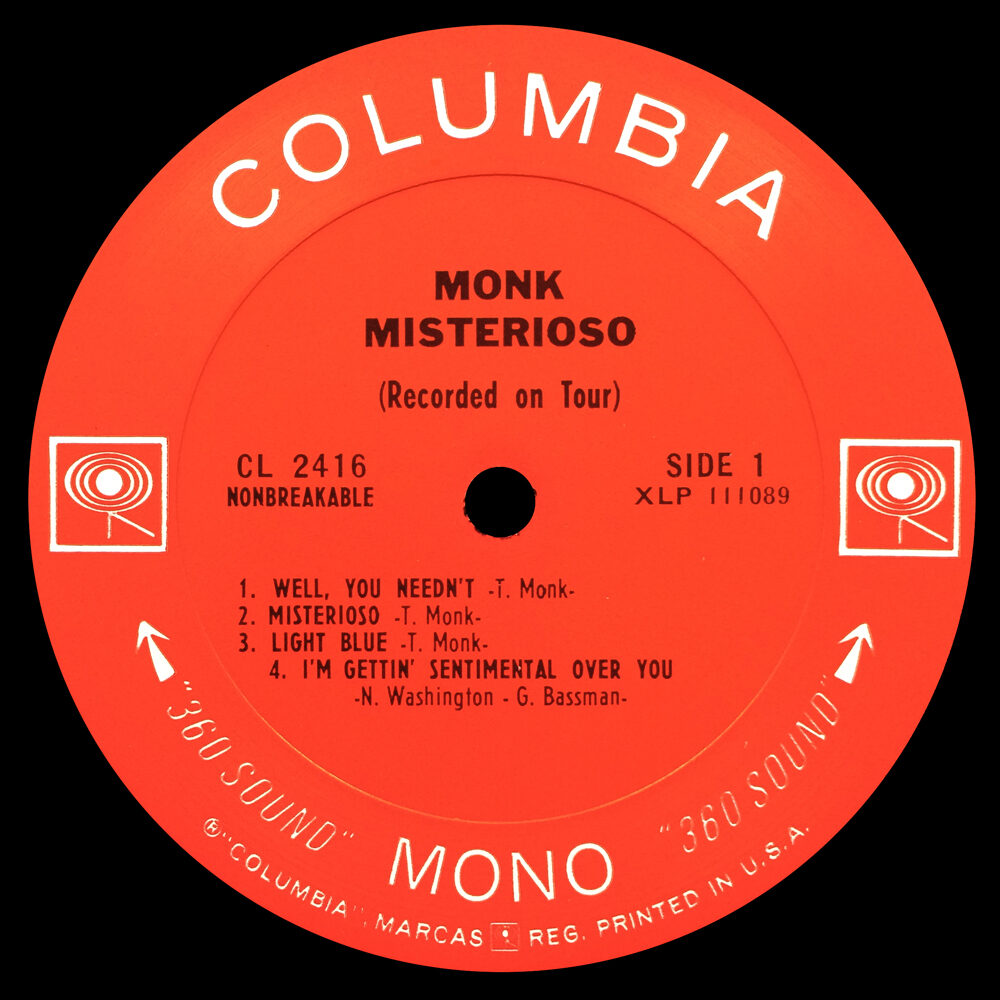
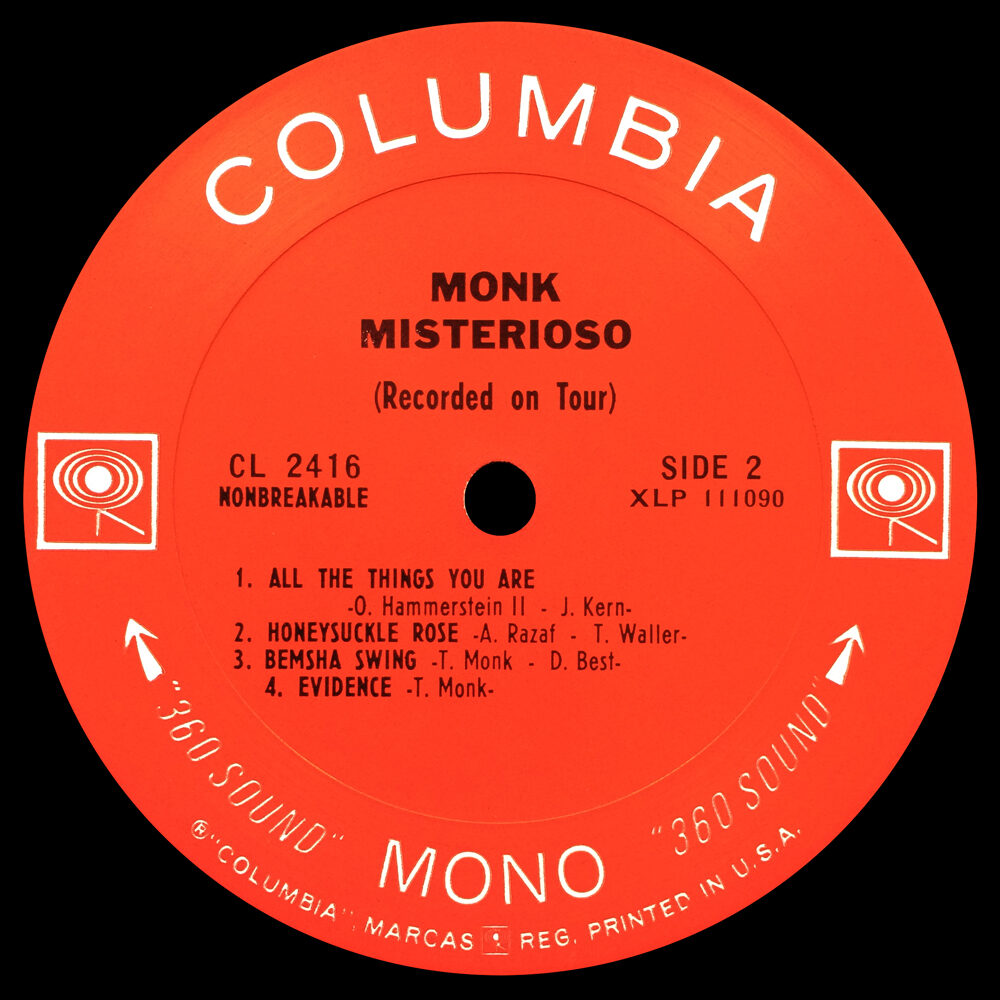
Vinyl Spotlight: Thelonious Monk, Misterioso (Columbia 2416) Original Mono Pressing

  • Original 1966 mono pressing
  • “2-eye” labels

Personnel:

All but “Misterioso”, “Light Blue”, and “Evidence”:

  • Charlie Rouse, tenor saxophone
  • Thelonious Monk, piano
  • Larry Gales, bass
  • Ben Riley, drums

“Misterioso”, “Light Blue”, and “Evidence” only:

  • Charlie Rouse, tenor saxophone
  • Thelonious Monk, piano
  • Butch Warren, bass
  • Frankie Dunlop, drums

“Evidence” recorded May 21, 1963 at Sankei Hall, Tokyo
“Light Blue” recorded July 4, 1963 at Newport Jazz Festival, Newport, RI
“Misterioso” recorded December 30, 1963 at Lincoln Center, New York, NY
“I’m Getting Sentimental Over You” and “All the Things You Are” recorded November 1, 1964 at The It Club, Los Angeles, CA
“Bemsha Swing” recorded November 4, 1964 at The Jazz Workshop, San Francisco, CA
“Well, You Needn’t” recorded February 27, 1965 at Brandeis University, Waltham, MA
“Honeysuckle Rose” recorded March 2, 1965 in New York, NY
Originally released in 1966

As big of a Thelonious Monk fan as I am, I don’t collect original pressings of Monk LPs. There are several reasons for this:

1. Some of Monk’s most inspired recordings were for Blue Note in the late ’40s and early ’50s. As a result, they are not high-fidelity and I don’t find myself seeking out older recordings like this on vinyl.

2. Though Monk’s recordings for Prestige are generally of outstanding quality in terms of both fidelity and performance, the sequencing of these recordings for Monk’s Prestige LPs is scattered in comparison to the original 10″ LP sequences, which make more sense to me.

3. I enjoy many of Monk’s Riverside releases but I’ve never found vintage Riverside pressings to be of a very high quality. I’ve owned a few but resold them shortly after acquiring them.

4. Much of Monk’s output for Columbia included songs he had already recorded for other labels in the past, and in most cases I prefer the older recording. No doubt, Monk’s Columbia recordings are of exceptionally high fidelity, but I do find that his playing on older albums sounds a little more inspired. I also don’t feel that the pinpoint accuracy of the Columbia recordings suits Monk’s music as well as the sonic signature of studios like Hackensack (Prestige and some Riverside) and Reeves (Riverside).

One of the exceptions to 4. above is this compilation of previously unreleased live material. Knowing that Monk felt his studio albums primarily served as advertisements for his live performances, I’ve taken a stronger interest in the pianist’s live albums. Although this album was released relatively close to the death knell of mono in 1964, and despite the fact that Columbia had been releasing brilliant-sounding stereo LPs for several years by that time, I still cherish the mono version of this album because the stereo mixes of Monk on Columbia fail to position the leader in the center of the stereo field.

This album has sentimental value to me because it served as my introduction to Monk when I borrowed my friend’s copy many years ago and this is the second original mono copy I’ve owned. The first was in pretty good shape but last year at the WFMU Record Fair I stumbled upon this copy in near-new condition, and for the asking price I couldn’t pass it up.

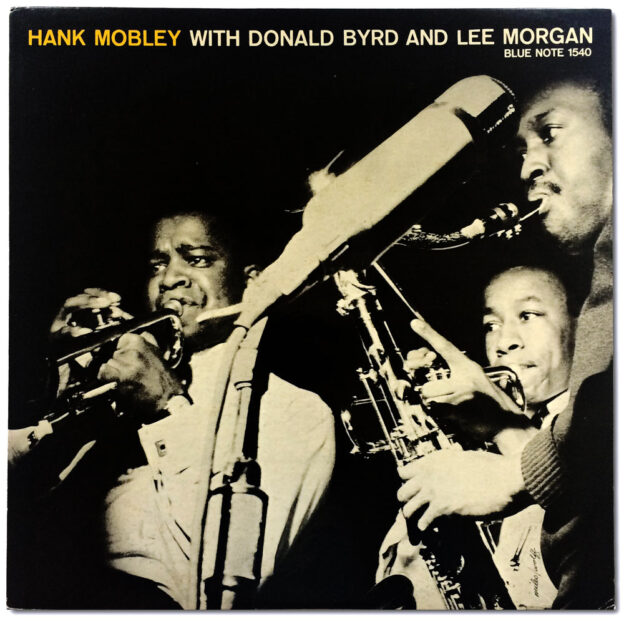
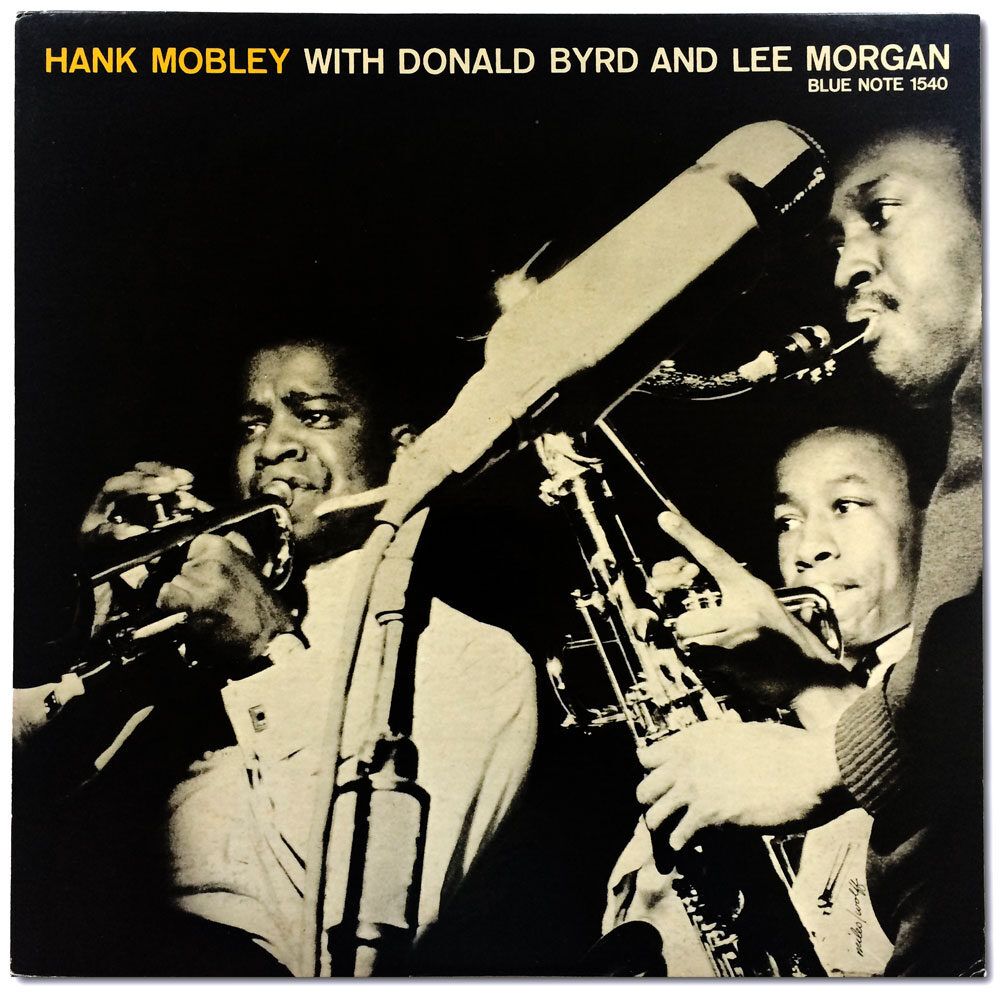
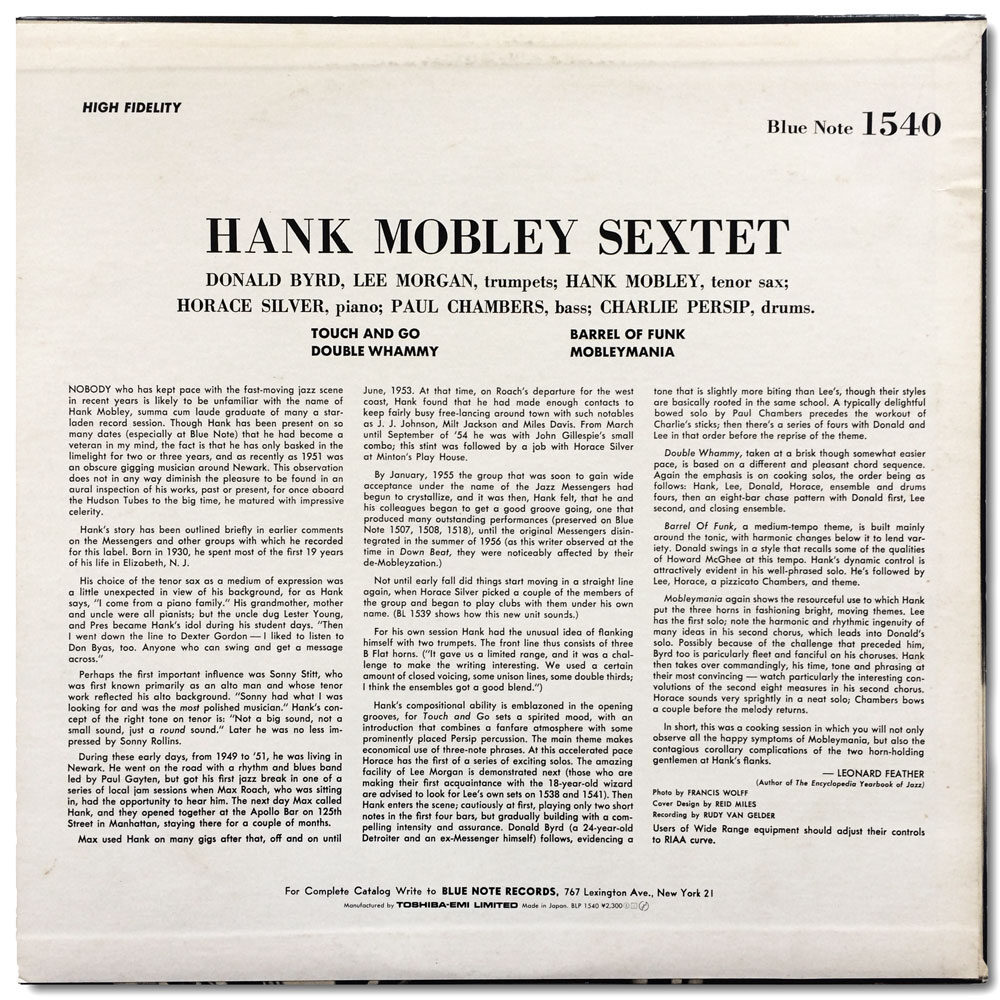
Vinyl Spotlight: Hank Mobley with Donald Byrd and Lee Morgan (Blue Note 1540) Toshiba Reissue

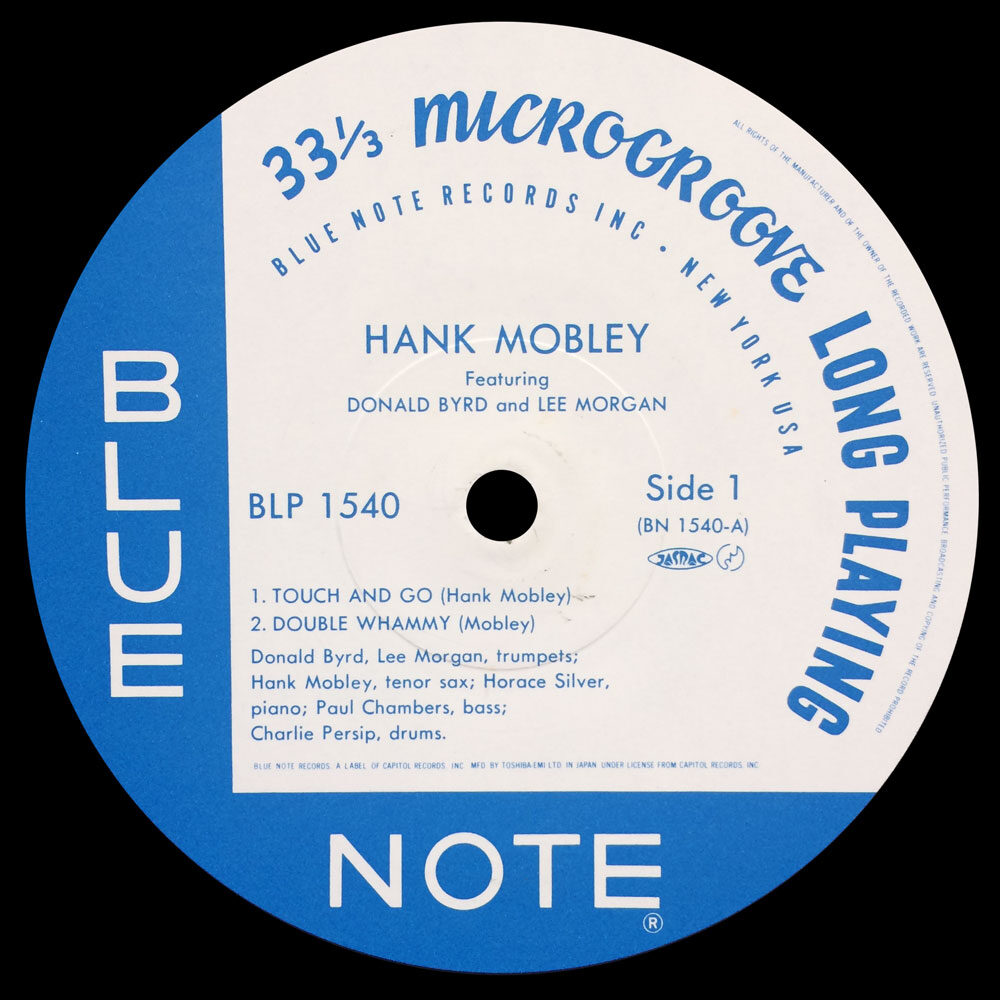
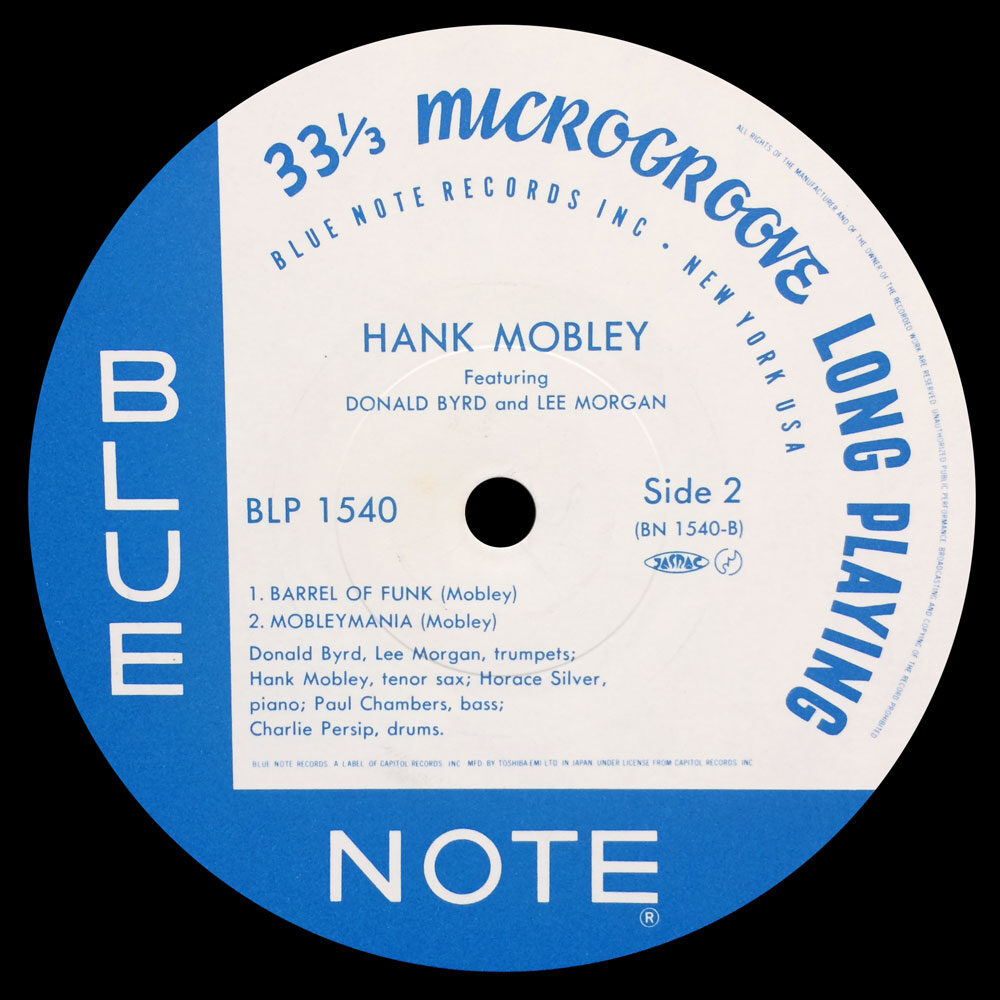
  • Japanese Toshiba reissue circa 1983 (BN 1540)

Personnel:

  • Donald Byrd, trumpet
  • Lee Morgan, trumpet
  • Hank Mobley, tenor saxophone
  • Horace Silver, piano
  • Paul Chambers, bass
  • Charlie Persip, drums

Recorded November 25, 1956 at Van Gelder Studio, Hackensack, New Jersey
Originally released January 1957

It’s been a while since I first discovered this album but I’m pretty sure I first heard it on Spotify back when they had that cool Blue Note app that allowed you to sift through the albums like actual records. This album mesmerized me instantly; the thunderous chorus of horns that introduces the album alerts the listener to the arrival of jazz royalty.

There was something different about this sound, though. The horns had a tremendous sonic impact. The unique arrangement of two trumpets and one tenor saxophone was certainly playing a role, but recording engineer Rudy Van Gelder had clearly found a rare synergy with his equipment that day and I have yet to hear this horn sound topped by any other jazz recording. It is intense, smooth, and cohesive all at once. Van Gelder was getting a similar sound on other albums in late 1956 but perhaps the particular combination of Mobley, Byrd, and Morgan sets this album apart. The engineer’s choices regarding microphone positioning, preamplifier gain, compression, and instrument balance certainly played a role in the creation of this monumental sound as well.

The album’s compositions, all written by leader Hank Mobley, are consistently menacing. The haunting harmonies of “Touch and Go” and “Double Whammy” carry a sense of foreboding, and while “Barrel of Funk” has a rather upbeat “A” section, the tune ultimately transforms into an intriguing progression of minor-key origins at its bridge. Even the album’s most upbeat tune, “Mobleymania”, manages to keep listeners on the edge of their seats with harmonic tension.

Blue Note catalog number 1540 features Mobley’s characteristic sweet, smooth tone throughout. As a youthful pair of trumpeters, Donald Byrd and Lee Morgan are difficult to tell apart. Horace Silver does little to detract from this star-studded frontline, and the forefather of bop humbly yet tastefully blends into the background for much of the program. Silver’s comping is never boastful here, but at the same time it falls short of embodying the pianist’s big musical personality and signature funk (it wouldn’t be long before Silver would ditch sideman work for good and become the leader of his own legendary quintet). To round things out, drummer Charlie Persip sits at the throne behind his drum kit in the far corner of Rudy Van Gelder’s living room studio. I cannot get enough of the beautiful simplicity of Van Gelder’s mono drum sound at Hackensack in the late ’50s. Persip sounds just as good as anyone in that room and his straight-ahead timekeeping compliments Van Gelder’s technique exceedingly well.

Beyond a repress in the late ’60s after Blue Note had been sold to Liberty Records (the proof of which lies in the existence of copies with “RVG” etchings but no “ear”), this album has never been reissued in the United States, not even on compact disc (it has, however, appeared on numerous compilations including Mosaic’s box set of Mobley’s ’50s Blue Note recordings). The Japanese almost never left a Blue Note stone unturned though and this album is no exception, having been reissued by Toshiba-EMI five times in various formats. I was also considering the King reissue from the same year when I bought this 1983 Toshiba copy on eBay from a Japanese seller but ultimately chose the Toshiba not only because it was cheaper but I also noticed that the fonts used on the Toshiba cover more accurately portrayed those of the original artwork (King album covers also often admit an unnaturally high level of contrast). This was my first Japanese Blue Note vinyl reissue venture and I remember being stunned by how dead-quiet this pressing was.

My dream is to someday own a vintage copy of this album with RVG etchings. Until then, this Toshiba reissue is sure to get lots of turntable time in my house.

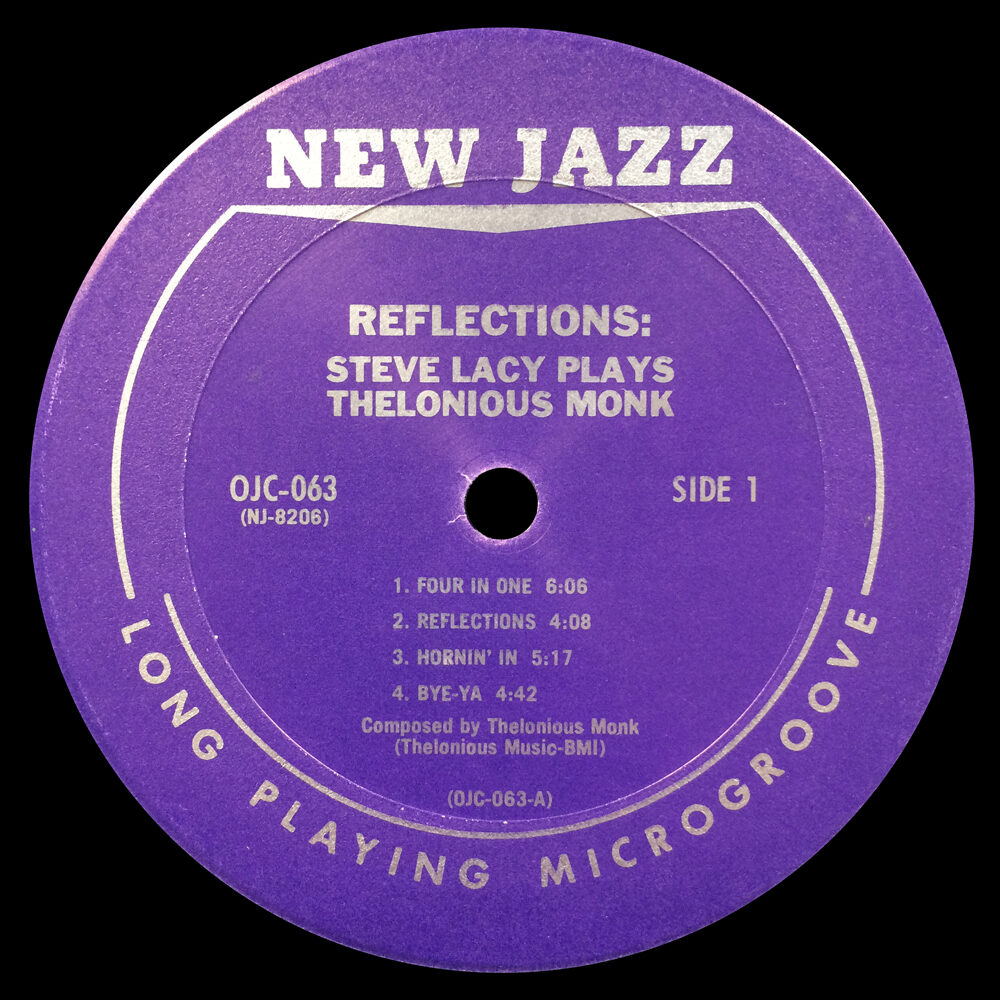
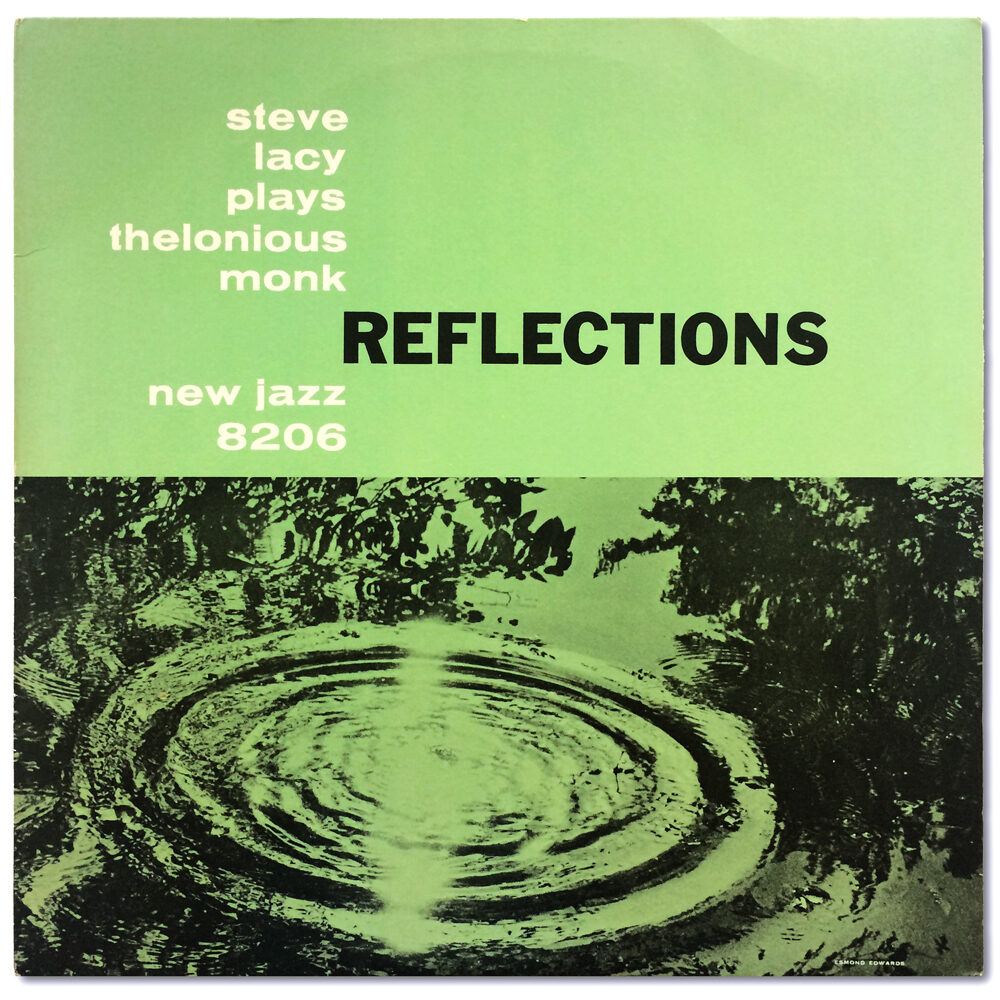
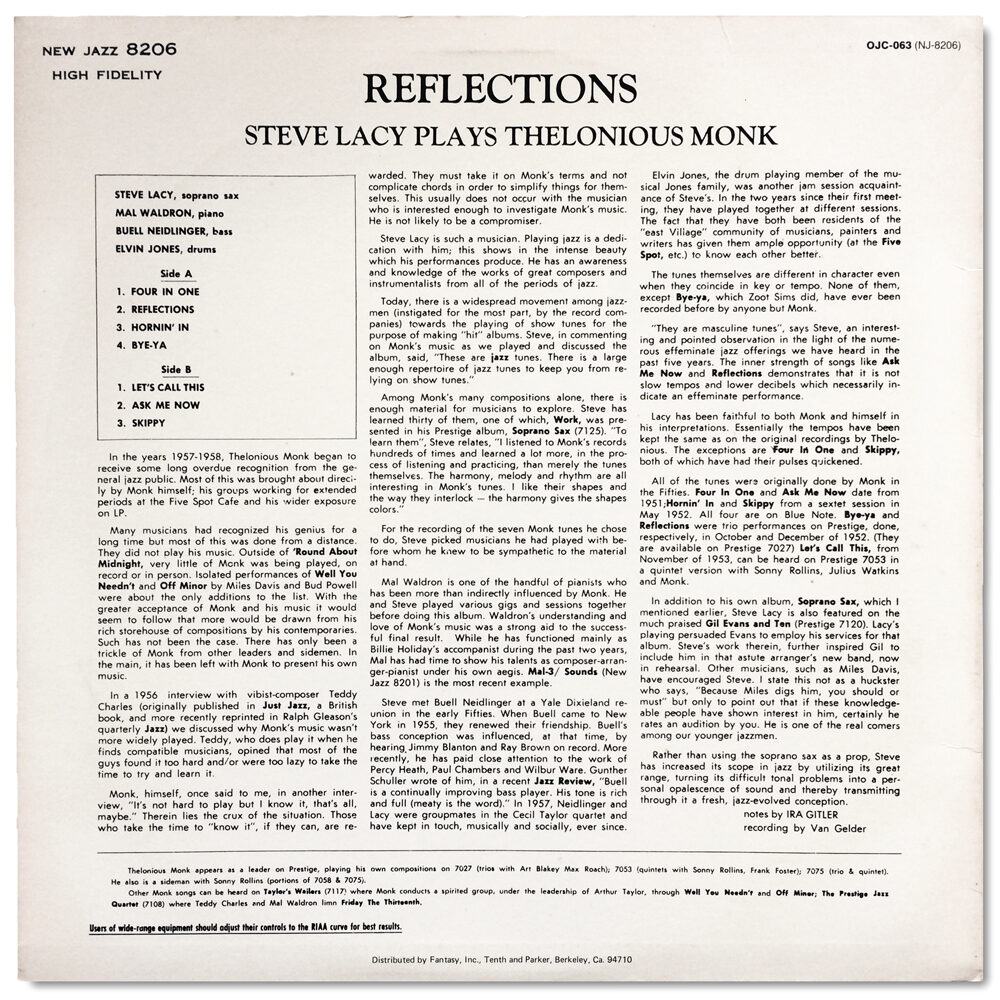
Vinyl Spotlight: Reflections: Steve Lacy Plays Thelonious Monk (New Jazz 8206) OJC Reissue

  • Original Jazz Classics reissue circa 1983 (OJC-063)
  • “GH” etched in dead wax (side 2 only)

Personnel:

  • Steve Lacy, soprano saxophone
  • Mal Waldron, piano
  • Buell Neidlinger, bass
  • Elvin Jones, drums

Recorded October 17, 1958 at Van Gelder Studio, Hackensack, New Jersey
Originally released in 1959

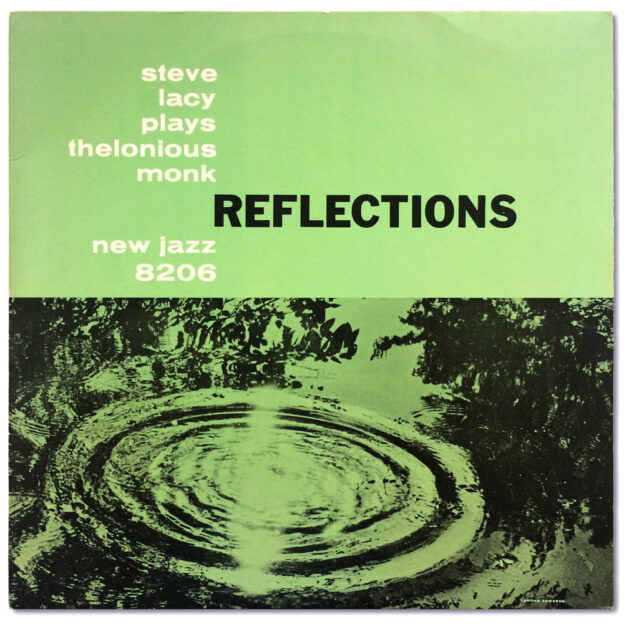
My discovery of this album came as a pleasant surprise. A record-dealing friend had recently pulled a mammoth score including a dozen or so cardboard boxes packed with jazz reissues. Sifting through the boxes, the bold lime green of this cover caught my eye as most modern, mid-century cover designs do. I knew nothing about Steve Lacy, and even though I had seen the album cover once or twice online, for the first time I noticed the words “plays Thelonious Monk” (unbeknownst to me at the time, “Reflections” is the title of a lesser-known Monk composition). I turned the cover over to glance at the arrangement. It was then that I realized that Steve Lacy was not one to follow trends. An album of Monk compositions played with soprano sax? I had long been a fan of John Coltrane’s work with the then-out-of-fashion instrument so I was intrigued.

On this expedition I had the luxury of being able to preview records as I dug, and when I put this record on I was surprised by how much I liked what I was hearing. I quickly realized that Lacy had chosen more obscure, challenging Monk tunes for the album. Wynton Marsalis did something similar when I saw the Lincoln Center Jazz Orchestra pay tribute to Monk at Town Hall in New York City in 2016 and I admire the bravery that goes into making this kind of choice.

Not to discredit Lacy’s chops (of which he has plenty), just the combination of Monk’s music being played with soprano sax is a treat in and of itself. Lacy and session pianist Mal Waldron are clearly big fans of Monk’s, each having recorded Monk tunes numerous times throughout their careers. Considering how much I enjoy this album on top of its condition and the price I paid, this has become one of my favorite records in my collection.

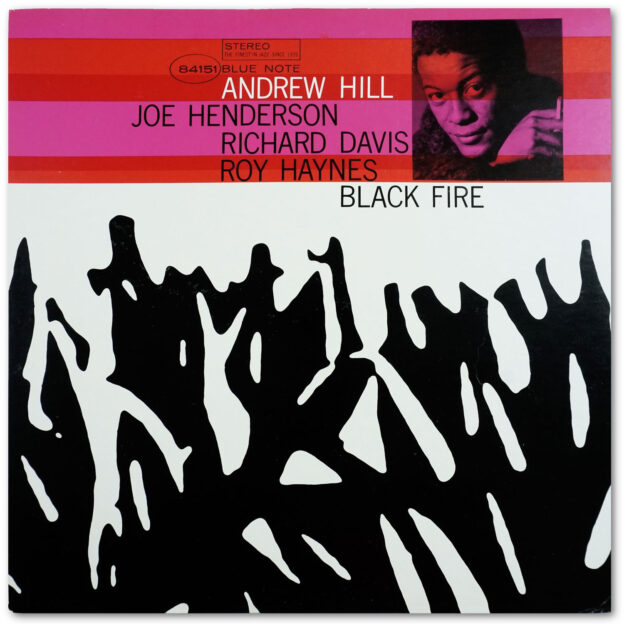
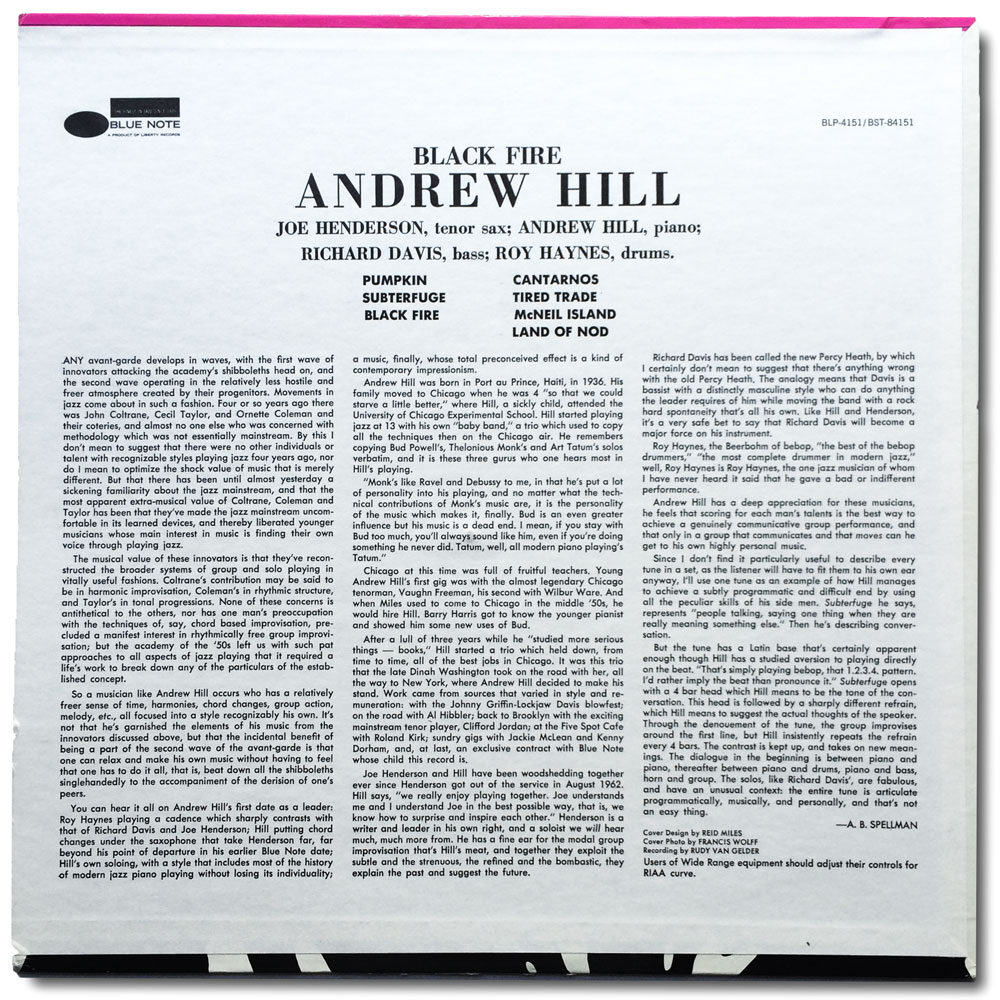
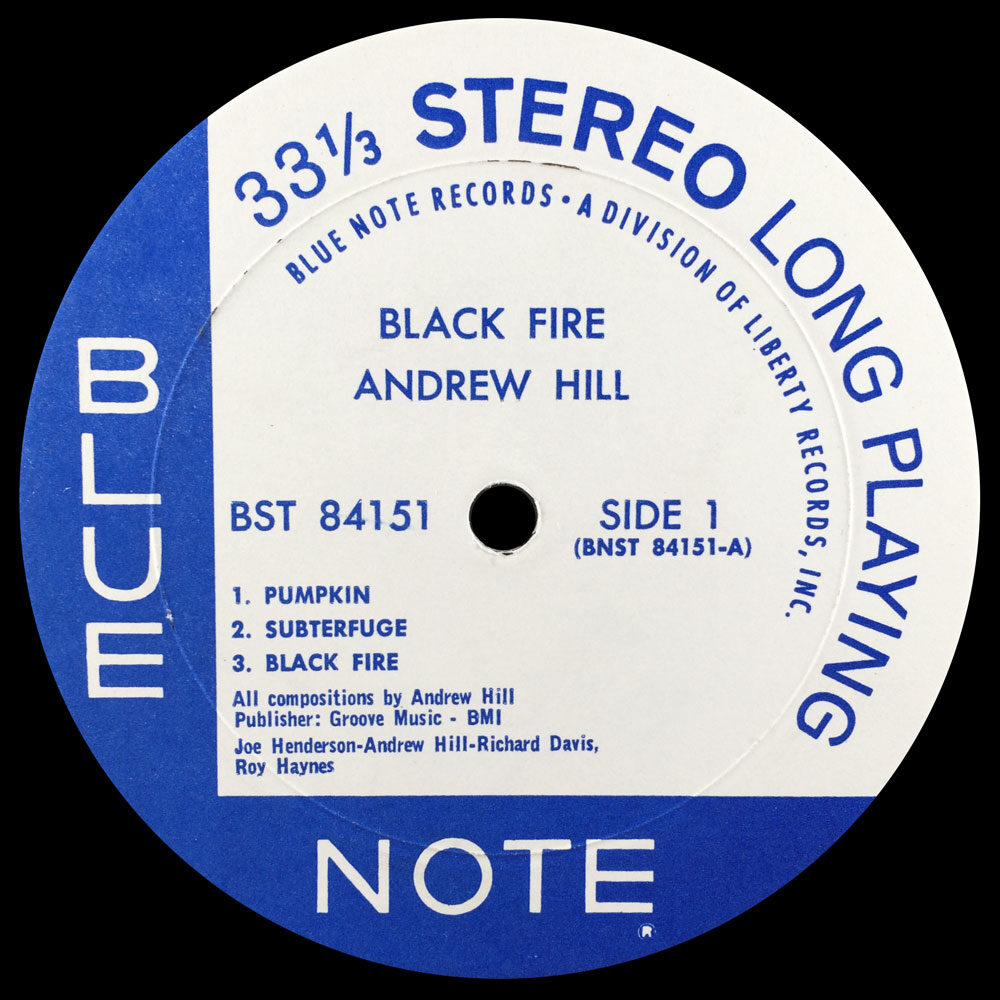
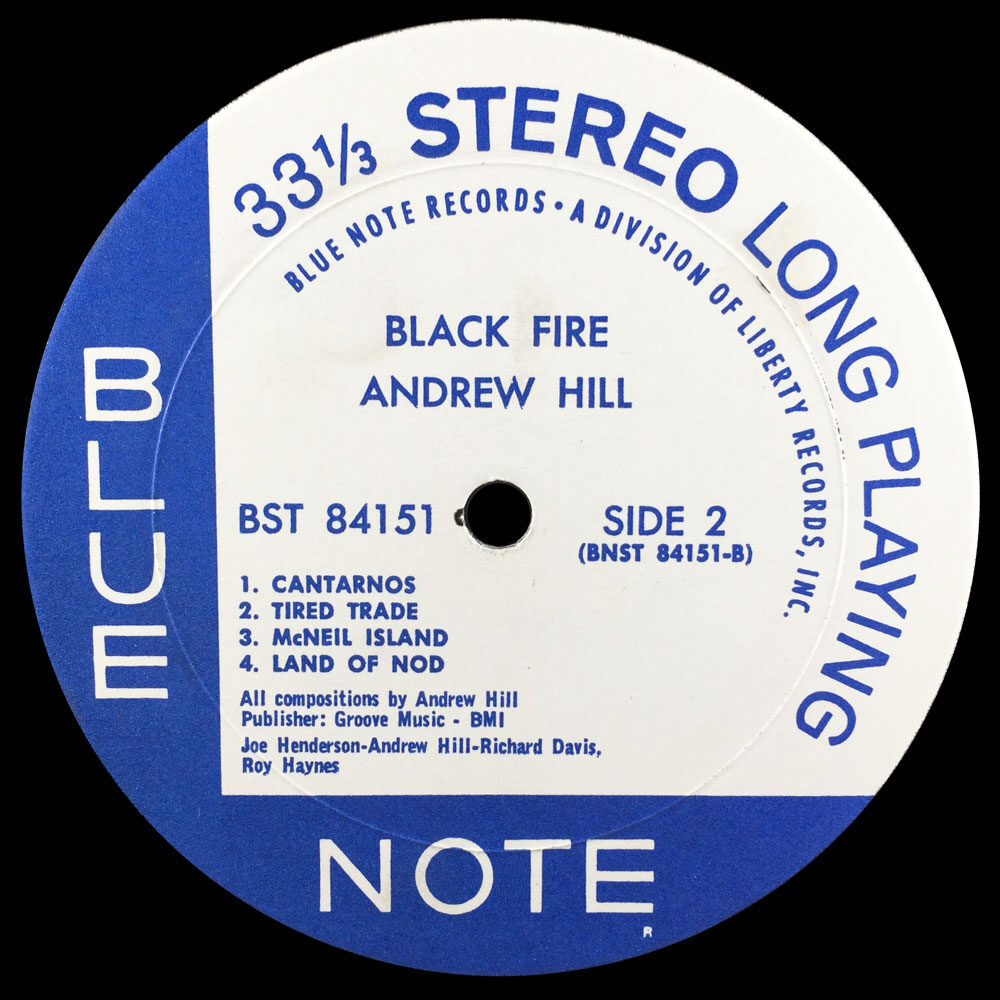
Vinyl Spotlight: Andrew Hill, Black Fire (Blue Note 84151) Liberty RVG Stereo Pressing

  • Stereo Liberty reissue circa 1966-1970
  • “A DIVISION OF LIBERTY RECORDS, INC.” on both labels
  • “VAN GELDER” stamped in dead wax

Personnel:

  • Joe Henderson, tenor saxophone
  • Andrew Hill, piano
  • Richard Davis, bass
  • Roy Haynes, drums

Recorded November 9, 1963 at Van Gelder Studio, Englewood Cliffs, New Jersey
Originally released March 1964

1 Pumpkin
2 Subterfuge
3 Black Fire
4 Cantarnos
5 Tired Trade
6 McNeil Island
7 Land of Nod

First and foremost, I think this is one of the greatest album covers of all time. I love the juxtaposition of the bold strips of various red hues with the cartoony black-and-white illustration of fire beneath. Reid Miles’ cover design speaks volumes and yet again complements the music incredibly well.

From the time Andrew Hill arrived at Blue Note in 1963, it didn’t take long for the pianist-composer to venture “out” and away from bop. Hill first recorded for the label in September of that year with Joe Henderson (Our Thing, Blue Note 4152), then with Hank Mobley the following month (No Room for Squares, Blue Note 4149). Black Fire, Hill’s first album as a leader for Blue Note, was recorded in November 1963 and gives us an early glimpse at Hill loosely conforming to the higher degree of harmonic and melodic structure commonly found in bop. Blue Note would continue to document Hill’s musical explorations in the coming months, laying to tape Smokestack, Judgment!, then finally Hill’s avant-garde classic Point of Departure in March 1964 — the same month that Eric Dolphy recorded his landmark album Out to Lunch! for the label.

This album is about as far out as I’m willing go into the free jazz sea. I’m not a fan of free jazz and don’t know much about it, but from the little I do know I’m willing to say that Black Fire tows the line between post bop and the avant-garde. The sounds here tend to invoke a subtle feeling of panic, but much like another favorite mid-sixties quartet album of mine, Black Fire maintains a surprising degree of calm and quietude through all of the chaos. We also get to hear Roy Haynes on an uncommon Blue Note date and he doesn’t disappoint, demonstrating his patented pinpoint precision and tight snare drum work throughout.