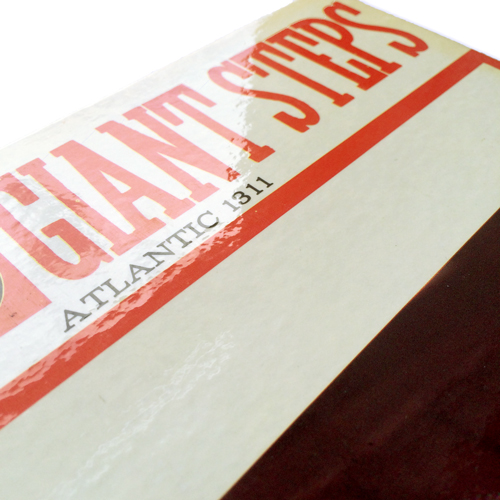
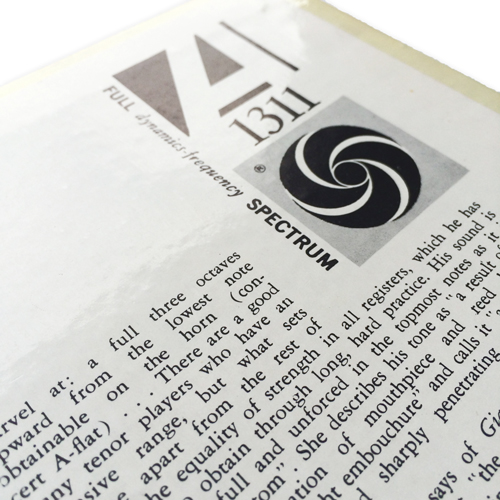
- Fifth mono pressing circa 1966
- Orange & purple label
- Box logo side 1; black fan logo side 2
- Side 1/2 matrix: 11637-A “AT” / 11638-A “AT”
VERSUS!
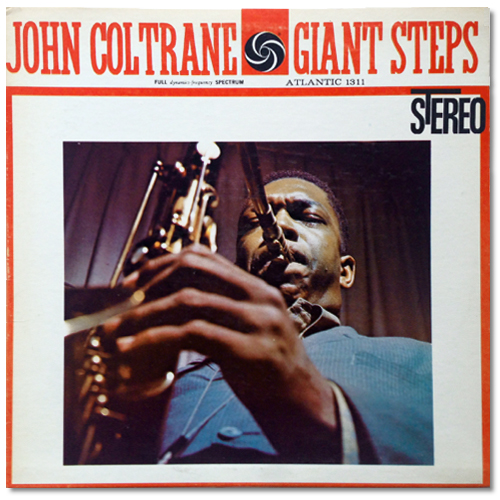
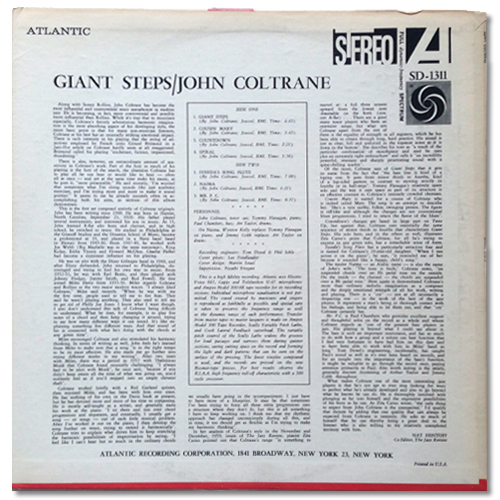
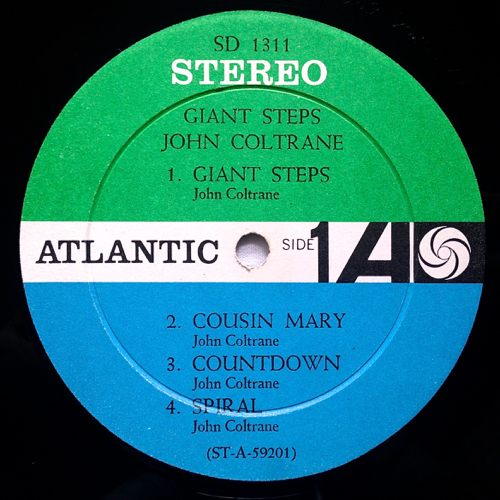
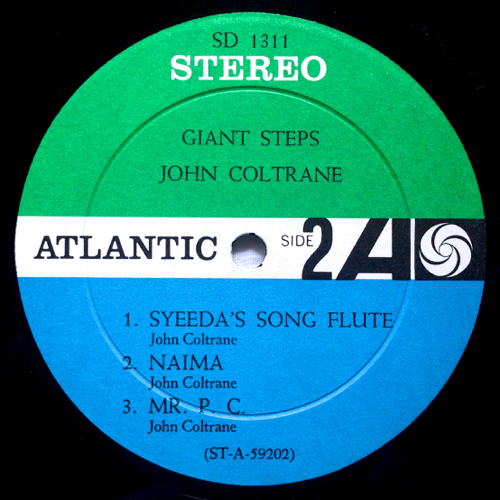
- Second stereo pressing circa 1960-1962
- Green & blue label
- Deep groove on both sides
- White fan logo on both sides
- Side 1/2 matrix: AVCO ST-A-59201 / AVCO ST-A-59202
Personnel:
All but “Naima”:
- John Coltrane, tenor saxophone
- Tommy Flanagan, piano
- Paul Chambers, bass
- Art Taylor, drums
“Naima” only:
- John Coltrane, tenor saxophone
- Wynton Kelly, piano
- Paul Chambers, bass
- Jimmy Cobb, drums
All but “Naima” recorded May 4-5, 1959; “Naima” recorded December 2, 1959
All selections recorded at Atlantic Records’ 56th Street studio, NYC
Originally released January 1960
| 1 | Giant Steps | |
| 2 | Cousin Mary | |
| 3 | Countdown | |
| 4 | Spiral | |
| 5 | Syeeda’s Song Flute | |
| 6 | Naima | |
| 7 | Mr. P.C. |
Selections:
“Giant Steps” (Coltrane) [Mono]
“Giant Steps” (Coltrane) [Stereo]
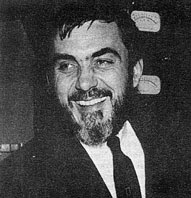
Tom Dowd
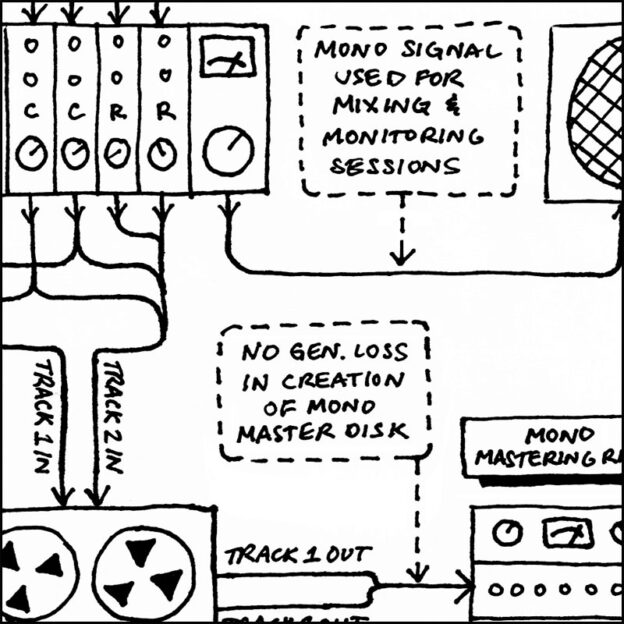
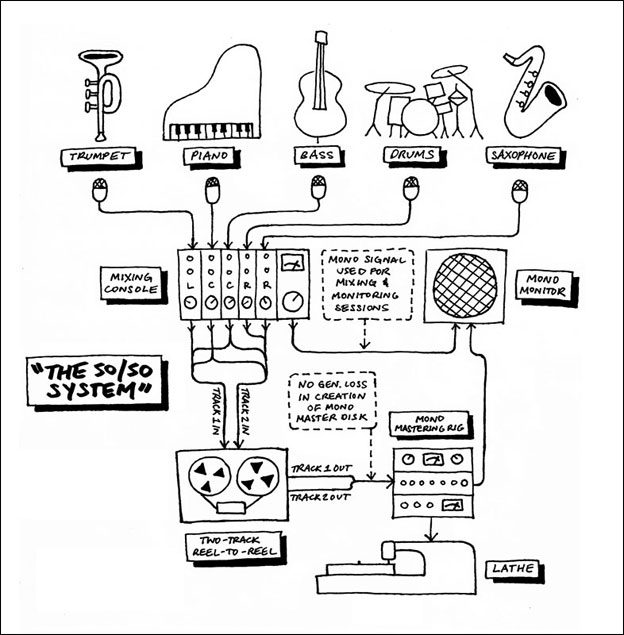
Giant Steps was recorded at Atlantic’s infamous 56th Street “office studio” under the supervision of legendary recording engineer Tom Dowd. According to the album’s liner notes, it was recorded to an Ampex 300-8R eight-track tape recorder, the results of which are two distinct i.e. ‘dedicated’ mixes, meaning the mono mix is not a ‘fold-down’.
The mono: Coltrane is front and center in this dark, bass-y mix. Trane and pianist Tommy Flanagan sit in good relationship to each other, though Paul Chambers’ bass doesn’t have a whole lot of definition, and Art Taylor’s drums get a bit buried behind Coltrane’s screaming presence.
The stereo: No instruments are presented center here, which for better or worse takes something away from Trane’s presence. (I doubt that Dowd was not yet privy to the theory of the ‘phantom center image’, and I can’t help but wonder why he was still not utilizing the center at this time.) Chambers’ bass still lacks good definition, though the spread gives Taylor more room to cut through. My first version of this album was the original 1990 stereo CD and I always appreciated how well I could hear the nuances in Taylor’s drumming in the stereo mix (I especially love the detail of the ride cymbal).
Head-to-head: On speakers, both mixes sound quite full, but in headphones the stereo version’s wide spread and its emphasis on the bass and treble leaves the mono feeling quite thin. However, Coltrane commands more presence in the mono mix, not only because he has been shifted from the far left to the center, but the mono also seems to favor the midrange, where the saxophone’s timbre is largely defined. This is probably why I feel that Coltrane sounds a bit muffled in the stereo mix when compared to the mono.
The verdict: Through speakers, both mixes sound great to me and I’d be happy to own either copy if I didn’t have a choice. But while I can only assume that most die-hard Coltrane fans will prefer the leader’s stronger presence in the mono mix, I personally love hearing all the nuances of Taylor’s kit in the stereo mix through headphones, which is probably why this is my favorite listening experience overall.
To play us out, I have included “Naima” as an added bonus because it is simply one of my favorite ballads of all-time. I chose the mono version because I find that the tune’s sparse composition works better without all the ‘empty space’ inherent in the stereo mix.
“Naima” (Mono)