- Second (Prestige) pressing with blue labels circa 1964
- “RVG” stamped in dead wax
Personnel:
- Idrees Sulieman, trumpet
- John Coltrane, tenor saxophone
- Tommy Flanagan, piano
- Doug Watkins, bass
- Louis Hayes, drums
Recorded April 18, 1957 at Van Gelder Studio, Hackensack, New Jersey
Originally released in 1959
Selection:
“Solacium” (Flanagan)
Then recently on one of my periodic trips to New York’s East Village record shops, I was doing my flip-through-the-jazz-bins routine, panning for gold and expecting to turn up nothing but the usual rocks. But then in the Kenny Burrell section, the deep purple of this cover peeked out from the tightly-packed row. I assumed this was another OJC reissue, but when I slid the record out of the jacket I was surprised to see the early ’60s blue Prestige label. Things were starting to heat up. The next crucial step was examining the dead wax. With any luck I’d find the initials of Mr. Rudolph Van Gelder stamped there, and sure enough, I did.
I then examined the vinyl, which looked solid VG+. The price tag made it seem like this one slipped by whatever staff member priced it, and strangely, the numbers on the sticker indicated that it had been priced for sale three months prior. I had to believe that it sat behind the counter for months before it made its way to the racks because this record at this price would never last in a store for more than a week. Finally, I brought it over to the listening station for the final leg of my inspection routine and was humbly blown away by how quiet and clean it sounded. So I didn’t hesitate to bring it to the front and I slammed my cash down on the counter: “It’s a deal.”
In the past I’ve expressed disbelief in the commonly uttered collector sentiment that “vintage jazz records sound better than they look”. But this record wasn’t just providing evidence to the contrary, it was proving me dead wrong. I don’t think I’ve ever encountered a record that looked more marked up and sounded so quiet. In fact, this record sounds cleaner than a lot of records I own that are visually EX.
Recorded in the spring of 1957, we hear John Coltrane in a less adventurous but more accessible mood characteristic of the saxophonist before he began his ferocious onslaught of scales later that year with the release of Blue Train (Blue Note 1577). “Minor Mishap” and “Eclypso” are two favorites, but the ultimate mood-setter is “Solacium”, a somber, quiet tune that will perfectly complement a rainy afternoon spent indoors. Available in bold, straight-down-the-middle Hackensack mono only — no stereo option here.
Vinyl Spotlight: Hank Mobley with Donald Byrd and Lee Morgan (Blue Note 1540) Toshiba Reissue
- Japanese Toshiba reissue circa 1983 (BN 1540)
Personnel:
- Donald Byrd, trumpet
- Lee Morgan, trumpet
- Hank Mobley, tenor saxophone
- Horace Silver, piano
- Paul Chambers, bass
- Charlie Persip, drums
Recorded November 25, 1956 at Van Gelder Studio, Hackensack, New Jersey
Originally released January 1957
Selection: “Touch and Go” (Mobley)
Selection: “Double Whammy” (Mobley)
There was something different about this sound, though. The horns had a tremendous sonic impact. The unique arrangement of two trumpets and one tenor saxophone was certainly playing a role, but recording engineer Rudy Van Gelder had clearly found a rare synergy with his equipment that day and I have yet to hear this horn sound topped by any other jazz recording. It is intense, smooth, and cohesive all at once. Van Gelder was getting a similar sound on other albums in late 1956 but perhaps the particular combination of Mobley, Byrd, and Morgan sets this album apart. The engineer’s choices regarding microphone positioning, preamplifier gain, compression, and instrument balance certainly played a role in the creation of this monumental sound as well.
The album’s compositions, all written by leader Hank Mobley, are consistently menacing. The haunting harmonies of “Touch and Go” and “Double Whammy” carry a sense of foreboding, and while “Barrel of Funk” has a rather upbeat “A” section, the tune ultimately transforms into an intriguing progression of minor-key origins at its bridge. Even the album’s most upbeat tune, “Mobleymania”, manages to keep listeners on the edge of their seats with harmonic tension.
Blue Note catalog number 1540 features Mobley’s characteristic sweet, smooth tone throughout. As a youthful pair of trumpeters, Donald Byrd and Lee Morgan are difficult to tell apart. Horace Silver does little to detract from this star-studded frontline, and the forefather of bop humbly yet tastefully blends into the background for much of the program. Silver’s comping is never boastful here, but at the same time it falls short of embodying the pianist’s big musical personality and signature funk (it wouldn’t be long before Silver would ditch sideman work for good and become the leader of his own legendary quintet). To round things out, drummer Charlie Persip sits at the throne behind his drum kit in the far corner of Rudy Van Gelder’s living room studio. I cannot get enough of the beautiful simplicity of Van Gelder’s mono drum sound at Hackensack in the late ’50s. Persip sounds just as good as anyone in that room and his straight-ahead timekeeping compliments Van Gelder’s technique exceedingly well.
Beyond a repress in the late ’60s after Blue Note had been sold to Liberty Records (the proof of which lies in the existence of copies with “RVG” etchings but no “ear”), this album has never been reissued in the United States, not even on compact disc (it has, however, appeared on numerous compilations including Mosaic’s box set of Mobley’s ’50s Blue Note recordings). The Japanese almost never left a Blue Note stone unturned though and this album is no exception, having been reissued by Toshiba-EMI five times in various formats. I was also considering the King reissue from the same year when I bought this 1983 Toshiba copy on eBay from a Japanese seller but ultimately chose the Toshiba not only because it was cheaper but I also noticed that the fonts used on the Toshiba cover more accurately portrayed those of the original artwork (King album covers also often admit an unnaturally high level of contrast). This was my first Japanese Blue Note vinyl reissue venture and I remember being stunned by how dead-quiet this pressing was.
My dream is to someday own a vintage copy of this album with RVG etchings. Until then, this Toshiba reissue is sure to get lots of turntable time in my house.
Vinyl Spotlight: Reflections: Steve Lacy Plays Thelonious Monk (New Jazz 8206) OJC Reissue
- Original Jazz Classics reissue circa 1983 (OJC-063)
- “GH” etched in dead wax (side 2 only)
Personnel:
- Steve Lacy, soprano saxophone
- Mal Waldron, piano
- Buell Neidlinger, bass
- Elvin Jones, drums
Recorded October 17, 1958 at Van Gelder Studio, Hackensack, New Jersey
Originally released in 1959
Selection:
“Reflections” (Monk)
On this expedition I had the luxury of being able to preview records as I dug, and when I put this record on I was surprised by how much I liked what I was hearing. I quickly realized that Lacy had chosen more obscure, challenging Monk tunes for the album. Wynton Marsalis did something similar when I saw the Lincoln Center Jazz Orchestra pay tribute to Monk at Town Hall in New York City in 2016 and I admire the bravery that goes into making this kind of choice.
Not to discredit Lacy’s chops (of which he has plenty), just the combination of Monk’s music being played with soprano sax is a treat in and of itself. Lacy and session pianist Mal Waldron are clearly big fans of Monk’s, each having recorded Monk tunes numerous times throughout their careers. Considering how much I enjoy this album on top of its condition and the price I paid, this has become one of my favorite records in my collection.
Vinyl Spotlight: Andrew Hill, Black Fire (Blue Note 84151) Liberty RVG Stereo Pressing
- Stereo Liberty reissue circa 1966-1970
- “A DIVISION OF LIBERTY RECORDS, INC.” on both labels
- “VAN GELDER” stamped in dead wax
Personnel:
- Joe Henderson, tenor saxophone
- Andrew Hill, piano
- Richard Davis, bass
- Roy Haynes, drums
Recorded November 9, 1963 at Van Gelder Studio, Englewood Cliffs, New Jersey
Originally released March 1964
| 1 | Pumpkin | |
| 2 | Subterfuge | |
| 3 | Black Fire | |
| 4 | Cantarnos | |
| 5 | Tired Trade | |
| 6 | McNeil Island | |
| 7 | Land of Nod |
Selections:
“Pumpkin” (Hill)
“Black Fire” (Hill)
First and foremost, I think this is one of the greatest album covers of all time. I love the juxtaposition of the bold strips of various red hues with the cartoony black-and-white illustration of fire beneath. Reid Miles’ cover design speaks volumes and yet again complements the music incredibly well.
From the time Andrew Hill arrived at Blue Note in 1963, it didn’t take long for the pianist-composer to venture “out” and away from bop. Hill first recorded for the label in September of that year with Joe Henderson (Our Thing, Blue Note 4152), then with Hank Mobley the following month (No Room for Squares, Blue Note 4149). Black Fire, Hill’s first album as a leader for Blue Note, was recorded in November 1963 and gives us an early glimpse at Hill loosely conforming to the higher degree of harmonic and melodic structure commonly found in bop. Blue Note would continue to document Hill’s musical explorations in the coming months, laying to tape Smokestack, Judgment!, then finally Hill’s avant-garde classic Point of Departure in March 1964 — the same month that Eric Dolphy recorded his landmark album Out to Lunch! for the label.
This album is about as far out as I’m willing go into the free jazz sea. I’m not a fan of free jazz and don’t know much about it, but from the little I do know I’m willing to say that Black Fire tows the line between post bop and the avant-garde. The sounds here tend to invoke a subtle feeling of panic, but much like another favorite mid-sixties quartet album of mine, Black Fire maintains a surprising degree of calm and quietude through all of the chaos. We also get to hear Roy Haynes on an uncommon Blue Note date and he doesn’t disappoint, demonstrating his patented pinpoint precision and tight snare drum work throughout.
Spotify Playlists: Rudy Van Gelder Studios
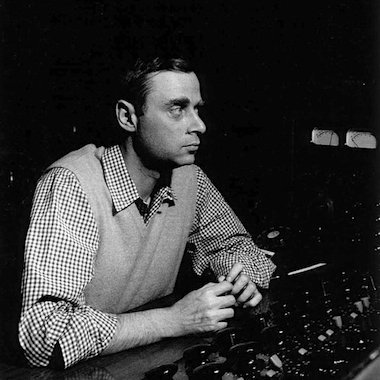
Rudy Van Gelder is one of the most recognized audio engineers to have ever lived. He has recorded hundreds of the most celebrated jazz albums the world has ever heard. His recordings are so characteristic, “the Van Gelder sound” has become a catchphrase known to jazz fans the world over. But under the umbrella of this moniker, Rudy Van Gelder’s recording technique, philosophy, and logistics went through numerous changes over his career. Perhaps the change that affected this sonic signature most was when he moved his studio from his parents’ living room in Hackensack, New Jersey to a custom-built, cathedral-like structure in nearby Englewood Cliffs. The following playlists should make clear the distinct sonic characteristics of each studio and the way each space left its mark on recordings:
- Hackensack Mono: This playlist embodies the immediate, up-front sound of Van Gelder’s Hackensack home studio. Additionally, since mono was the singular focus here, this playlist consists entirely of mono recordings and thus embodies Van Gelder’s legendary mono sound from start to finish.
- Englewood Cliffs: The stereo presentation of each recording here helps to emphasize the open, spacious sound of this studio.
Click the links below to listen to the playlists on Spotify, or shuffle through the playlists right here!
Note: If you are not logged in to Spotify on your web browser, clicking one of the “play” icons above will only play 30-second clips of the songs. Click any of the embedded links to sign in, open Spotify in your browser, or launch the app on your computer.
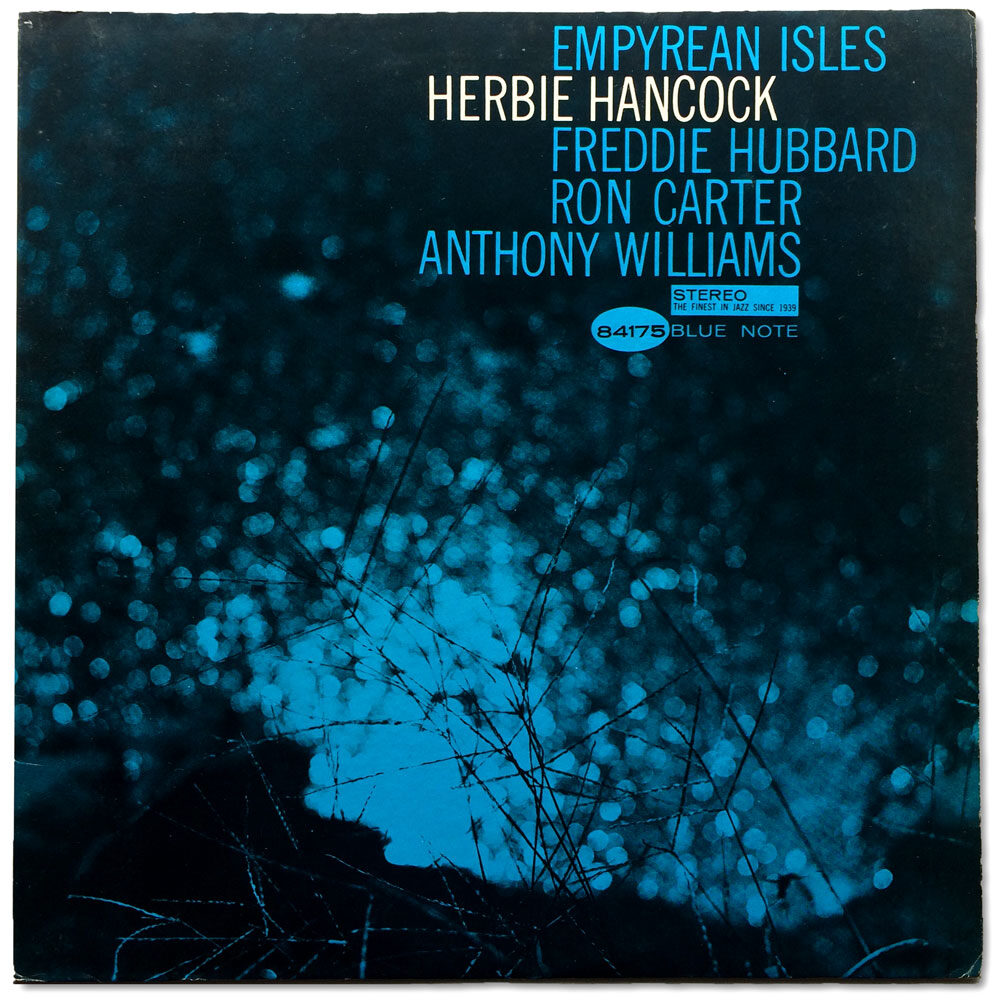
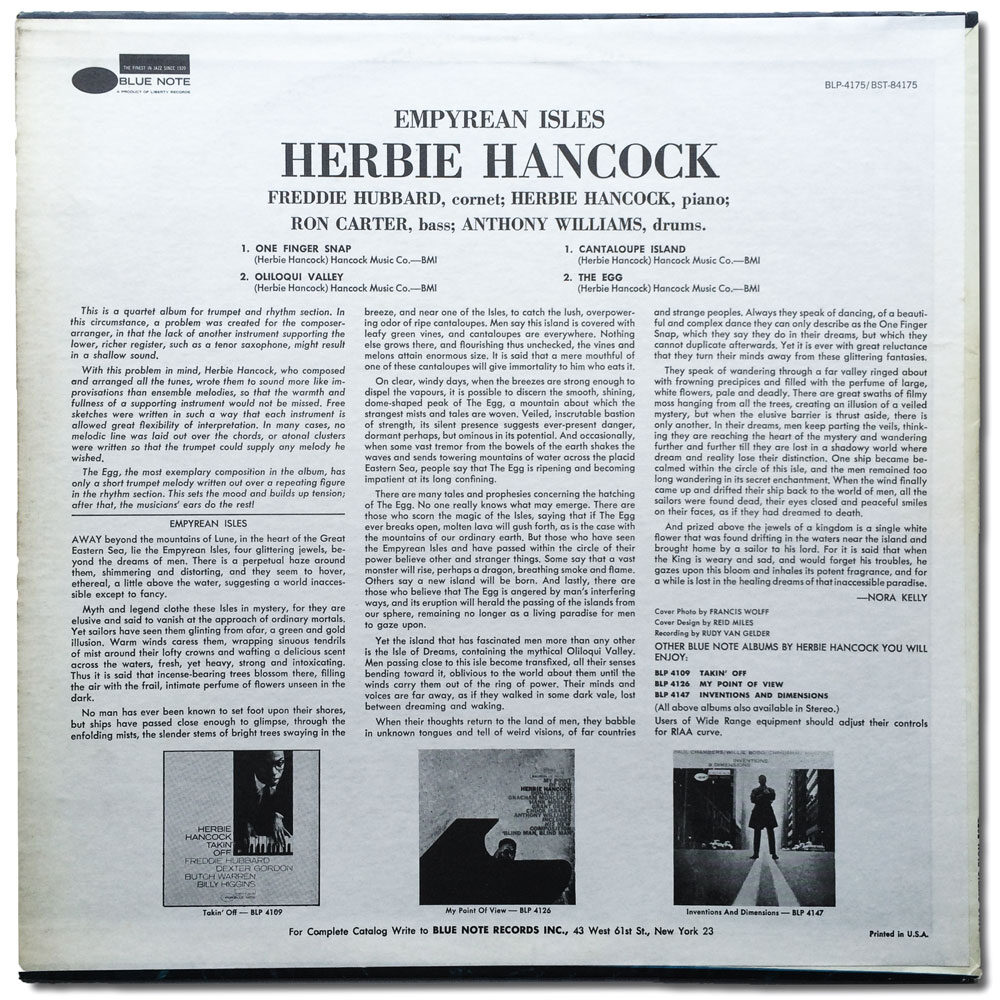
Vinyl Spotlight: Herbie Hancock, Empyrean Isles (Blue Note 4175) UA RVG Stereo Pressing
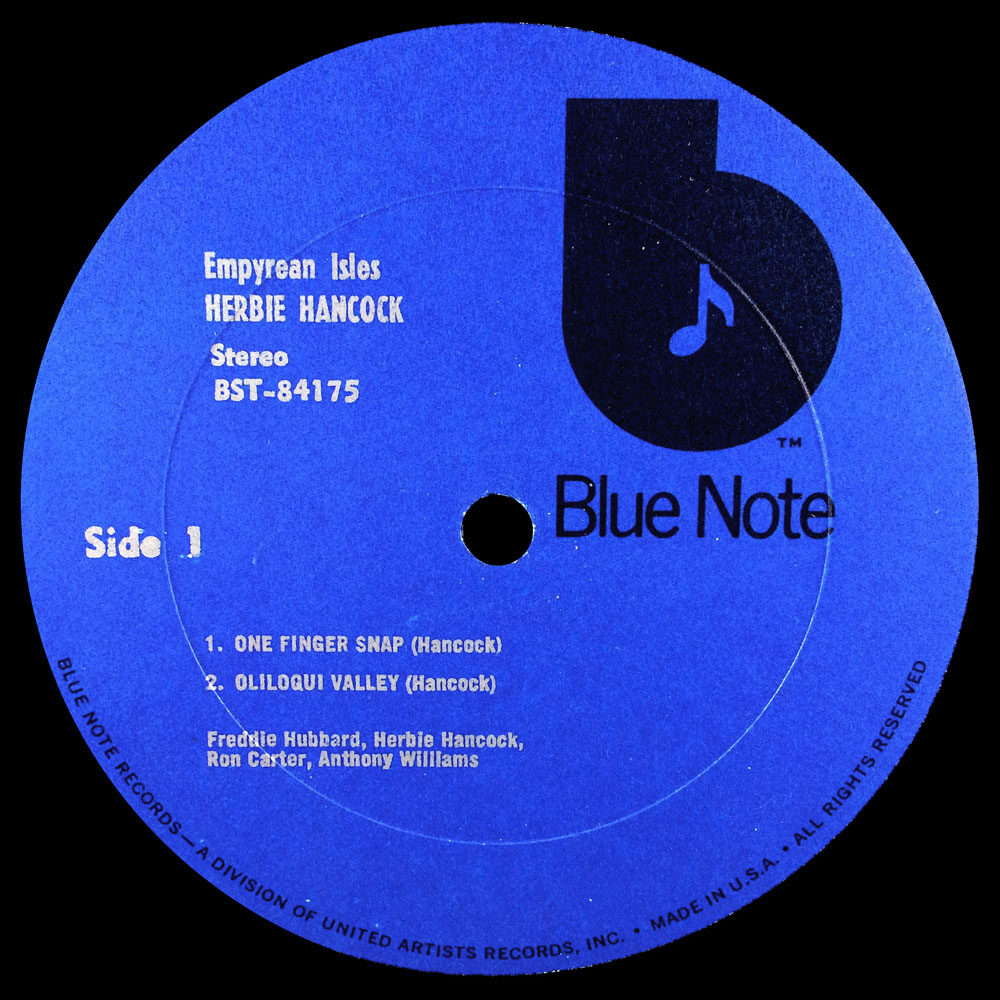
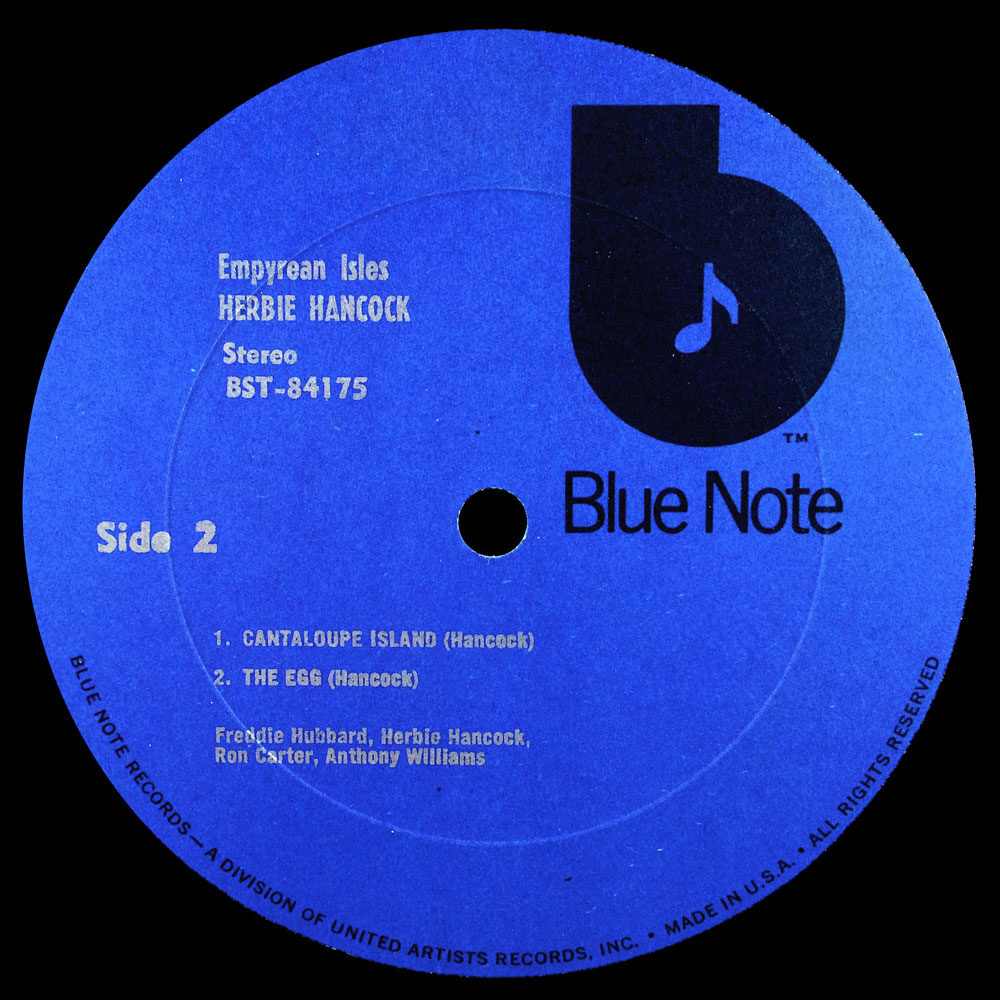
- United Artists stereo reissue circa 1972-1975
- “VAN GELDER” stamped in dead wax
Personnel:
- Freddie Hubbard, trumpet
- Herbie Hancock, piano
- Ron Carter, bass
- Tony Williams, drums
Recorded June 17, 1964 at Van Gelder Studio, Englewood Cliffs, New Jersey
Originally released November 1964
Selections:
“One Finger Snap” (Hancock)
“Oliloqui Valley” (Hancock)
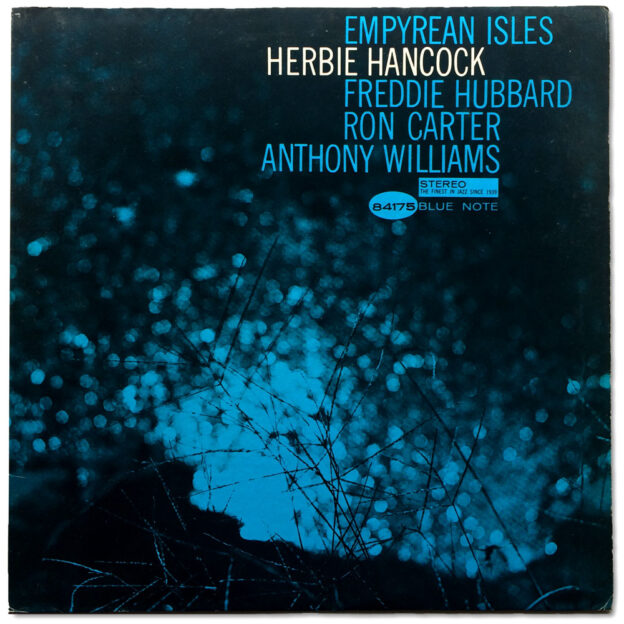
This is one of my favorite Herbie Hancock albums. It has a soft, gentle vibe that I return to time and time again when I want to listen to something quiet. The quartet with trumpet seems like the perfect minimal arrangement for this album, and even though I’m not the biggest Freddie Hubbard fan, I find that he fits in with the rest of the group like a glove here. I love the cover too. Reid Miles had a way of making album art reflect the music contained within, and with this album, the simple, out-of-focus image of shimmering water cast in a teal blue tint complements the music extremely well…even the pronunciation of the title has a calming sort of effect (“Em-PEE-ree-in”).
Although the album’s closing track, “The Egg”, ventures out a bit too far for my taste, the other three compositions are all favorites. “Cantaloupe Island” sounds like part three in a trilogy of soulful, radio-friendly Hancock compositions that began with “Watermelon Man” and “Blind Man, Blind Man”, but side 1 consists of sixteen of my favorite minutes in music. Eighteen-year-old (Eighteen!) Tony Williams’ drumming is fiery, imaginative and expressive. His kit sounds incredible here as well, especially his ride cymbal. Engineer Rudy Van Gelder’s spacious Englewood Cliffs studio had a way of making drum kits sound colossal when they needed to, which can be heard during Williams’ solo on “One Finger Snap”. Who would have ever thought that Blue Note darling Freddie Hubbard would pair with the rhythm section of Miles Davis’ Second Great Quintet so well?
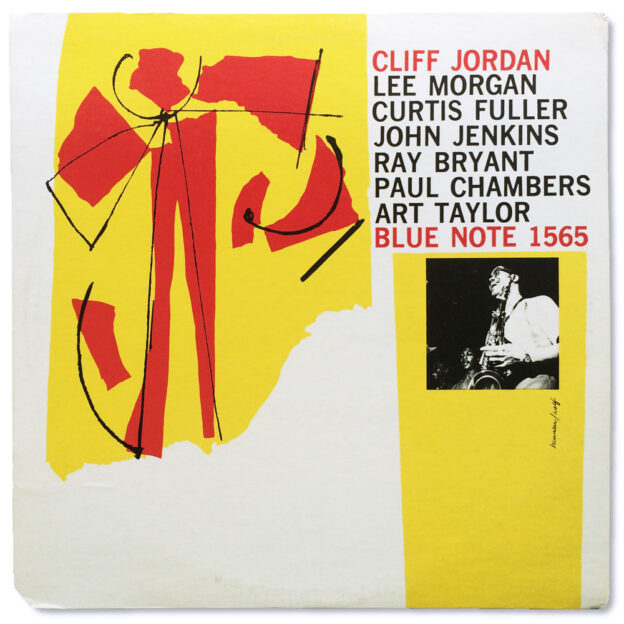
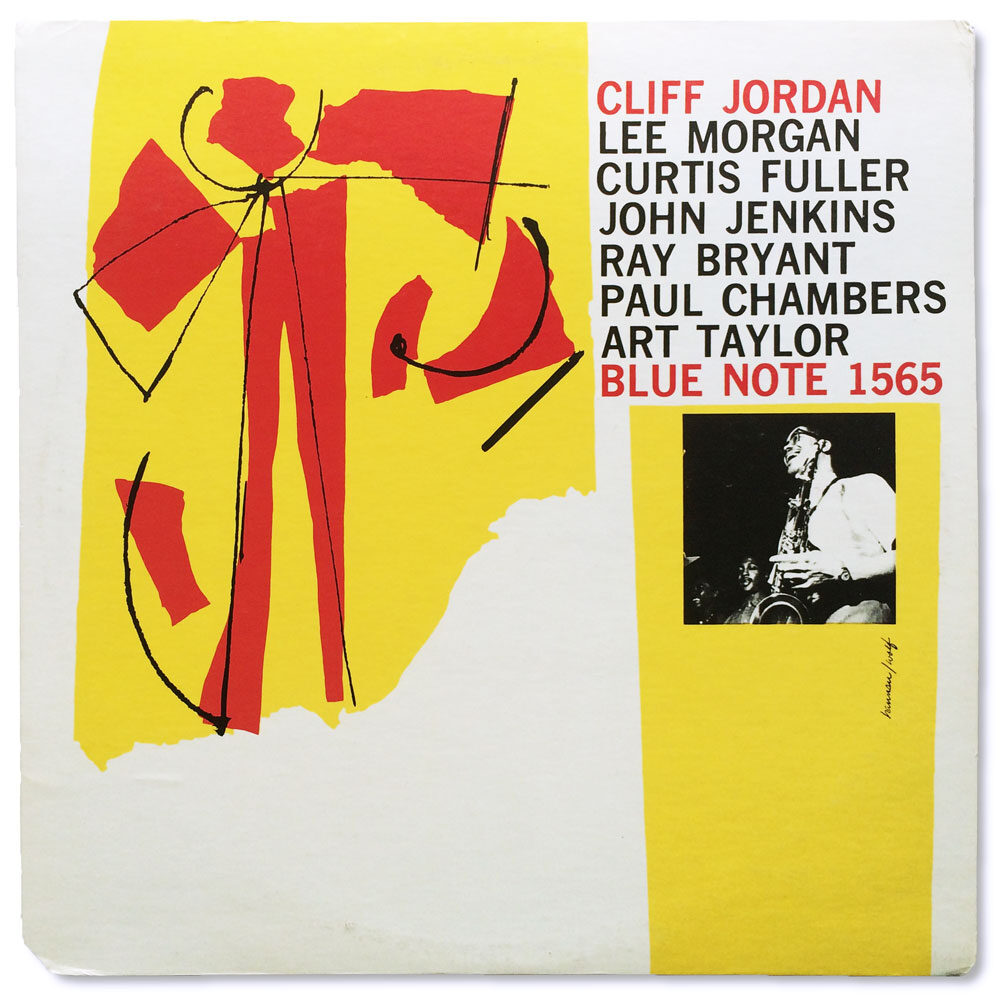
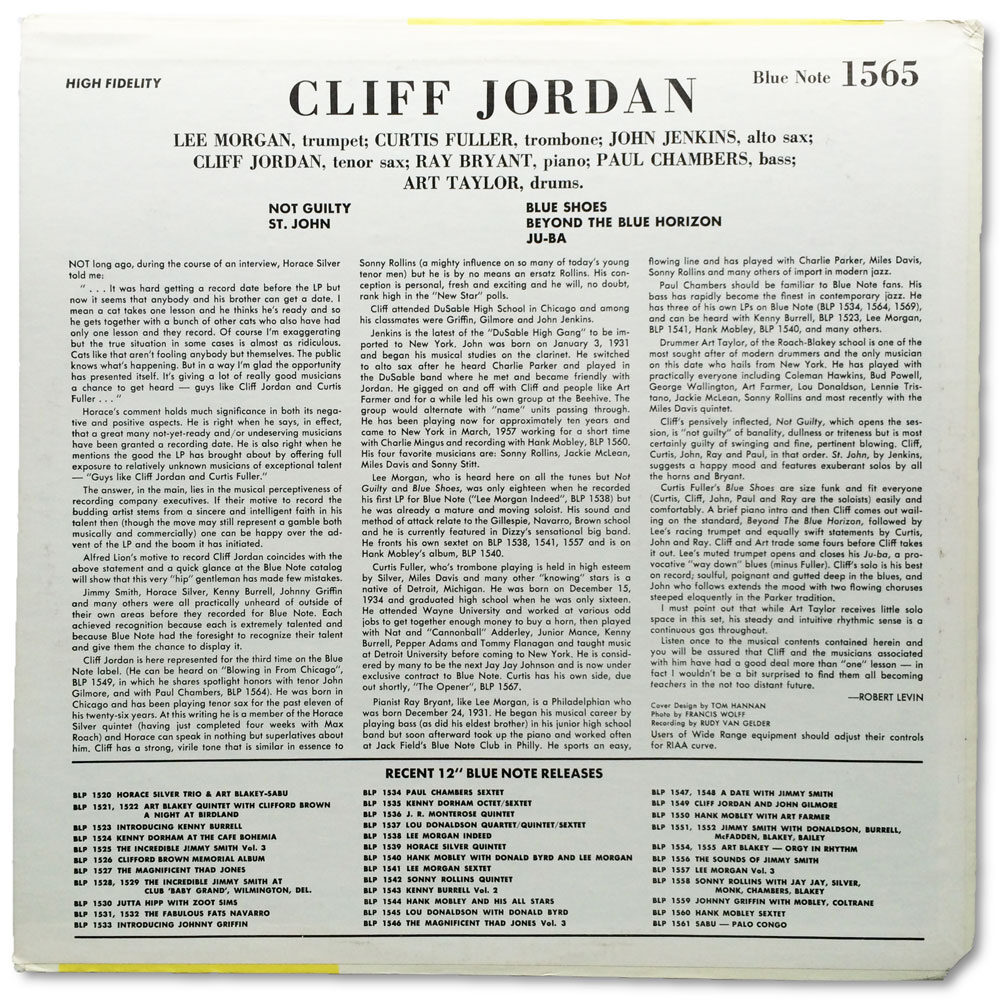
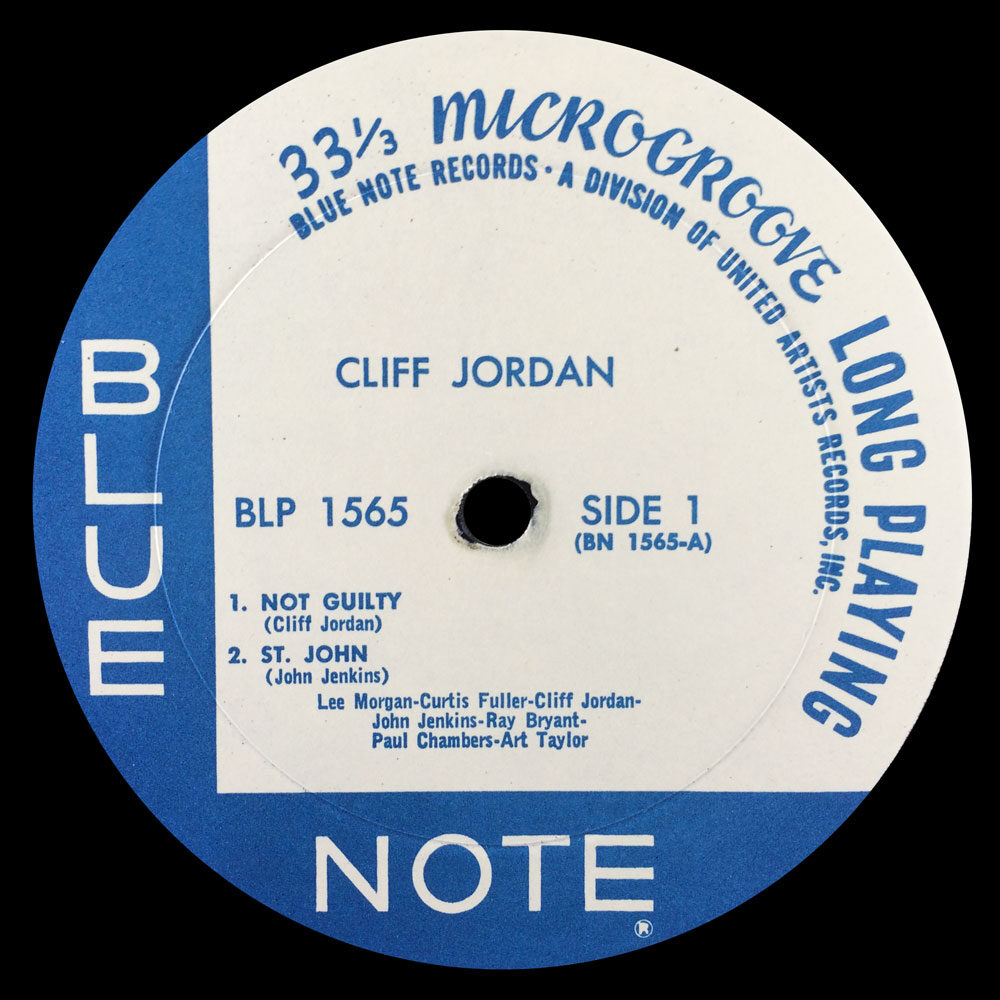
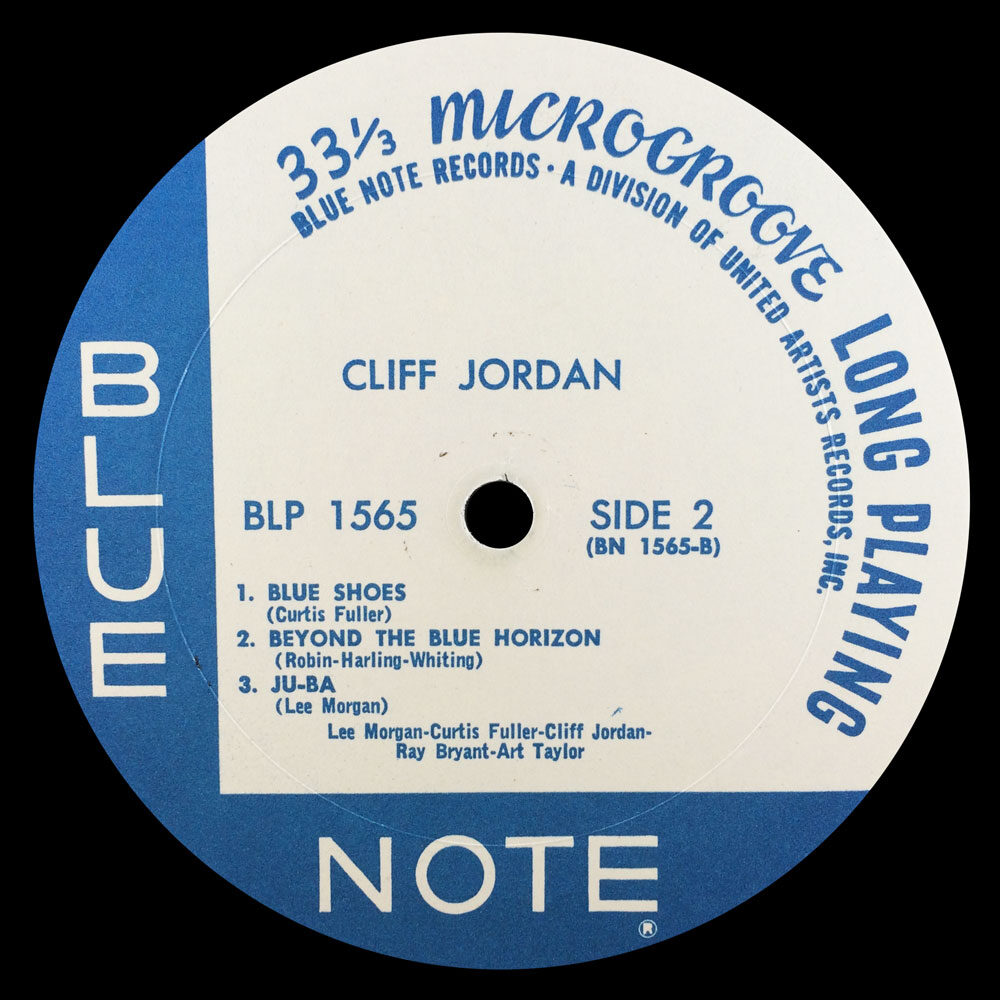
Vinyl Spotlight: Cliff Jordan (Blue Note 1565) UA Mono Pressing
- United Artists mono reissue circa 1972-1975
- “A DIVISION OF UNITED ARTISTS RECORDS, INC.” on both labels
Personnel:
- Lee Morgan, trumpet
- Curtis Fuller, trombone
- John Jenkins, alto saxophone
- Cliff Jordan, tenor saxophone
- Ray Bryant, piano
- Paul Chambers, bass
- Art Taylor, drums
Recorded June 2, 1957 at Van Gelder Studio, Hackensack, New Jersey
Originally released October 1957
Selection:
“Blue Shoes” (Fuller)
Truth be told, these United Artists mono pressings from the early to mid ’70s are hit and miss, having heard more than one that suffered from significant non-fill problems. But this particular copy made it through that inconsistent manufacturing process unscathed. United Artists pressings also seem to have a gentler top end than a lot of modern audiophile reissues, which to some collectors makes them worth seeking out despite the difficulty in finding a quality copy.
This particular Cliff Jordan album also seems difficult to find in any format, which is why I jumped at the chance to buy it when it popped up on eBay. Discogs indicates that it has only been issued in the US twice on vinyl (originally in 1957 and this copy in the early ’70s) and never on CD. Though it has been reissued by Toshiba EMI in Japan once as an LP in 1984 (undocumented by Discogs) and three more times on compact disc there, these copies are hard to find in the states. And try you may, but you will not find these sides in any shape or form on iTunes or Spotify, making this a rare and special listen indeed.
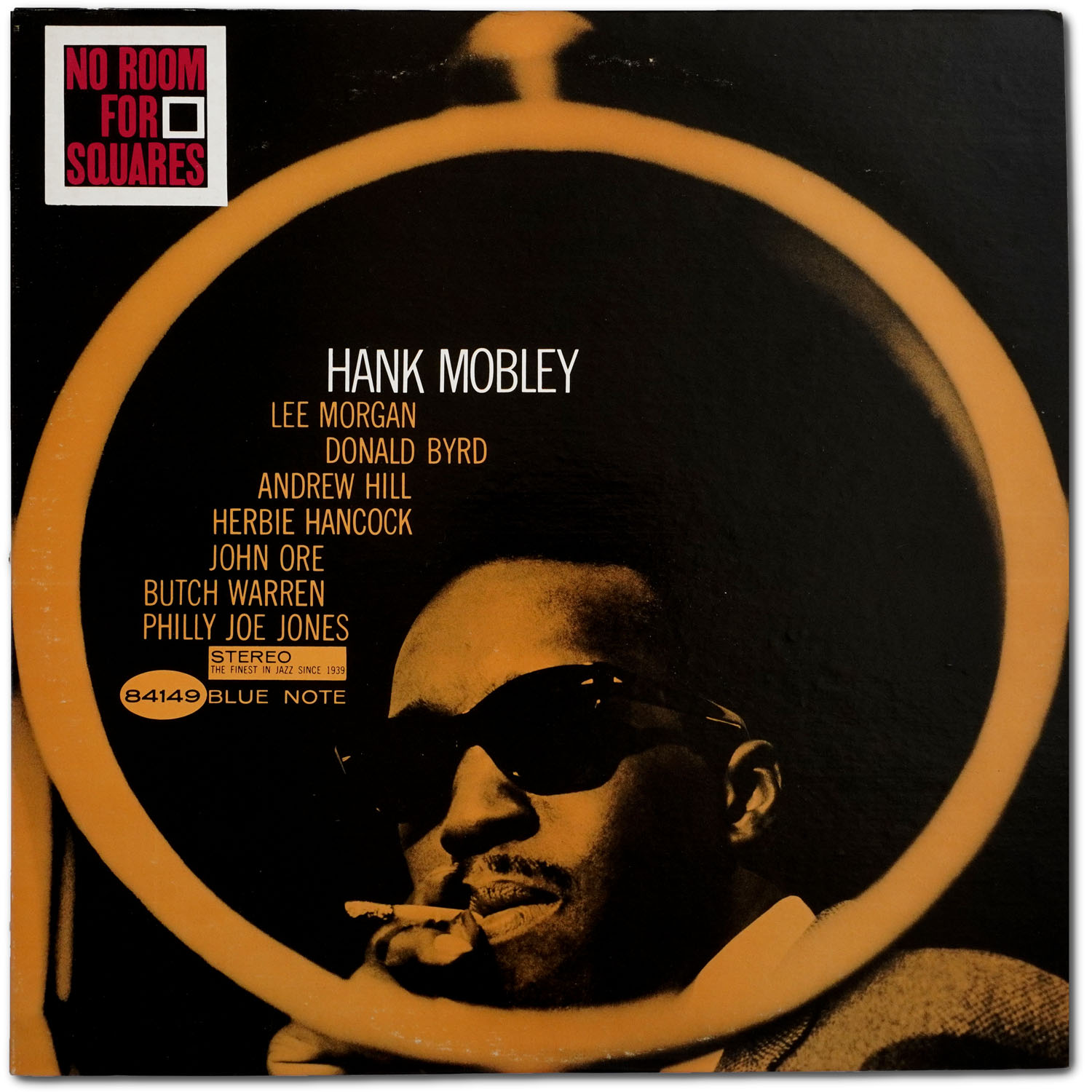
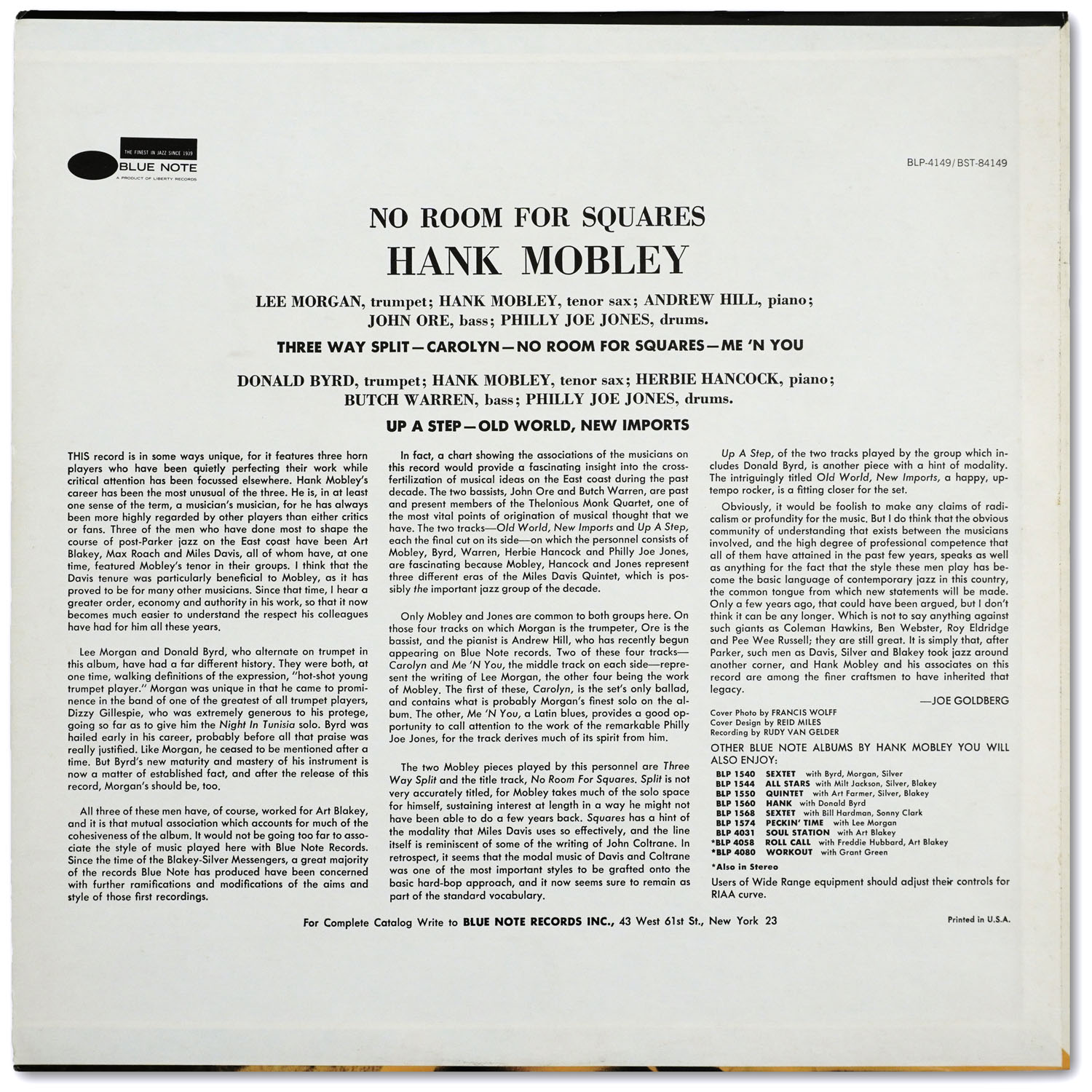
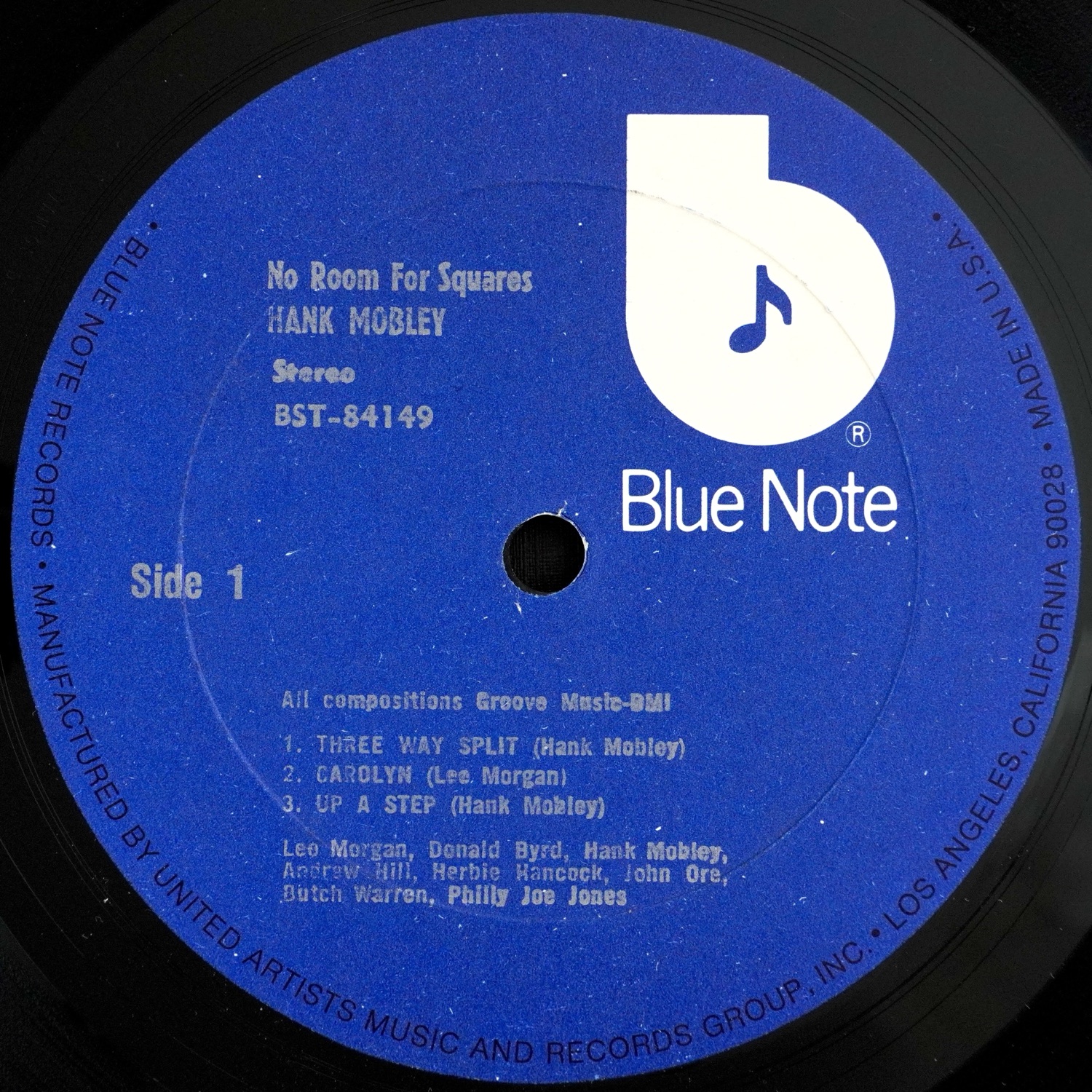
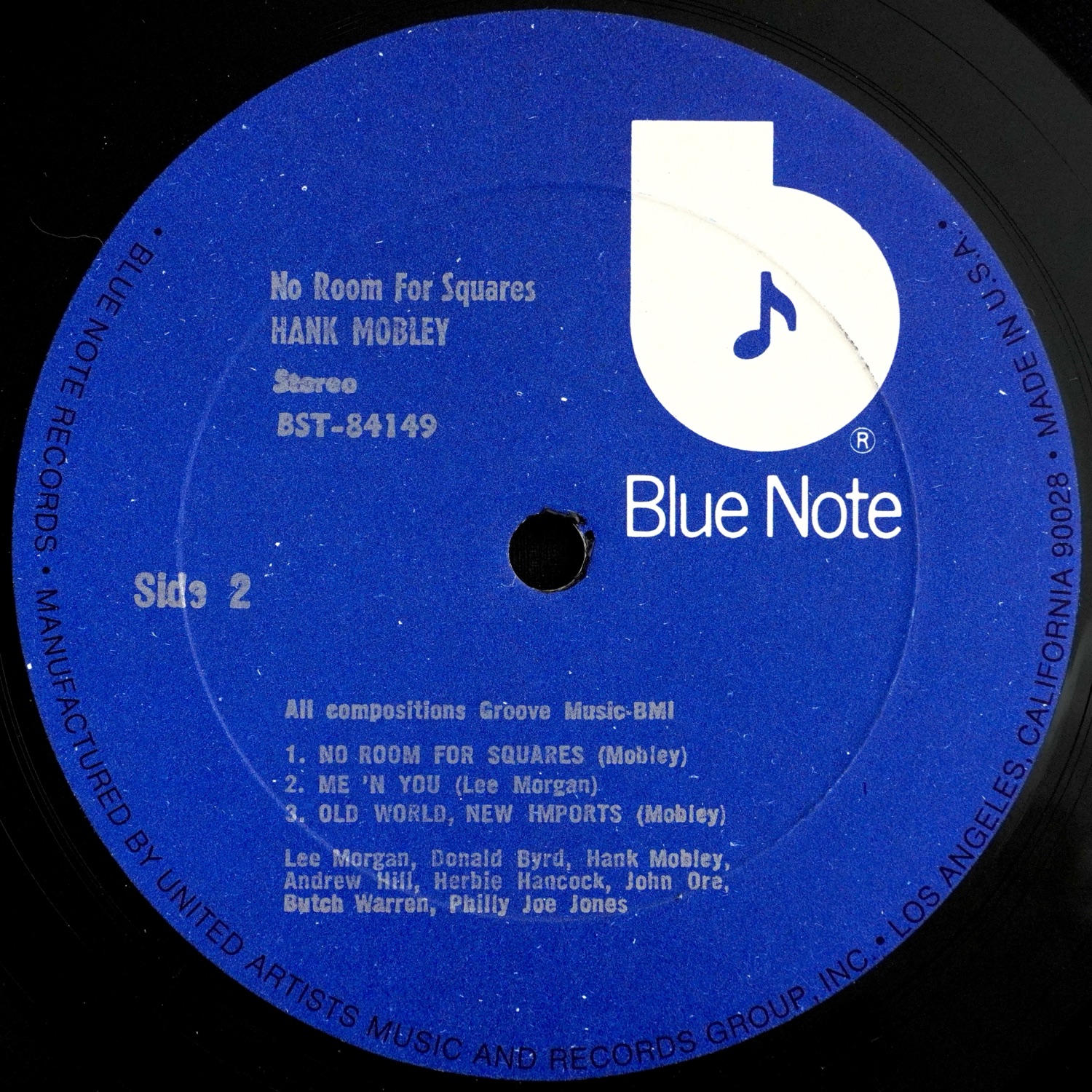
Vinyl Spotlight: Hank Mobley, No Room for Squares (Blue Note 84149) UA RVG Stereo Pressing
- United Artists stereo reissue circa 1975-1978
- “VAN GELDER” stamped in dead wax
Personnel:
All but “Up a Step”, “Old World, New Imports”:
- Lee Morgan, trumpet
- Hank Mobley, tenor saxophone
- Andrew Hill, piano
- John Ore, bass
- Philly Joe Jones, drums
“Up a Step”, “Old World, New Imports” only:
- Donald Byrd, trumpet
- Hank Mobley, tenor saxophone
- Herbie Hancock, piano
- Butch Warren, bass
- Philly Joe Jones, drums
“Up a Step”, “Old World, New Imports” recorded March 7, 1963
All other selections recorded October 2, 1963
All selections recorded at Van Gelder Studio, Englewood Cliffs, New Jersey
Originally released May 1964
| 1 | Three Way Split | |
| 2 | Carolyn | |
| 3 | Up a Step | |
| 4 | No Room for Squares | |
| 5 | Me ‘n You | |
| 6 | Old World, New Imports |
Selection:
“Three Way Split” (Mobley) [Stereo]
“Three Way Split” (Mobley) [Summed Mono]
So far on Deep Groove Mono, we’ve covered original pressings, Liberty pressings and early ’70s United Artists pressings of classic albums released by the beloved Blue Note label. This ’70s copy of Hank Mobley’s No Room for Squares with the all-blue label and the white (sometimes black) lowercase “b” logo is more or less the last phase in vintage US Blue Note pressings. (Prior to the current era of audiophile reissue programs, which gained great momentum in the late ’90s with Classic Records, the ’80s and ’90s saw a series of less popular, less acclaimed reissue programs eclipsed by the advent and subsequent reign of the compact disc.) This reissue program also constitutes the last time the original mastering work of engineer Rudy Van Gelder would be used to press reissues of classic Blue Note albums.
As is the case with the earlier mono UA reissues of the early ’70s with the classic blue-and-white label scheme, these all blue-label reissues seem hit or miss. This is at least in part due to the fact that Van Gelder’s metal work was being employed beyond the point where it could produce records of the exceptional quality originals and earlier reissues are known for. Several Blue Note albums I have encountered with all-blue-labels and Van Gelder mastering have been duds, but No Room for Squares is not one of them.
This is one of my favorite Hank Mobley albums. Recorded in 1963, it is far removed from the string of 1500-series albums Mobley recorded for Blue Note in the late fifties, all of which are very rare and in-demand in their original incarnations. Nonetheless, Mobley puts together a solid, consistent program here, best demonstrated by a pair of the leader’s own compositions (the title track and “Three Way Split”) and the ballad “Carolyn”, an original work of session trumpeter Lee Morgan. Then-veteran of the bop scene, drummer Philly Joe Jones, provides a driving and exciting performance on the skins as well.
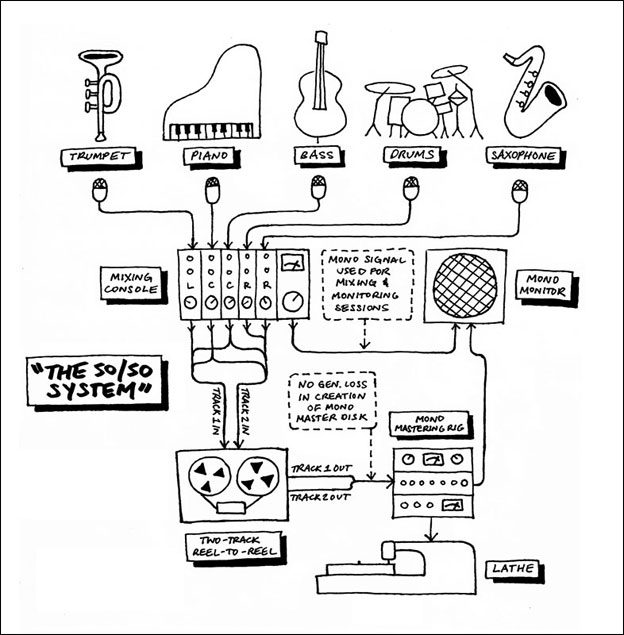
Though this is a stereo copy, it is tempting to hit the ‘mono’ button on my amplifier in order gain a sense of what an original mono pressing might sound like. The reason we can be fairly certain that this type of summing can produce comparable results is because of what we know about the way Rudy Van Gelder recorded, mixed, and mastered these albums for both mono and stereo. Though the clarity and separation offered by the stereo spread is a treat in its own right, summing to mono provides a glue to the mix that the stereo presentation is incapable of, especially when it comes to the harmonies of the horns.
Vinyl Spotlight: John Coltrane, Coltrane Live at Birdland (Impulse 50) Original Mono Pressing
- Original 1964 mono pressing
- “ABC-Paramount” on labels
- “VAN GELDER” in dead wax
Personnel:
- John Coltrane, tenor and soprano saxophone
- McCoy Tyner, piano
- Jimmy Garrison, bass
- Elvin Jones, drums
All but “Alabama”, “Your Lady” recorded October 8, 1963 at Birdland, New York, New York
“Alabama”, “Your Lady” recorded November 18, 1963 at Van Gelder Studio, Englewood Cliffs, NJ
Originally released April 1964
Selection: “Afro Blue” (Coltrane)
Generally speaking, I don’t know the Impulse catalog very well, and accordingly I have a harder time keeping track of the ‘first-first pressing’ melee associated with the label. Thus I’m not really sure if this is a ‘first-first pressing’ or just a ‘first pressing’, but it has the Van Gelder stamp of approval and, more importantly, it plays through without the hideous artifacts of groove wear so I’m a happy camper. This copy had a lot of light scuffs when I first looked at it, which is probably what kept the price down, but by the time I got it home and gave it a listen I was happy to find that this was a rare case of a record ‘playing better than it looked’. I am so inspired by the intensity with which John Coltrane played the soprano saxophone during this time period, and “Afro Blue” is a fine example of that passion and vigor.
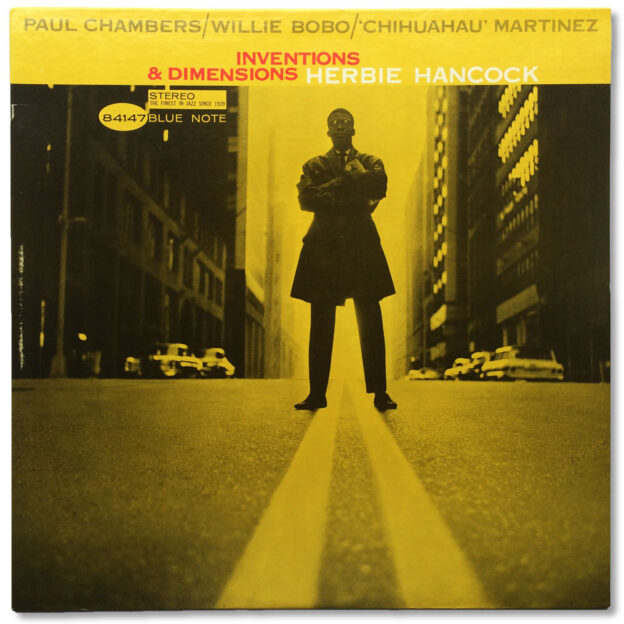
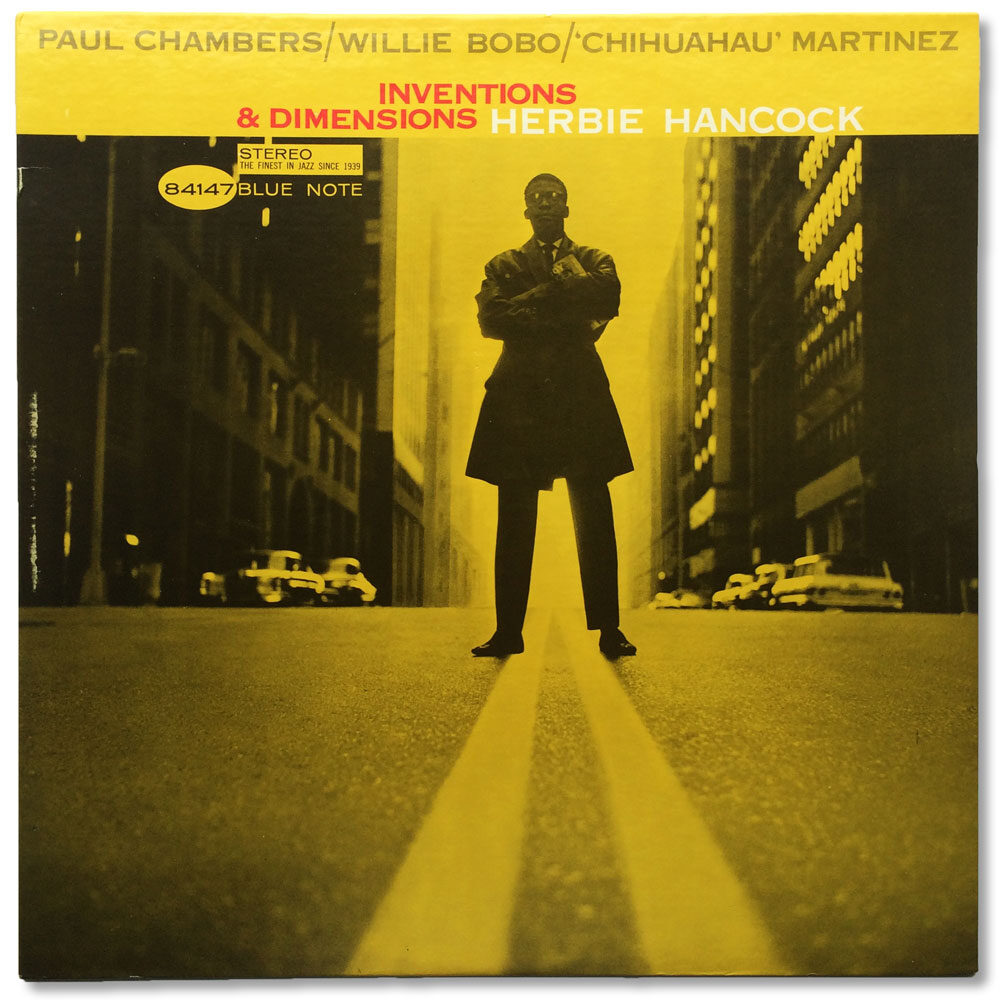
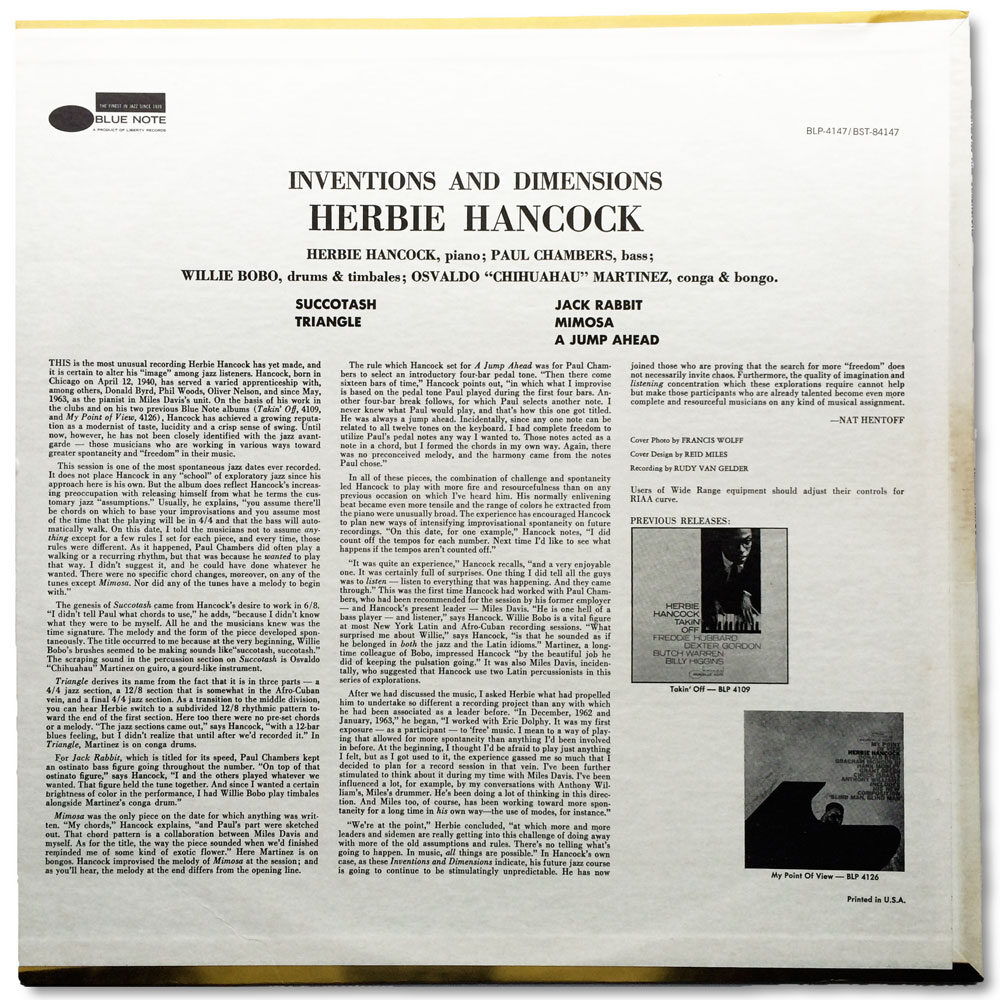
Vinyl Spotlight: Herbie Hancock, Inventions and Dimensions (Blue Note 84147) Liberty RVG Stereo Pressing
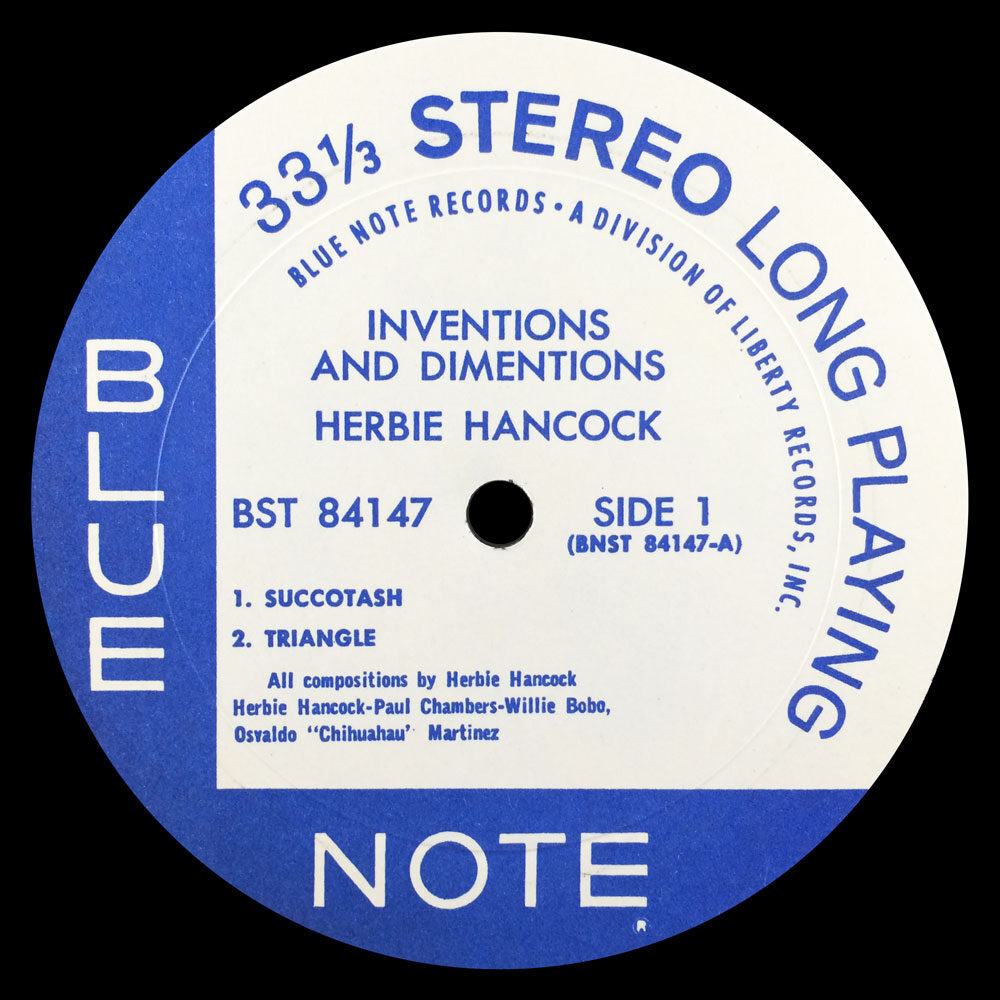
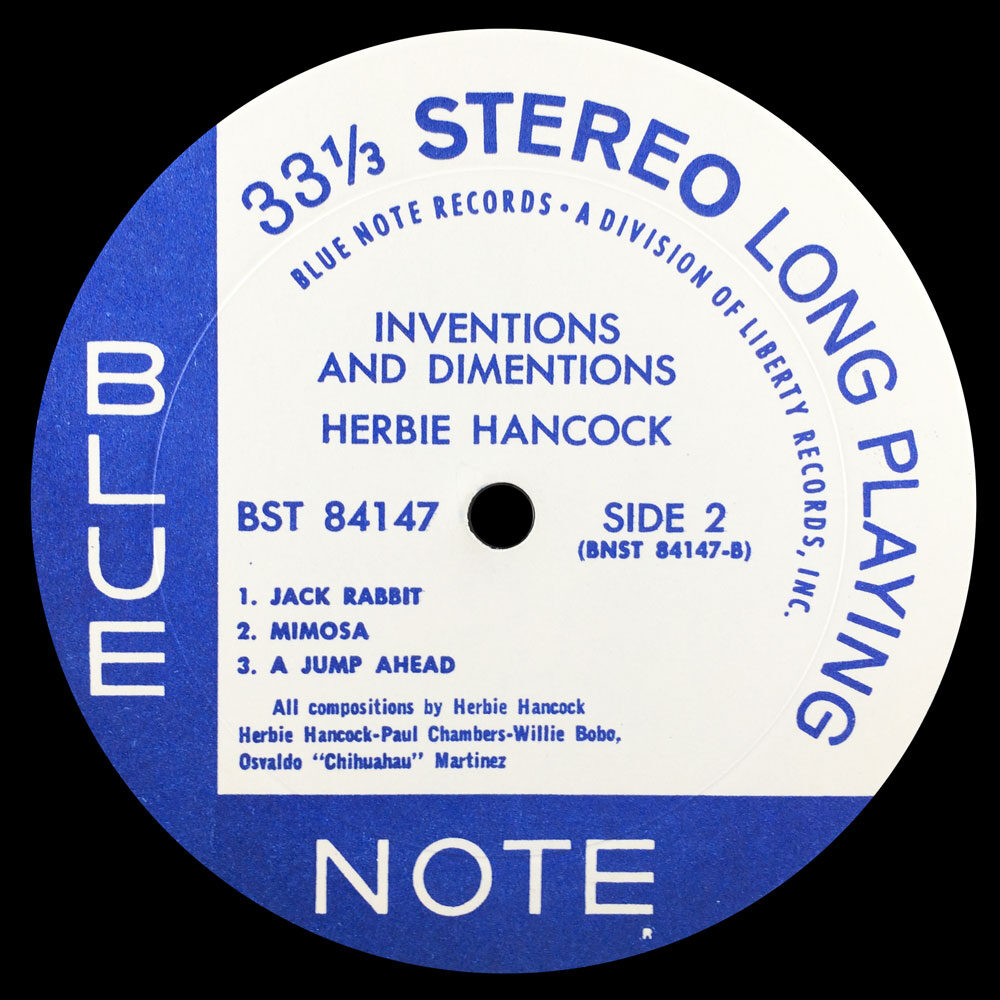
- Stereo Liberty reissue circa 1966-1970
- “A DIVISION OF LIBERTY RECORDS, INC.” on both labels
- “VAN GELDER” stamped in dead wax
Personnel:
- Herbie Hancock, piano
- Paul Chambers, bass
- Willie Bobo, drums and timbales
- Osvaldo “Chihuahua” Martinez, conga and bongo
Recorded August 30, 1963 at Van Gelder Studio, Englewood Cliffs, New Jersey
Originally released February 1964
Selection:
“Triangle” (Hancock)
Although Liberty pressings of most classic Blue Note albums are not original pressings, they still have the potential to sound great. They may lack the Plastylite “P” found in the runout groove of most originals but they do usually brandish the Van Gelder stamp in the runout groove, indicating that they were made from the same master lacquer disk as an original. This stereo copy of Herbie Hancock’s third album for Blue Note may not be a first pressing but it still embodies engineer Rudy Van Gelder’s original mastering work.
Many collectors will shun any vintage Blue Note without the “P”, claiming that its absence takes something away from the listening experience. I beg to differ, having never heard a significant contrast between originals and subsequent Liberty-era pressings sourced from the original metal work. In fact, I have found that Liberty pressings are more likely to sound fresher since they are less likely than originals to have suffered excessive wear.
One does need to be careful of how far they venture away from the original release of an album, however. Van Gelder’s mastering was used well into the late ’70s after Liberty had sold Blue Note to United Artists, and depending on the title, it seems there is an increased chance that the original work parts will have lost some measure of quality by this time. These records are more likely to lack the ‘life’ of earlier pressings (usually a reference to lower distortion and better high-frequency detail).
Despite having heard the popular audiophile criticisms of Rudy Van Gelder’s mastering work, I often find his LP masters to be highly accurate, even, and dynamic. But be careful — you won’t get this experience if you’re listening to a worn record. This particular copy was purchased sealed a couple years back, which I feel makes it a shining example of the mastering engineer’s handiwork, certainly more so than any wear-ridden original.
As for the music, this is my favorite Herbie Hancock album. Every time I listen, I listen from start to finish. Hancock takes an experimental approach to the songwriting here and can often be heard working out ideas on the fly. This leads to frequent use of refrain, a technique that has never been popular with jazz soloists (because of the central role improvisation plays in the genre, jazz musicians often seem driven by an intense desire to constantly invent, which means never sitting on the same phrase for very long at all). My longstanding relationship with sampling and hip hop has made me very accustomed to repetition in instrumentation, which I think has much to do with why I find Hancock’s regular use of refrain here a very welcome break from the bop norm. Bassist Paul Chambers and drummer Willie Bobo intensify the trance-like qualities of the music by locking in on various rhythms throughout, and percussionist Chihuahua Martinez’s timing is rock solid — something crucial in a minimal arrangement like this.