

- Stereo Liberty reissue circa 1966-1970
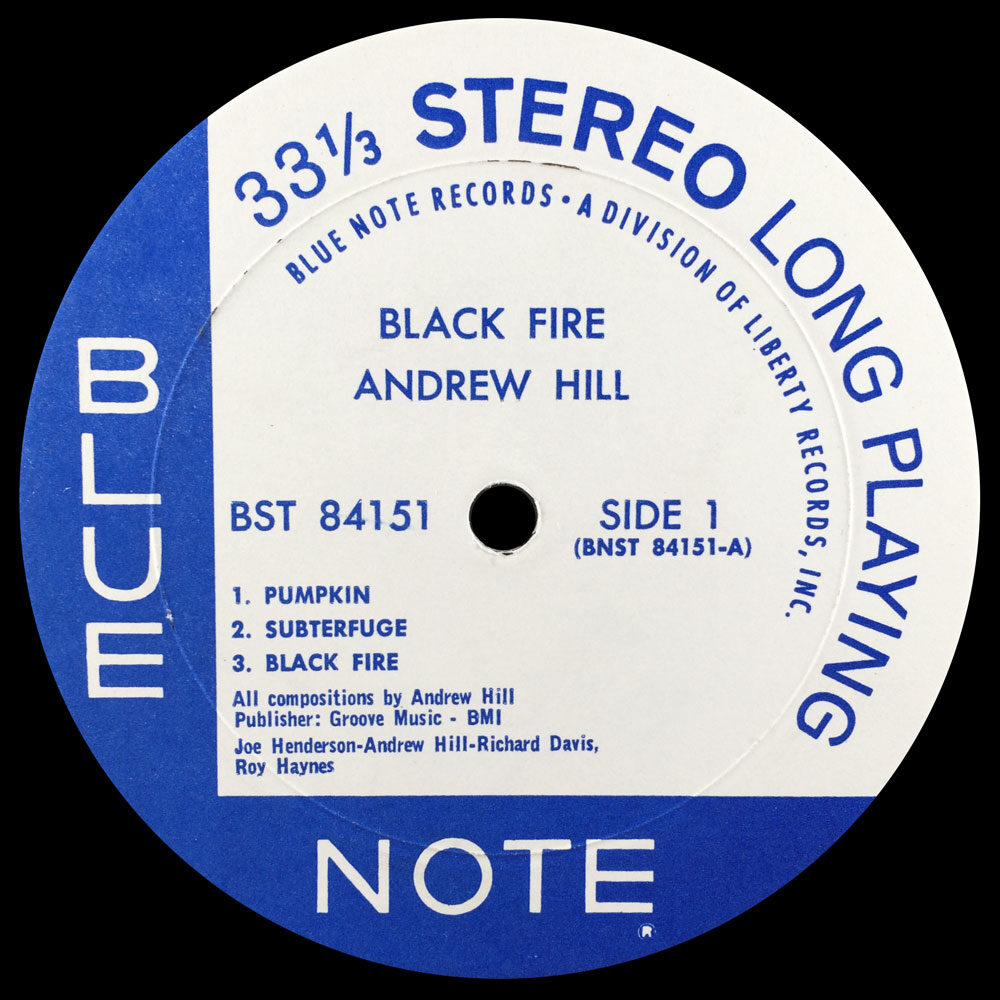
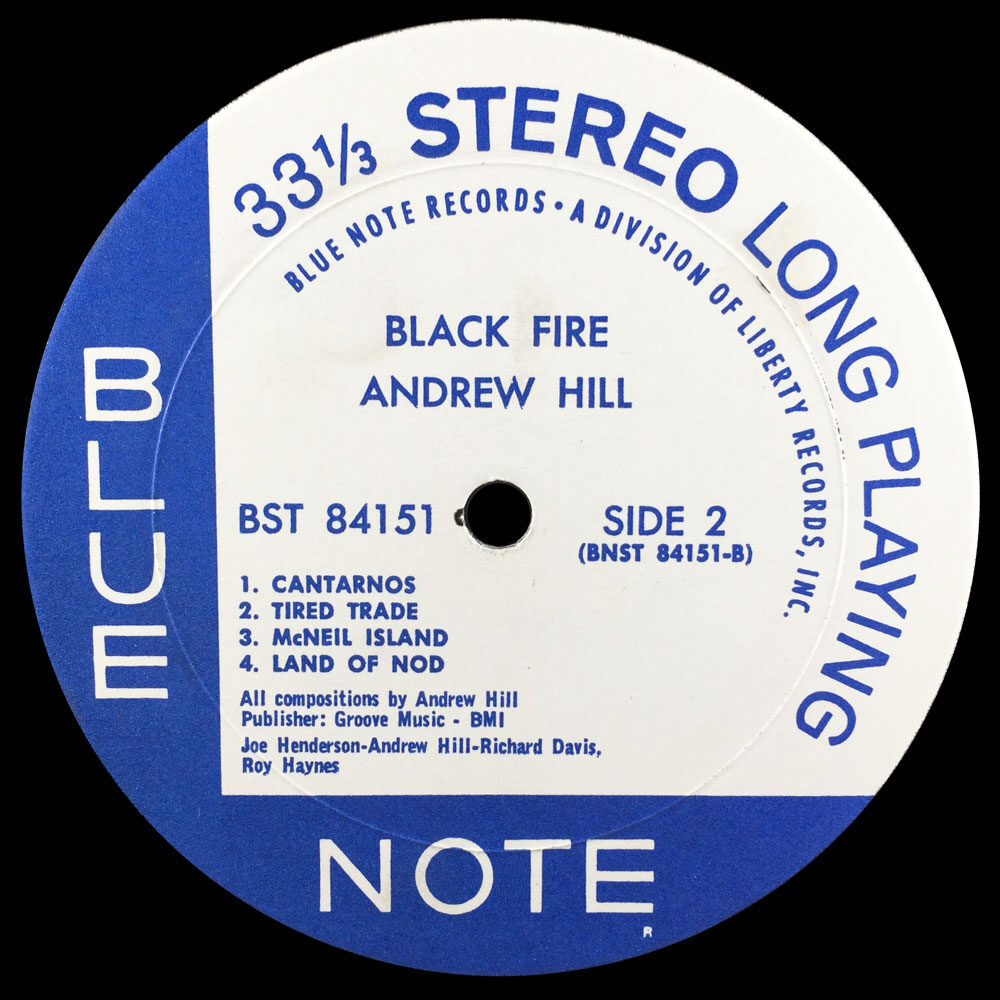
- “A DIVISION OF LIBERTY RECORDS, INC.” on both labels
- “VAN GELDER” stamped in dead wax
Personnel:
- Joe Henderson, tenor saxophone
- Andrew Hill, piano
- Richard Davis, bass
- Roy Haynes, drums
Recorded November 9, 1963 at Van Gelder Studio, Englewood Cliffs, New Jersey
Originally released March 1964
| 1 | Pumpkin | |
| 2 | Subterfuge | |
| 3 | Black Fire | |
| 4 | Cantarnos | |
| 5 | Tired Trade | |
| 6 | McNeil Island | |
| 7 | Land of Nod |
Selections:
“Pumpkin” (Hill)
“Black Fire” (Hill)
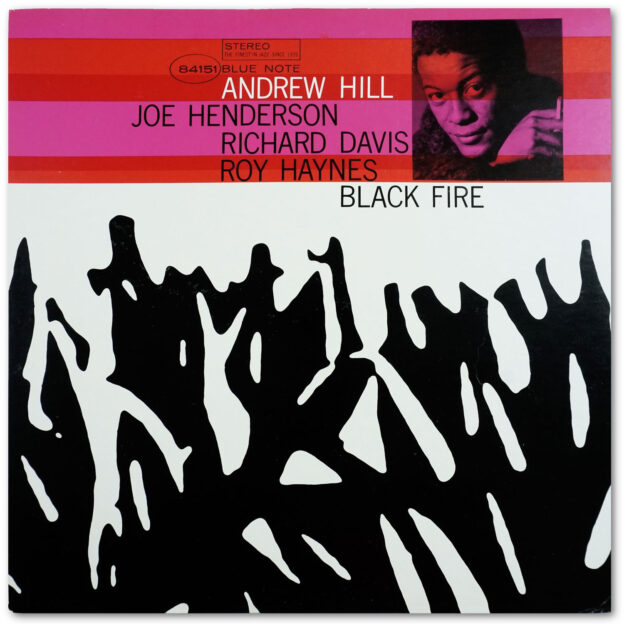
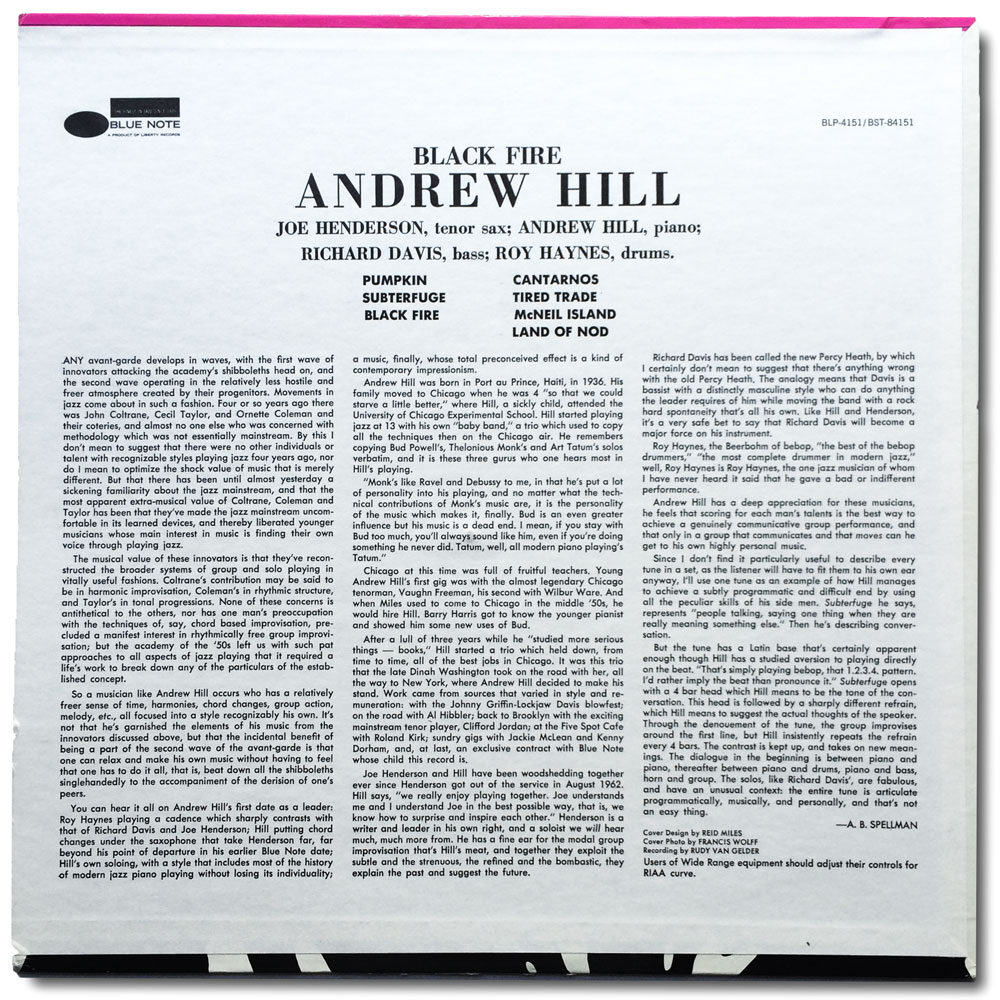
First and foremost, I think this is one of the greatest album covers of all time. I love the juxtaposition of the bold strips of various red hues with the cartoony black-and-white illustration of fire beneath. Reid Miles’ cover design speaks volumes and yet again complements the music incredibly well.
From the time Andrew Hill arrived at Blue Note in 1963, it didn’t take long for the pianist-composer to venture “out” and away from bop. Hill first recorded for the label in September of that year with Joe Henderson (Our Thing, Blue Note 4152), then with Hank Mobley the following month (No Room for Squares, Blue Note 4149). Black Fire, Hill’s first album as a leader for Blue Note, was recorded in November 1963 and gives us an early glimpse at Hill loosely conforming to the higher degree of harmonic and melodic structure commonly found in bop. Blue Note would continue to document Hill’s musical explorations in the coming months, laying to tape Smokestack, Judgment!, then finally Hill’s avant-garde classic Point of Departure in March 1964 — the same month that Eric Dolphy recorded his landmark album Out to Lunch! for the label.
This album is about as far out as I’m willing go into the free jazz sea. I’m not a fan of free jazz and don’t know much about it, but from the little I do know I’m willing to say that Black Fire tows the line between post bop and the avant-garde. The sounds here tend to invoke a subtle feeling of panic, but much like another favorite mid-sixties quartet album of mine, Black Fire maintains a surprising degree of calm and quietude through all of the chaos. We also get to hear Roy Haynes on an uncommon Blue Note date and he doesn’t disappoint, demonstrating his patented pinpoint precision and tight snare drum work throughout.
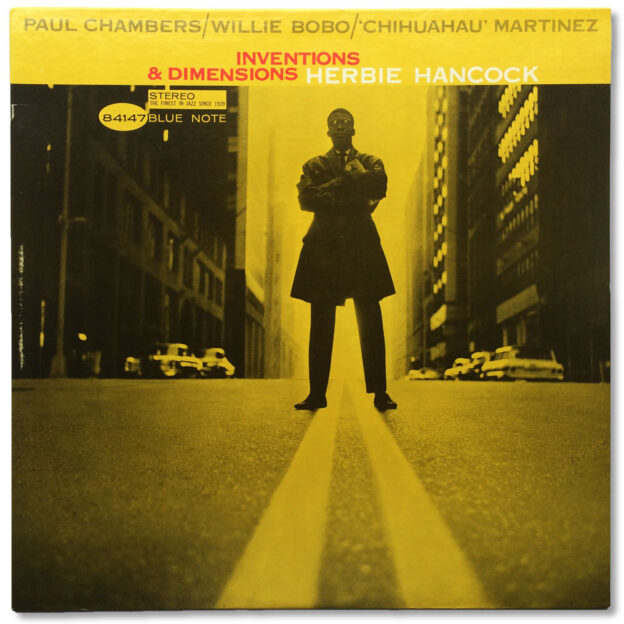
Vinyl Spotlight: Herbie Hancock, Inventions and Dimensions (Blue Note 84147) Liberty RVG Stereo Pressing
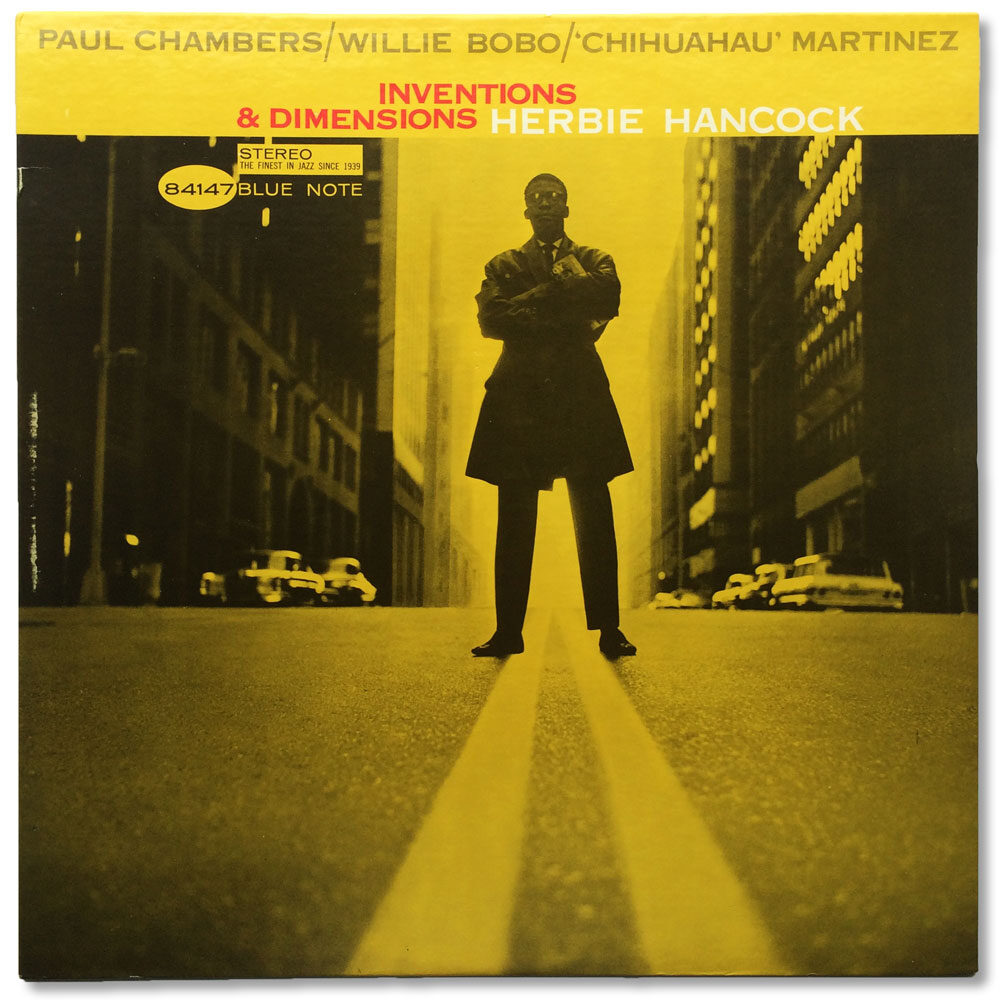
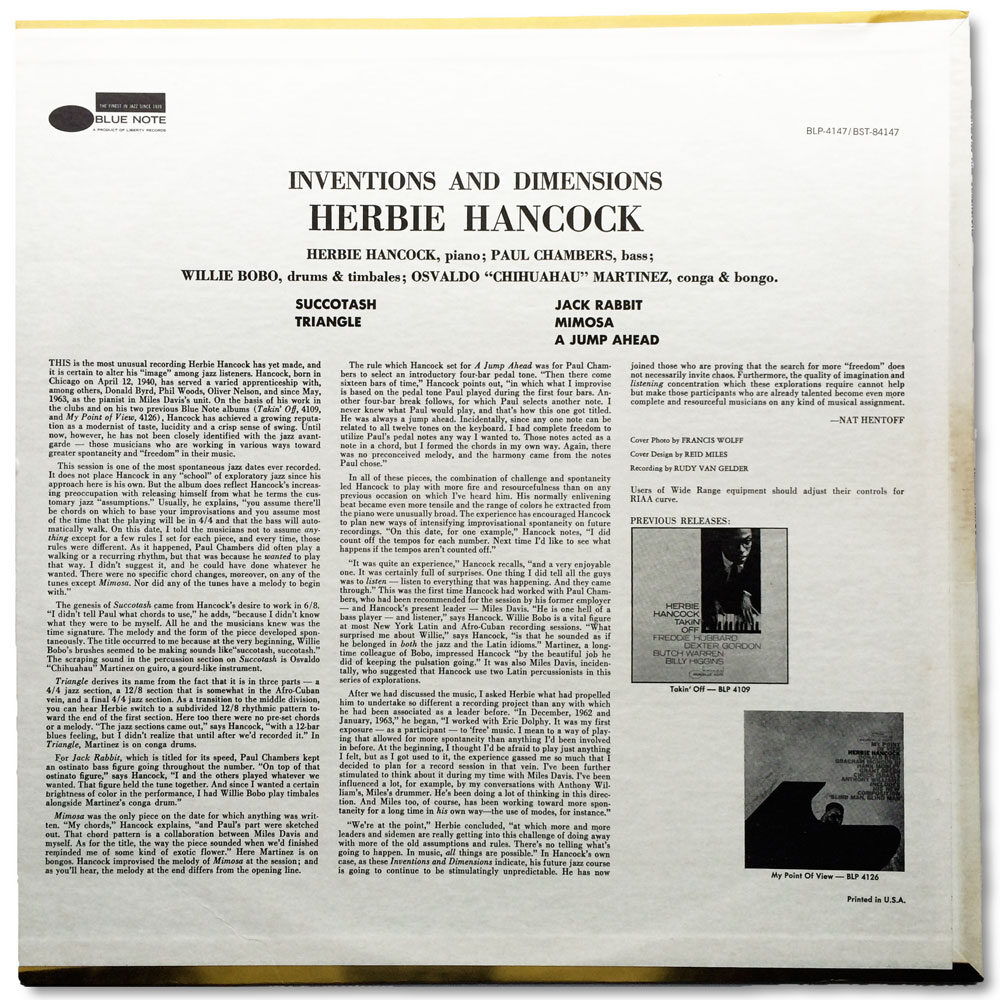
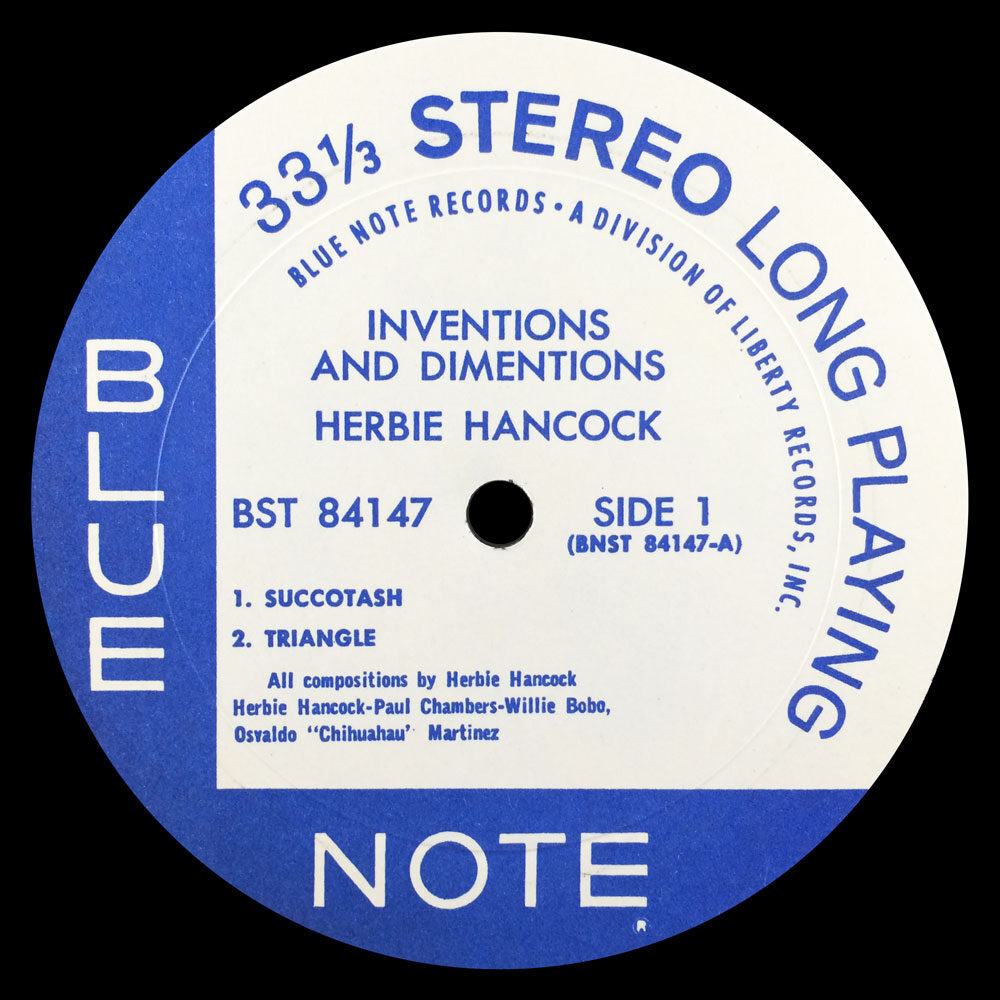
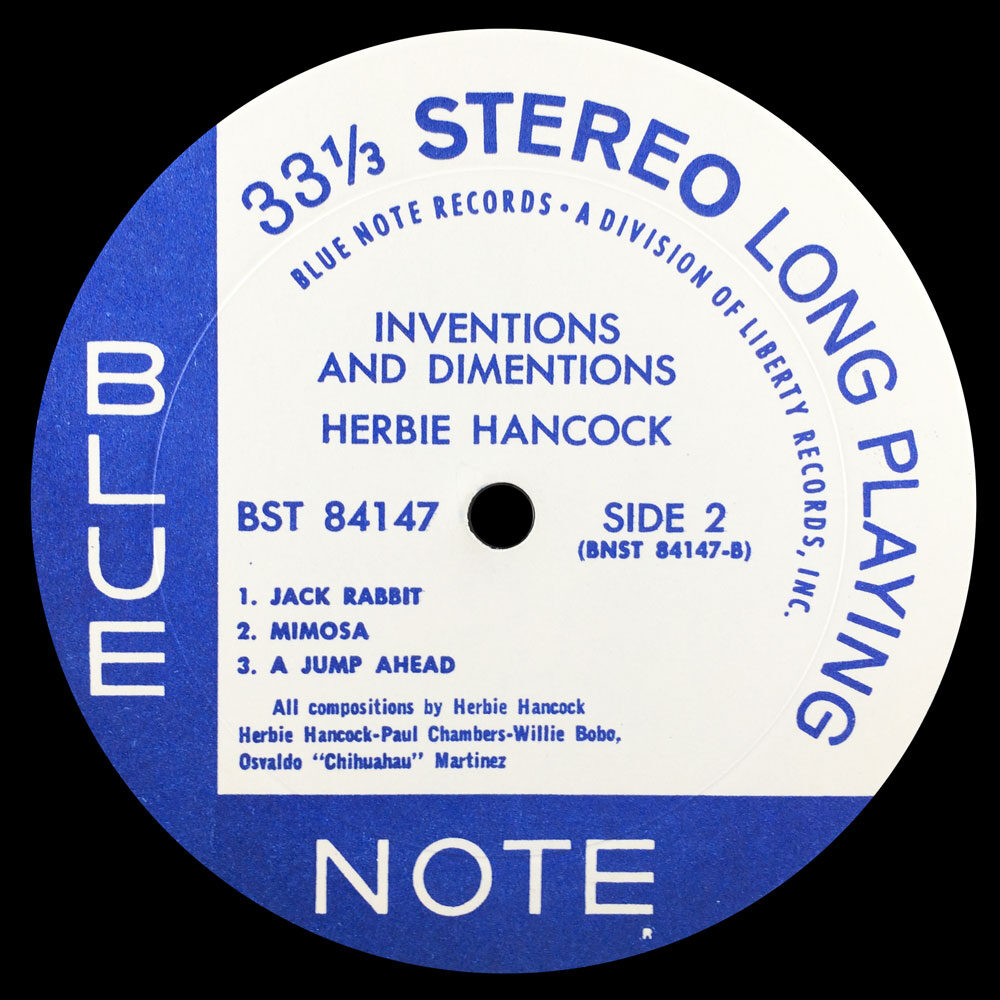
- Stereo Liberty reissue circa 1966-1970
- “A DIVISION OF LIBERTY RECORDS, INC.” on both labels
- “VAN GELDER” stamped in dead wax
Personnel:
- Herbie Hancock, piano
- Paul Chambers, bass
- Willie Bobo, drums and timbales
- Osvaldo “Chihuahua” Martinez, conga and bongo
Recorded August 30, 1963 at Van Gelder Studio, Englewood Cliffs, New Jersey
Originally released February 1964
Selection:
“Triangle” (Hancock)
Although Liberty pressings of most classic Blue Note albums are not original pressings, they still have the potential to sound great. They may lack the Plastylite “P” found in the runout groove of most originals but they do usually brandish the Van Gelder stamp in the runout groove, indicating that they were made from the same master lacquer disk as an original. This stereo copy of Herbie Hancock’s third album for Blue Note may not be a first pressing but it still embodies engineer Rudy Van Gelder’s original mastering work.
Many collectors will shun any vintage Blue Note without the “P”, claiming that its absence takes something away from the listening experience. I beg to differ, having never heard a significant contrast between originals and subsequent Liberty-era pressings sourced from the original metal work. In fact, I have found that Liberty pressings are more likely to sound fresher since they are less likely than originals to have suffered excessive wear.
One does need to be careful of how far they venture away from the original release of an album, however. Van Gelder’s mastering was used well into the late ’70s after Liberty had sold Blue Note to United Artists, and depending on the title, it seems there is an increased chance that the original work parts will have lost some measure of quality by this time. These records are more likely to lack the ‘life’ of earlier pressings (usually a reference to lower distortion and better high-frequency detail).
Despite having heard the popular audiophile criticisms of Rudy Van Gelder’s mastering work, I often find his LP masters to be highly accurate, even, and dynamic. But be careful — you won’t get this experience if you’re listening to a worn record. This particular copy was purchased sealed a couple years back, which I feel makes it a shining example of the mastering engineer’s handiwork, certainly more so than any wear-ridden original.
As for the music, this is my favorite Herbie Hancock album. Every time I listen, I listen from start to finish. Hancock takes an experimental approach to the songwriting here and can often be heard working out ideas on the fly. This leads to frequent use of refrain, a technique that has never been popular with jazz soloists (because of the central role improvisation plays in the genre, jazz musicians often seem driven by an intense desire to constantly invent, which means never sitting on the same phrase for very long at all). My longstanding relationship with sampling and hip hop has made me very accustomed to repetition in instrumentation, which I think has much to do with why I find Hancock’s regular use of refrain here a very welcome break from the bop norm. Bassist Paul Chambers and drummer Willie Bobo intensify the trance-like qualities of the music by locking in on various rhythms throughout, and percussionist Chihuahua Martinez’s timing is rock solid — something crucial in a minimal arrangement like this.