Tag Archives: Englewood Cliffs

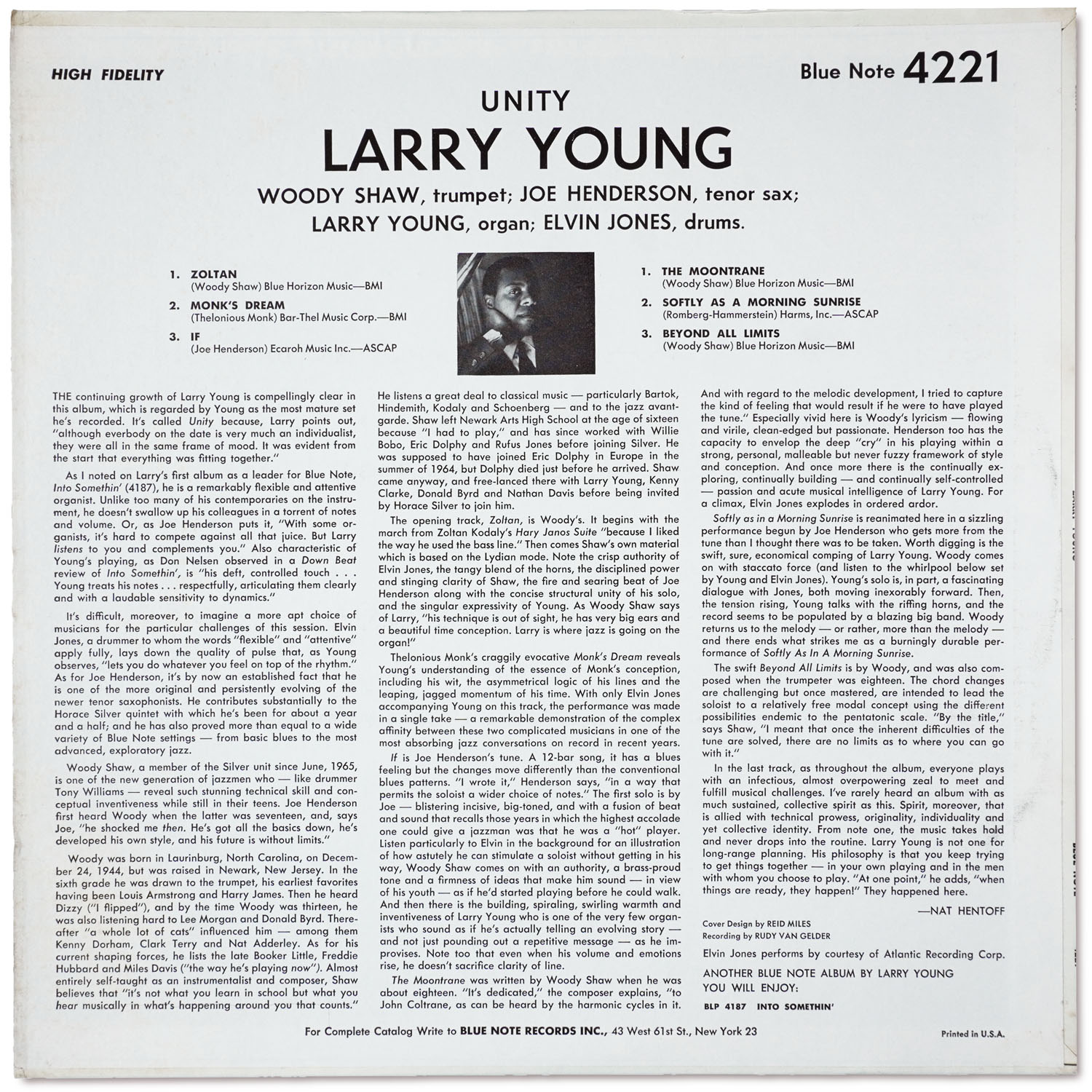
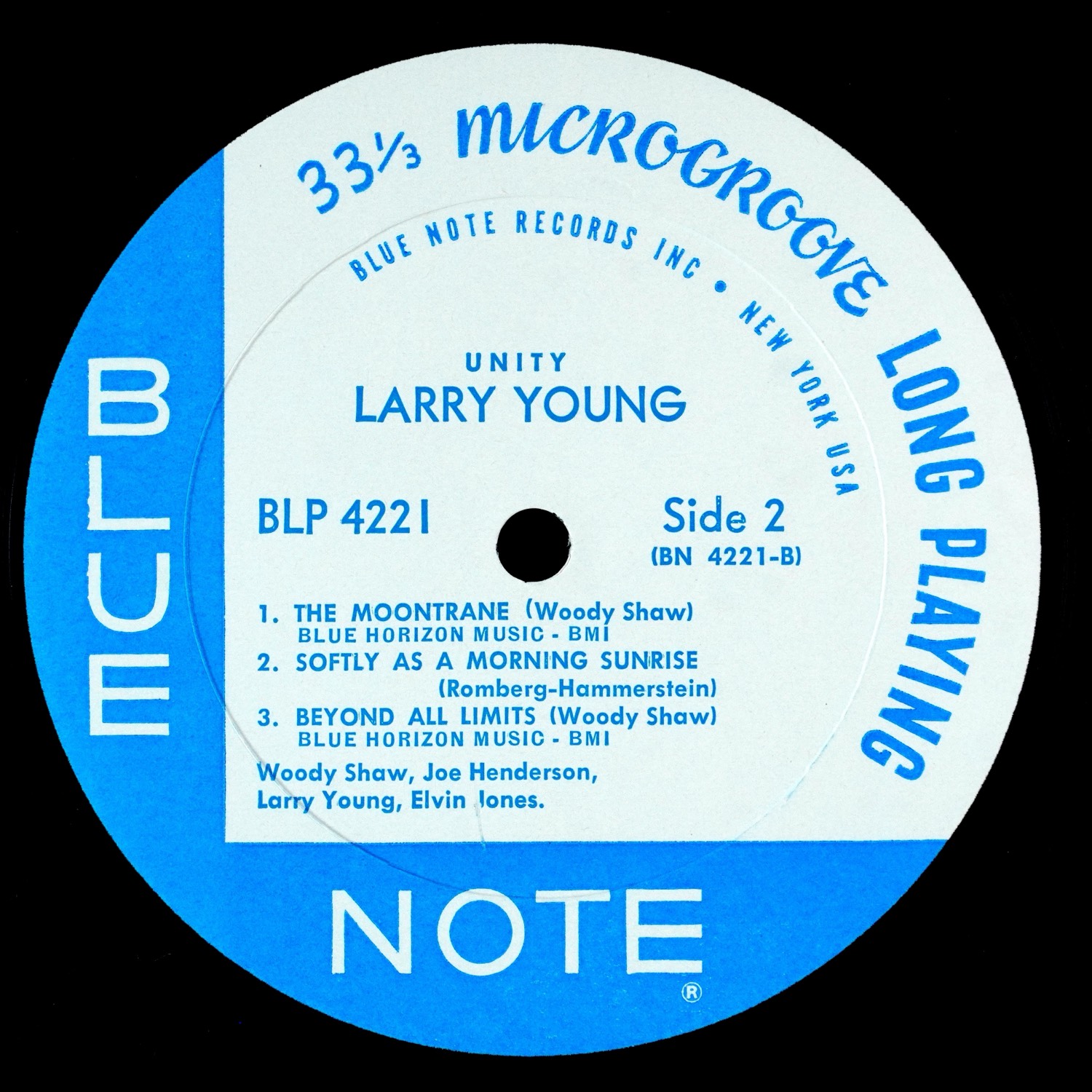
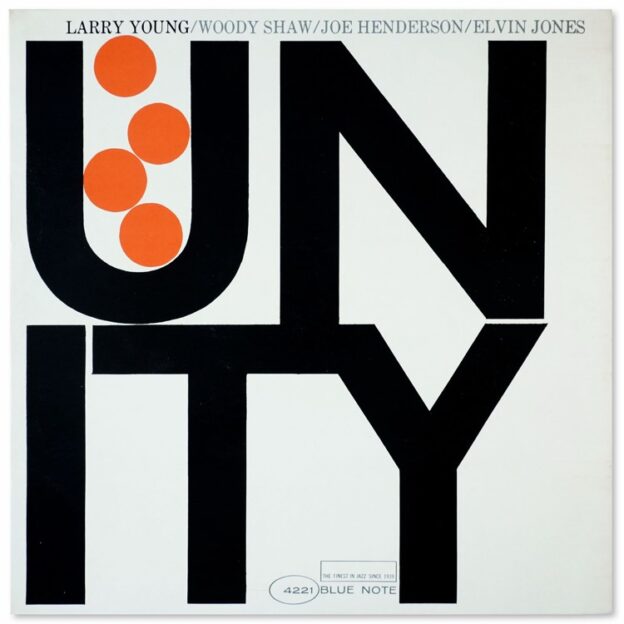
Vinyl Spotlight: Larry Young, Unity (Blue Note 4221) “Earless NY” Mono Pressing

  • Second “earless New York” mono pressing ca. 1966
  • “VAN GELDER” stamped in dead wax

Personnel:

  • Woody Shaw, trumpet
  • Joe Henderson, tenor saxophone
  • Larry Young, organ
  • Elvin Jones, drums

Recorded November 10, 1965 at Van Gelder Studio, Englewood Cliffs, New Jersey
Originally released August 1966

1 Zoltan
2 Monk’s Dream
3 If
4 The Moontrane
5 Softly As A Morning Sunrise
6 Beyond All Limits
Back in 2010, I first got interested in collecting vintage jazz records by way of the Blue Note Album Cover Art book. Since then it’s been glaringly obvious that Larry Young’s Unity sports one of the most popular and timeless covers in the legendary label’s catalog — there’s even a copy of it on display (alongside BLP 1530, Jutta Hipp and Zoot Sims) at the Museum of Modern Art here in New York City. I always fancied this album art but initially ignored the music; I may have initially bought into the hype of jazz records with organ not being “cool”, and the post bop leanings of the soloists here didn’t appeal to me at first either.

Well I’ve come full circle with most of that. Finding an earless mono copy in excellent condition for a fair price on Discogs recently forced my hand at giving the album another chance, and all kinds of great musical things started jumping out at me. Being a big Monk fan, “Monk’s Dream” got my attention first, and I found a new appreciation for its tag-team arrangement featuring Young and drummer Elvin Jones. From there, it became clear how incredible Jones sounds on this album and how well his kit was recorded by engineer Rudy Van Gelder. Over time I’ve also become a bigger fan of the sound coming out of Van Gelder’s Englewood Cliffs studio in the mid ‘60s. Distinguished from all of the engineer’s previous eras by a “softer” approach to recording and mastering, there is a smoothness to these 1965 takes that starkly contrasts with the more heavily compressed instrumentation on other Van Gelder albums recorded in 1963 and 1964 like The Sidewinder (BLP 4157), Search for the New Land (BLP 4169), and Song for My Father (BLP 4185).

Other standout tunes on Unity include “If” and “The Moontrane”, composed by frontmen Joe Henderson and Woody Shaw, respectively, and the pair’s contribution as songwriters is paramount to the album’s classic status. As for this band’s interpretation of “Softly as in a Morning Sunrise”, I prefer Sonny Rollins’ (BLP 1581, A Night at the Village Vanguard) and Sonny Clark’s (BLP 1579, Sonny Clark Trio) treatments of the standard. Auditioning this album multiple times early on in my jazz listening, I probably rarely got past Shaw’s “Zoltan”: I enjoy the melody here but the tune’s dissonant “B” section leaves the door open for chaotic improvisation and Joe Henderson seems to take advantage of that more than any other band member.

Unity is a gorgeous recording of four adventurous musicians that I have returned to countless times since acquiring it. The more progressive frontline pairing of Henderson and Shaw make it a challenging listen, and the more tempered post bop leanings of Young and Jones have kept me coming back for more.

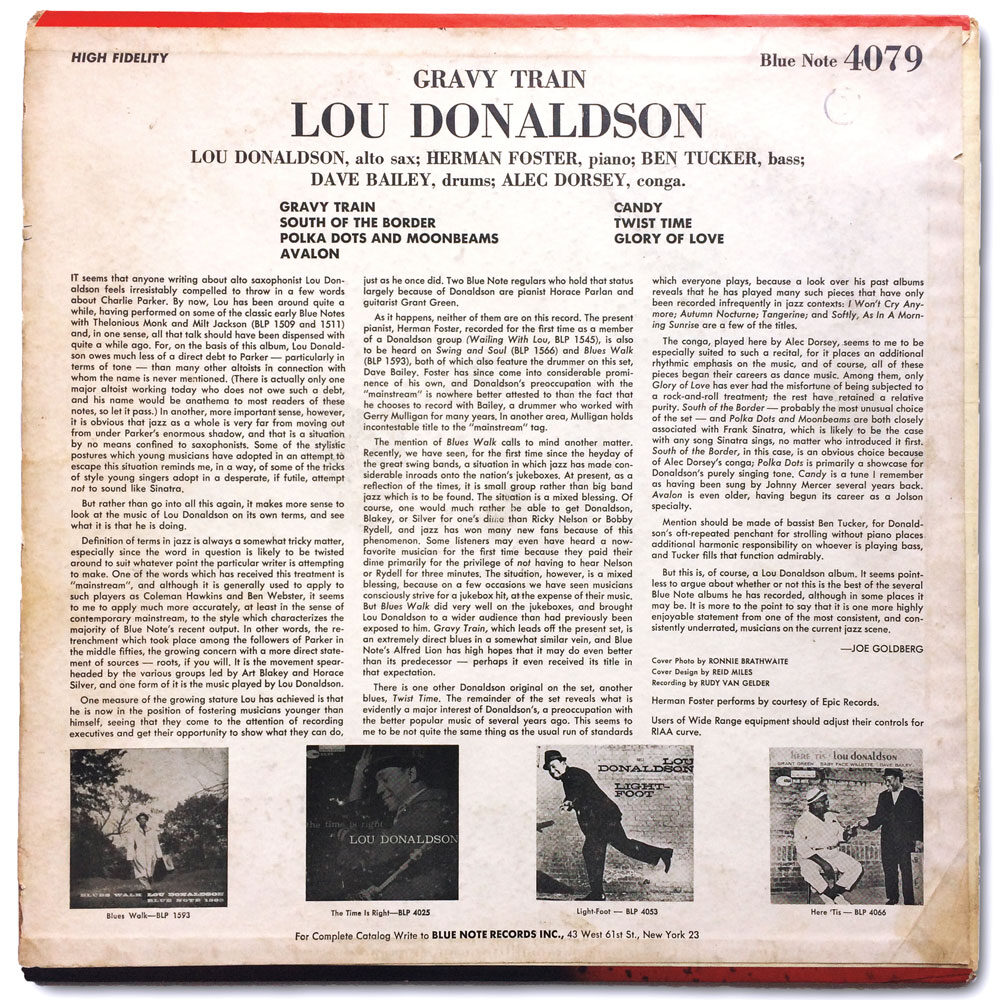
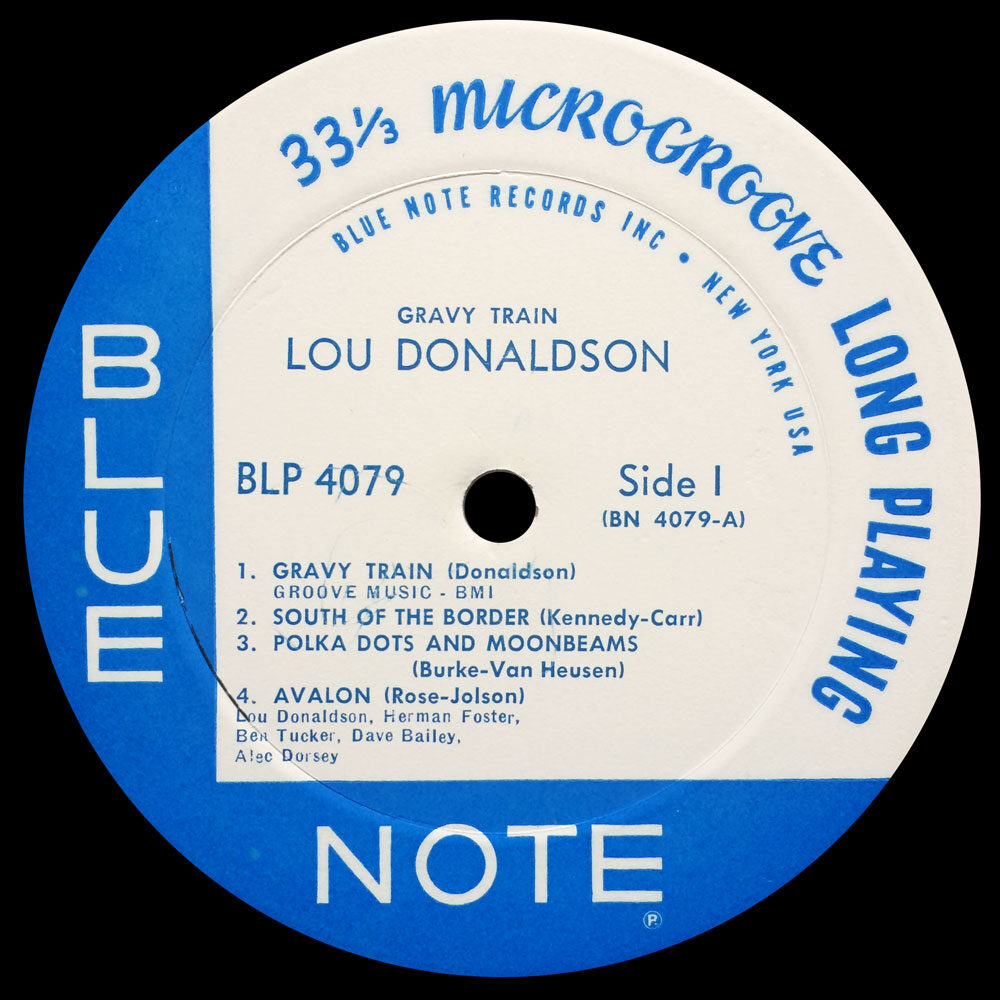
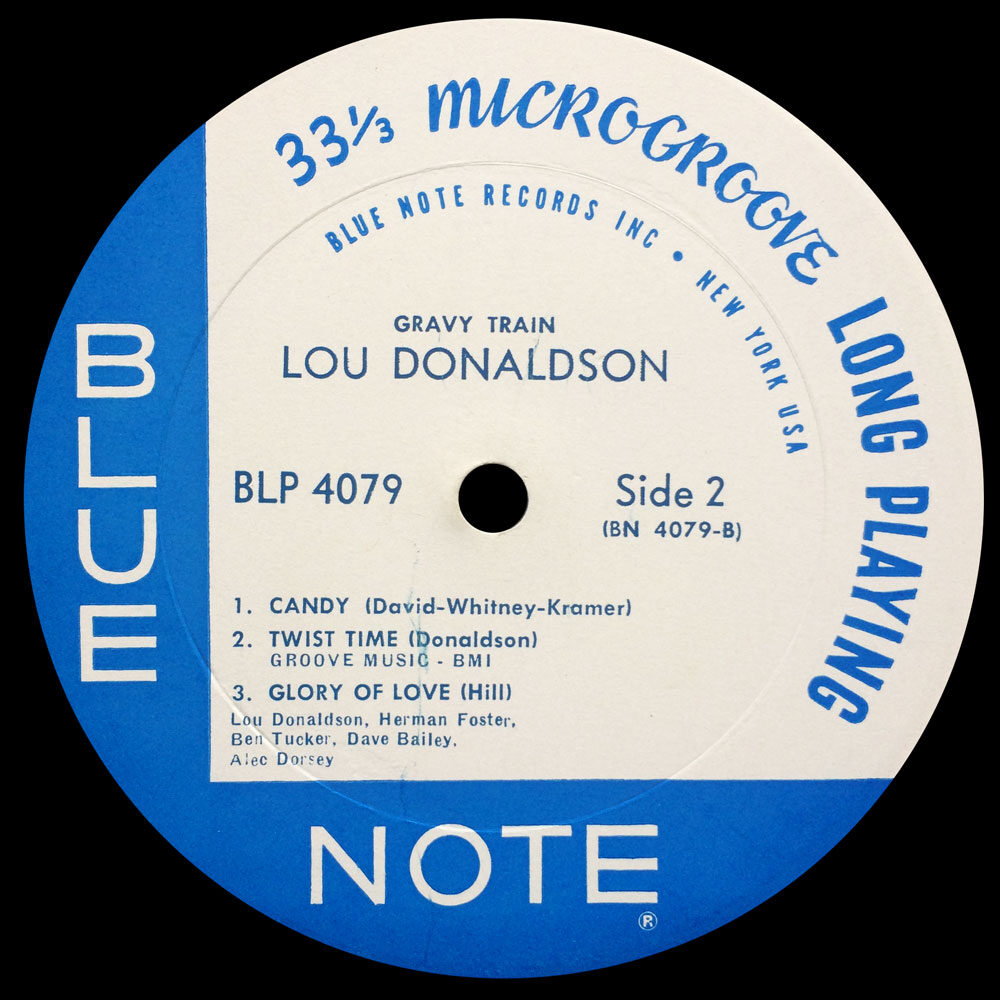
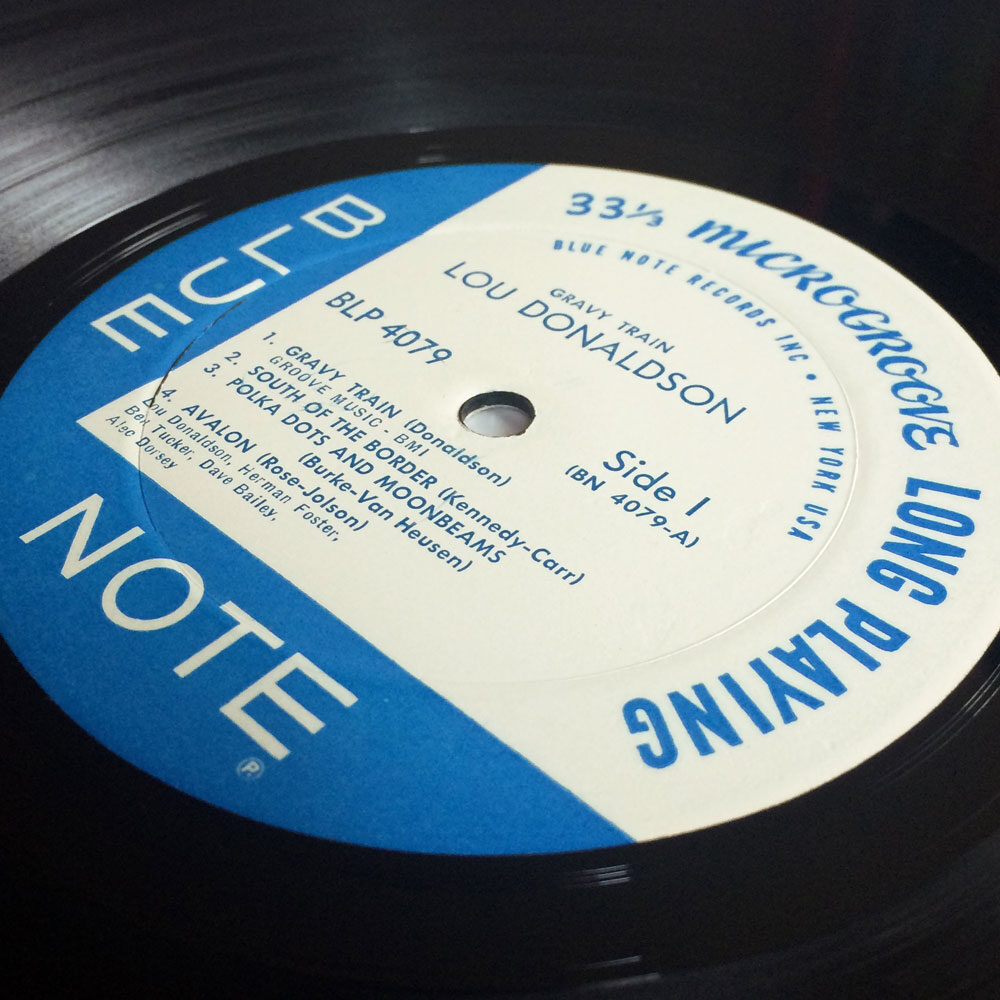
Vinyl Spotlight: Lou Donaldson, Gravy Train (Blue Note 4079) Original Mono Pressing

  • Original 1962 mono pressing
  • “NEW YORK USA” on both labels
  • Plastylite “P” etched and “RVG” stamped in dead wax
  • “43 West 61st St., New York 23” address on jacket

Personnel:

  • Lou Donaldson, alto saxophone
  • Herman Foster, piano
  • Ben Tucker, bass
  • Dave Bailey, drums
  • Alec Dorsey, conga

Recorded April 27, 1961 at Van Gelder Studio, Englewood Cliffs, New Jersey
Originally released June 1962

1 Gravy Train
2 South of the Border
3 Polka Dots and Moonbeams
4 Avalon
5 Candy
6 Twist Time
7 Glory of Love
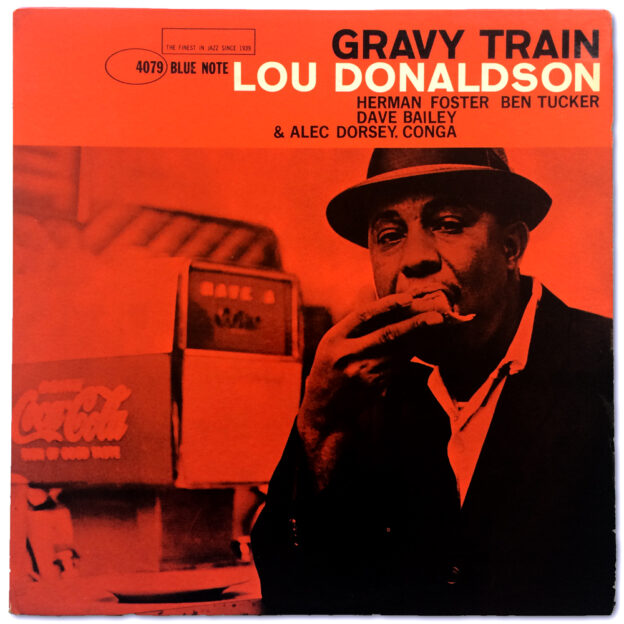
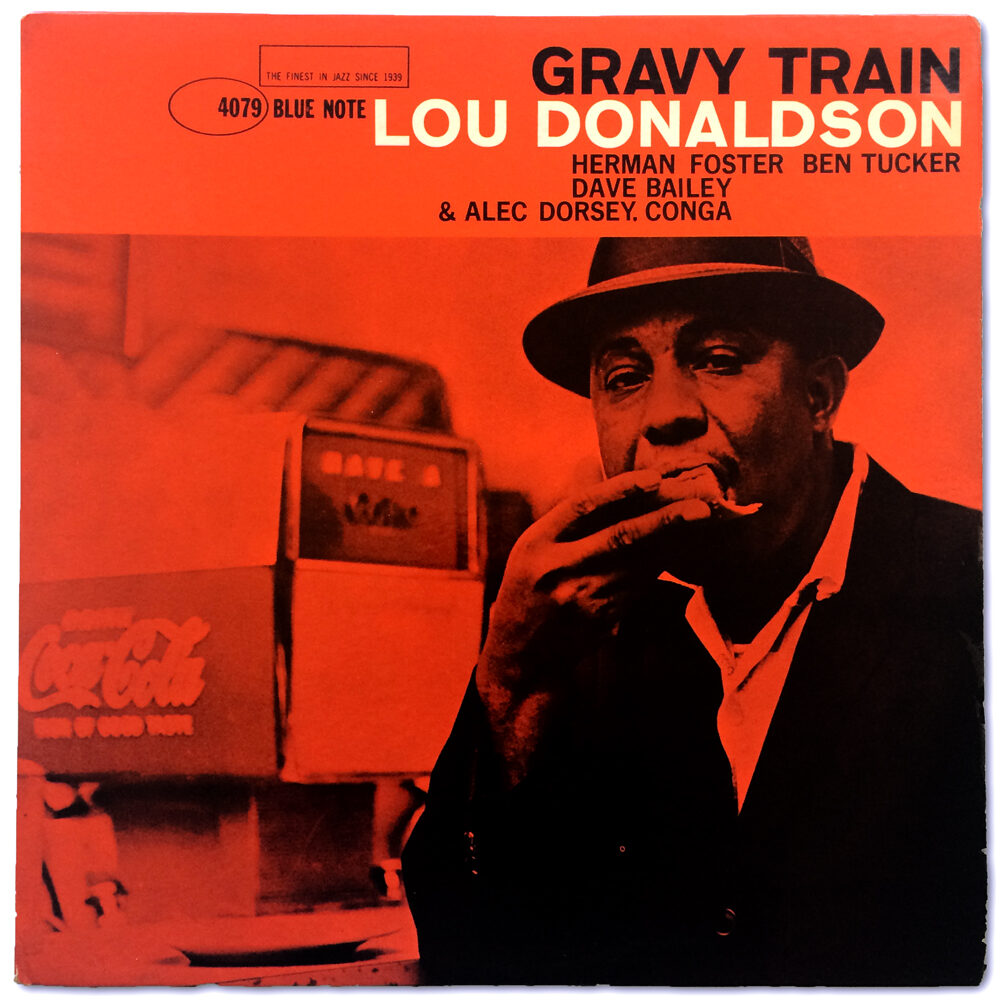
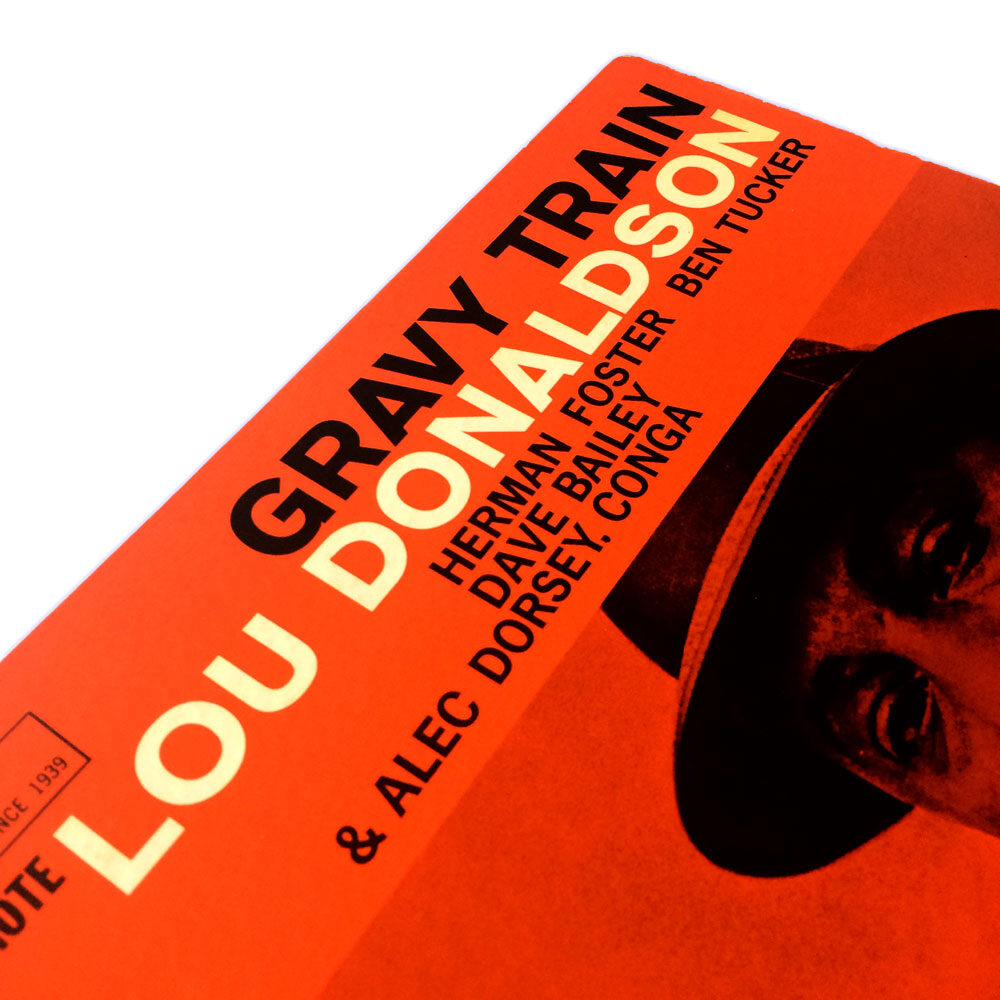
This is the fourth original mono pressing of this album I’ve owned. Why would I be so persistent for this album? While the title track is one of my all-time favorite soul jazz numbers, the truth is I’m not a huge fan of this album in its entirety, and I’ve largely pursued an original so diligently because I love the album cover so much. Lou Donaldson looks like a serious boss on this cover as he woofs down what looks like a hot dog in a mid-century luncheonette. And that two-tone, bold, fiery orange is indeed very eye-catching.

The first copy I owned was a VG copy I won on eBay in the dawn of my vintage jazz record collecting experience. I quickly replaced that worn copy with a wear-free but crackly copy. A couple years later I found a copy on eBay whose record was touted as VG+ but the jacket was exceptional (sometimes if a jacket is graded conservatively I’ll take a chance on a VG+ record).

That third copy ended up being fairly graded VG+. It looked EX but suffered from a mild case of…dun dun duuun: groove wear. I ultimately gave it up, not feeling it was worth what I paid. Then last year I found this copy at a local record shop for a much more reasonable price. It suffers from groove wear in much the same way as the last copy (the wear being less audible on the outermost tracks like my favorite, “Gravy Train”, as a result of inner groove distortion), and the jacket isn’t as clean as the last either, but I feel that its price more accurately represented its condition than the previous copy I owned. Generally speaking, the records that end up staying im my collection aren’t always the nicest but they always were purchased for a fair price.

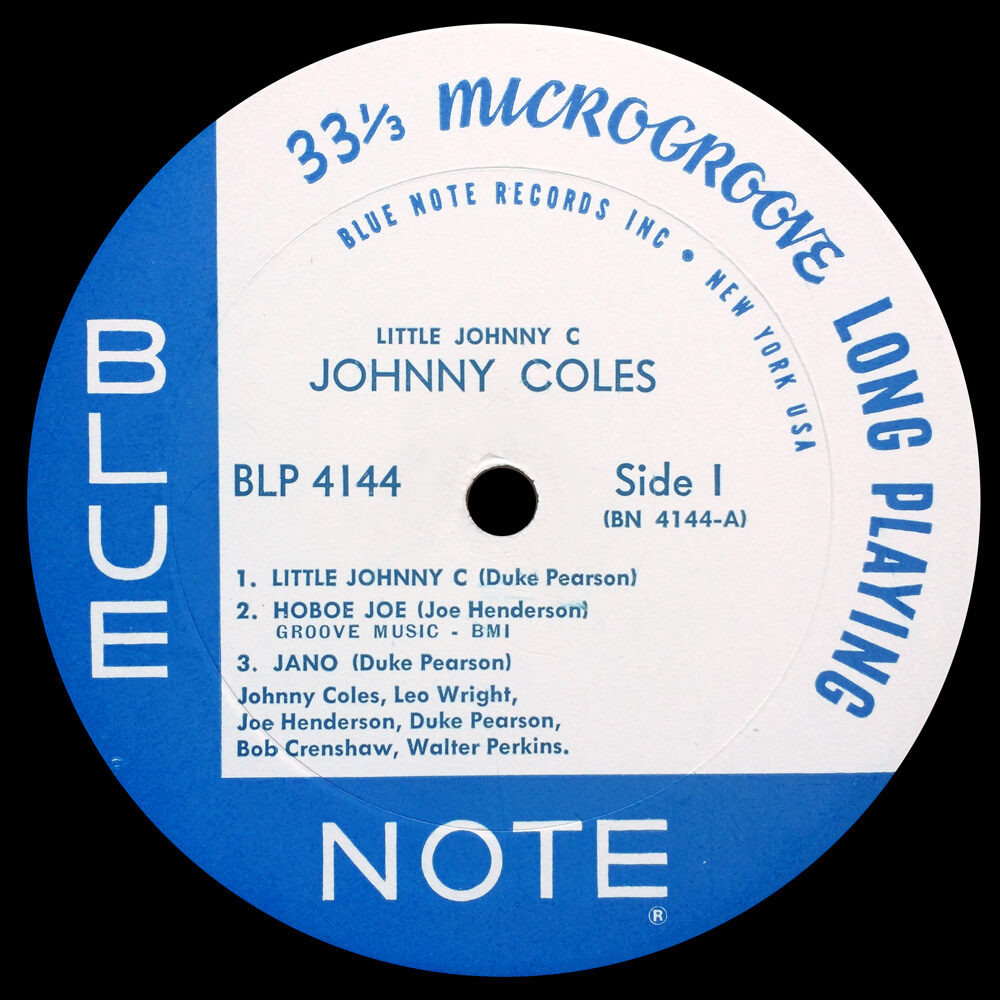
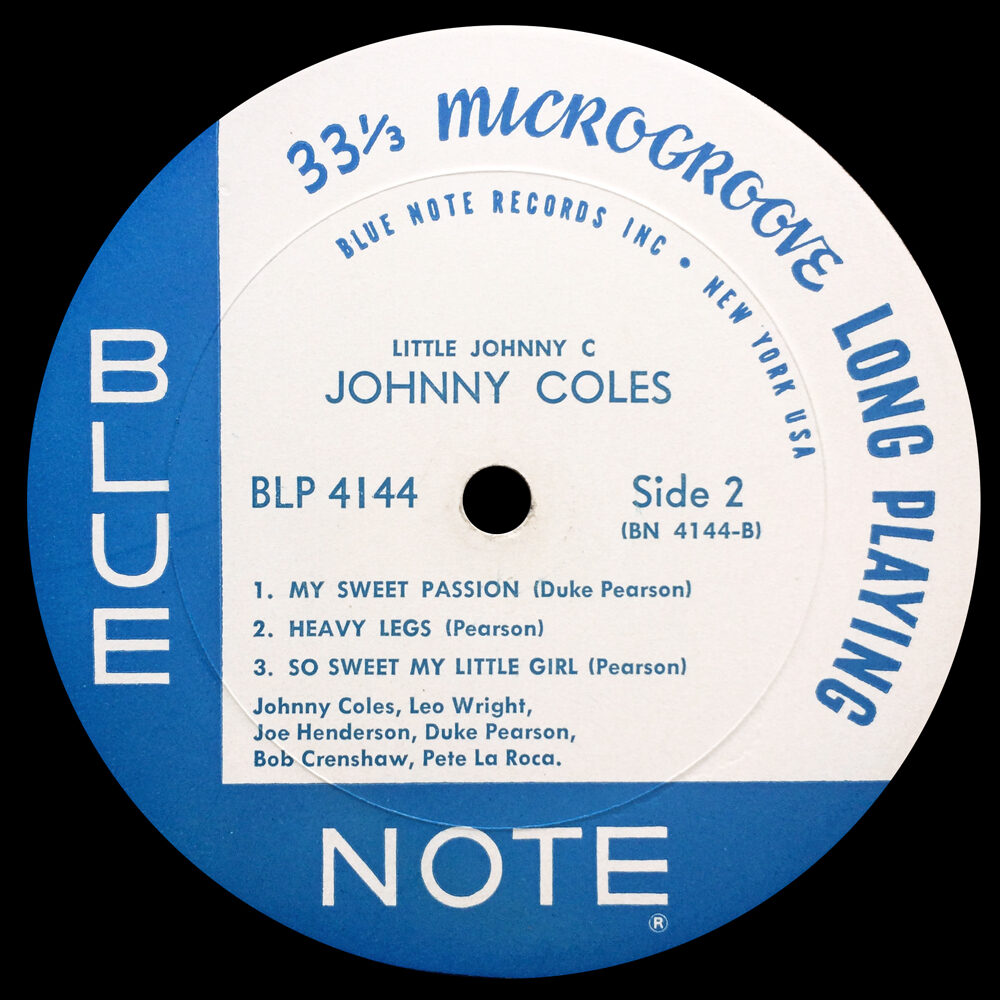
Vinyl Spotlight: Johnny Coles, Little Johnny C (Blue Note 4144) “Earless NY” Mono Pressing

  • “Earless NY” mono pressing ca. 1966
  • “NEW YORK USA” on both labels
  • “VAN GELDER” stamped in dead wax
  • “43 West 61st St., New York 23” address on jacket with “Printed in U.S.A.”

Personnel:

  • Johnny Coles, trumpet
  • Leo Wright, alto saxophone & flute
  • Joe Henderson, tenor saxophone
  • Duke Pearson, piano
  • Bob Cranshaw, bass
  • Walter Perkins (Side 1) and Pete La Roca (Side 2), drums

Side 1 recorded July 18, 1963
Side 2 recorded August 9, 1963
All selections recorded at Van Gelder Studio, Englewood Cliffs, New Jersey
Originally released February 1964

1 Little Johnny C
2 Hobo Joe
3 Jano
4 My Secret Passion
5 Heavy Legs
6 So Sweet My Little Girl
I’m sure you guys get tired of me saying “this is one of my favorite albums” but I’m saying it again, deal with it!

Song for song, start to finish, this is a brilliantly executed body of work, and session pianist Duke Pearson deserves the lion’s share of the credit. As composer of five of the album’s six tracks, Little Johnny C demonstrates Pearson’s talents in a leadership role and points to his timely inclusion in the Blue Note family as an A&R man and producer.

Recorded on two separate dates, the program undergoes a drummer change between sides 1 and 2 while the frontline is maintained. Walter Perkins sits at the throne for the album’s most fast-paced tracks (“Little Johnny C” and “Jano”), his playing unique and imaginative on both takes. Coles seems to follow Miles in his “less is more” approach to solos, and Leo Wright’s work on alto sax is perhaps the finest of all the album’s soloists, arguably topping even tenor heavyweight Joe Henderson.

Engineer Rudy Van Gelder’s Englewood Cliffs recording studio typically exerts a roomy, larger-than-life sound on recordings. But in a rare break from routine, producer Alfred Lion has opted for a tighter, more up-close-and-personal sound here reminiscent of the days in Hackensack. The result is a unique take on the Blue Note sound that has the immediacy of a Hackensack record but also the clarity and definition of Englewood Cliffs.

Little Johnny C is a delightful roller coaster ride that ends with a slow and gentle stop. Rising and dipping between up-tempo and mid-tempo readings, the listener finally arrives at “So Sweet My Little Girl”, a heartfelt ballad unmatched in its syrupy pace. Pearson rightfully concludes the album with a string of breathtaking notes that comprise one of the most perfect endings to a song I have ever heard.

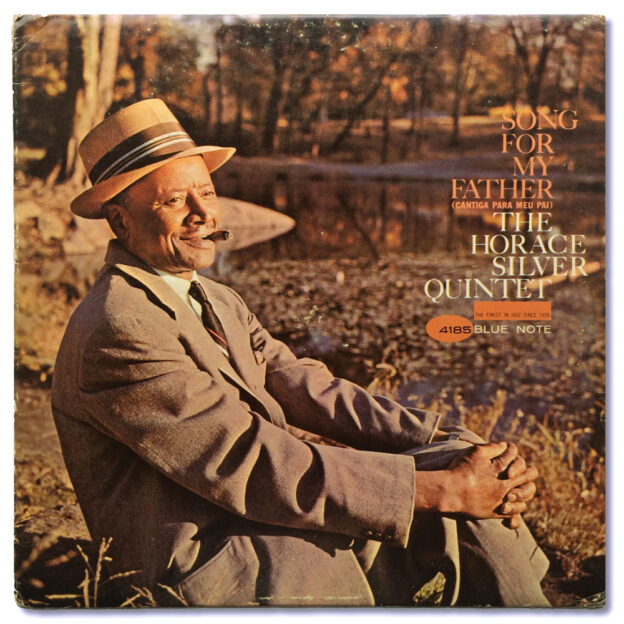
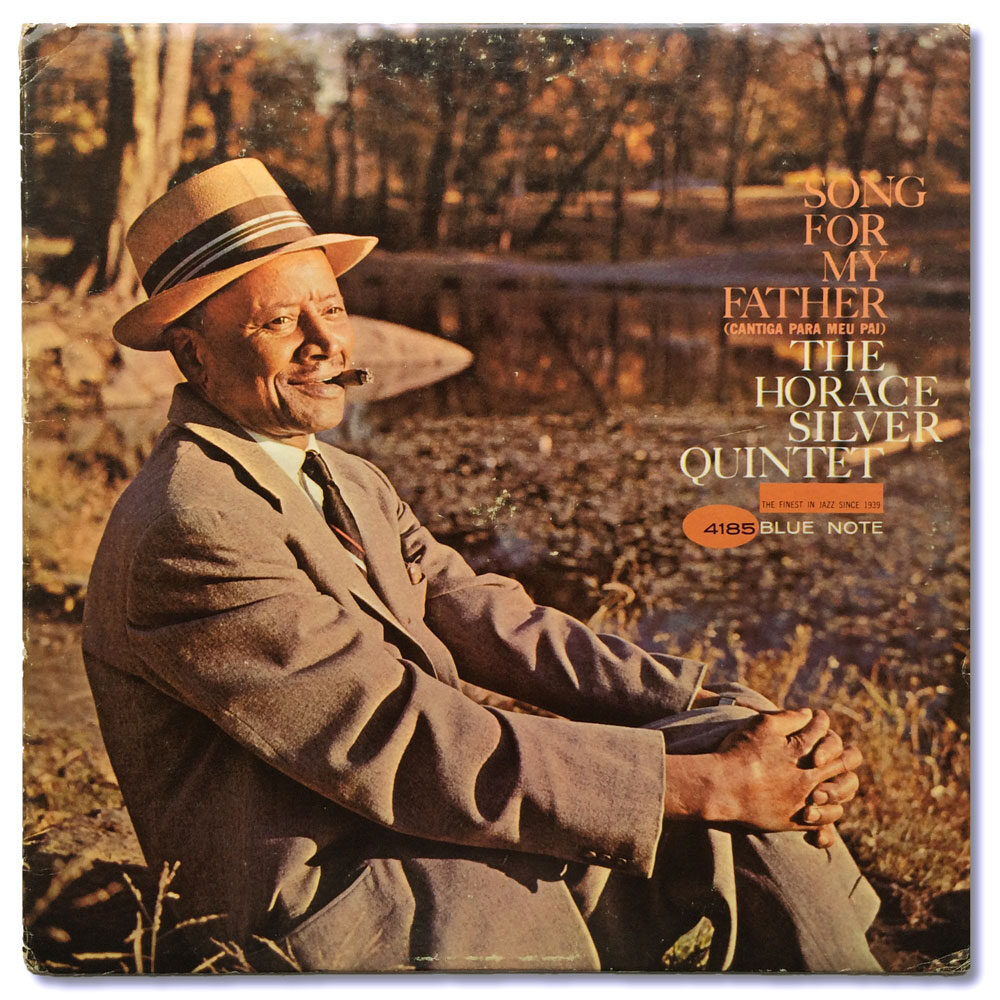
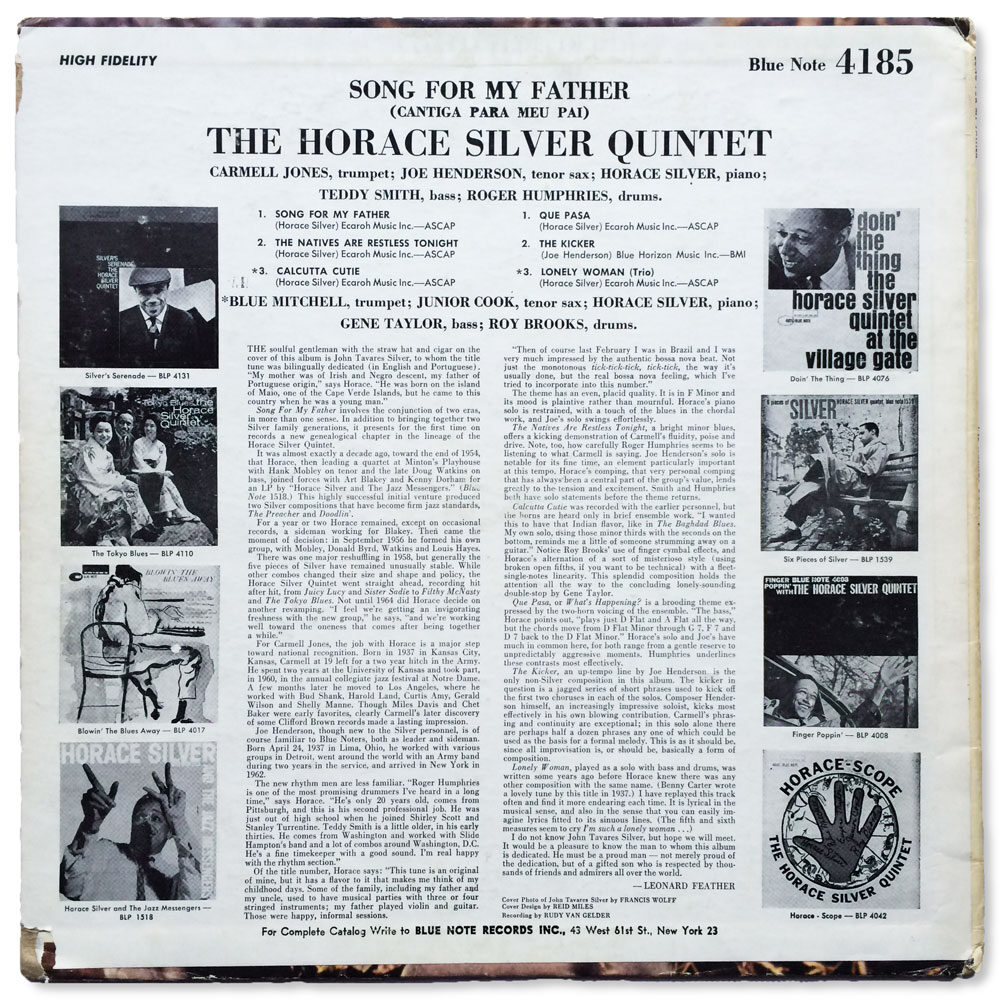
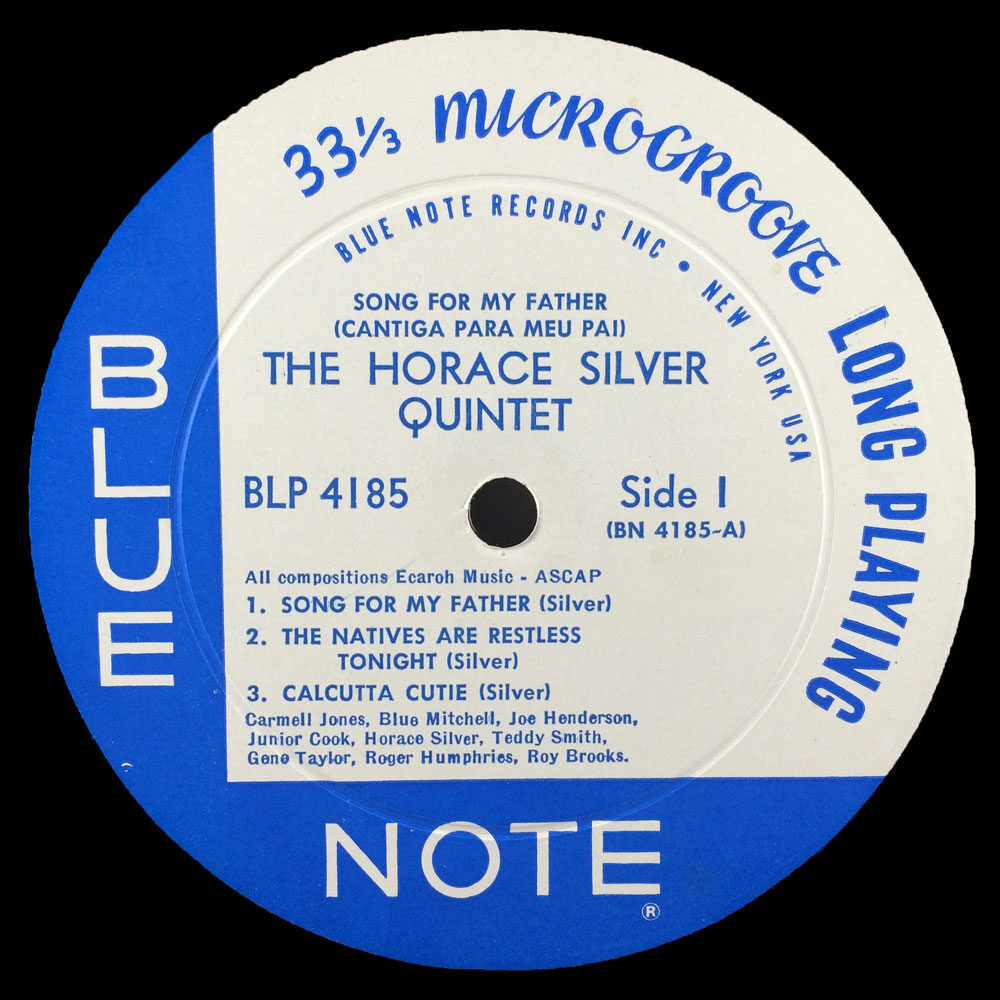
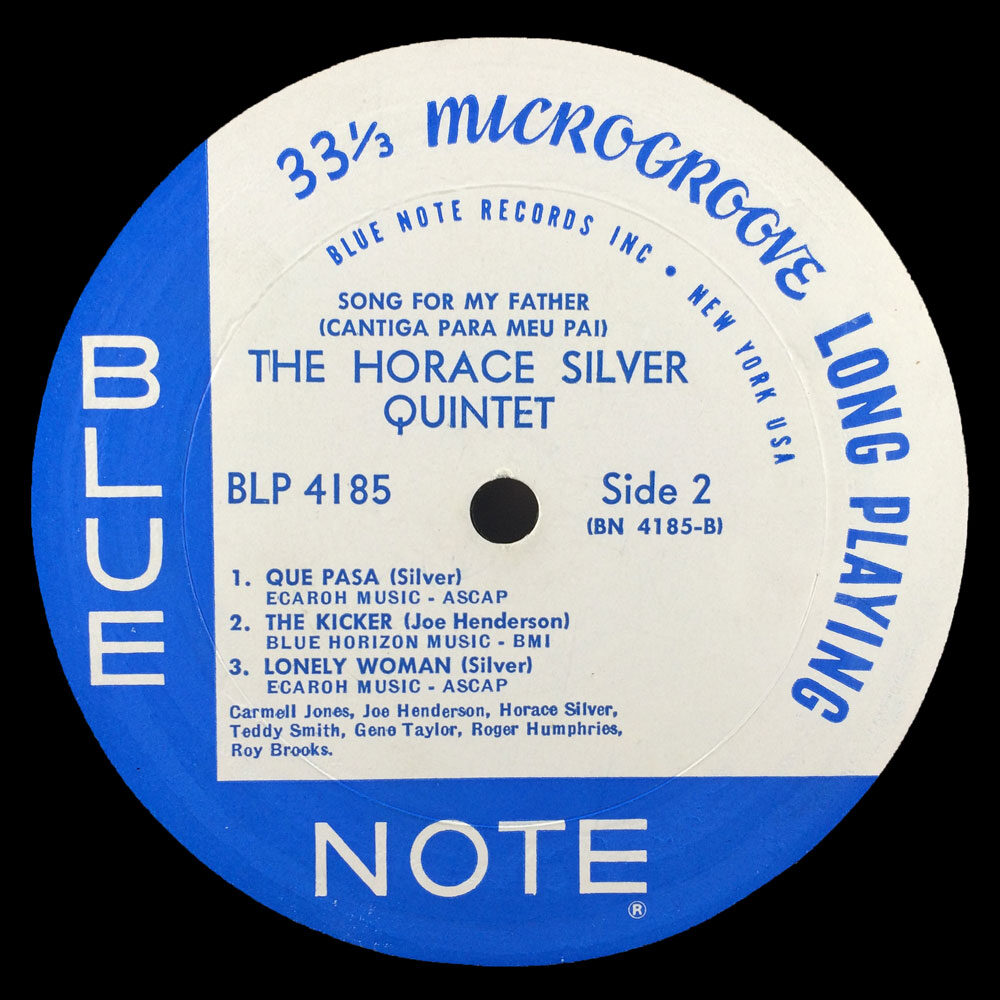
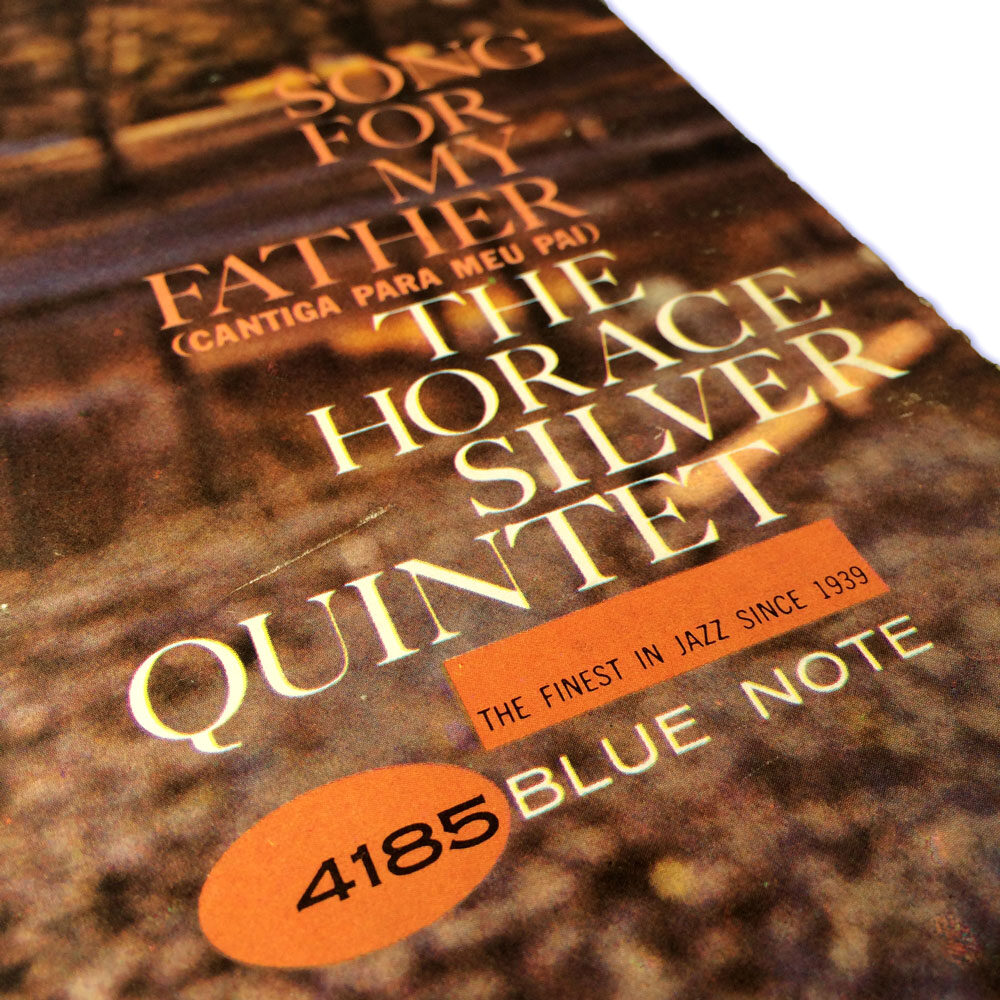
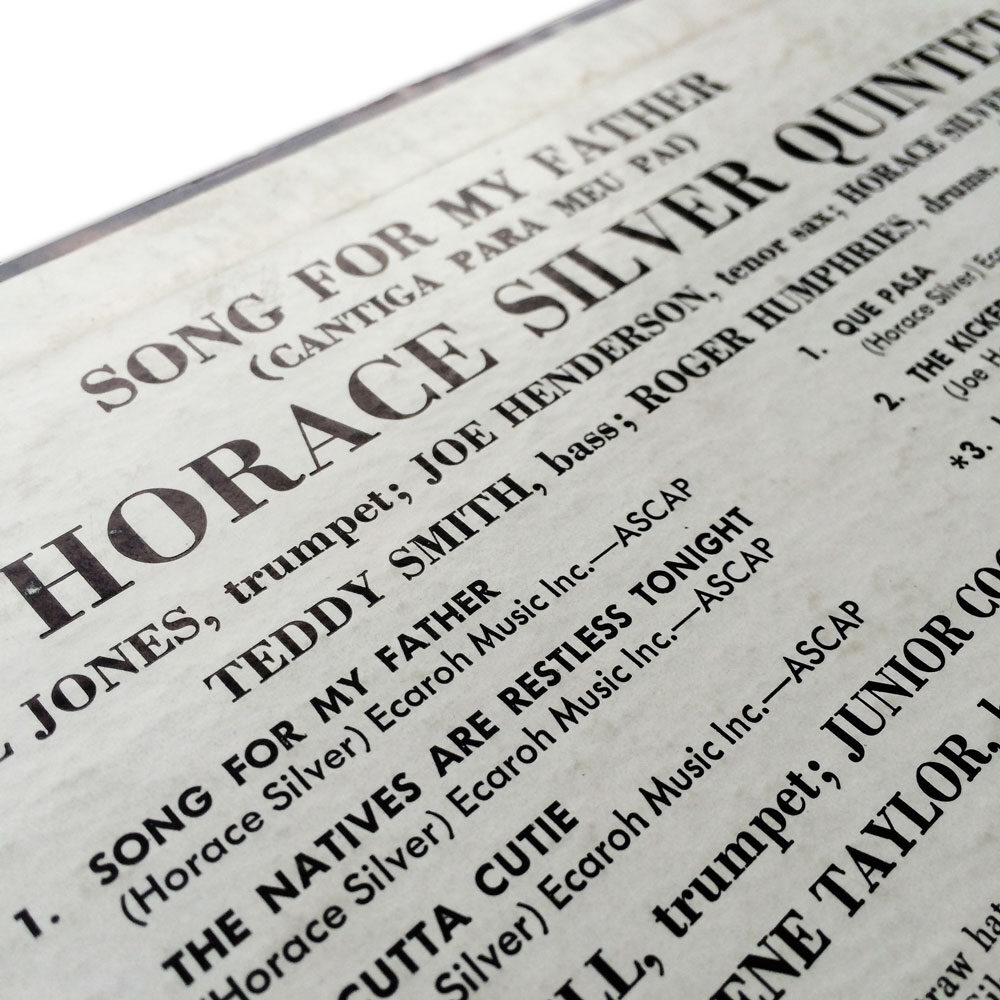
Vinyl Spotlight: The Horace Silver Quintet, Song for My Father (Blue Note 4185) Original Mono Pressing

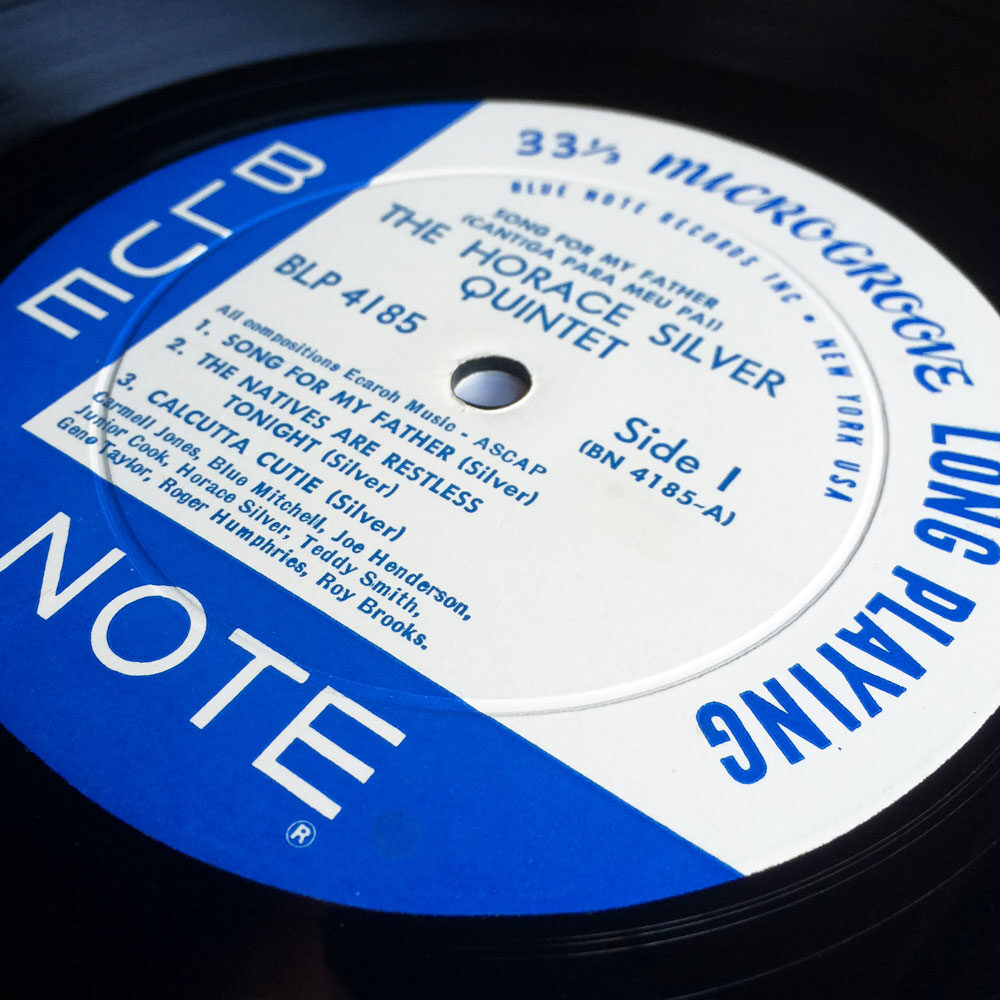
  • Original 1964 mono pressing
  • “NEW YORK USA” on both labels
  • Plastylite “P” etched and “VAN GELDER” stamped in dead wax
  • Deep groove on side 1
  • “43 West 61st St., New York 23” address on jacket without “Printed in U.S.A.”

Personnel:

All but “Calcutta Cutie”, “Lonely Woman”:

  • Carmell Jones, trumpet
  • Joe Henderson, tenor saxophone
  • Horace Silver, piano
  • Teddy Smith, bass
  • Roger Humphries, drums

“Calcutta Cutie”, “Lonely Woman” only:

  • Blue Mitchell, trumpet (“Calcutta Cutie” only)
  • Junior Cook, tenor saxophone (“Calcutta Cutie” only)
  • Horace Silver, piano
  • Gene Taylor, bass
  • Roy Brooks, drums

“Calcutta Cutie” and “Lonely Woman” recorded October 31, 1963
All other tracks recorded October 26, 1964
All selections recorded at Van Gelder Studio, Englewood Cliffs, New Jersey
Originally released December 1964

1 Song for My Father
2 The Natives are Restless Tonight
3 Calcutta Cutie
4 Que Pasa
5 The Kicker
6 Lonely Woman

It makes sense that Song for My Father is part of many peoples’ introduction to the jazz genre. It is not only an essential part of the classic jazz canon, it is also a very accessible album. The minimalist structure of “Calcutta Cutie” and “Que Pasa” should cause just about anyone’s ears to perk up and listen. The album has everything: accessible tunes, a radio-friendly title track, two cooking sessions, and a gorgeous ballad. It certainly was one of the first albums I sought out. I first had the Rudy Van Gelder Edition CD, but when I started collecting jazz vinyl, this album was definitely near the top of my wish list.

The first time I came across an original pressing was at the Jazz Record Center in New York City. It was pretty exciting: I had just recently begun collecting and they had both original mono and stereo copies; I went for the mono. Though the record looked pretty darn clean when I bought it, to my dismay I later discovered that it suffered from audible groove wear. I bought another original mono copy on eBay with the same result before I got this copy via Buy It Now from a German seller. Although its visual condition is really only VG+, this copy is one of those rare instances where a vintage jazz record is scuffed up but free from groove wear and thus plays better than it looks.

My favorite song on this record is perhaps my favorite ballad of all time, “Lonely Woman”. It’s the last song on side 2, and because it’s the last song on the side I was faced with a particular dilemma. The phenomenon of inner groove distortion makes the innermost tracks on each side of a record more susceptible to groove wear, and this is exactly why my first two copies ended up for sale on eBay. Piano is an instrument especially prone to causing mistracing in the presence of groove wear, and on a ballad like this, that distortion is going to be easier to notice if it’s there. If you can find a Rudy Van Gelder-mastered original that’s free from groove wear like this one, the plus side to the engineer’s aggressive mastering techniques is that the music usually overpowers surface marks even in the most excessive of instances; listen above to hear the results.

Whereas my copy of this album has a deep groove on side 1 only, Fred Cohen’s Blue Note guide indicates that copies exist with deep grooves on both sides. But note that Cohen is very clear on page 77 of his guide when he explains the significance of deep grooves when evaluating the vintage of a Blue Note record:

“After a certain point, it can never truly be known whether similar pressings for the same record, whose only difference is the presence or absence of a deep-groove on one, both, or neither labels, is actually the original FIRST pressing. But since collectors have a natural bias for any detail that suggests an early or original issue, the presence of a deep-groove has been treated in this guide as an indication of an original, but ONLY an indication.”

Each of us is free to agree or disagree with him (I happen to think his scientific approach to the issue is exactly right) but I discourage the interpretation of the deep groove data in his guide as a definitive end-all-be-all as to what constitutes a first pressing for Blue Note albums released after the appearance of the first non-deep groove copies in 1961. There is no hard evidence suggesting that either deep groove or non-deep groove pressings of these albums always came first. For someone like myself, this means that in the event that all the other appropriate indicators are there, both deep groove and non-deep groove pressings should be considered first pressings. So if you have a copy of this album with the Van Gelder stamp and the “P” but no deep grooves, my advice is to consider it a first pressing.

The sound of this album is characteristic of Rudy Van Gelder’s work in the mid-1960s. As early as 1963 (see Lee Morgan’s The Sidewinder), one can hear Van Gelder pushing his compressors harder than ever, resulting in a saturated, thick sound. Horns meld together like glue, piano notes come thundering down like hammers, and drums have an in-your-face presence where each and every nuance is amplified to cut through the mix. Of the sides presented here, “Song for My Father” embodies this sound the most.

This album is a bonafide classic. It is yet another Blue Note staple filled with brilliant music, an album that beckons to be listened to from start to finish every time.

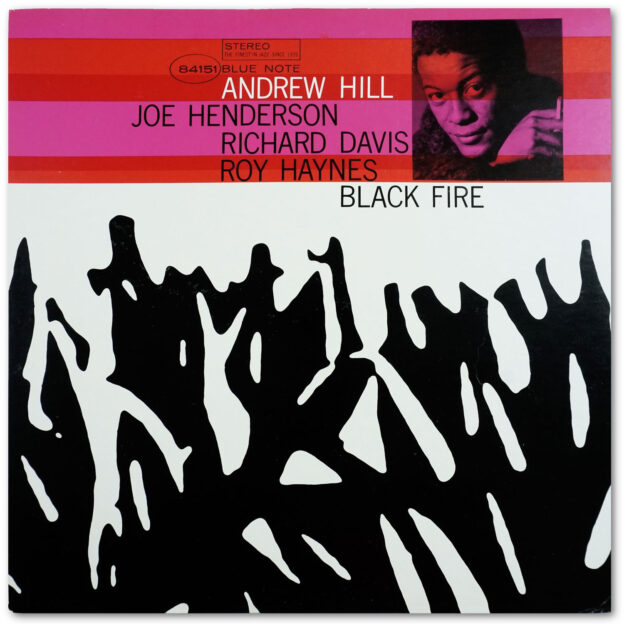
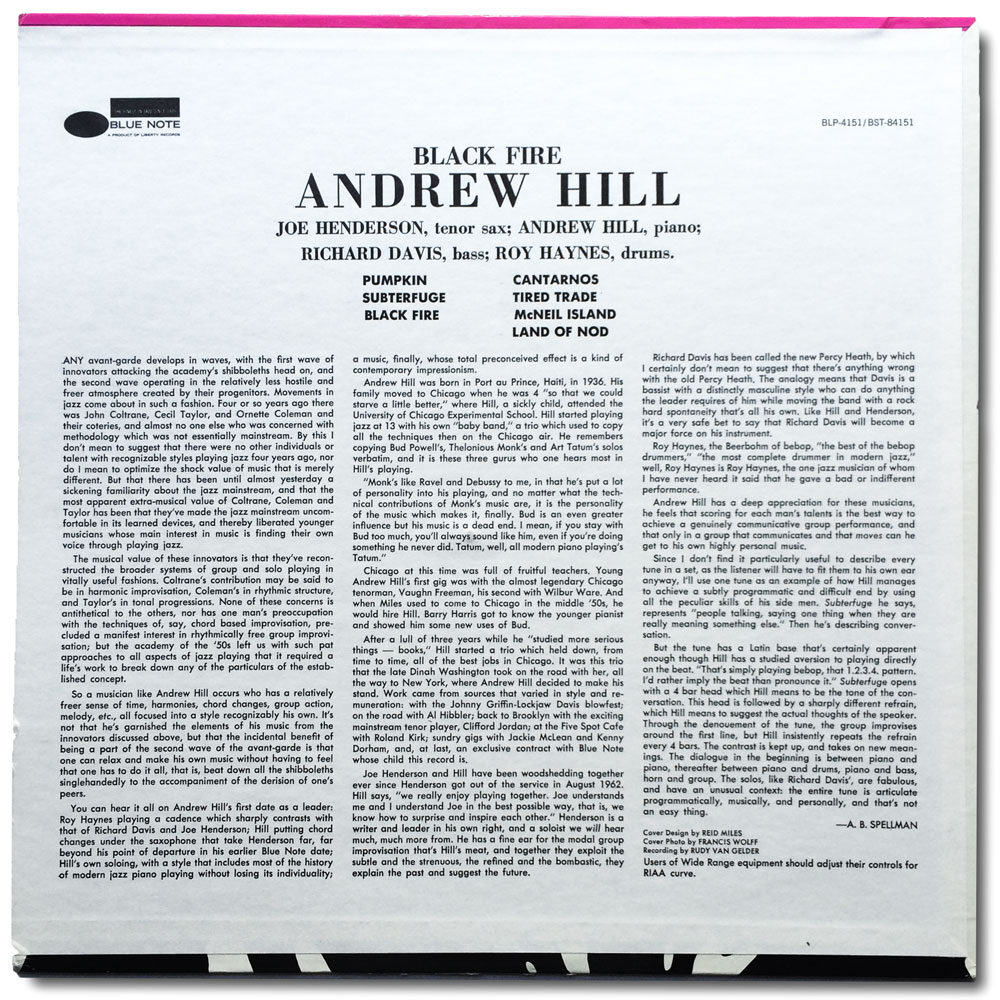
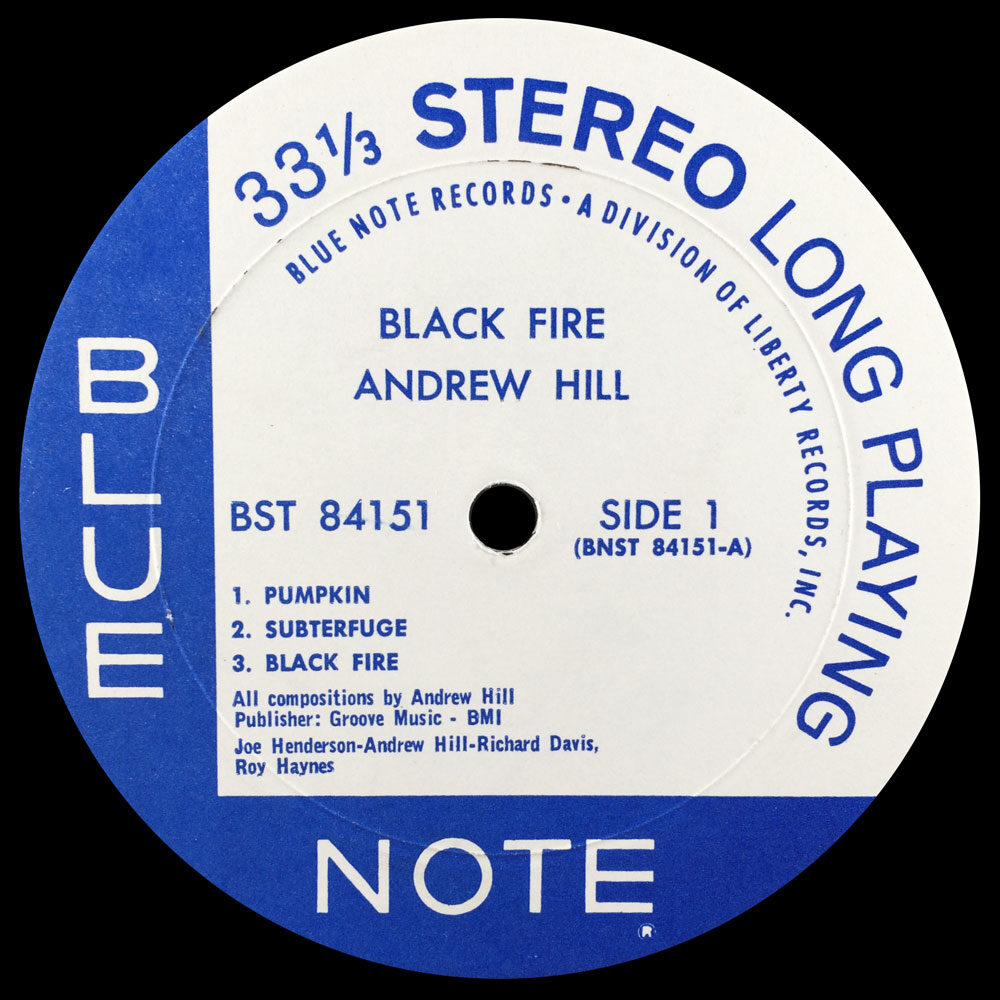
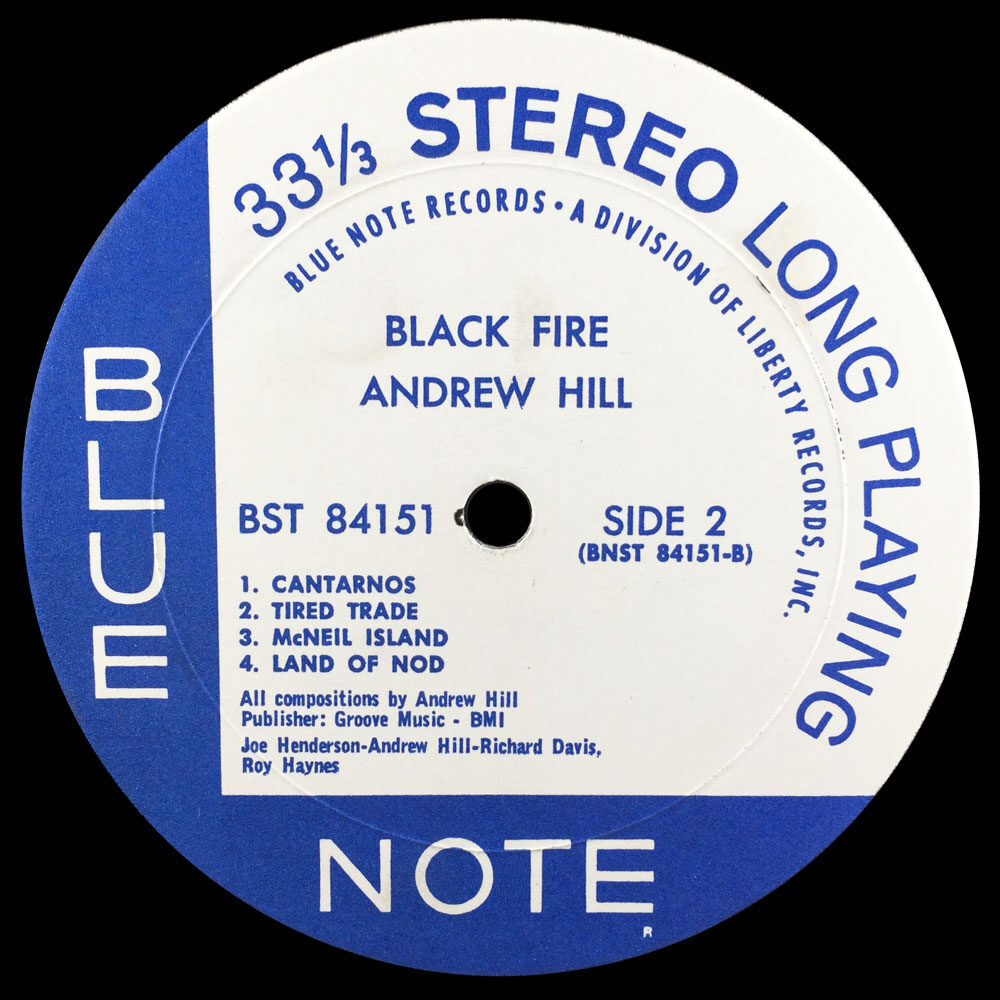
Vinyl Spotlight: Andrew Hill, Black Fire (Blue Note 84151) Liberty RVG Stereo Pressing

  • Stereo Liberty reissue circa 1966-1970
  • “A DIVISION OF LIBERTY RECORDS, INC.” on both labels
  • “VAN GELDER” stamped in dead wax

Personnel:

  • Joe Henderson, tenor saxophone
  • Andrew Hill, piano
  • Richard Davis, bass
  • Roy Haynes, drums

Recorded November 8, 1963 at Van Gelder Studio, Englewood Cliffs, New Jersey
Originally released March 1964

1 Pumpkin
2 Subterfuge
3 Black Fire
4 Cantarnos
5 Tired Trade
6 McNeil Island
7 Land of Nod

First and foremost, I think this is one of the greatest album covers of all time. I love the juxtaposition of the bold strips of various red hues with the cartoony black-and-white illustration of fire beneath. Reid Miles’ cover design speaks volumes and yet again complements the music incredibly well.
From the time Andrew Hill arrived at Blue Note in 1963, it didn’t take long for the pianist-composer to venture “out” and away from bop. Hill first recorded for the label in September of that year with Joe Henderson (Our Thing, Blue Note 4152), then with Hank Mobley the following month (No Room for Squares, Blue Note 4149). Black Fire, Hill’s first album as a leader for Blue Note, was recorded in November 1963 and gives us an early glimpse at Hill loosely conforming to the higher degree of harmonic and melodic structure commonly found in bop. Blue Note would continue to document Hill’s musical explorations in the coming months, laying to tape Smokestack, Judgment!, then finally Hill’s avant-garde classic Point of Departure in March 1964 — the same month that Eric Dolphy recorded his landmark album Out to Lunch! for the label.

This album is about as far out as I’m willing go into the free jazz sea. I’m not a fan of free jazz and don’t know much about it, but from the little I do know I’m willing to say that Black Fire tows the line between post bop and the avant-garde. The sounds here tend to invoke a subtle feeling of panic, but much like another favorite mid-sixties quartet album of mine, Black Fire maintains a surprising degree of calm and quietude through all of the chaos. We also get to hear Roy Haynes on an uncommon Blue Note date and he doesn’t disappoint, demonstrating his patented pinpoint precision and tight snare drum work throughout.
Spotify Playlists: Rudy Van Gelder Studios

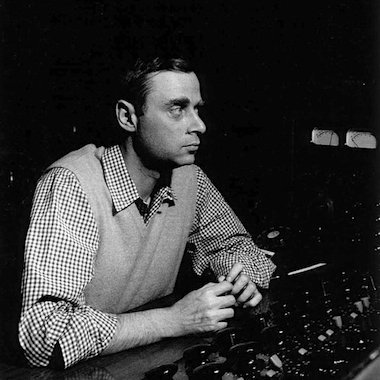
Rudy Van Gelder is one of the most recognized audio engineers to have ever lived. He has recorded hundreds of the most celebrated jazz albums the world has ever heard. His recordings are so characteristic, “the Van Gelder sound” has become a catchphrase known to jazz fans the world over. But under the umbrella of this moniker, Rudy Van Gelder’s recording technique, philosophy, and logistics went through numerous changes over his career. Perhaps the change that affected this sonic signature most was when he moved his studio from his parents’ living room in Hackensack, New Jersey to a custom-built, cathedral-like structure in nearby Englewood Cliffs. The following playlists should make clear the distinct sonic characteristics of each studio and the way each space left its mark on recordings:

  • Hackensack Mono: This playlist embodies the immediate, up-front sound of Van Gelder’s Hackensack home studio. Additionally, since mono was the singular focus here, this playlist consists entirely of mono recordings and thus embodies Van Gelder’s legendary mono sound from start to finish.
  • Englewood Cliffs: The stereo presentation of each recording here helps to emphasize the open, spacious sound of this studio.

Click the links below to listen to the playlists on Spotify, or shuffle through the playlists right here!

Note: If you are not logged in to Spotify on your web browser, clicking one of the “play” icons above will only play 30-second clips of the songs. Click any of the embedded links to sign in, open Spotify in your browser, or launch the app on your computer.

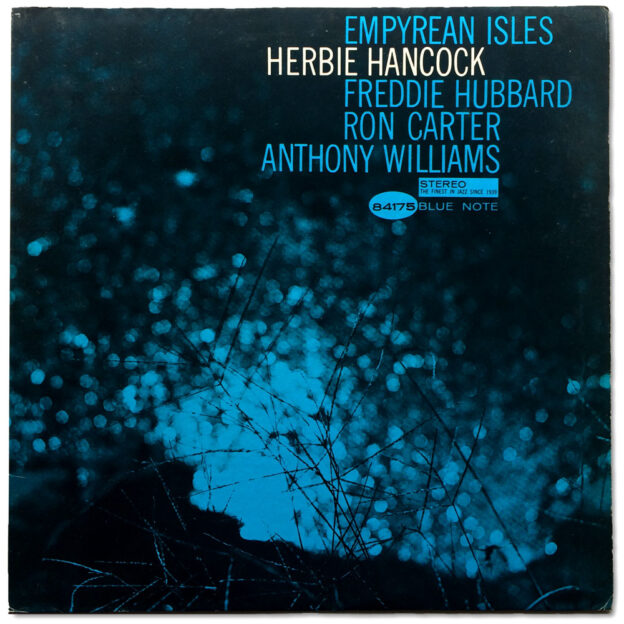
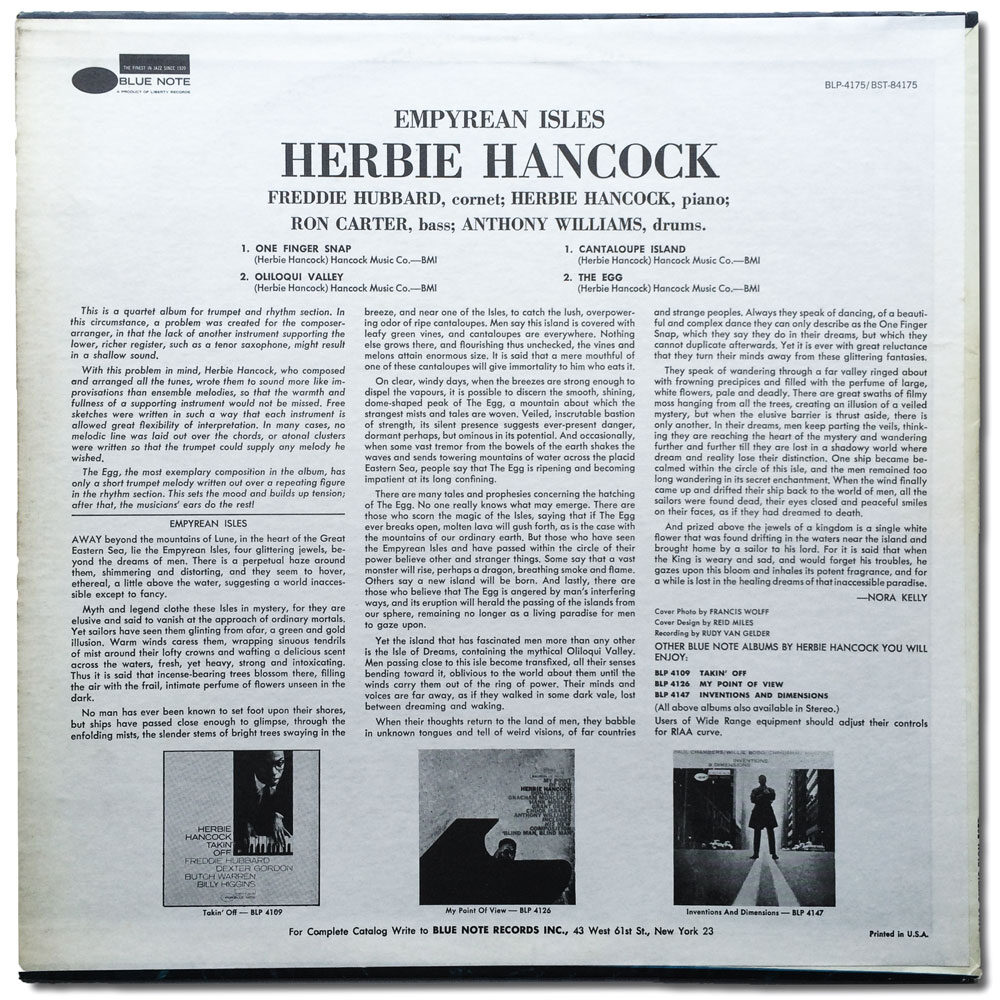
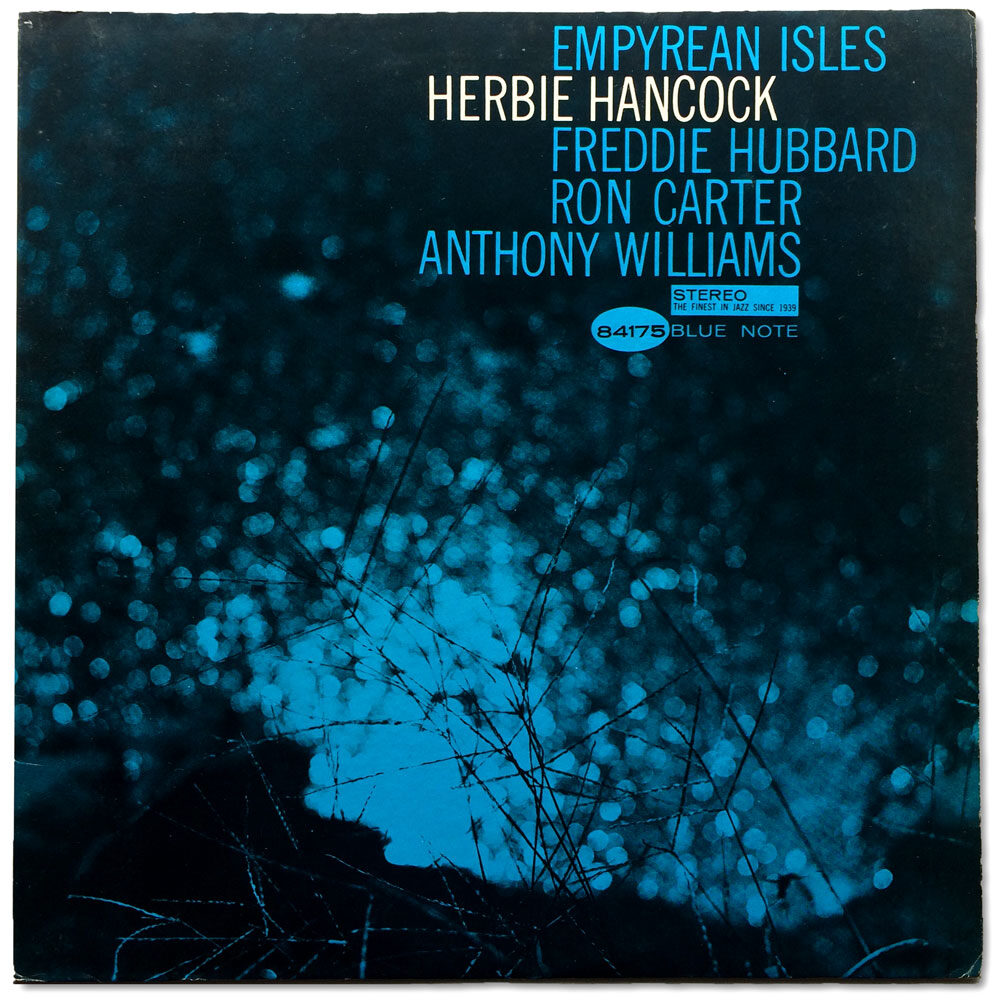
Vinyl Spotlight: Herbie Hancock, Empyrean Isles (Blue Note 4175) UA RVG Stereo Pressing

  • United Artists stereo reissue circa 1972-1975
  • “VAN GELDER” stamped in dead wax

Personnel:

  • Freddie Hubbard, trumpet
  • Herbie Hancock, piano
  • Ron Carter, bass
  • Tony Williams, drums

Recorded June 17, 1964 at Van Gelder Studio, Englewood Cliffs, New Jersey
Originally released November 1964

This is one of my favorite Herbie Hancock albums. It has a soft, gentle vibe that I return to time and time again when I want to listen to something quiet. The quartet with trumpet seems like the perfect minimal arrangement for this album, and even though I’m not the biggest Freddie Hubbard fan, I find that he fits in with the rest of the group like a glove here. I love the cover too. Reid Miles had a way of making album art reflect the music contained within, and with this album, the simple, out-of-focus image of shimmering water cast in a teal blue tint complements the music extremely well…even the pronunciation of the title has a calming sort of effect (“Em-PEE-ree-in”).

Although the album’s closing track, “The Egg”, ventures out a bit too far for my taste, the other three compositions are all favorites. “Cantaloupe Island” sounds like part three in a trilogy of soulful, radio-friendly Hancock compositions that began with “Watermelon Man” and “Blind Man, Blind Man”, but side 1 consists of sixteen of my favorite minutes in music. Eighteen-year-old (Eighteen!) Tony Williams’ drumming is fiery, imaginative and expressive. His kit sounds incredible here as well, especially his ride cymbal. Engineer Rudy Van Gelder’s spacious Englewood Cliffs studio had a way of making drum kits sound colossal when they needed to, which can be heard during Williams’ solo on “One Finger Snap”. Who would have ever thought that Blue Note darling Freddie Hubbard would pair with the rhythm section of Miles Davis’ Second Great Quintet so well?

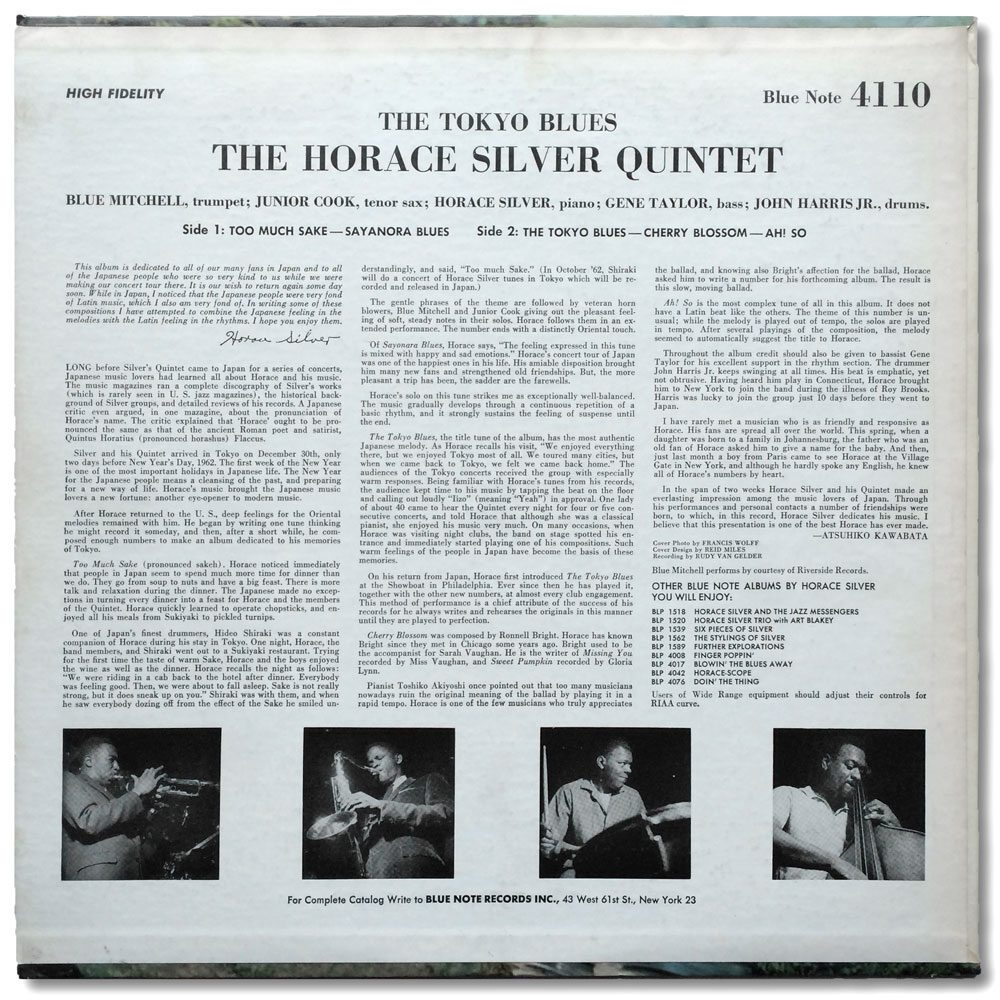
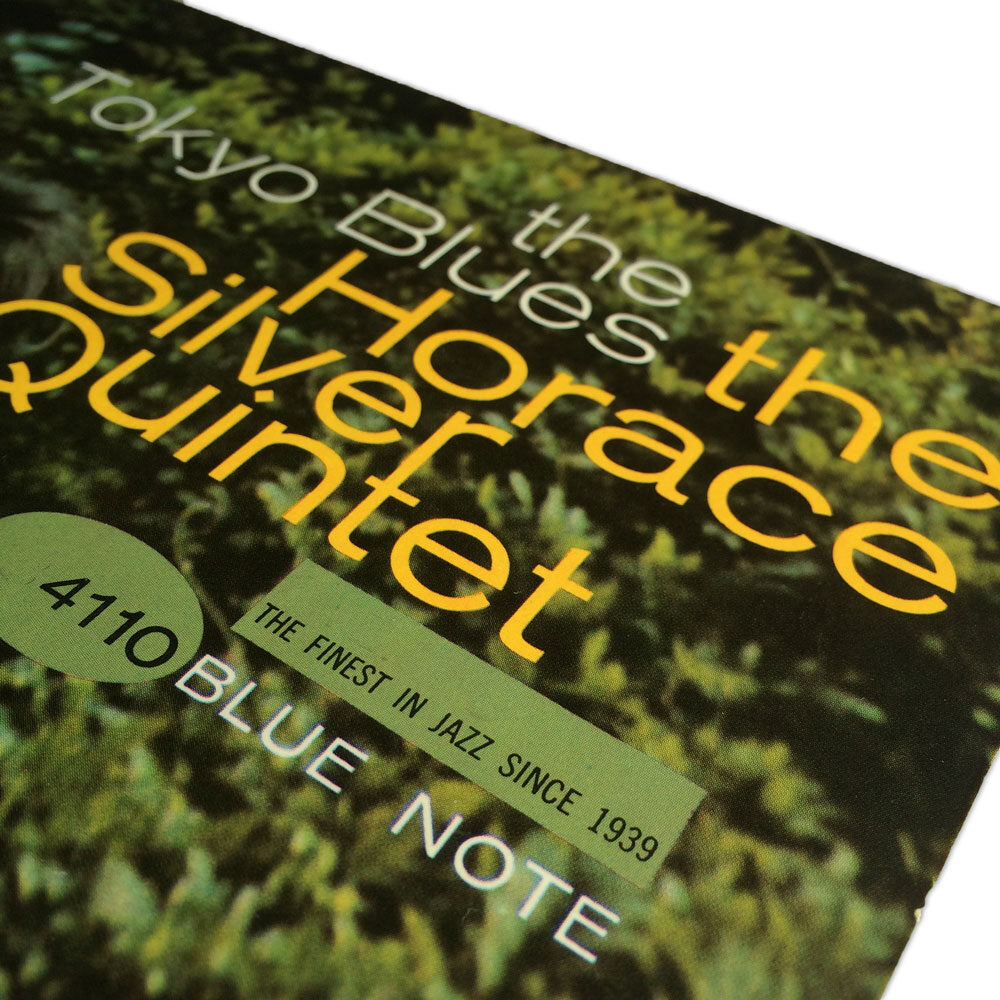
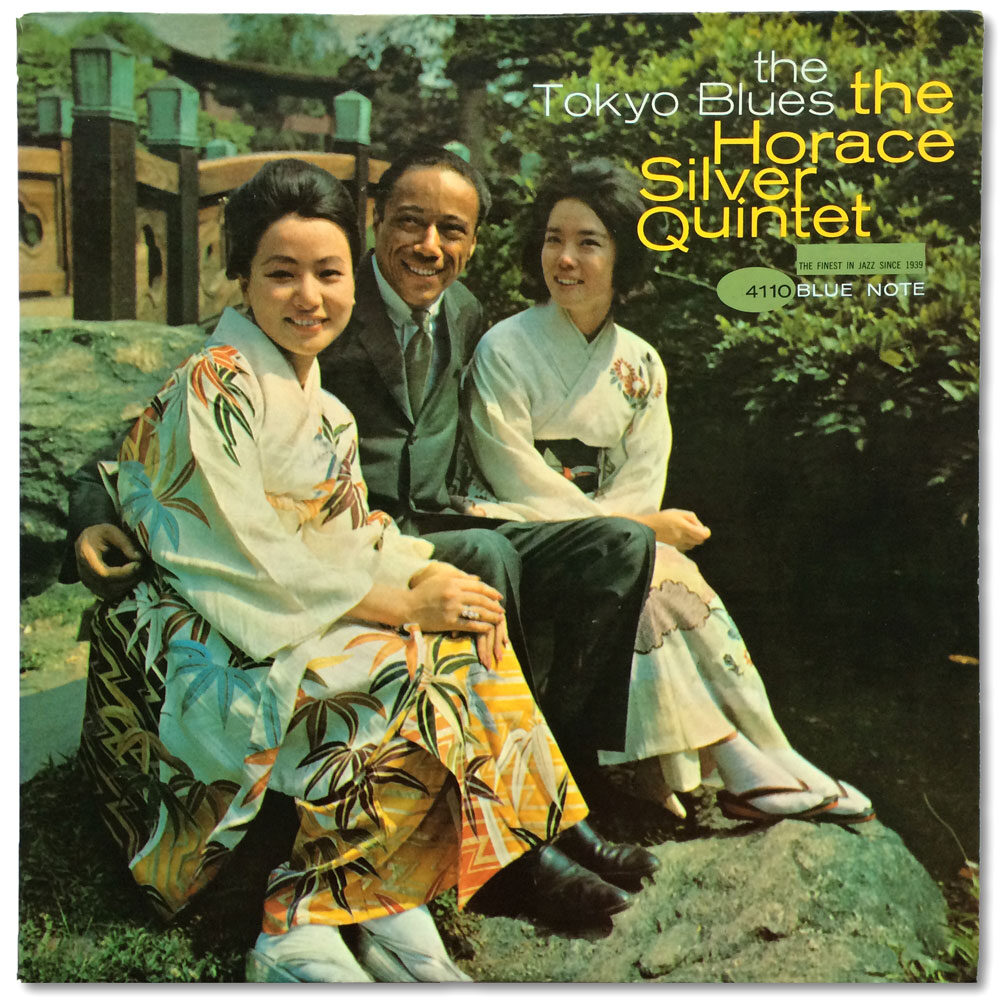
Vinyl Spotlight: The Horace Silver Quintet, The Tokyo Blues (Blue Note 4110) Original Mono Pressing

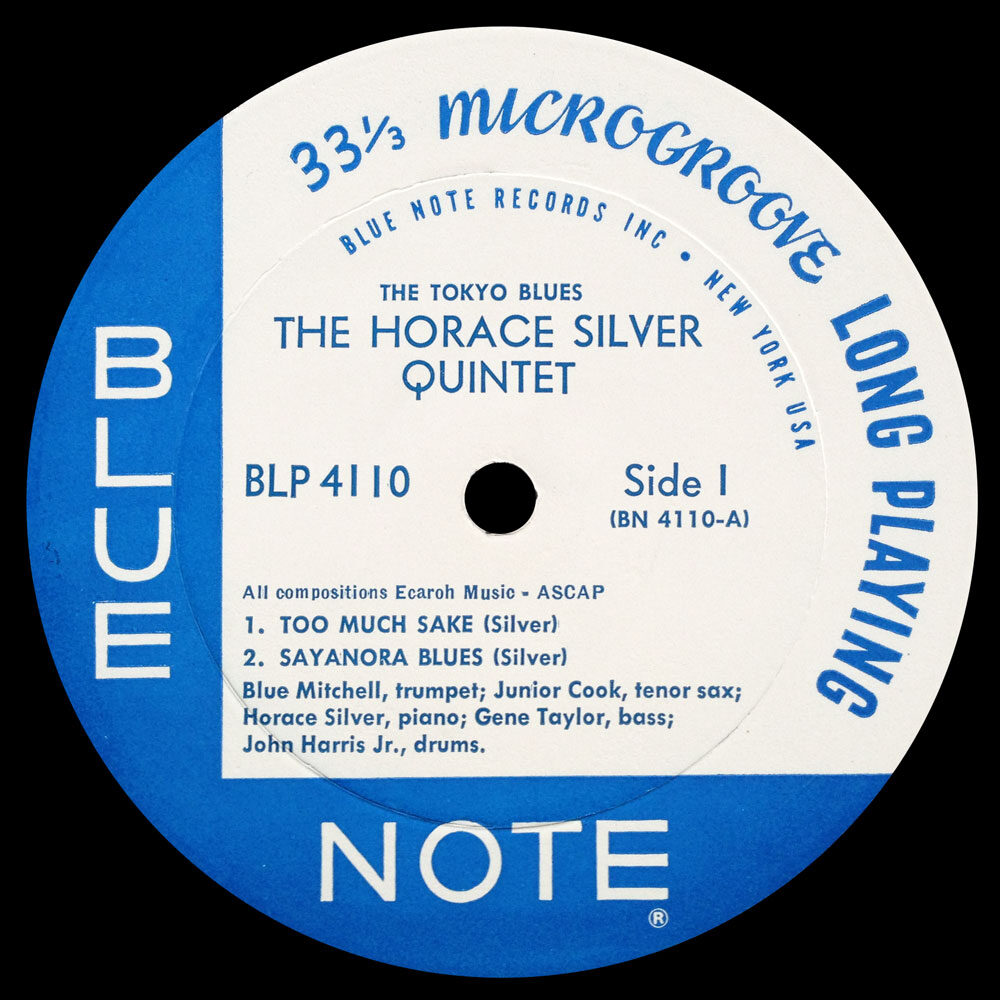
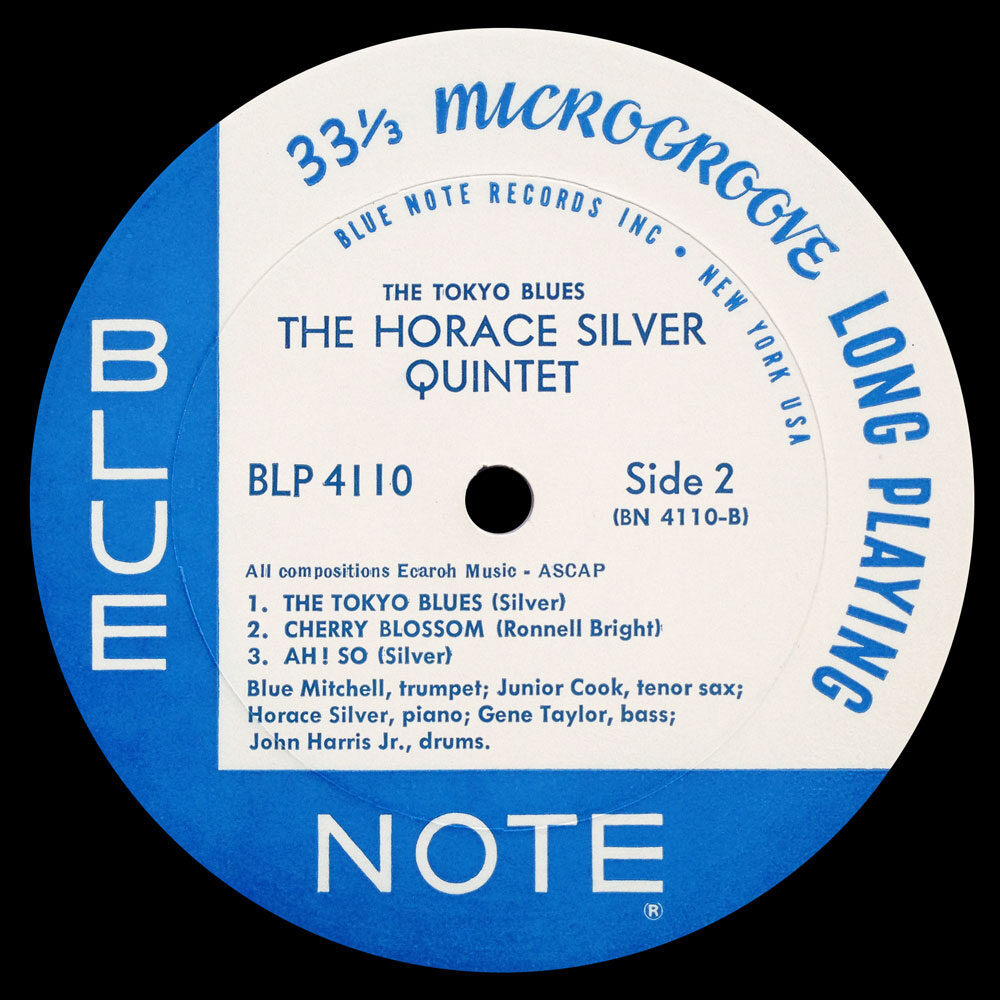
  • Original 1962 mono pressing
  • “NEW YORK USA” on both labels
  • Plastylite “P” etched and “VAN GELDER” stamped in dead wax
  • “43 West 61st St., New York 23” address on jacket without “Printed in U.S.A.”

Personnel:

  • Blue Mitchell, trumpet
  • Junior Cook, tenor saxophone
  • Horace Silver, piano
  • Gene Taylor, bass
  • John Harris, Jr., drums

Recorded July 13-14, 1962 at Van Gelder Studio, Englewood Cliffs, New Jersey
Originally released November 1962

1 Too Much Sake
2 Sayonara Blues
3 The Tokyo Blues
4 Cherry Blossom
5 Ah! So

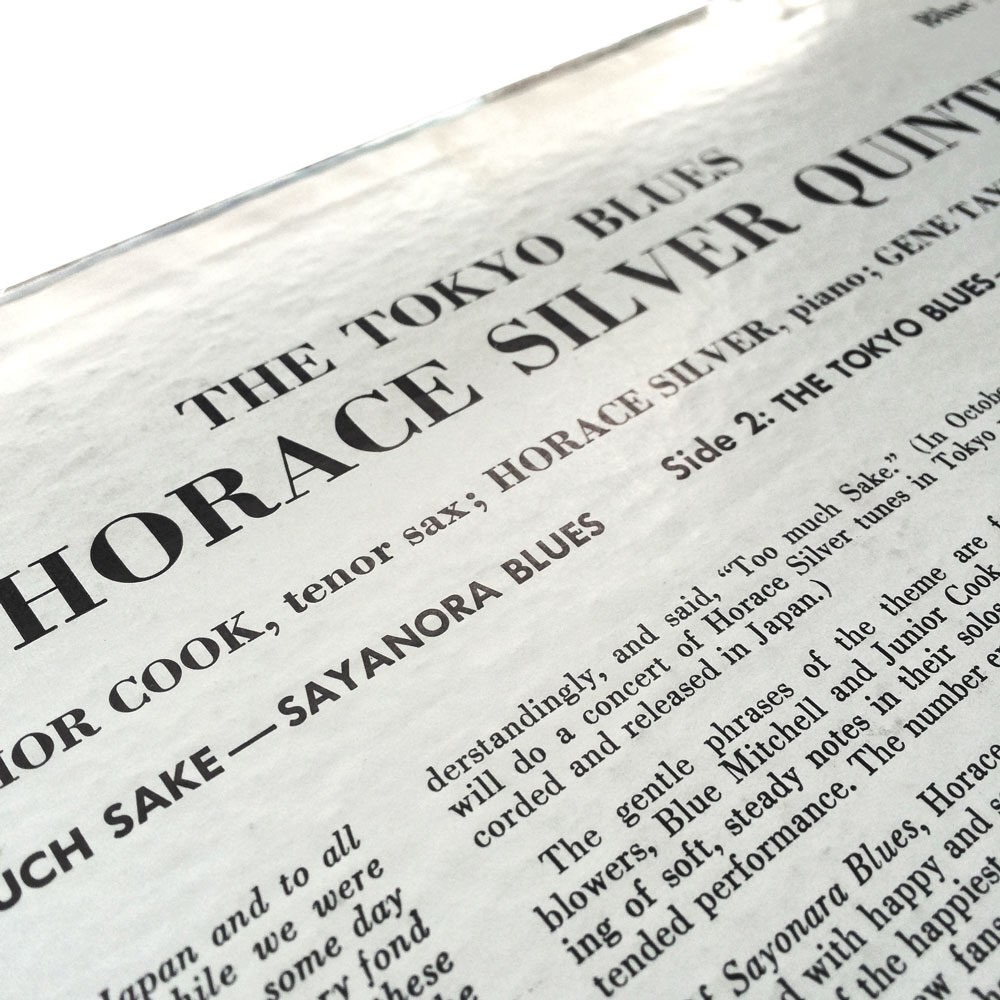
This record is one of the finest examples of engineer Rudy Van Gelder’s original mono mastering work in my entire collection. Granted, I only own a handful of these, but I’ve had dozens more pass through my hands over the years and this is definitely one of the good ones. What makes it one of the best? Condition. Since so many original Blue Notes seem to have suffered groove damage at the hands of primitive playback equipment, I have found that the key ingredient in a stellar-sounding original is the extent to which past usage has left its mark on the record. Not only does this record look amazing 55 years after it would have been taken home from the store, the sound is still fresh and vivid — the way you might expect it to have sounded back in 1962.

It’s possible that bandleader Horace Silver’s choice of a Far Eastern theme influenced drummer John Harris Jr.’s choice of a more minimal, sparse style of playing throughout, which gives each instrument plenty of room to breathe and cut through. (Less percussive energy also provides less of a challenge when getting the music onto tape and into the grooves of the wax.) The standout moment here is Silver’s four-and-a-half-minute romp on the keys in “Sayonara Blues”, a solo with trance-like qualities reinforced by a two-chord, left-hand mantra.

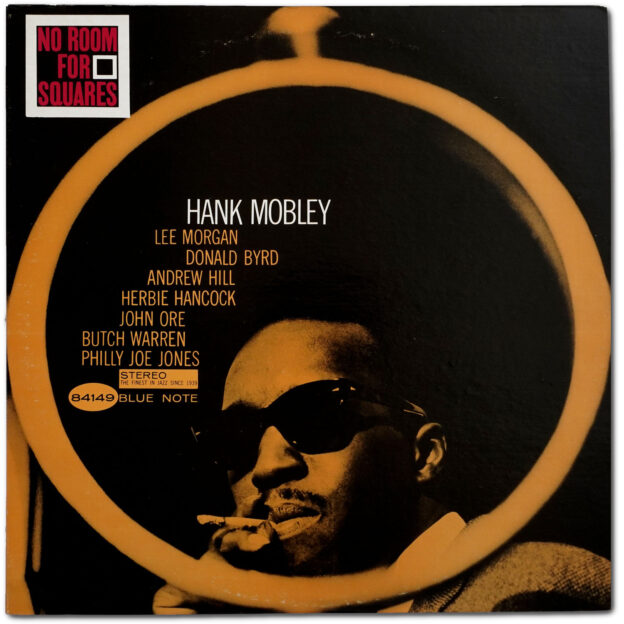
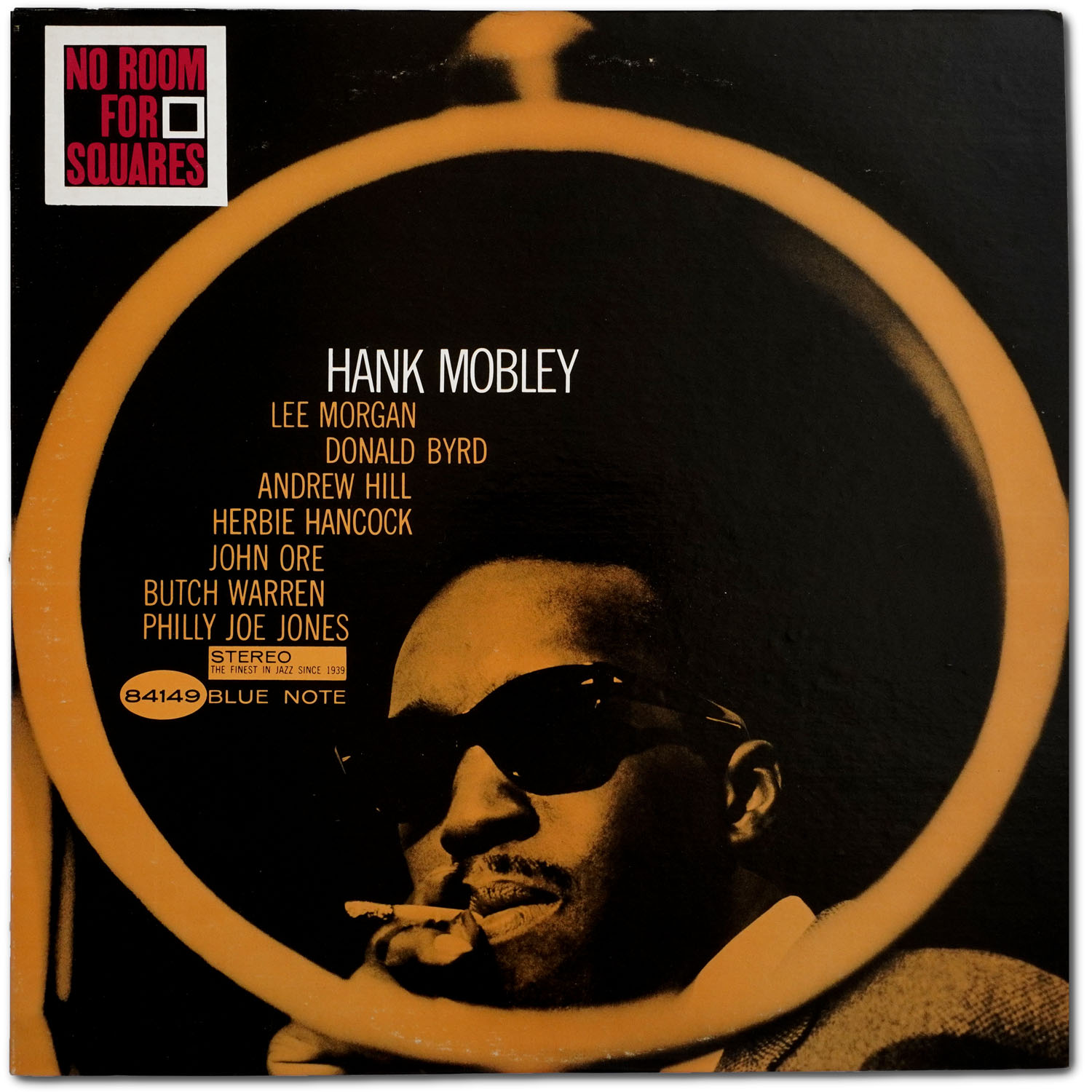
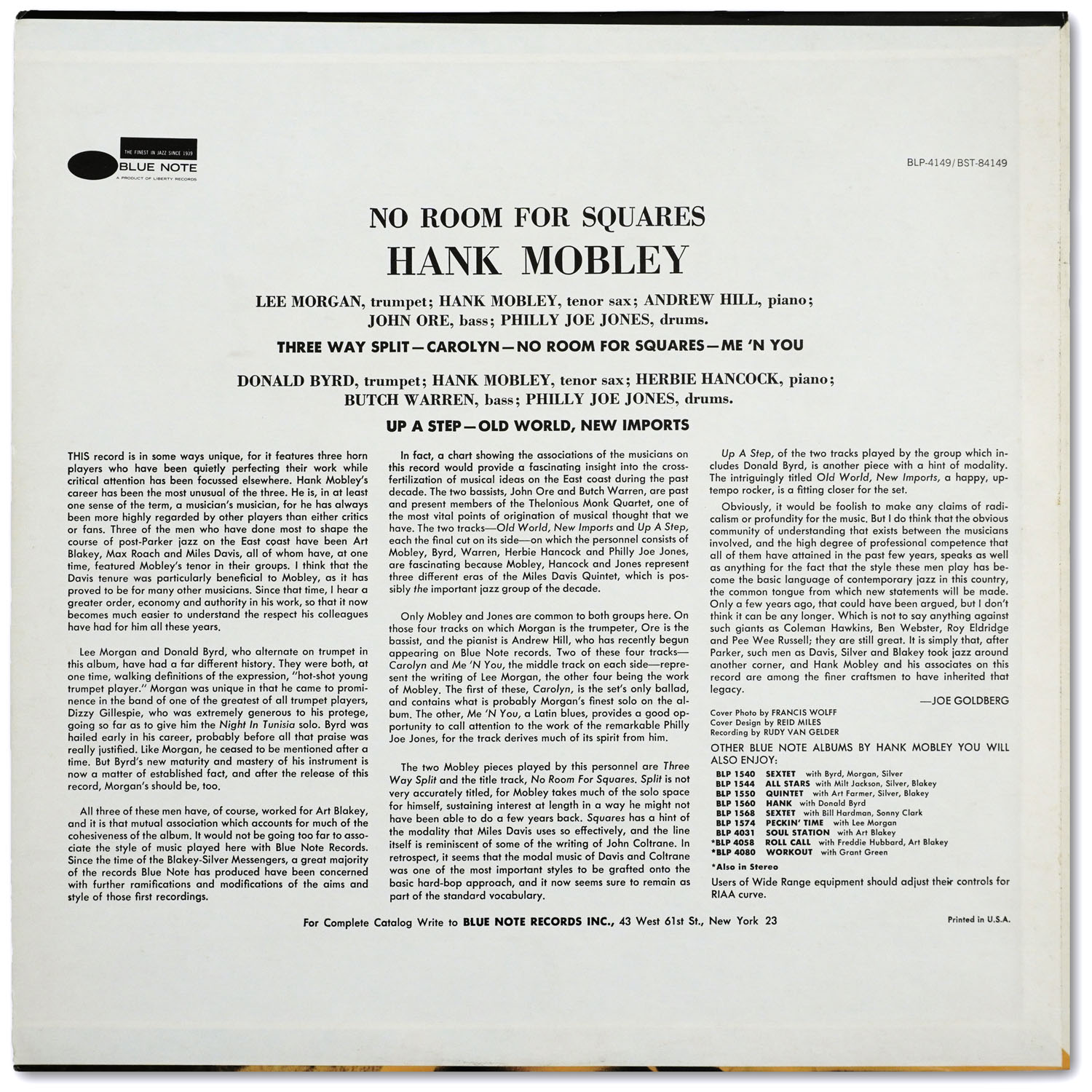
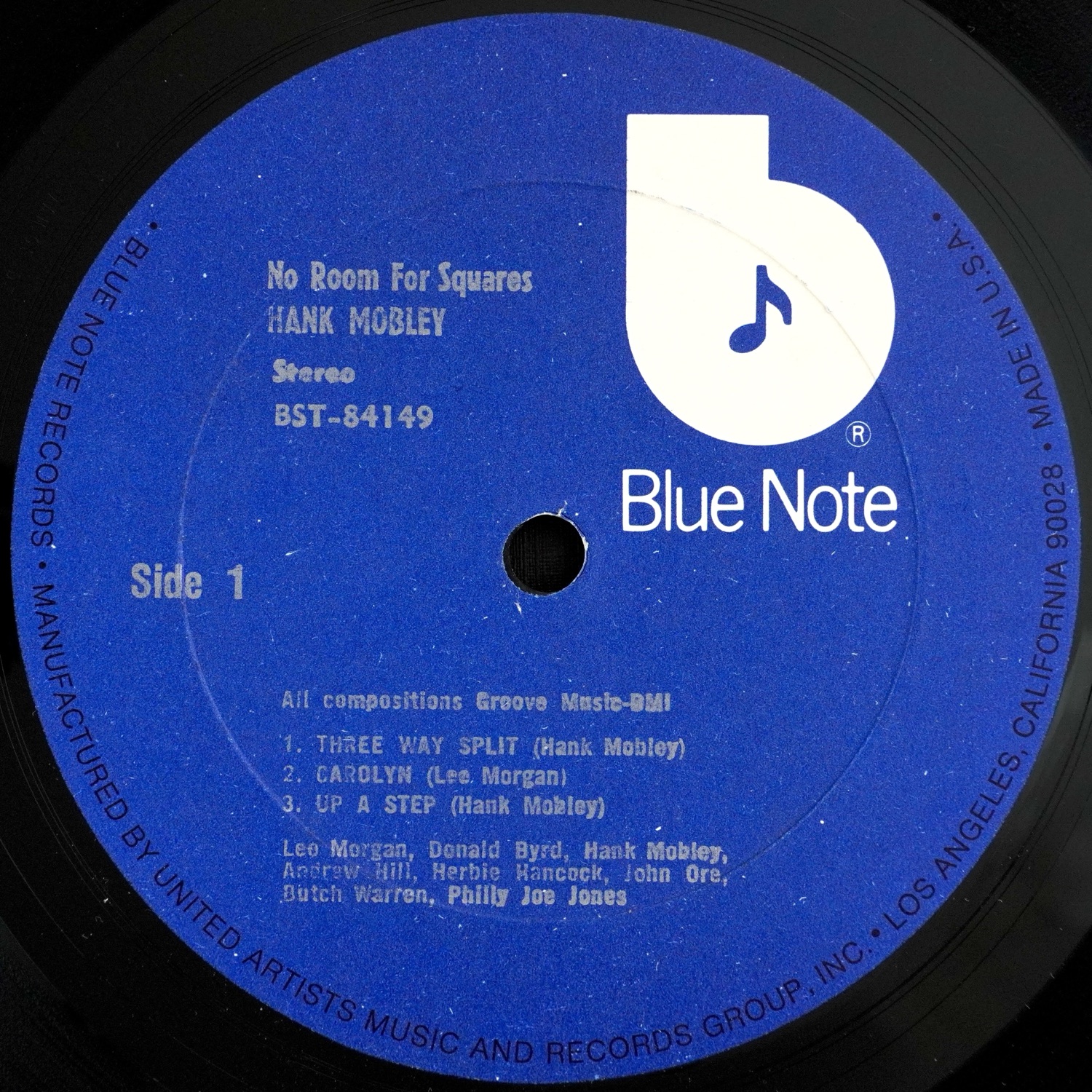
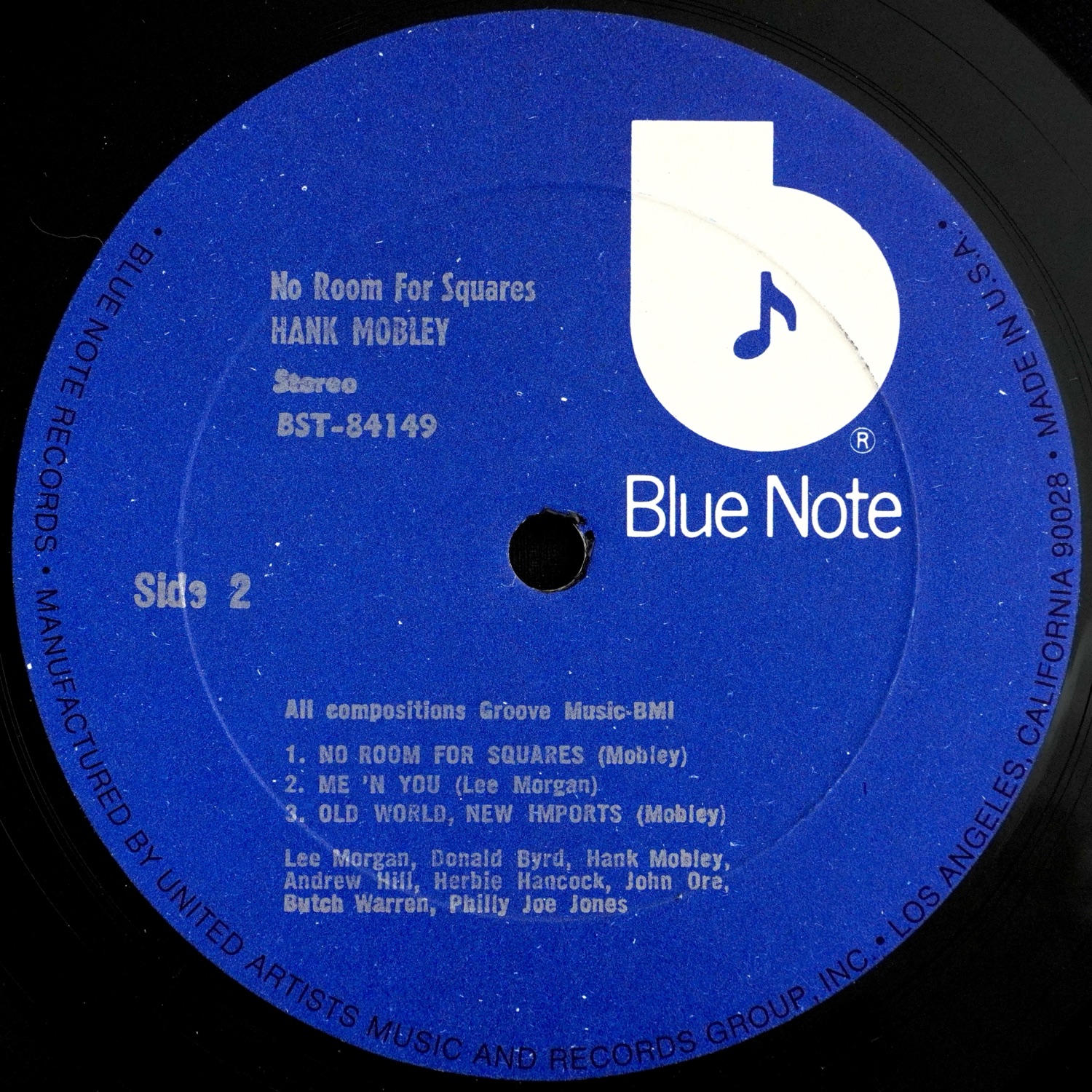
Vinyl Spotlight: Hank Mobley, No Room for Squares (Blue Note 84149) UA RVG Stereo Pressing

  • United Artists stereo reissue circa 1975-1978
  • “VAN GELDER” stamped in dead wax

Personnel:

All but “Up a Step”, “Old World, New Imports”:

  • Lee Morgan, trumpet
  • Hank Mobley, tenor saxophone
  • Andrew Hill, piano
  • John Ore, bass
  • Philly Joe Jones, drums

“Up a Step”, “Old World, New Imports” only:

  • Donald Byrd, trumpet
  • Hank Mobley, tenor saxophone
  • Herbie Hancock, piano
  • Butch Warren, bass
  • Philly Joe Jones, drums

“Up a Step”, “Old World, New Imports” recorded March 7, 1963
All other selections recorded October 2, 1963
All selections recorded at Van Gelder Studio, Englewood Cliffs, New Jersey
Originally released May 1964

1 Three Way Split
2 Carolyn
3 Up a Step
4 No Room for Squares
5 Me ‘n You
6 Old World, New Imports

So far on Deep Groove Mono, we’ve covered original pressings, Liberty pressings and early ’70s United Artists pressings of classic albums released by the beloved Blue Note label. This ’70s copy of Hank Mobley’s No Room for Squares with the all-blue label and the white (sometimes black) lowercase “b” logo is more or less the last phase in vintage US Blue Note pressings. (Prior to the current era of audiophile reissue programs, which gained great momentum in the late ’90s with Classic Records, the ’80s and ’90s saw a series of less popular, less acclaimed reissue programs eclipsed by the advent and subsequent reign of the compact disc.) This reissue program also constitutes the last time the original mastering work of engineer Rudy Van Gelder would be used to press reissues of classic Blue Note albums.

As is the case with the earlier mono UA reissues of the early ’70s with the classic blue-and-white label scheme, these all blue-label reissues seem hit or miss. This is at least in part due to the fact that Van Gelder’s metal work was being employed beyond the point where it could produce records of the exceptional quality originals and earlier reissues are known for. Several Blue Note albums I have encountered with all-blue-labels and Van Gelder mastering have been duds, but No Room for Squares is not one of them.

This is one of my favorite Hank Mobley albums. Recorded in 1963, it is far removed from the string of 1500-series albums Mobley recorded for Blue Note in the late fifties, all of which are very rare and in-demand in their original incarnations. Nonetheless, Mobley puts together a solid, consistent program here, best demonstrated by a pair of the leader’s own compositions (the title track and “Three Way Split”) and the ballad “Carolyn”, an original work of session trumpeter Lee Morgan. Then-veteran of the bop scene, drummer Philly Joe Jones, provides a driving and exciting performance on the skins as well.

Though this is a stereo copy, it is tempting to hit the ‘mono’ button on my amplifier in order gain a sense of what an original mono pressing might sound like. The reason we can be fairly certain that this type of summing can produce comparable results is because of what we know about the way Rudy Van Gelder recorded, mixed, and mastered these albums for both mono and stereo. Though the clarity and separation offered by the stereo spread is a treat in its own right, summing to mono provides a glue to the mix that the stereo presentation is incapable of, especially when it comes to the harmonies of the horns.

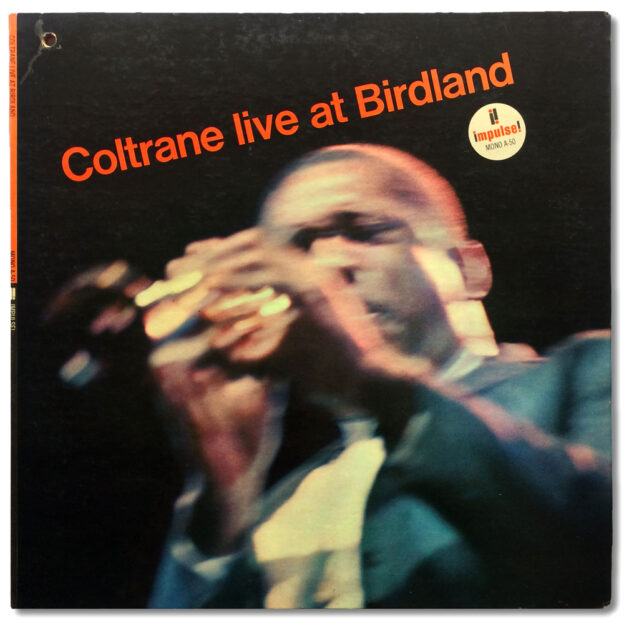
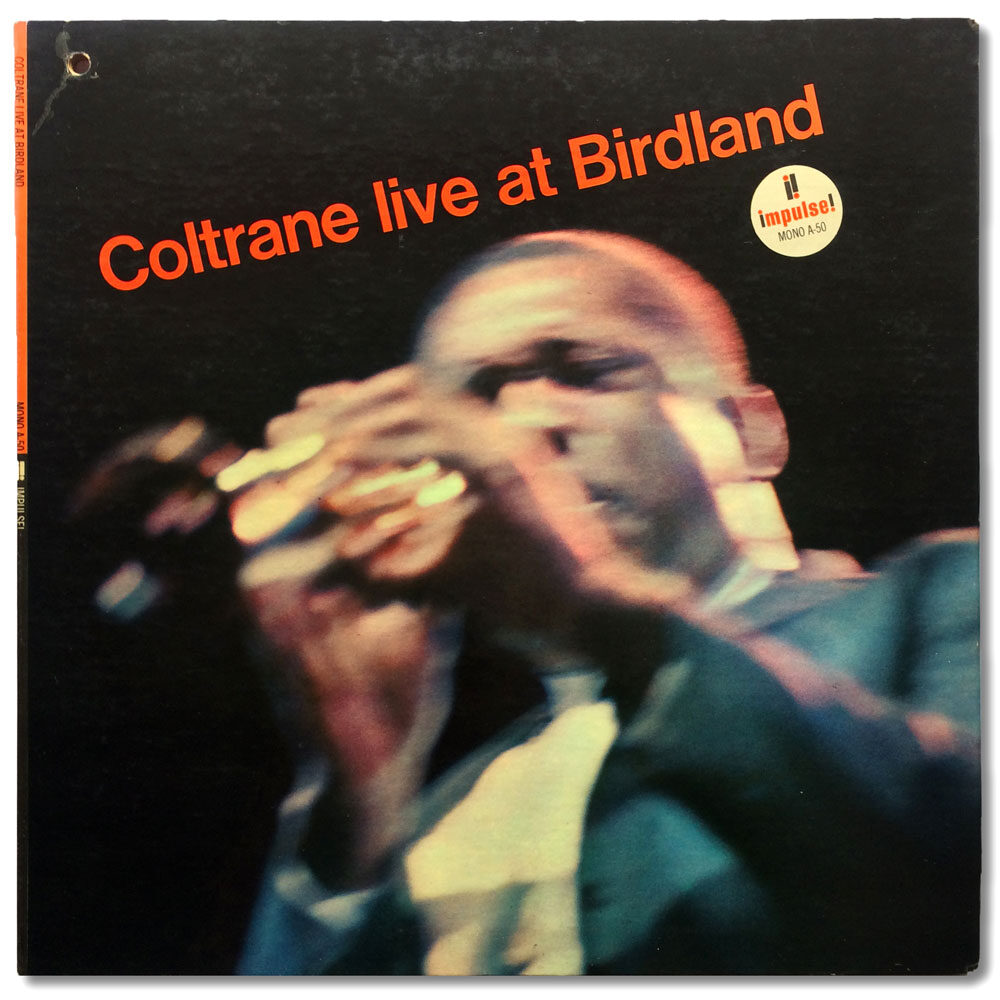
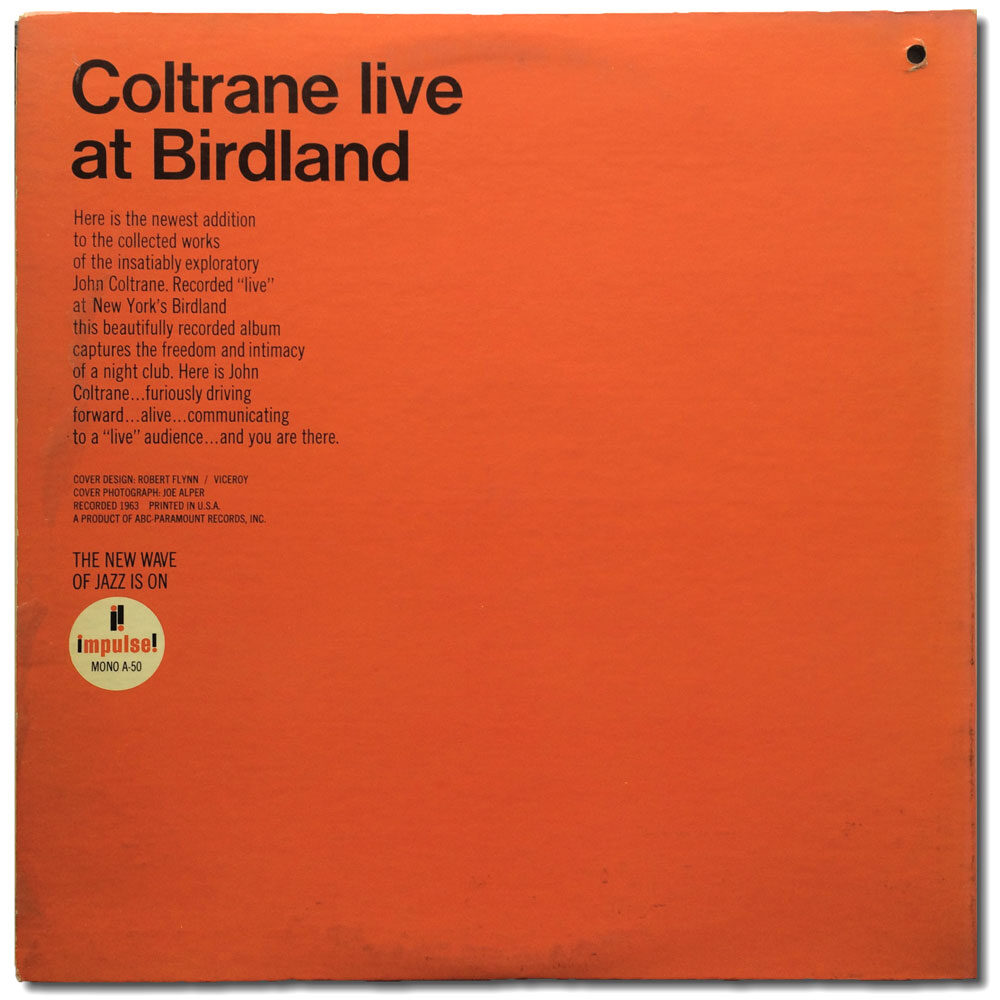
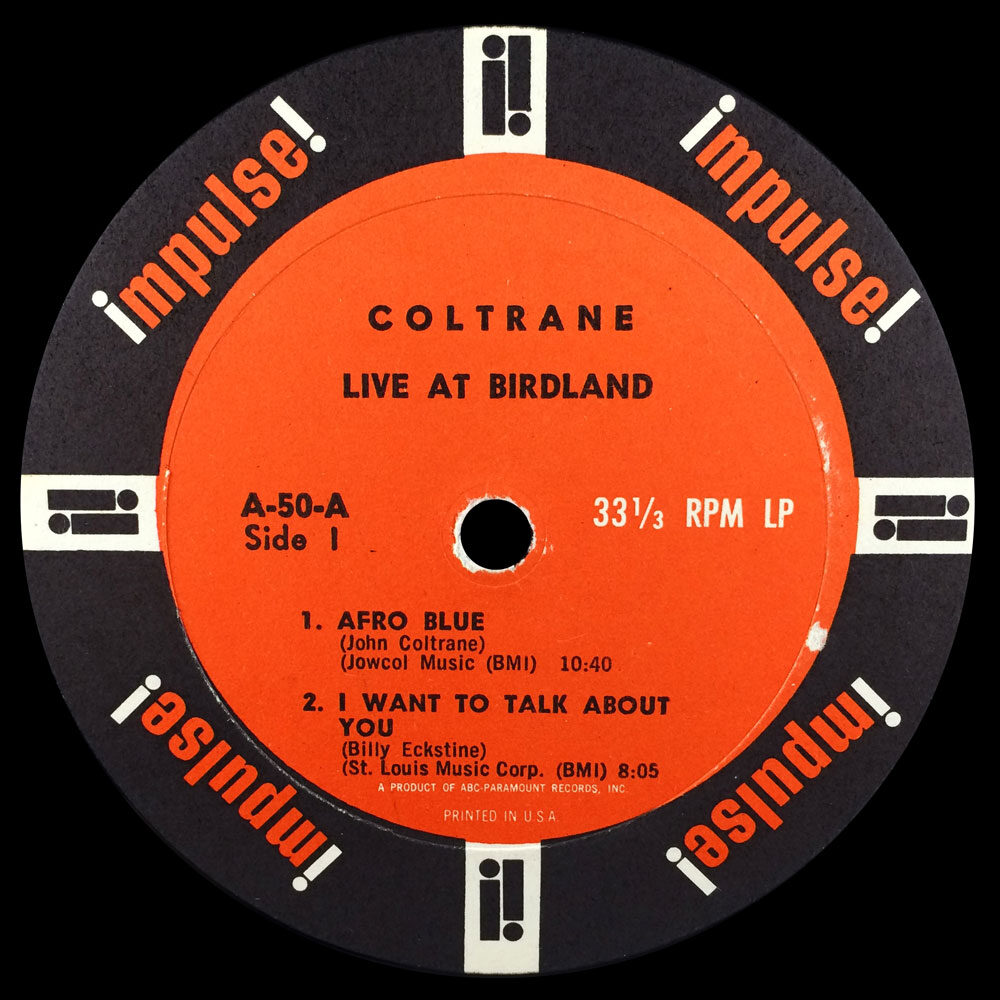
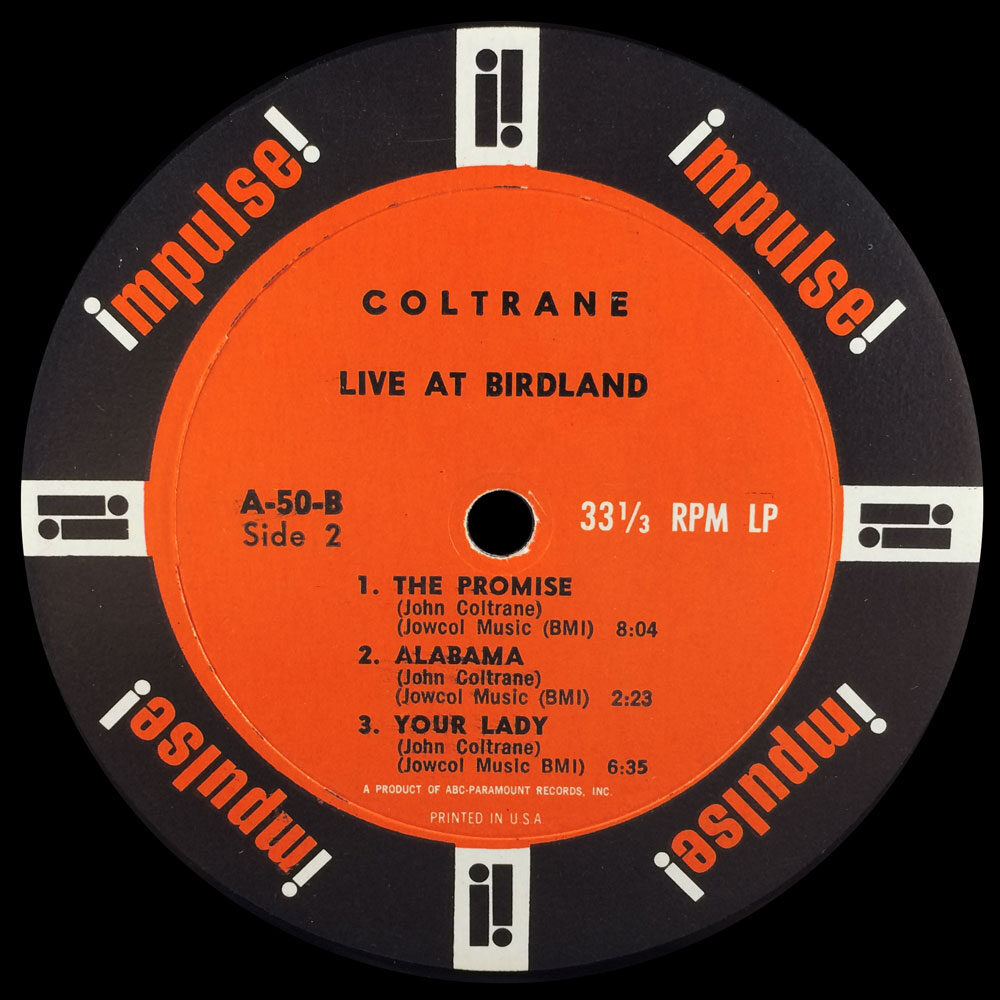
Vinyl Spotlight: John Coltrane, Coltrane Live at Birdland (Impulse 50) Original Mono Pressing

  • Original 1964 mono pressing
  • “ABC-Paramount” on labels
  • “VAN GELDER” in dead wax

Personnel:

  • John Coltrane, tenor and soprano saxophone
  • McCoy Tyner, piano
  • Jimmy Garrison, bass
  • Elvin Jones, drums

All but “Alabama”, “Your Lady” recorded October 8, 1963 at Birdland, New York, New York
“Alabama”, “Your Lady” recorded November 18, 1963 at Van Gelder Studio, Englewood Cliffs, NJ
Originally released April 1964

Generally speaking, I don’t know the Impulse catalog very well, and accordingly I have a harder time keeping track of the ‘first-first pressing’ melee associated with the label. Thus I’m not really sure if this is a ‘first-first pressing’ or just a ‘first pressing’, but it has the Van Gelder stamp of approval and, more importantly, it plays through without the hideous artifacts of groove wear so I’m a happy camper. This copy had a lot of light scuffs when I first looked at it, which is probably what kept the price down, but by the time I got it home and gave it a listen I was happy to find that this was a rare case of a record ‘playing better than it looked’. I am so inspired by the intensity with which John Coltrane played the soprano saxophone during this time period, and “Afro Blue” is a fine example of that passion and vigor.