Tag Archives: Jazz Vinyl

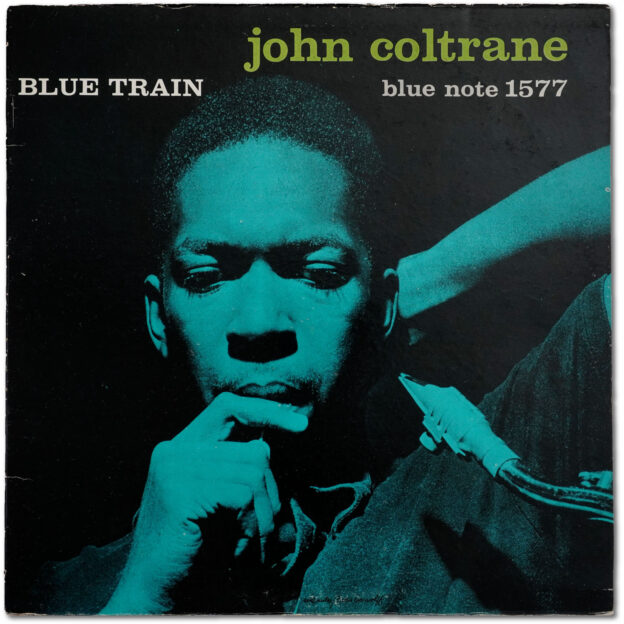
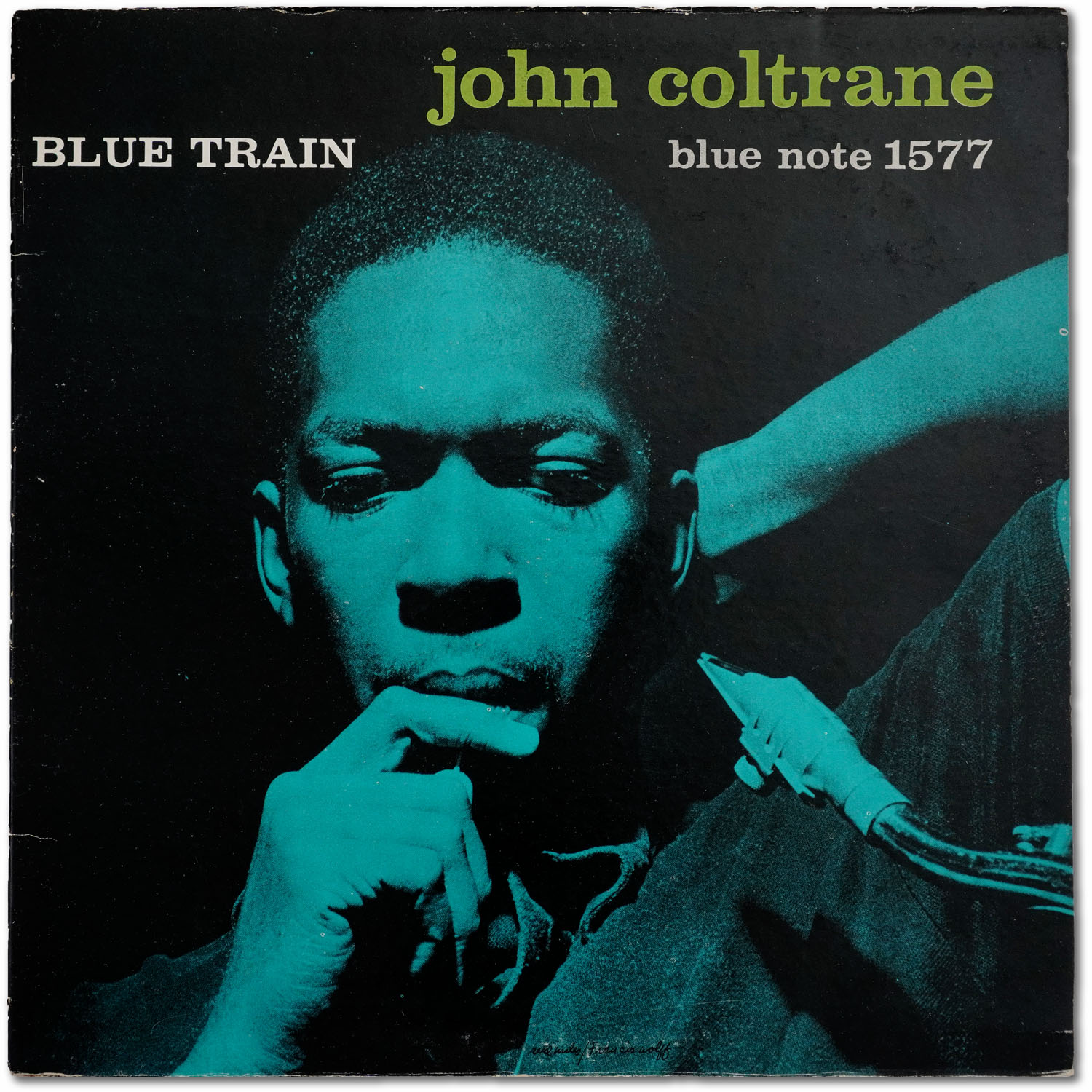
Vinyl Spotlight: John Coltrane, Blue Train (Blue Note 1577) “Earless NY” Mono Pressing

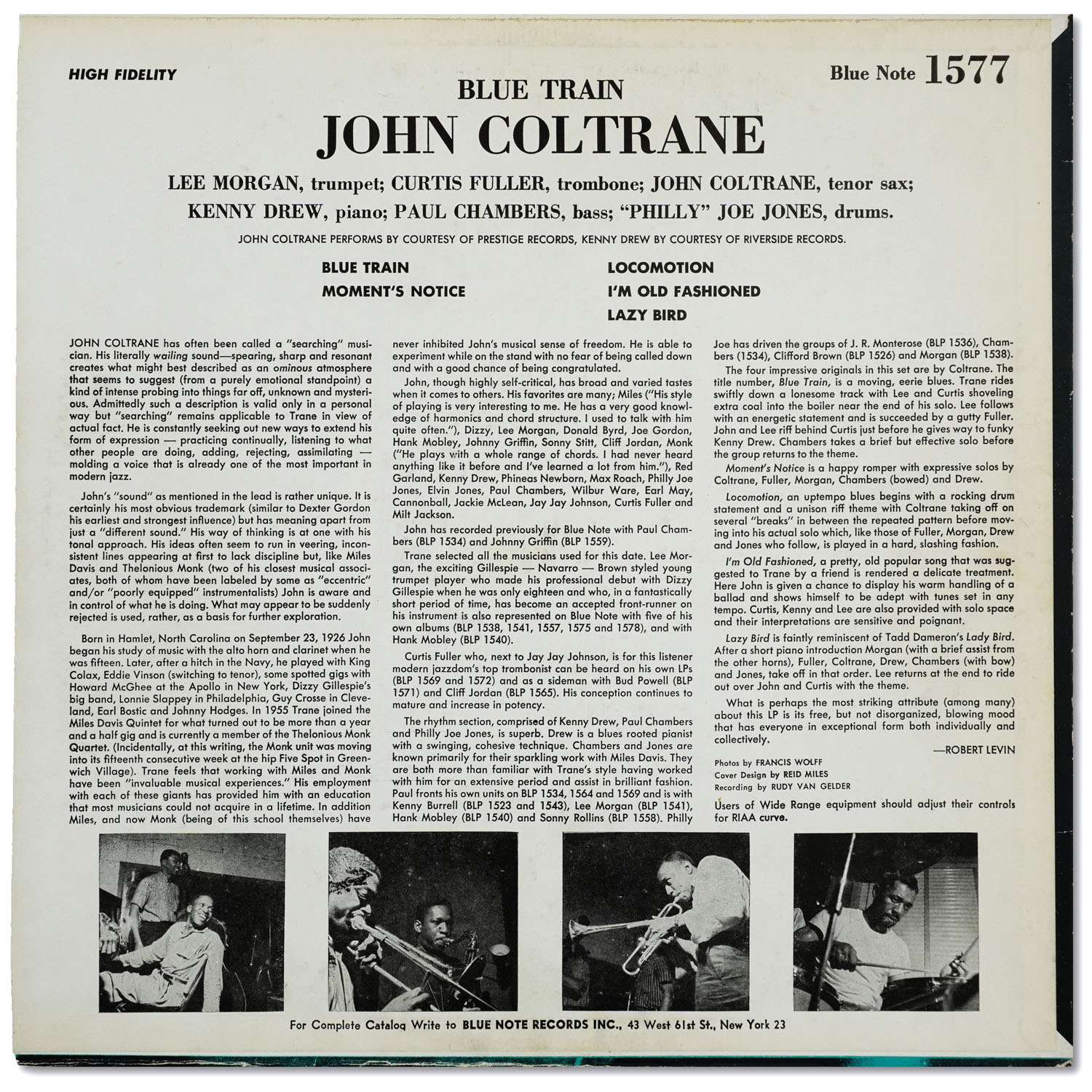
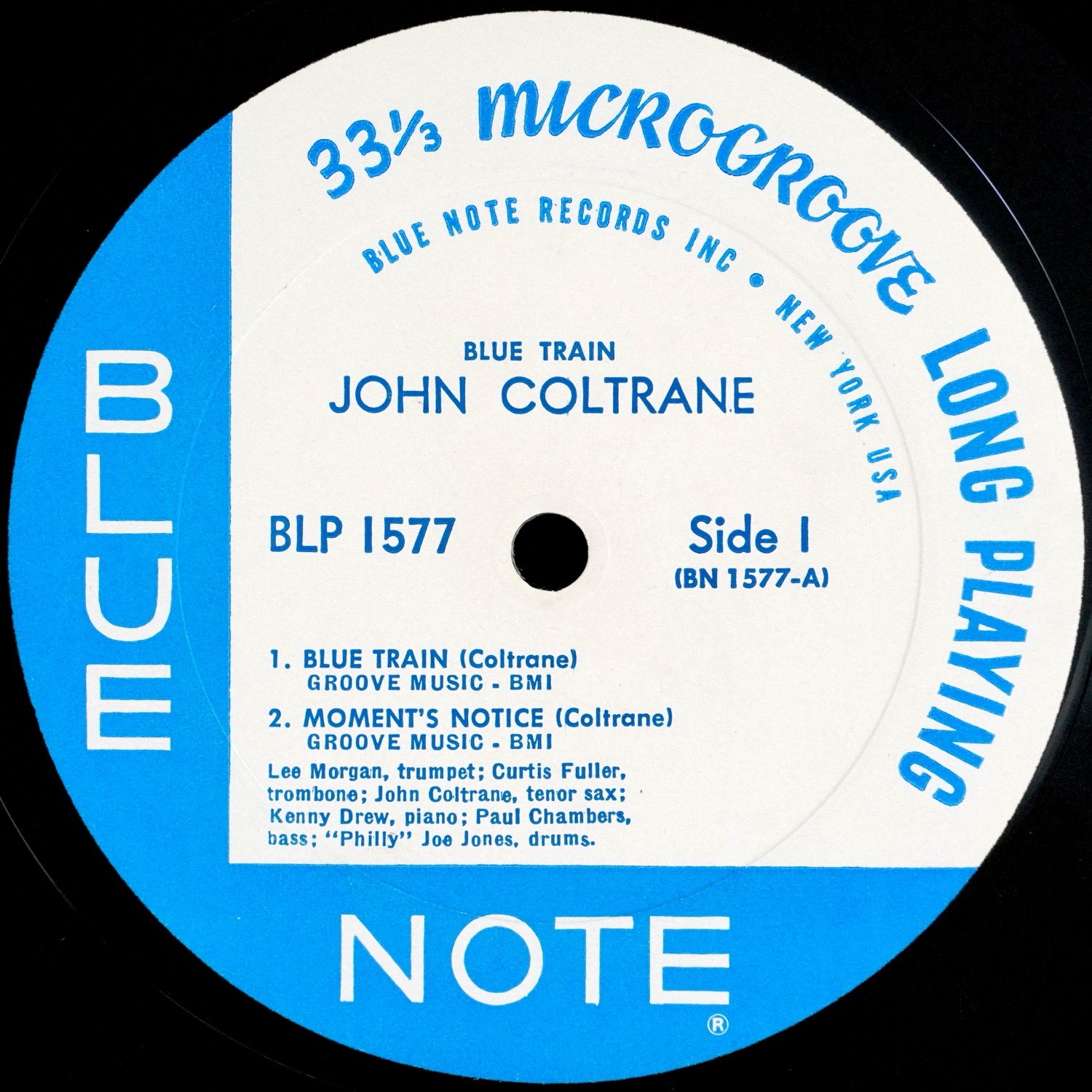
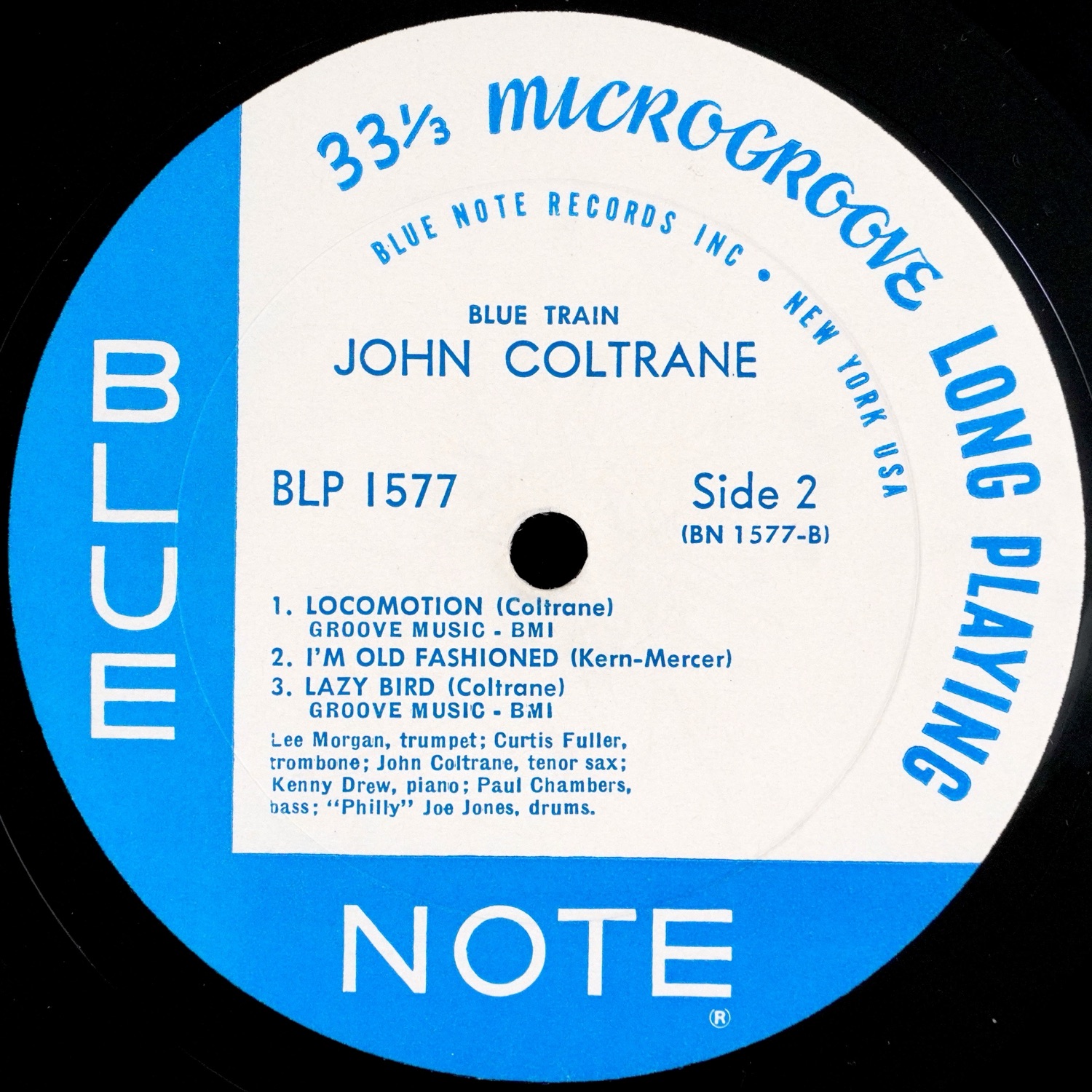
  • “Earless NY” mono pressing ca. 1966
  • “RVG” stamped in dead wax

Personnel

  • Lee Morgan, trumpet
  • John Coltrane, tenor saxophone
  • Curtis Fuller, trombone
  • Kenny Drew, piano
  • Paul Chambers, bass
  • Philly Joe Jones, drums

Recorded September 15, 1957 at Van Gelder Studio, Hackensack, New Jersey
Originally released November 1957

1 Blue Train
2 Moment’s Notice
3 Locomotion
4 I’m Old Fashioned
5 Lazy Bird

For Music Lovers

I’m surprised by how many people recommend this album to jazz novices because I don’t necessarily find it to be an “accessible” listen. Slowly it has become one of my favorite jazz albums but I didn’t like it initially and ignored it for quite some time. I find Coltrane’s solos here challenging, and this next comment may not be something most people can identify with, but I initially found many of the melodies to sound “major” in terms of scale and thus maybe a little old-fashioned (no pun intended) at a time when I was looking for something more edgy and “minor”.

Growing out of my fashionable pessimism phase, I’ve come to appreciate older-sounding jazz numbers. But there’s a sort of hidden darkness looming in between the heads of the songs here. “Moment’s Notice”, an album favorite of mine, is the prime example of this: its happy, soulful theme seems to deceitfully change from major to minor key at the renewal of each chorus.

One by one, I grew to adore every song on this album. “I’m Old Fashioned”, a standard written by songwriting juggernauts Jerome Kern and Johnny Mercer, initially sounded like a cookie-cutter ballad but ultimately won me over. On “Lazy Bird”, trumpeter Lee Morgan’s quiet introductory proclamation of the theme is a welcome break from the sheer power of this all-star sextet. But what hasn’t already been said about the album’s mega-classic title track? The simple 24-bar theme is one of the most famous intros in all of jazz, and Coltrane’s solo has been exhaustively picked apart by scholars. No more than forty seconds after the album’s first notes sound, the leader launches this Molotov cocktail at the listener. It was too intense for me as a jazz newcomer, but over the years I feel I have grown to better understand Coltrane’s music, and today I marvel at the flurry of notes played here. In my view of jazz history this marks the beginning of Coltrane’s revolution: uninspired by what he was hearing at the time, it is the moment when the saxophonist took his instrument and proclaimed to the jazz world, “Enough is enough, it’s time to push this music forward.”
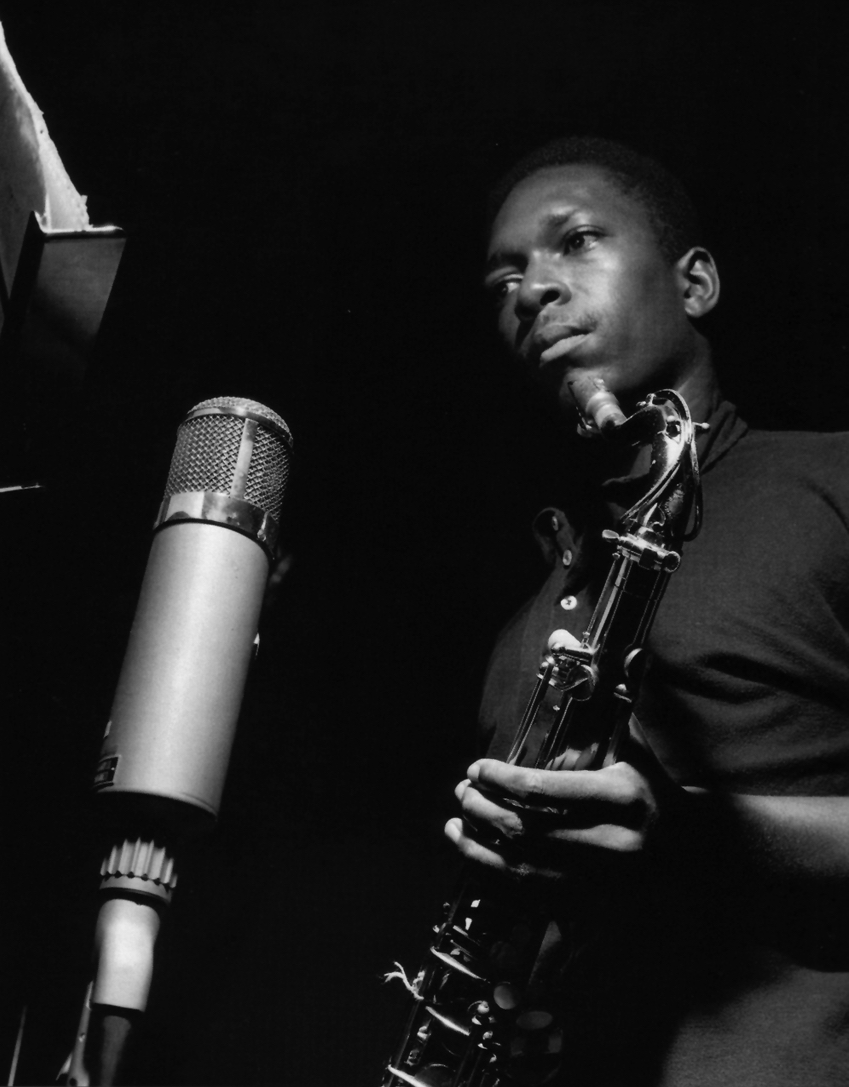
John Coltrane approaching Rudy Van Gelder’s Telefunken U47 microphone

On a side note, two weeks prior to the recording of this album in mid-September 1957, Coltrane was in the studio as a sideman for the recording of Sonny’s Crib (Blue Note 1576). That album’s title track bears a striking resemblance to the minimal, bluesy progression in “Blue Train”. Was Coltrane inspired by Sonny Clark? Had he taken Clark’s idea and ran with it? We may never know if there was a conscious connection between the two songs in Coltrane’s mind (“Sonny’s Crib” was not necessarily written first just because it was recorded first) but I found it worth mentioning.

BLP 1576, Sonny’s Crib

The choice of lineup on Blue Train is interesting. Coltrane was not known to have a regular working relationship with either Kenny Drew or Lee Morgan (he had recorded with each of them once on separate occasions prior to this date), which leaves open the possibility that Drew and Morgan were suggested by Blue Note producer Alfred Lion. This seems more plausible in the case of Morgan, a regular leader with the label. Though the album proved a grand slam for Blue Note in terms of sales, it was ultimately a one-off recording Trane did for them.
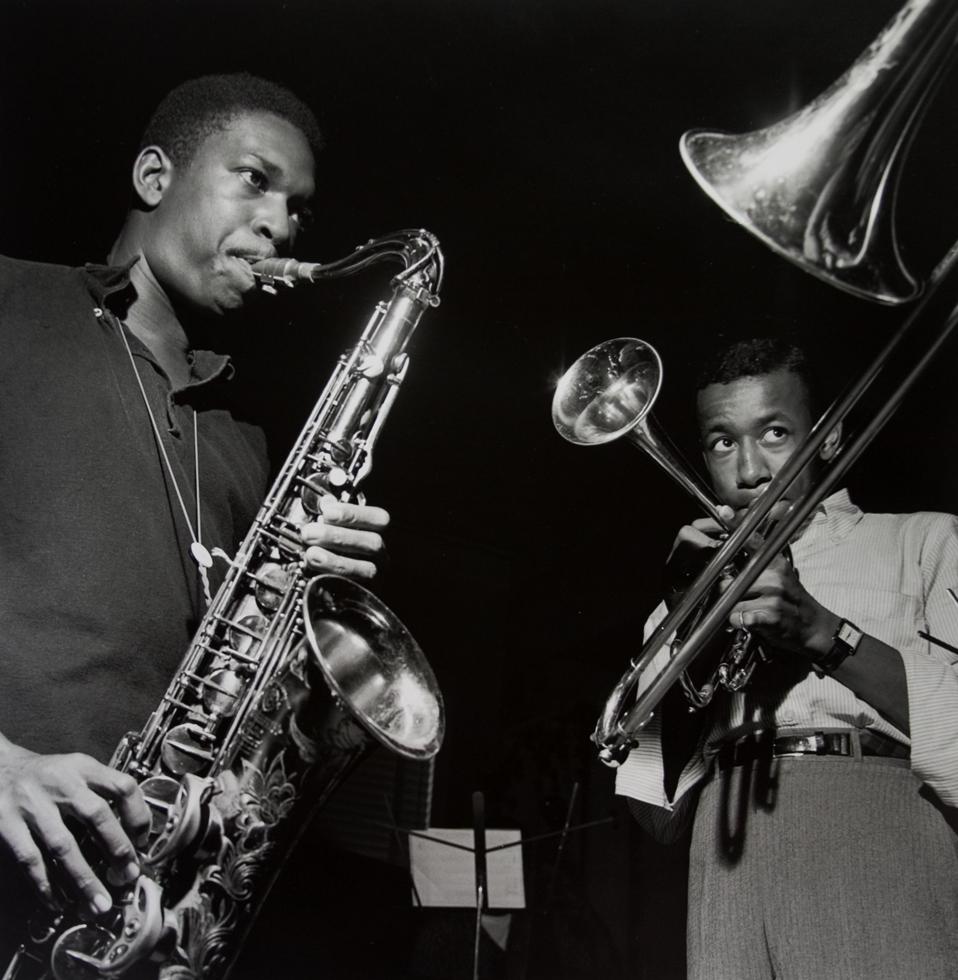
Coltrane, Morgan, and Curtis Fuller (off camera) rehearsing before a take

Critics seem split as to the brilliance of Blue Train. Beyond the title track, I have read reviews suggesting that the album amounts to little more than a run-of-the-mill bop date. The Penguin Guide to Jazz Recordings, while awarding it four stars, also manages to call it “an overvalued record”. I personally find the music jubilant and adventurous. The pairing of Trane with Morgan doesn’t create a seamless fusion to me, but it’s interesting to hear how Morgan responds to being thrown into such a foreign situation.

For Collectors

My experiences with vinyl versions of this album began many years ago with the 2005 Classic Records mono reissue. Though visually near mint, that copy had significant surface noise (a problem I’ve sadly run into again and again with Classic reissues — not all, but most). After ditching that copy, I spent several years getting more familiar with the material by listening to the 2003 stereo RVG Edition CD before I acquired the 2014 Music Matters mono reissue. I’m not nearly as fanatical about Music Matters as most jazz fans, but the fact that they released this as a single 33 R.P.M. disc in mono got my attention. Mastered by Kevin Gray, it is sonically astonishing. Through all this, I’ve always kept my eye on auctions for the rarer “NEW YORK USA” mono reissues of this with the RVG stamp and ear. These pressings sell for much less than copies displaying some form of the “West 63rd NYC” address on the labels, but I was always outbid.

Speaking of pressings, there is a hotly-contested debate over what constitutes a “first pressing” of this album. While fundamentalists will insist that only copies brandishing the “NEW YORK 23” address on one side should be considered first pressings, these copies are so rare that many collectors are left to conclude that “WEST 63RD” copes without the “INC” or registered trademark “R” must have also been part of that initial run. I side with the latter camp, considering all of these copies firsts, which would make this copy a second pressing (notice my quotes around the word “second” in the description above). Some collectors, including the venerable Larry Cohn, even go as far as suspecting that the New York 23 copies are second pressings. Semantics aside, this is an absolutely stunning copy of this classic and one of the cleanest vintage jazz records in my collection.
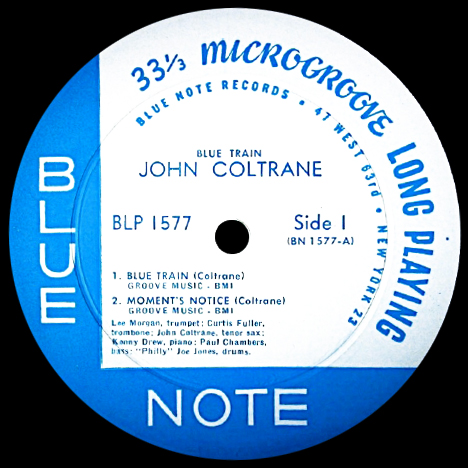
The elusive “NEW YORK 23” label

I’m not usually one to sweat the details when it comes to various runs of album jackets, but through a bit of recent research I have come to realize that there is a small difference between the first and second pressings of this jacket despite the “West 63rd Street” address appearing on both: while second jackets have black printing artifacts on the photo of Curtis Fuller, first jackets do not.

Original (left) and second edition (right) jackets

Though engineer Rudy Van Gelder is famous for his high level of sonic consistency, careful inspection will expose a multitude of different approaches both he and producer Alfred Lion took to the recording and mixing processes. Blue Train is an ideal example of this. The dead-black background depicted on the cover compliments the “nighttime” vibe of this recording exceedingly well. This is partly due to the fact that the album was laid to tape not long after Van Gelder acquired his new EMT plate reverb unit. This replaced his old (and frankly, cheap-sounding) “spring” reverb unit, which to the dismay of many jazz fans plagues numerous earlier Hackensack recordings by saturating the soundstage with choppy echoes of horns and drums. And while stereo versions of Blue Train present a rather disjointed soundstage (instruments on the far left and right with the reverb alone in the center), the unified mono presentation of the music here coupled with the roomy decay of the mono EMT plate succeeds at creating a spacious, dark soundstage that’s as far as one might imagine from the natural characteristics of a makeshift living room studio. And while the true-to-life sonic character of that room has appeared on countless jazz recordings and been celebrated for decades, this is a shining example of a time when Van Gelder and Lion decided that the music and temperaments of the artists required a fresh approach.
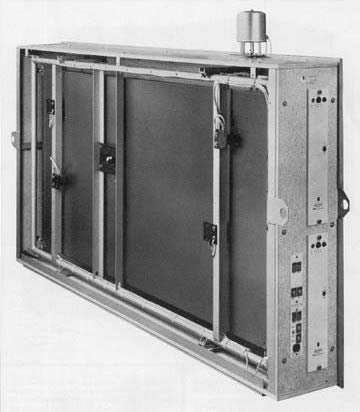
EMT reverb plate

It really doesn’t get any better than this when it comes to a vintage jazz listening experience: a clean copy of a classic album with a star-studded, exceptionally recorded cast being presented in monophonic fidelity as originally intended. It’s a time machine back to that cool autumn day in 1957 when jazz giants roamed Rudy Van Gelder’s New Jersey living room, expressing themselves the best way they knew how. This is an album I will cherish when I’m old and grey, and it is sure to get lots and lots of plays from now until then.
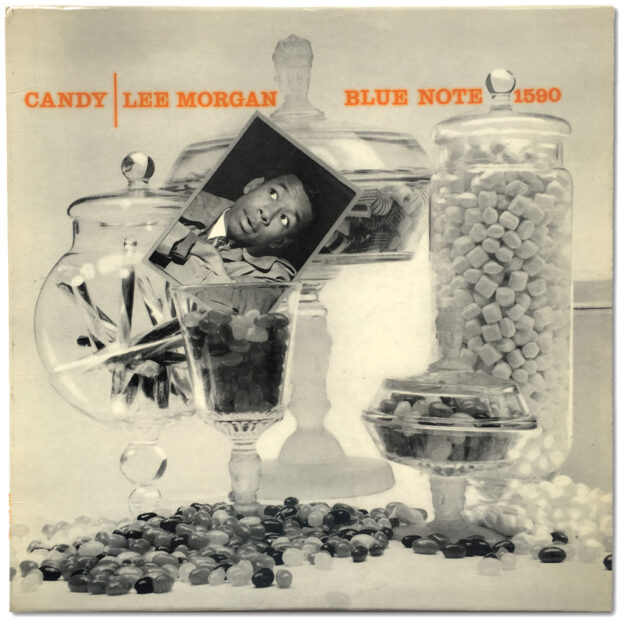
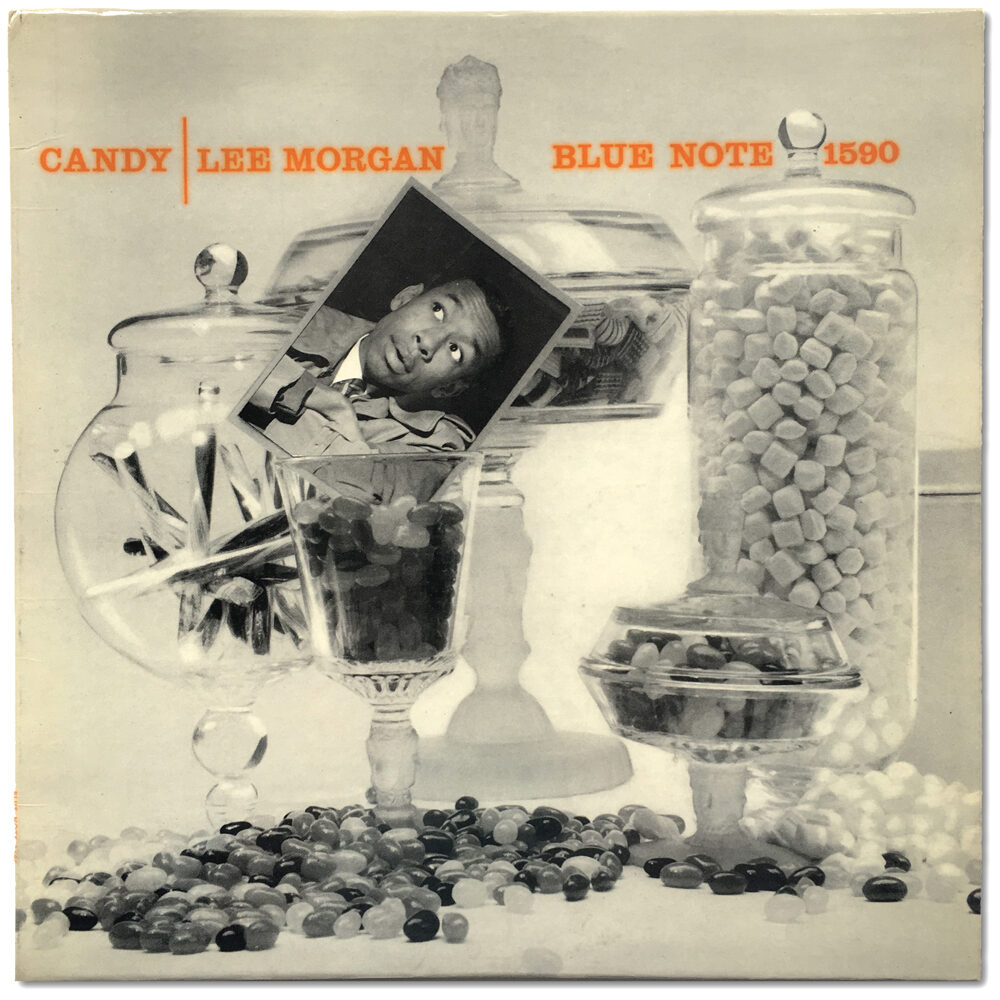
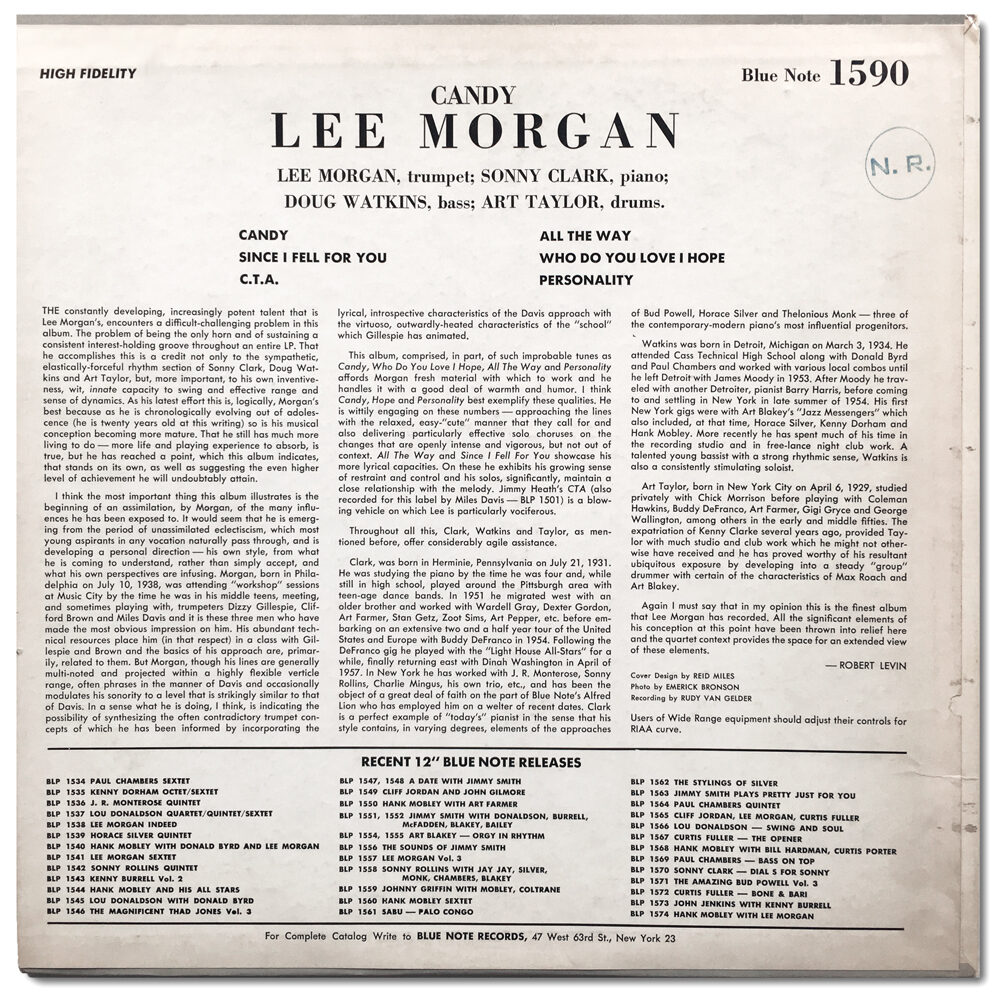
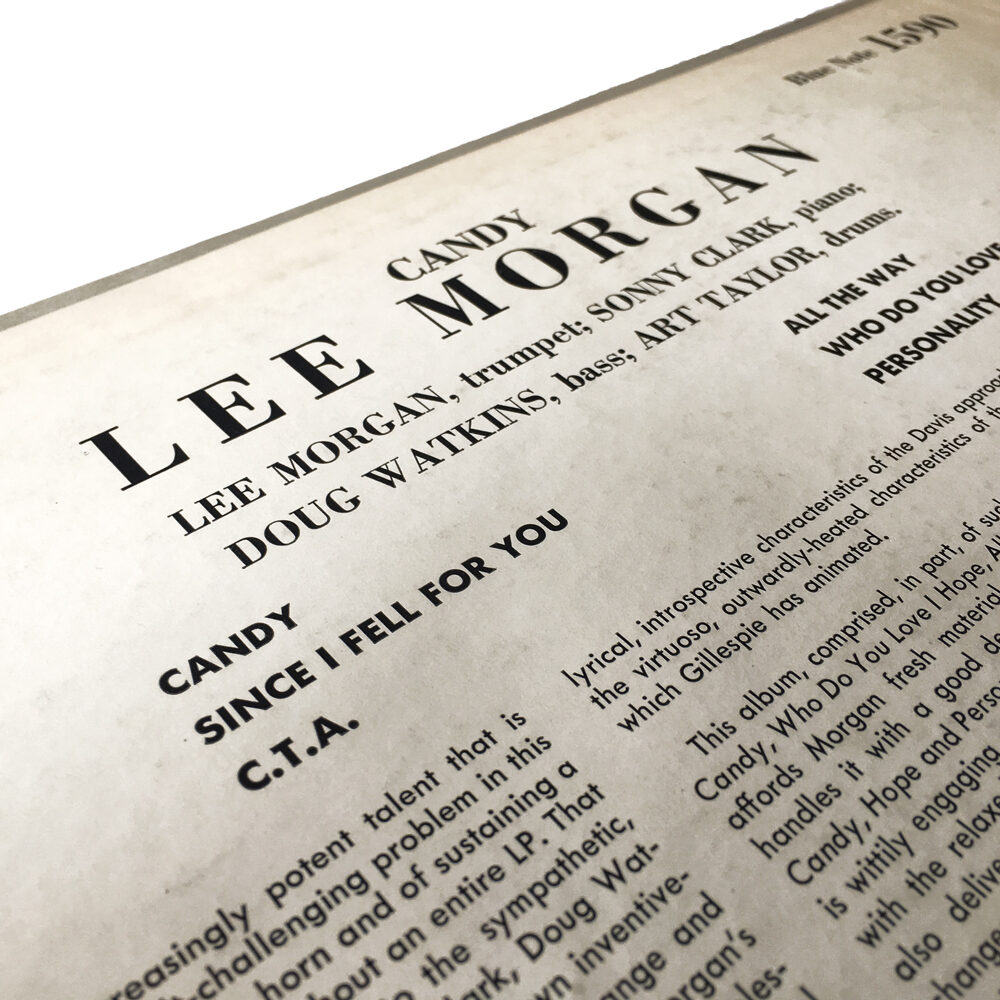
Vinyl Spotlight: Lee Morgan, Candy (Blue Note 1590) Original Pressing

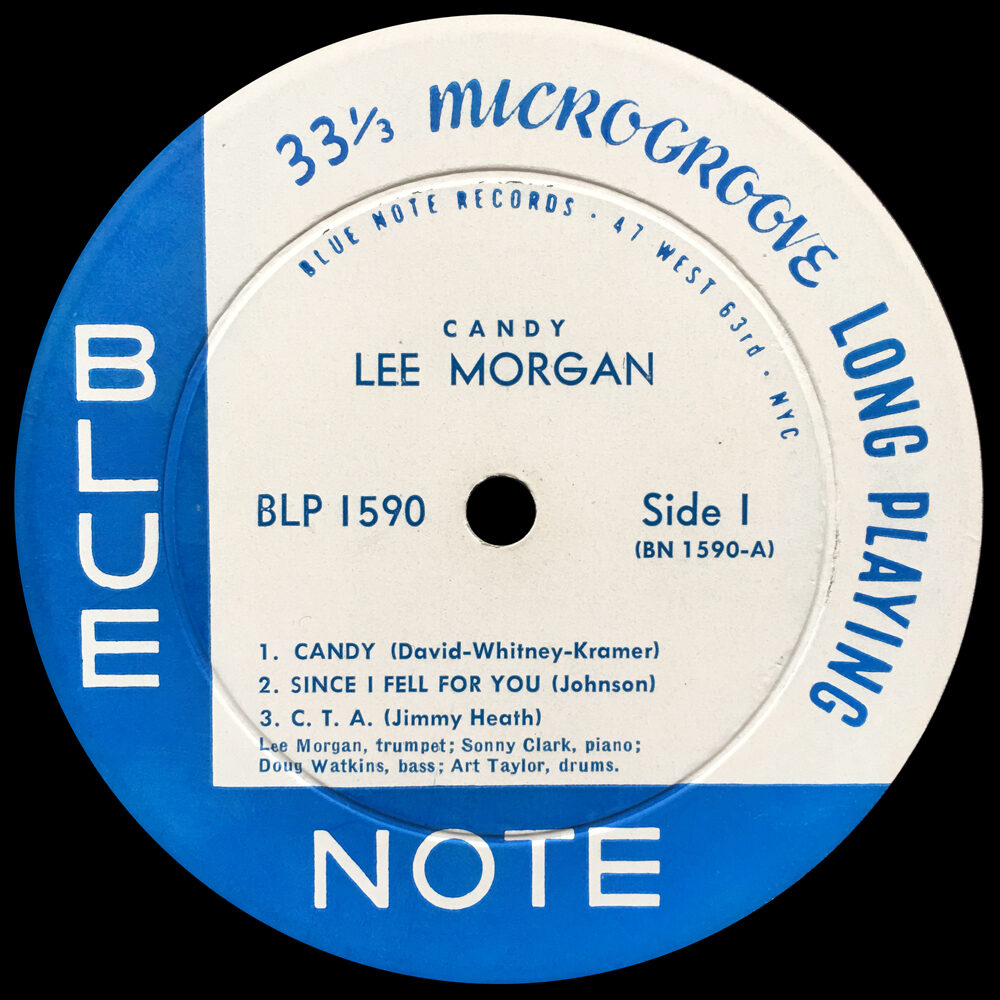
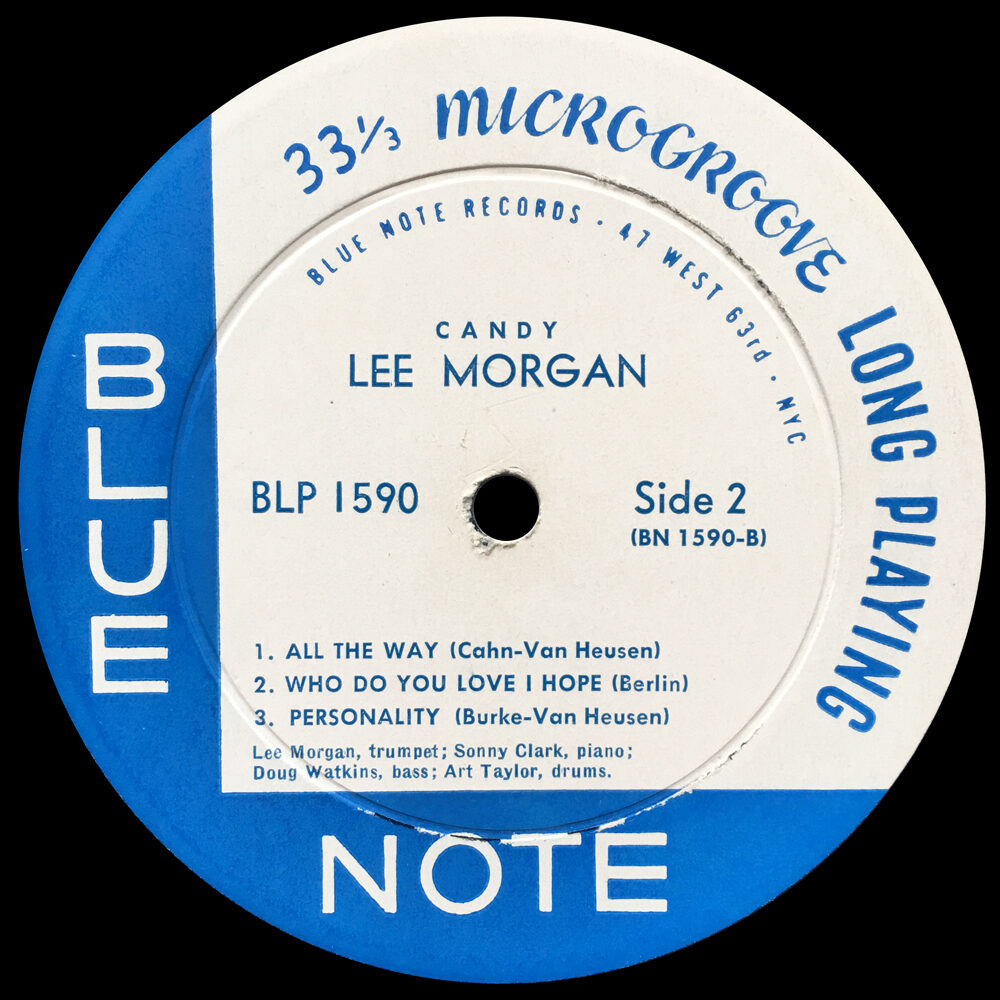
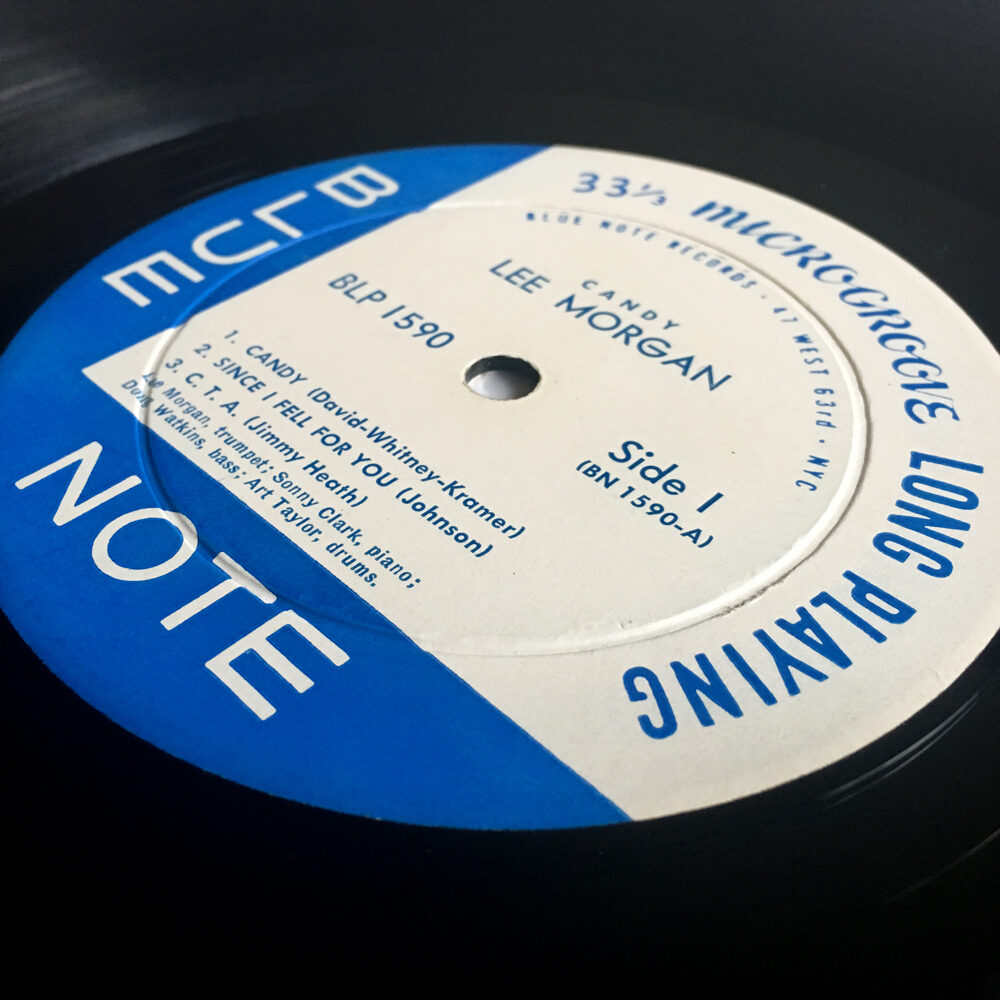
  • Original 1958 mono pressing
  • West 63rd address on both labels
  • Deep groove on both sides
  • Plastylite “P” etched and “RVG” stamped in dead wax

Personnel:

  • Lee Morgan, trumpet
  • Sonny Clark, piano
  • Doug Watkins, bass
  • Art Taylor, drums

Recorded November 18, 1957 and February 2, 1958 at Van Gelder Studio, Hackensack, New Jersey
Originally released September 1958

It appears that along with a recent change in my philosophy of collecting has also come a change in my luck. I recently decided to go all in on creating the most authentic vintage mono jazz LP listening experience I could. This meant a new turntable (a gorgeous Garrard 301 which I have already secured), a separate component tonearm fitted to a plinth, and the Ortofon CG 25 mono cartridge. But before I could gather all the components for this new rig, an opportunity presented itself to me that I would have been a fool to ignore.

As a result of my change in philosophy, I have worked to put myself in a position where original pressings of my favorite jazz albums are more within my reach financially. Not too long after making this decision, this copy of Lee Morgan’s Candy popped up in a friend’s Instagram feed. “That seems like a very fair price for that Morgan,” was my first text to my friend, sent without any serious intent to buy. But 24 hours later the record was still on my mind, so I worked on my financials and decided I could make it work — if the record checked out — and two days later I made the 90-minute trip upstate on the Metro North railroad to look at the record first-hand and give it a listen.

Once I had it in my hands, the jacket was indeed a strong VG+ with no splits, and the labels were clean with the assumed deep grooves, “47 West 63rd NYC” address, and lack of registered trademark “R”. I listened to the record in its entirety before making a decision. Overall I would have play graded it VG+ with light surface noise that could be heard more during some of the quieter passages, but no loud or repetitive clicks and no distortion from wear. The record came from the original owner, an Upper West Side native who, according to my friend, remembered it as the first record he ever bought.

After making payment, I got on the train home with reserved excitement. I was honestly banking on the noise quieting down after running it through my Spin Clean (one of the greatest dollar-to-value purchases a collector can make, in my humble opinion). After one cleaning the surface noise settled down and I was quite pleased. But after a few plays I wondered if the simple act of playing the LP may have loosened some of the dirt, so why not run it through the machine one more time and see what happens? And I was happy to find that the surface noise had virtually disappeared in many places.

As for holy grails, I’d say Quiet Kenny, Jutta Hipp with Zoot Sims, and Overseas are near the top of my wish list, but Candy is really my number one, mainly because I find the entire program to be so great. When I first got into jazz, the atypical arrangement of trumpet quartet stood out to me. I love how playful sounding the music is, and the ballads are some of my favorites of all time.

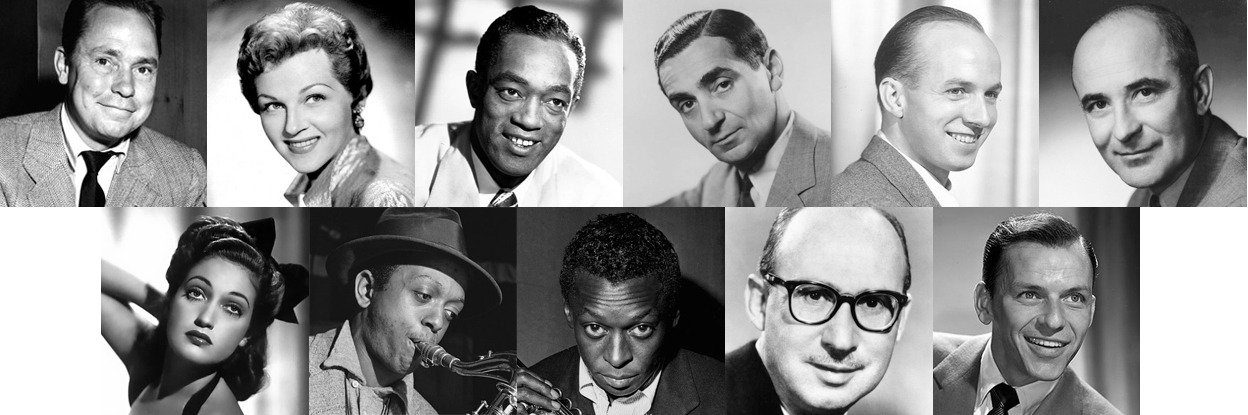
I think Candy is marginalized by jazz critics for its lack of original compositions, but I could care less when the songs are played with such beauty and brilliant execution. It turns out that most of the songs have their origins in the mid-1940s when Morgan was between the ripe ages of seven and eight. The title track was first recorded by Johnny Mercer and Jo Stafford for Capitol Records and reached number 2 on Billboard’s Best Seller chart in 1945. That same year, “Since I Fell for You” was written and recorded by Buddy Johnson for Decca Records. “Who Do You Love I Hope” is a lesser known song written by Irving Berlin for Annie Get Your Gun in 1946, and “Personality”, penned by Jimmy Van Heusen and Johnny Burke for the play Road to Utopia, also premiered in 1946 with a film starring Dorothy Lamour to follow in 1950.

The remaining two songs completing the tracklist would have been more readily recognized by their respective audiences in 1958. “C.T.A”, the only cut on the album with modern jazz origins, was written by saxophonist Jimmy Heath and first recorded by Miles Davis with Heath on sax for Blue Note in 1953 (according to Miles, “C.T.A.” were the initials of Heath’s then-girlfriend Connie Theresa Ann). “All the Way”, the 1957 Academy Award winner for Best Original Song, was written by Van Heusen and Sammy Cahn for The Joker Is Wild, a film about the life of comedian/singer Joe E. Lewis starring Frank Sinatra. Scroll down to hear a Spotify playlist featuring the original recordings of all of these great songs.

Top: Johnny Mercer, Jo Stafford, Buddy Johnson, Irving Berlin, Jimmy Van Heusen, Johnny Burke
Bottom: Dorothy Lamour, Jimmy Heath, Miles Davis, Sammy Cahn, Frank Sinatra

Candy immortalizes the legend of Rudy Van Gelder’s Hackensack home studio, with the album’s sparse arrangement leaving plenty of room for the sound of the engineer’s living room to make its mark on the recording. Sonny Clark’s piano playing takes center stage here and can be heard with startling clarity, and Art Taylor’s drum kit embodies the gorgeous drum sound Van Gelder would regularly get at Hackensack in the 1950s: a slightly roomy, unified sound with soft cymbals and lifelike accuracy in the bass, snare, and tom toms (for this session, perhaps a little too accurate at times: most collectors are aware of Taylor’s infamous squeaky hi-hat pedal during Clark’s leading solo on the title track).

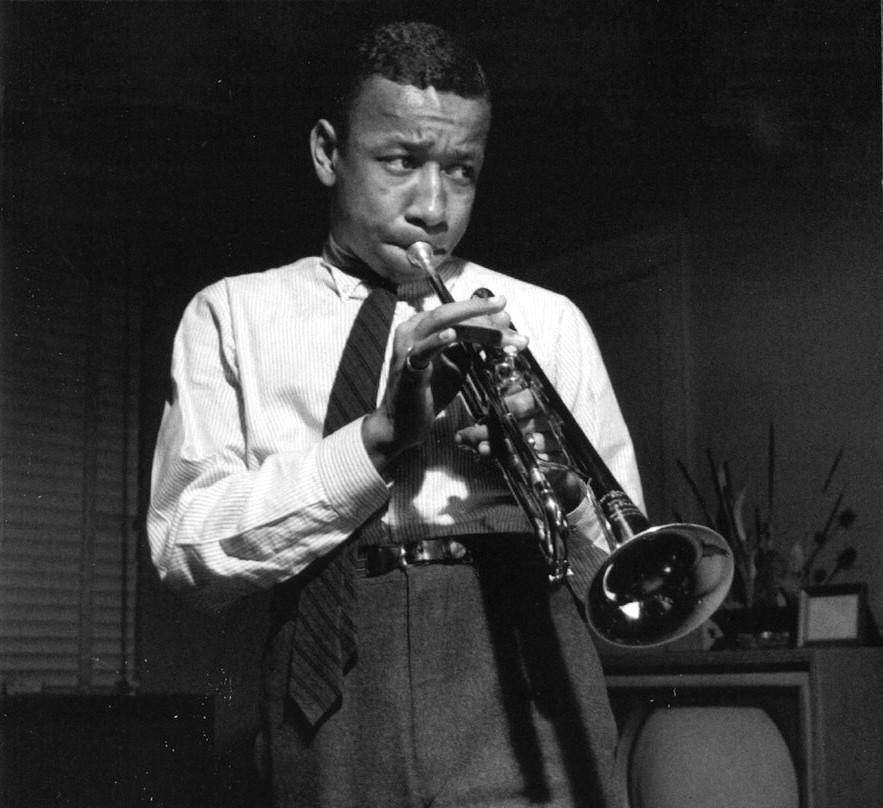
Morgan dressed to impress while recording Candy in February 1958 at Hackensack

The mono presentation of the music, while not exclusively found on the original LP, is less than common. In stereo the music sounds as full as primitive stereo can with Lee’s regular presence on the far left of the spread, but the sparse arrangement here never leaves me feeling that the mono presentation of the band is “crammed into the center image”, as critics of the format often object. What’s more, there does appear to be some tape degradation on my stereo 1987 Capitol/Manhattan CD during “Who Do You Love I Hope”, though this is a nonstarter on all mono issues of the album. Apparently Music Matters did find some sort of a two-track “safety tape” of Candy that was in better condition than the old master, and as a result decided to release the album in stereo for their 33 1/3 R.P.M. series after releasing it in mono for their original 45 R.P.M. campaign.

Other interesting variations in the mono and stereo releases of this album include different piano lines played by Sonny Clark for the intro of “All the Way”. The intro of a different take must have been preferred by the team and thus spliced into the full-track master reel by Rudy Van Gelder. Why the two-track reel did not receive similar treatment is testament to the fact that Candy was only released in mono originally, with stereo being a mere afterthought for Blue Note producer Alfred Lion in early 1958. Additionally, the 1987 stereo CD boasts a reading of “All at Once You Love Her” that is noticeably absent from the original tracklist, which I have to believe was a decision made solely as a consequence of the temporal limitations of the LP format.

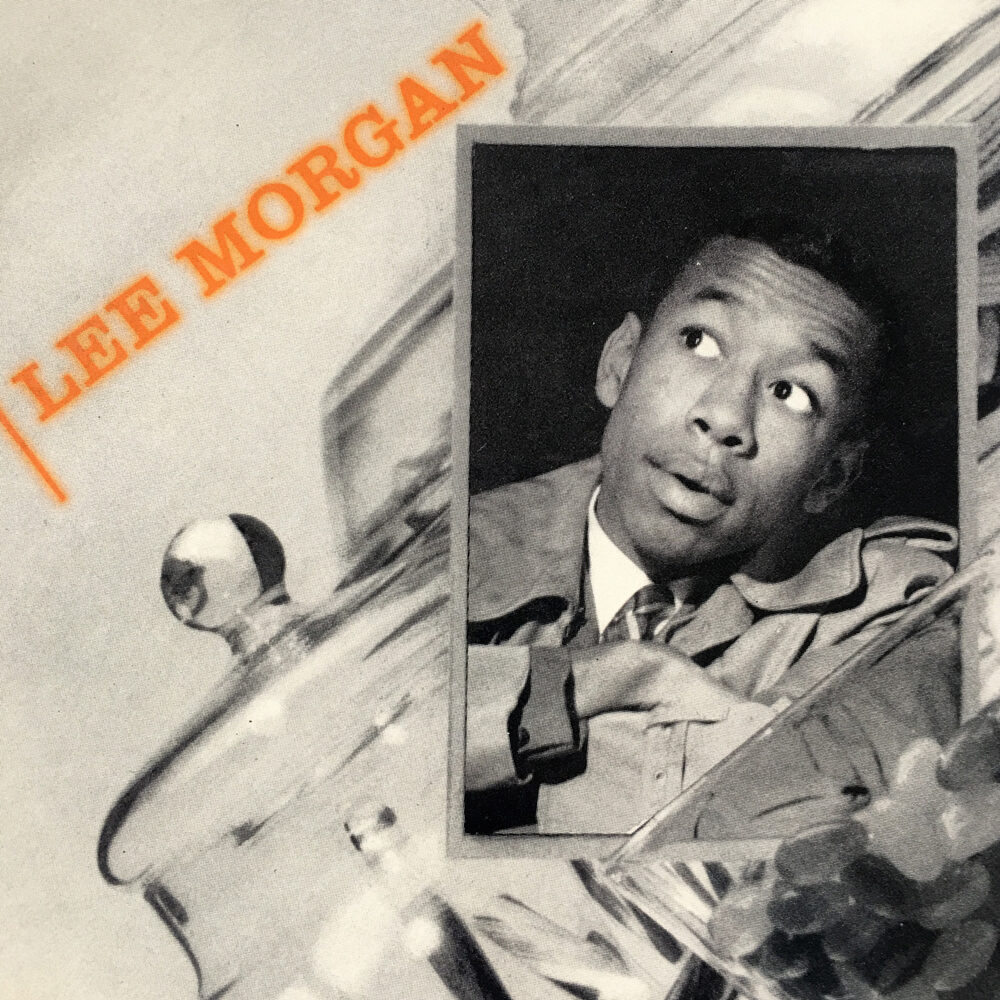
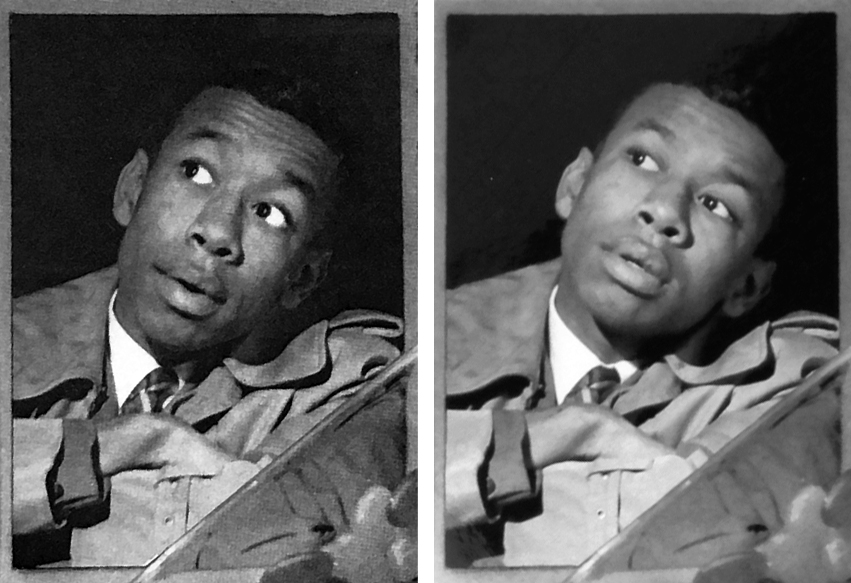
Finally, I admit that I understand when collectors express their distaste for this album cover, but I can’t help but love it. As Lee mischievously glances upward at his name hovering above, the young trumpeter’s boyish innocence conveys a sense of awe toward his newfound fame (side note: though it appears to be a shot from the same sequence of photos as the original, Music Matters used a slightly different photo of Morgan for their reissues). Not being sure why Reid Miles opted to neutralize the potentially explosive rainbow of colored candy pieces depicted here with a black-and-white overlay — perhaps he felt it would be too much of a departure from Blue Note’s two-tone theme — it is a juxtaposition that nonetheless succeeds, with the help of Morgan’s presence, at communicating the playful nature of the musical themes within.

Photos used for the original release (left) and Music Matters reissue (right) of Candy

When I first started collecting, I gawked at the prices original pressings of this album would fetch, and I would have never guessed I’d be in possession of a copy so early on in my collecting years. So the collector saying goes, music comes first. I have always cherished the gorgeous music presented here, but I can’t deny that listening to an original mono pressing has caused my ears to perk up and listen more intently, specifically to the charming solos of all the instrumentalists. I couldn’t be more satisfied with this acquisition, and this copy of Candy is now, obviously and without question, the crown jewel of my collection.


Spotify Playlist: Songs That Inspired Candy

Note: If you are not logged in to Spotify on your web browser, clicking the “play” icon above will only play 30-second clips of the songs. Click “Play on Spotify” or the Spotify logo to launch the app on your computer. Click here to open this playlist in your web browser.

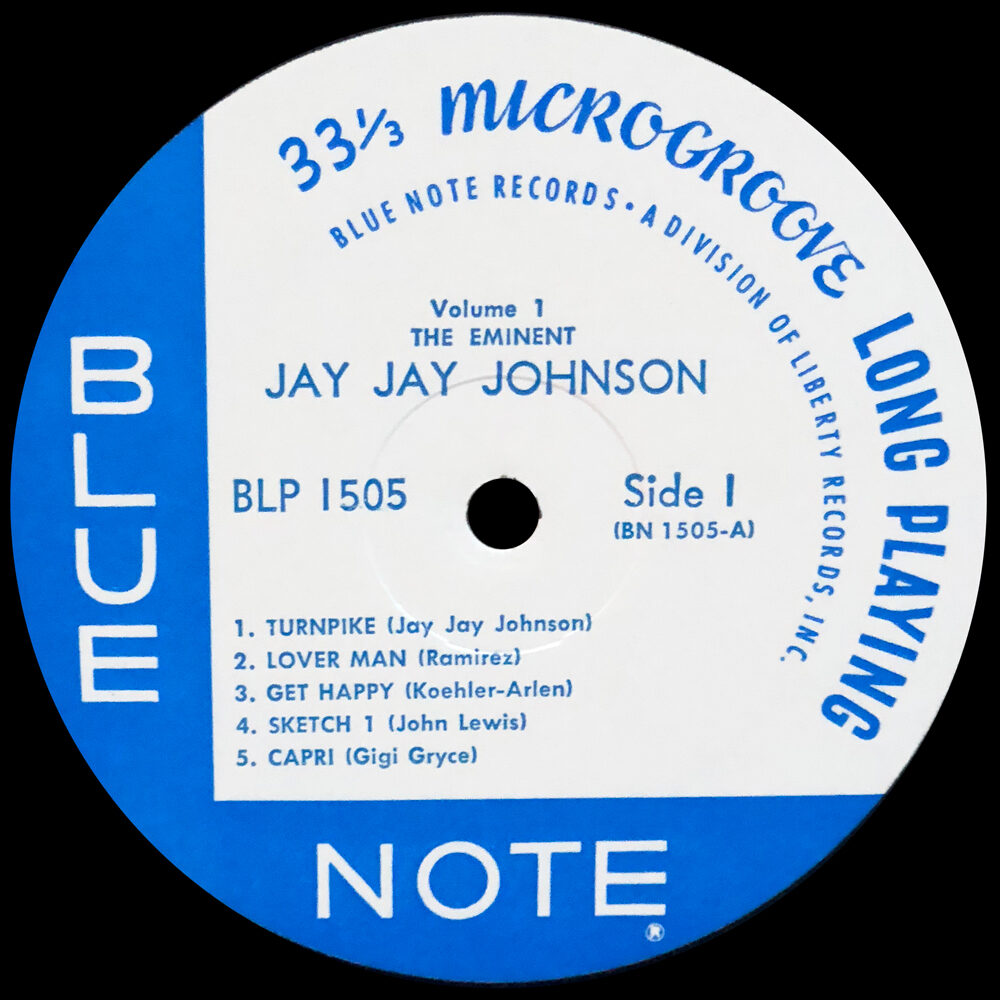
Vinyl Spotlight: The Eminent Jay Jay Johnson, Volume 1 (Blue Note 1505) Liberty Mono Pressing

  • Liberty mono pressing circa 1966-1970
  • RVG etched in dead wax

Personnel:

Side 1:

  • Clifford Brown, trumpet
  • J.J. Johnson, trombone
  • Jimmy Heath, tenor & baritone saxophone
  • John Lewis, piano
  • Percy Heath, bass
  • Kenny Clarke, drums

Side 2:

  • Jay Jay Johnson, trombone
  • Wynton Kelly, piano
  • Charles Mingus, bass
  • Kenny Clarke, drums
  • Sabu Martinez, congas

Side 1 recorded June 22, 1953 at WOR Studios, New York City
Side 2 recorded September 24, 1954 at Van Gelder Studio, Hackensack, New Jersey
Originally released in 10″ format (BLP 5028/5057) in 1953/1954 (BLP 1505 released January 1956)

Selection: “Old Devil Moon” (Lane-Harburg)

Note: This is a guest post by Charles Strong.

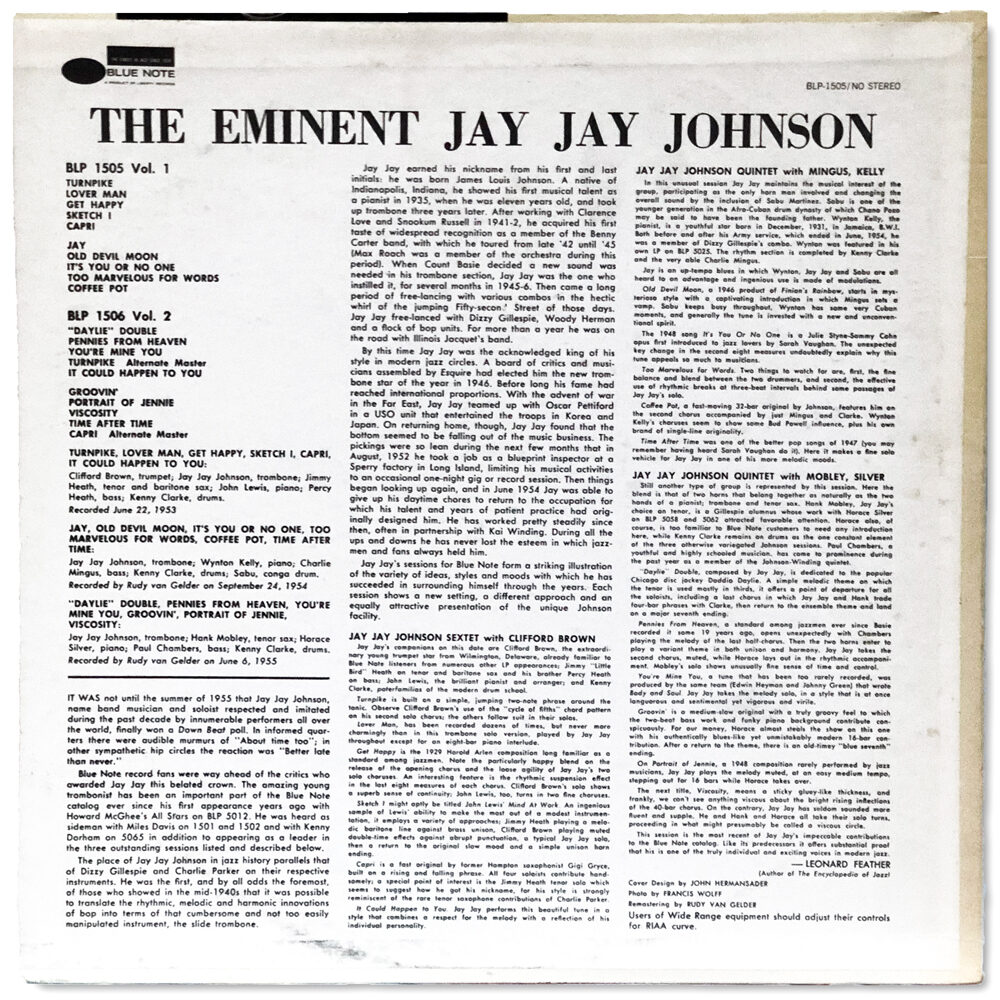
As with many of these compilations of earlier Blue Note material, there are several different configurations of musicians on each track of this album. But, unlike many of those compilations of 10” and 78 RPM material, this collection of sides contains some of the finest musicians in early bebop. Led by arguably the greatest trombonist in modern jazz, J.J. Johnson, the lineups play fast and furious on the first side with the talismanic Clifford Brown trading very quick riffs with Johnson and Jimmy Heath on the opening track, “Turnpike”. If the song was named after fast traffic on a New Jersey toll road, it is very appropriate. The three horns pound out a hard-driving, repeating riff to open the song. Per usual, Clifford Brown and Jimmy Heath continue the furious pace as they often do on most of the recordings featuring them at the time.

But what is most impressive about fast-paced bop numbers like “Turnpike” that feature a trombonist or tubist is each player’s ability to keep pace with the other soloists. During a short period of time in junior high school, I chose trombone as my first instrument. In those six months, the only thing I learned on the trombone was that it was extremely difficult to play anything fast. My young muscles struggled to play even quarter notes fluidly. I simply could not move the slide into the different positions fast enough to be in key. Having to do that all while breathing in sync with finger motions is very difficult. Knowing what it’s like to move that slide into the perfect position and then hearing J.J. Johnson fly through a solo, playing notes in rapid fire succession with the ease of a trumpeter or saxophonist impresses me every time I play this LP.

On the next song, the same band plays the standard “Lover Man”. Like many standards, it is a classic that has seen very creative interpretation by several musicians. But what sets this reading apart is the bottom end sound of Johnson’s trombone. The other trombonist that I (and frankly, most other collectors) revere most is Curtis Fuller. For me, Fuller always has a somber tone to his trombone sound even in songs such as the classic “Blue Train”, which is a very uptempo song. But Johnson’s tone, though low like Fuller’s, has a very swinging yet casual kind of sound. It seems to dare the audience to sway but not quite dance to the music. Also, Johnson seemed to embrace the wide use of trombones in the new and exciting latin salsa music that was emerging from New York at the time; his music can sometimes have a latin tinge that adds a unique sound to the typical bebop track.

The latin influence is most present on the song that I most enjoy on this LP. Johnson turns the Broadway standard “Old Devil Moon” into a cool, relaxing latin jam. Johnson plays his trombone with a kind of warble, like a guitarist with a wah-wah pedal for a special effect. As he plays the familiar riff, time is kept by one of the most influential drummer of the early days of bebop, Kenny Clarke. As worthy as he is of the praise he receives, for me the most exciting percussionist of the whole compilation is the conguero, Sabu Martinez. I’ve always been a fan of the conga on classic jazz sessions, whether it’s Ray Barretto on such influential recordings as Blues Walk, Manteca, and Midnight Blue, or Martinez, who is very lively on this LP. It is a rare treat to hear Sabu (who had a short life and career due to drug abuse), and he is the perfect fit to a latinized song such as this one.

Strangely enough, Charles Mingus, the biggest name on the session and one of the greatest composers, bassists, and personalities in the history of music, fails to make any kind of impression on me here. Mingus always seemed, to me, to enjoy playing and writing his own material most. Perhaps he felt restrained by playing music composed by others, and in this case maybe he had grown tired of exploring these standards. It is also documented that Mingus did not like the way that Blue Note’s house engineer, Rudy Van Gelder, recorded his sound. I notice the bass of Percy Heath far more on the record than I do Mingus.

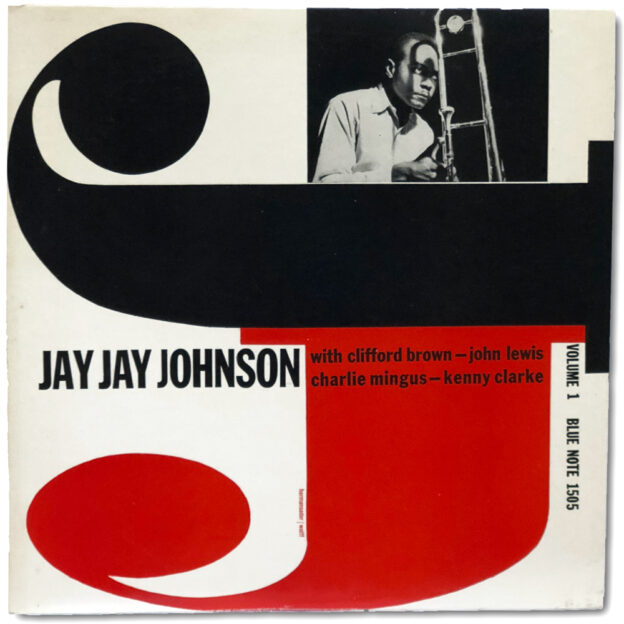
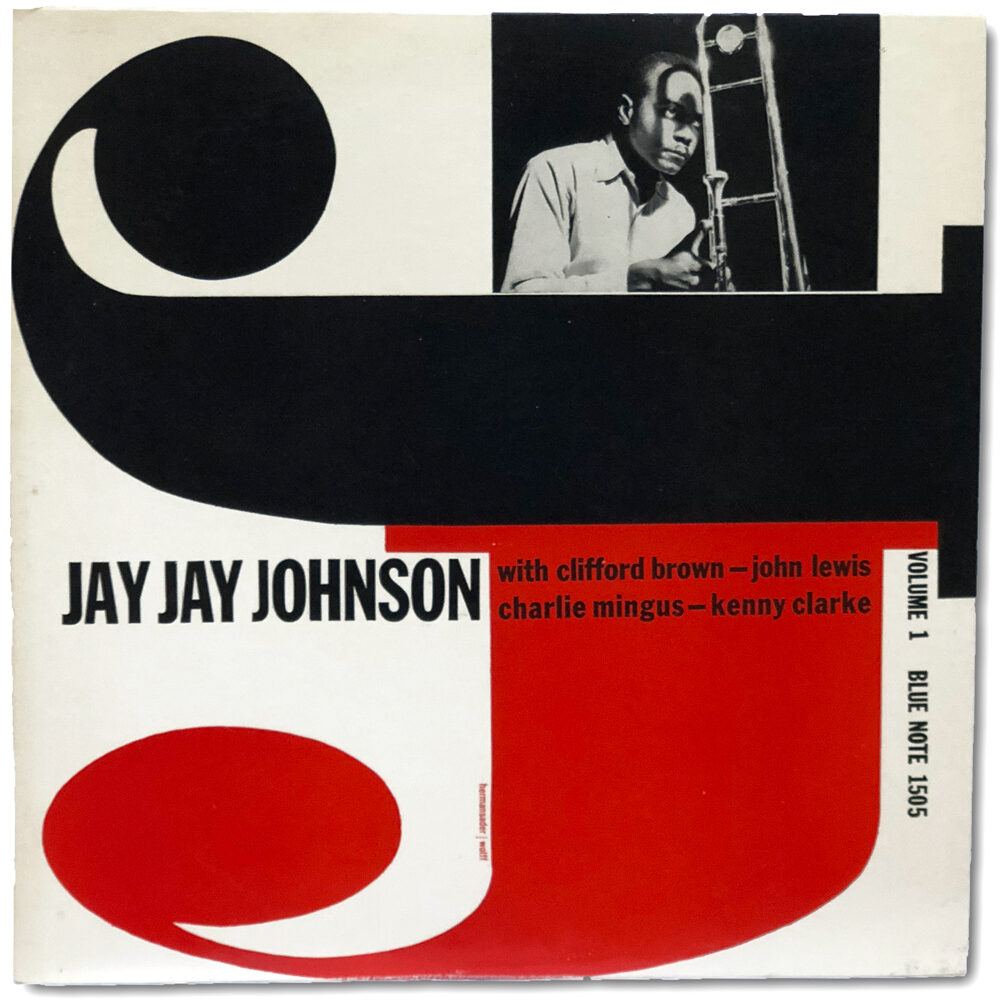
Lastly and aside from the phenomenal music laid to tape here, the thing I enjoy most about this LP is probably the cover. The color scheme of the bright red, black, and white pops out at one’s eyes, and the neatly placed photo of J.J., looking serious and a bit menacing, is fitting. It is a perfect example of all of the things that Blue Note covers were known for at the time: an excellent photograph juxtaposed with some of the most clever, aesthetically pleasing typography of the day. The cleanliness of this record, the jacket, and most importantly, the music makes me feel fortunate to have it in my collection.

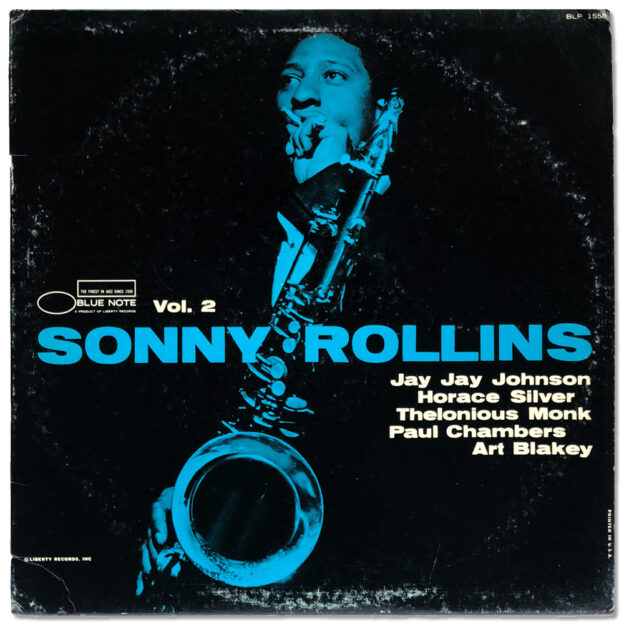
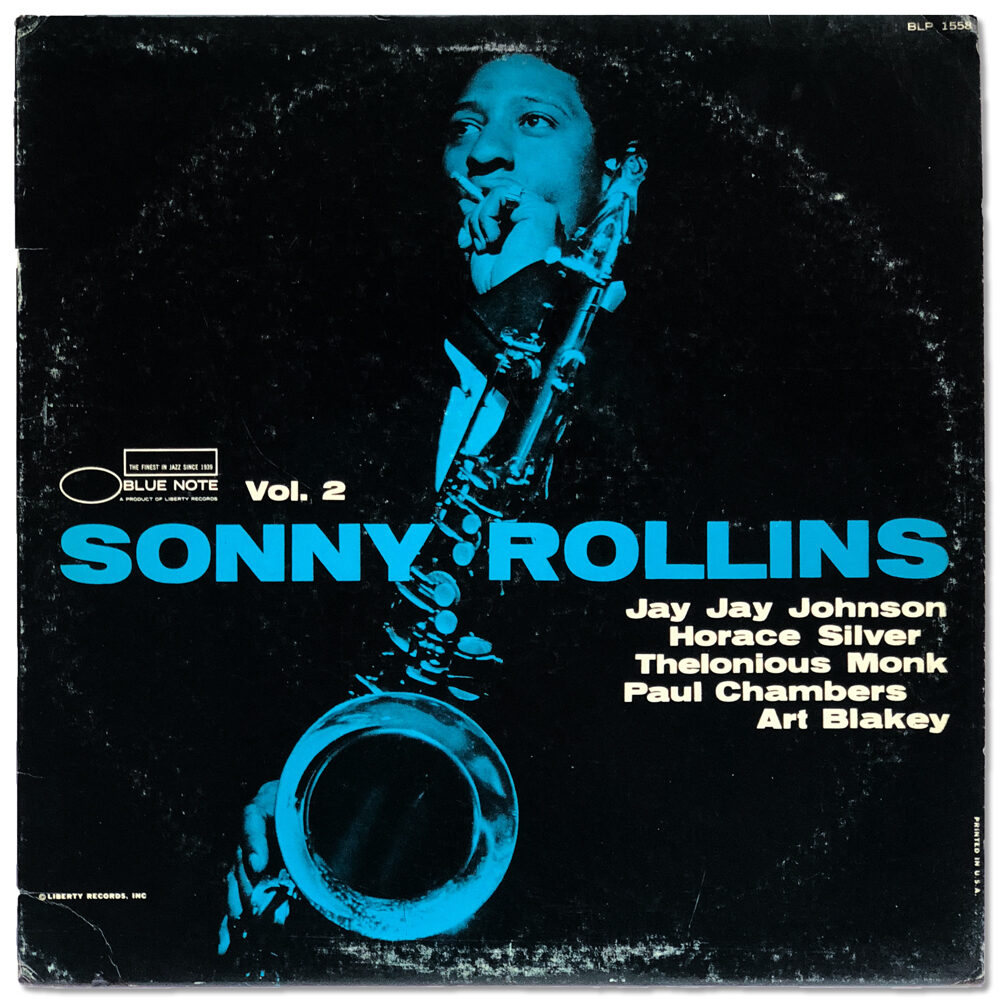
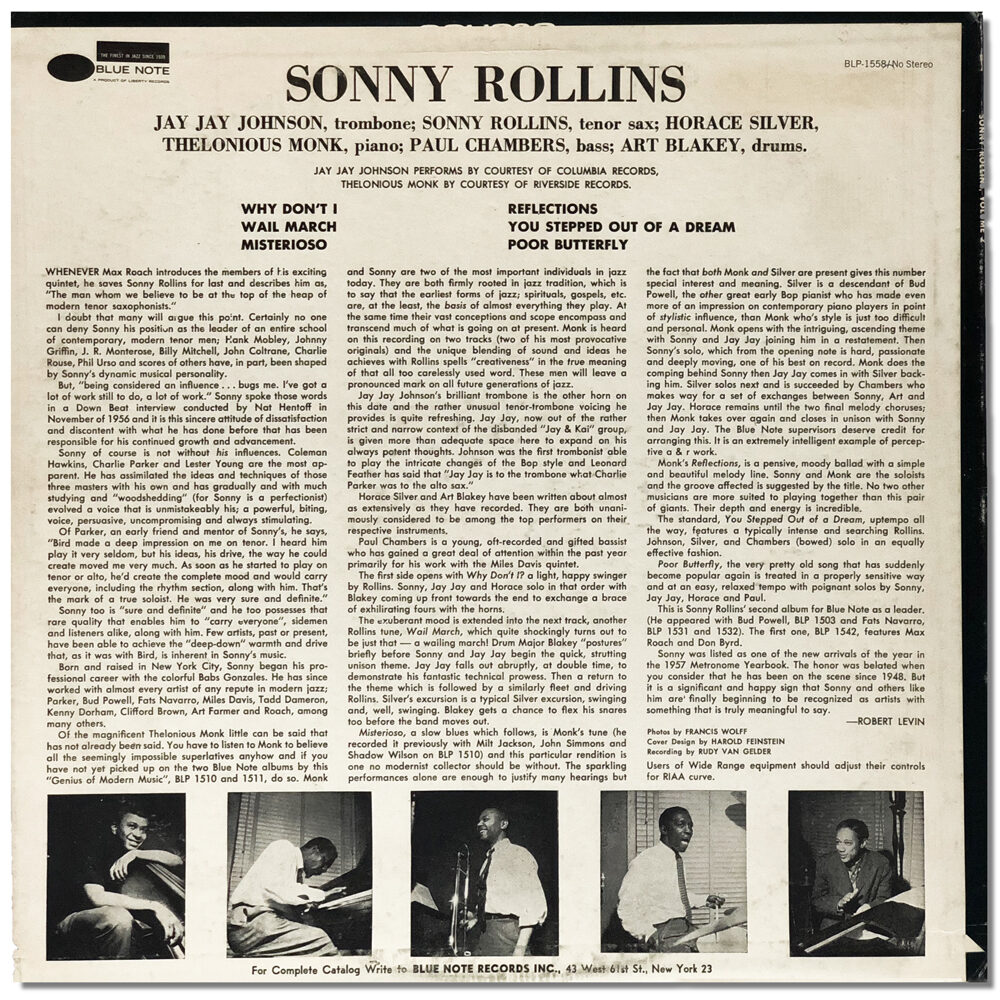
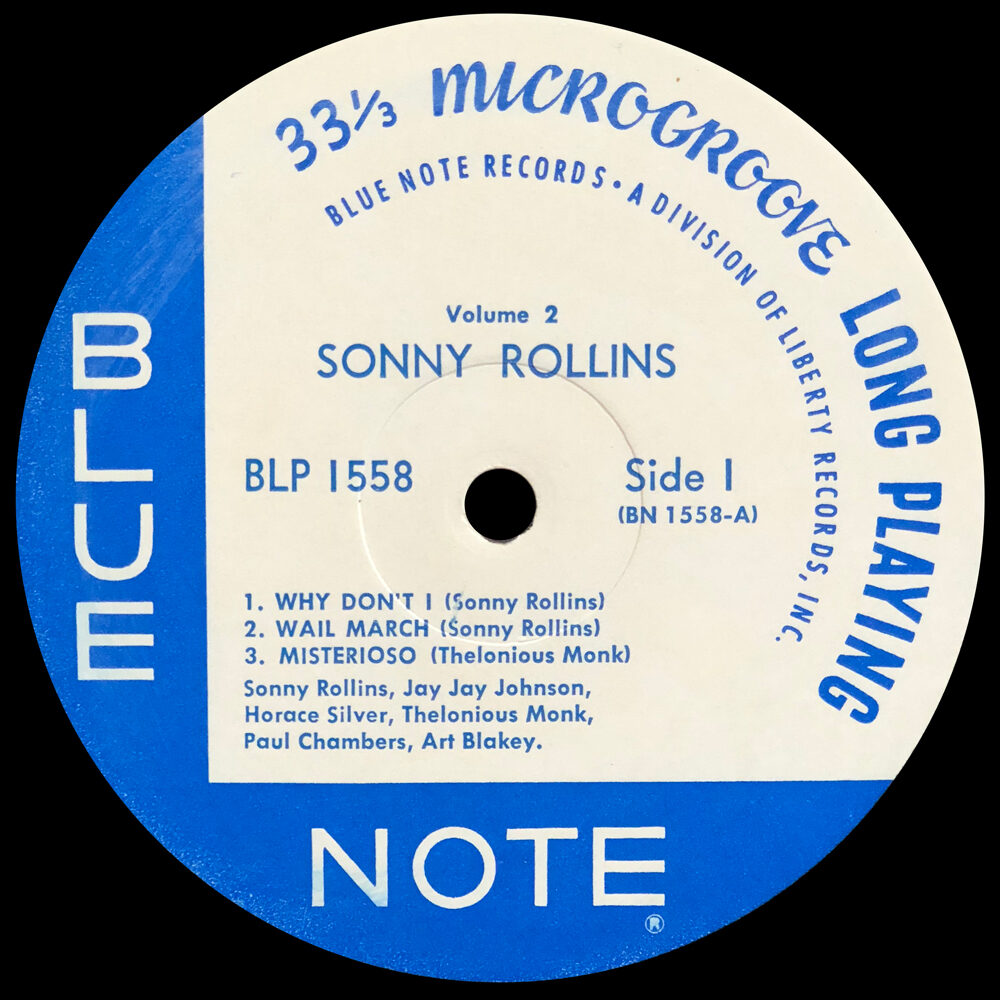
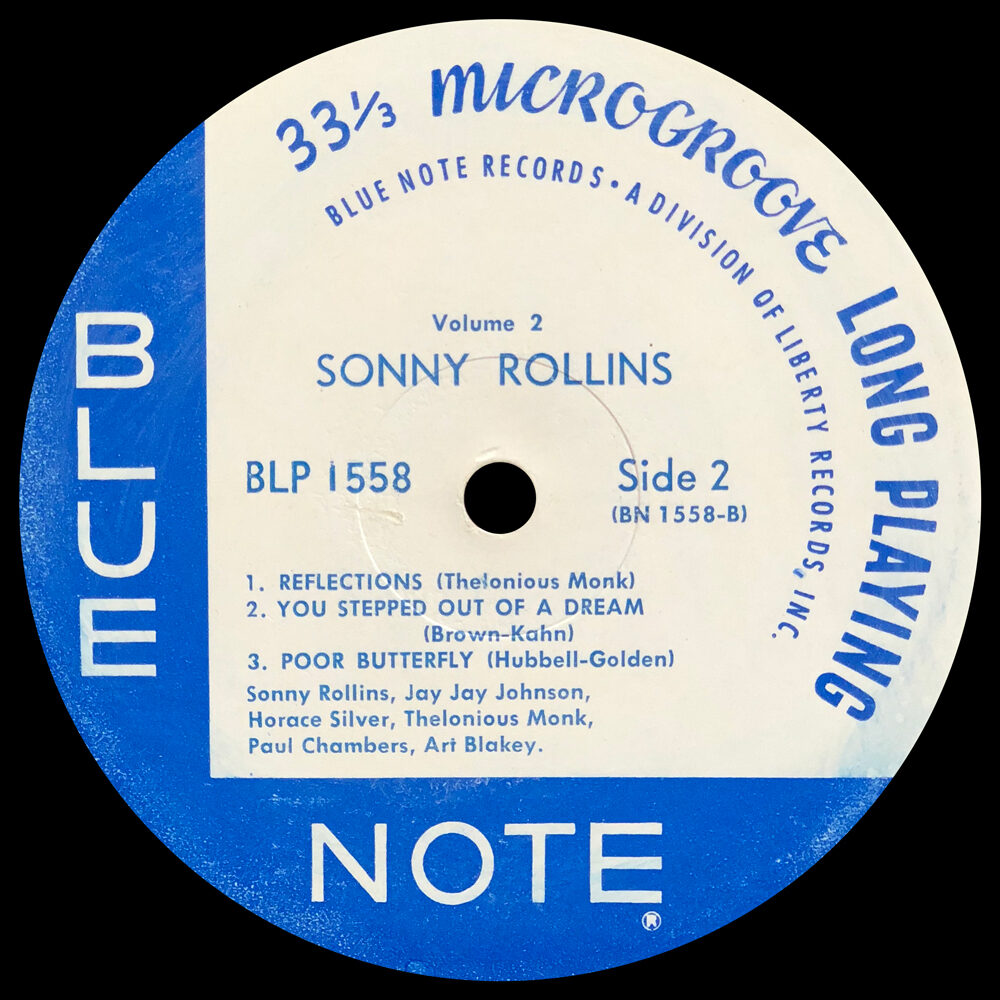
Vinyl Spotlight: Sonny Rollins, Volume 2 (Blue Note 1558) Liberty Mono Pressing

  • Liberty mono pressing circa 1966-1970
  • RVG etched in dead wax

Personnel:

  • Sonny Rollins, tenor saxophone
  • J.J. Johnson, trombone (all but “Reflections”)
  • Horace Silver, piano (all but “Reflections”)
  • Thelonious Monk, piano (“Reflections” and “Misterioso” only)
  • Paul Chambers, bass
  • Art Blakey, drums

Recorded April 14, 1957 at Van Gelder Studio, Hackensack, New Jersey
Originally released in September 1957

Note: This is a guest post by Charles Strong.

As a jazz lover and record collector, I am very fortunate to live near New York and its dusty record stores, as well as fellow collectors like the namesake of this blog, Mr. Mono himself. If we can’t hunt for LPs together in person, he will sometimes send me pictures of any records I might be interested in from the stores in the city — and sometimes be so kind as to snag some for me to be mailed later. A few months ago, he was in a store that has a very serious reputation for jazz sales when he sent me a few shots of some early pressing Blue Notes at pretty fair prices. One of the pics was of a glossy early pressing of Sonny Rollins Volume 2. The copy was not the first pressing but still had all the things that make collectors warm inside: a West 63rd Street label, Rudy Van Gelder’s initials in the dead wax, and the famous cursive ‘P’ indicative of a copy made in the company’s heyday. Best of all, the dealer did not want an arm and a leg for the copy, and it was payday Friday.

I was very tempted. Sonny Rollins is hands down my favorite artist in the entire genre, and in my quest to own the best possible copies of his LPs that I can afford, Volume 2 is a record I did not have an original of. I did own a copy of this album on Capitol and it had never made an impression on me. Despite its critical acclaim and my liking every artist on the date, it had never caused me to want to listen to it frequently. I do not attribute this to the record I had; the purpose of this post is not to downplay or argue the fidelity of other copies of an LP, but my Capitol copy certainly didn’t do anything to elevate the music of this album higher than A Night at the Village Vanguard or Way Out West, my two favorite Sonny records. So I texted Rich back a dismissive reply: “Nah, forget it — it’s never been my favorite Rollins LP,” to which he replied, “Mine either.” This made me feel two ways: pleased because a fellow collector had validated my opinion, but upset that one of the most celebrated records by my favorite musician was somehow dismissed by two knowledgeable jazz lovers.

Fast forward to a few weeks ago. I had just run into a nice string of luck with my favorite saxophonist on Blue Note. Within a two-week span, I had lucked out on copies of Volume One and the LP that has eluded me most in recent years, Newk’s Time. A few days after buying Newk’s, I was browsing eBay and a seller was selling Volume 2 as a Buy It Now. I usually avoid the Buy It Now sellers for rare records. However, this was a Liberty copy with some wear on the cover, and it was a later cover with the Division of Liberty lettering on the cover. In other words, this copy was not one that a high stakes collector or dealer would value.

However, as a listener of Sonny Rollins, it had some very good things going for it. For one, it was a monaural copy, which I’m not terribly picky over, except for these very early Blue Note recordings where the focus, at least for sales purposes and sound quality, was mono over the primitive stereo of the day. Secondly, it had the initials of Rudy Van Gelder in the dead wax which, without going into too many details, usually results in a high quality sound regardless of year of issue. Lastly, this thing was cheap! Relatively so, but at less than half the price of the copy that Mr. Mono showed me. I felt that if I was ever going to enjoy this record in its somewhat original form, this was going to be the most affordable way to do so.

After a busy few days of package receiving because of the other Rollins LPs I had just purchased, Volume 2 arrived almost as if it matched my opinion of it, as an afterthought. It was the last in a string of records that I had just purchased, and the two records that preceded it (Volume 1 and Newk’s Time) were two of my favorites. Well imagine my surprise when I dropped the needle. The opening riff of “Why Don’t I?” leapt out of the speaker with great urgency. To me it could have been an outtake from Volume 1 with its loud, honking Rollins riff announcing his unmistakable tone in a similar manner to the Volume 1 jams “Decision” and “Bluesnote”. Despite the presence of a piano here, Rollins hints at the legendary style of pianoless strolling he would perfect the following year, all while trading loud, fast riffs with Art Blakey in a conversation punctuated by the drummer’s own Elvin Jones-esque grunts and patented press roll. It all makes for an exciting conclusion to the take.

Another surprising highlight of the album that mirrored my expectations is the song “Wail March”. I am not usually a fan of marches, from the traditional bop march of “Blues March” by Blakey’s Messengers to the almost avant garde style of march found on Bobby Hutcherson’s “Les Noires Marchant”, but “Wail March” changed that quickly. Normally turned off by their corny, almost antiquated style of beat, “Wail March” is a freewheeling song with the driving snare of any classic march but also wild, reckless improvisation by Rollins and trombonist J.J. Johnson and an admittedly catchy chorus. I could not picture any of the stereotypically bland members of a T.V. sitcom marching band playing such a swinging tune at all. It is one of the myriad example of Rollins taking a theme or tune that was considered ‘corny’ or ‘overdone’ and using his dominating tone and knack for off-the-cuff improvisation to make it into something fresh and revolutionary.

The track on this record that most critics laud is the rendition of the Thelonious Monk standard “Misterioso”, instantly memorable because of a repeating, haunting piano riff played by Monk with a sporadic stabbing motion. It has been recorded on many other albums, but this version instantly became my favorite. Every member of the band plays to their strengths on this song. J.J. Johnson has a memorable solo where he fluidly recreates the opening riff while Rollins finds yet another way to insert “Camptown Races” into a song. Horace Silver and Monk appear on the track — a rarity — and they do a remarkable job of playing their own styles. So many musicians have tried to play Monk’s songs just like he did and failed. These guys all knew how to play with Monk. They all retain their own unique sounds all while paying respect to the song’s original theme.

A few weeks ago, Rich and I had one of our many conversations about our respective collections. We discussed what we believed in our opinion to be the best pressings of Blue Note records in terms of collectability, sound quality, condition, lack of wear, and value. The Division of Liberty Blue Notes, especially reissues of earlier Blue Note material in mono, continued to come up in our talks. When I mentioned to Rich that I had quite a few of these, he asked me to review and write about them for his blog, and in the next few posts I hope to demonstrate that these pressings are not just a mere runner-up to original pressings. They have the potential to provide collectors with a high-quality, affordable listening experience while maintaining many of the hallmarks that make originals so collectable.

Many people think that there is a mystique to the Blue Note sound captured by engineer Rudy Van Gelder. That, of course, is an unscientific way of saying that there is an unexplainable and unique sound to these records. The fact that a Liberty pressing purchased at a discount price can project the classic Blue Note sound so well speaks volumes. It essentially changed my opinion of the recording and also provides evidence that Blue Note’s new parent label was capable of preserving the sound of the original LPs to a tee.